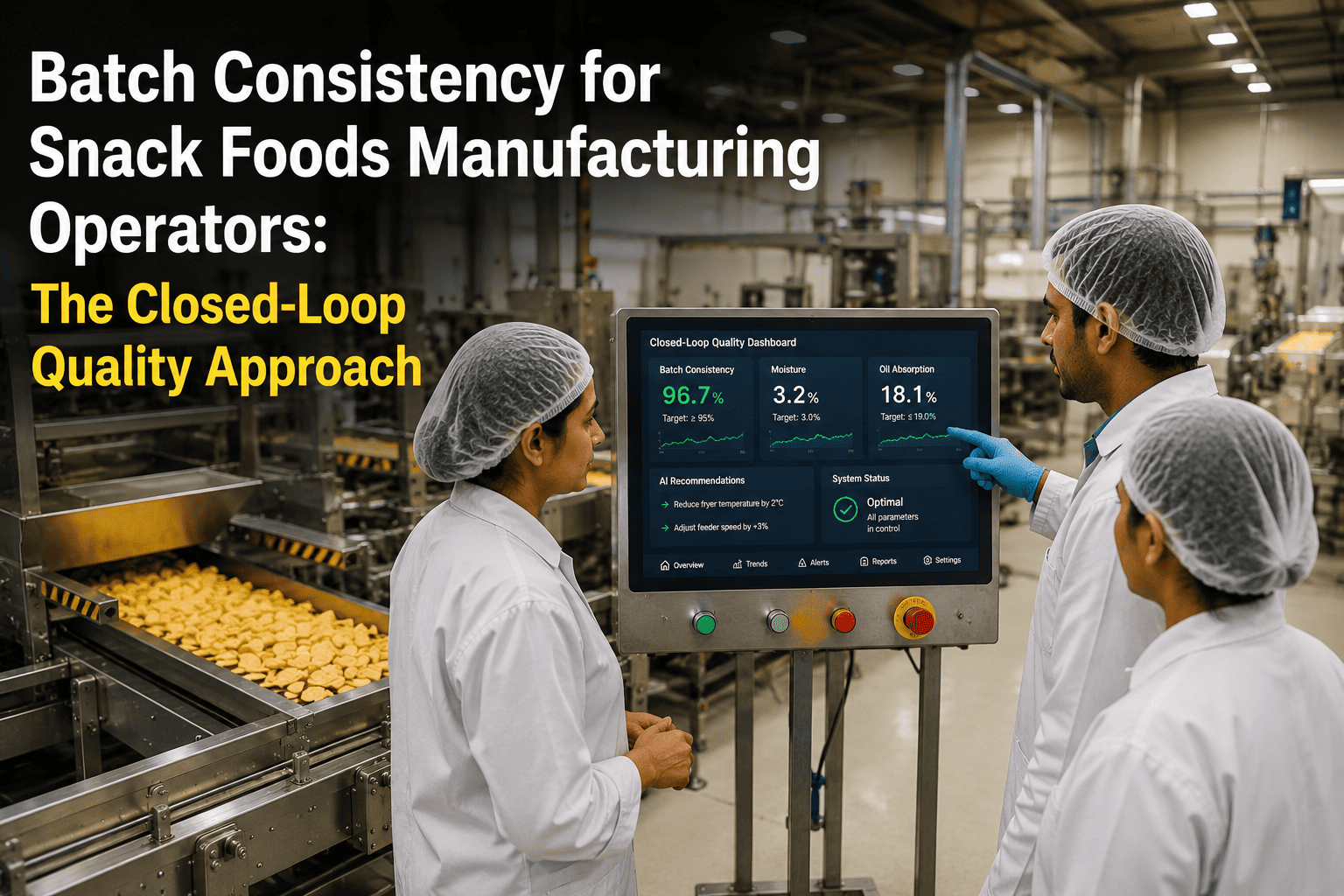
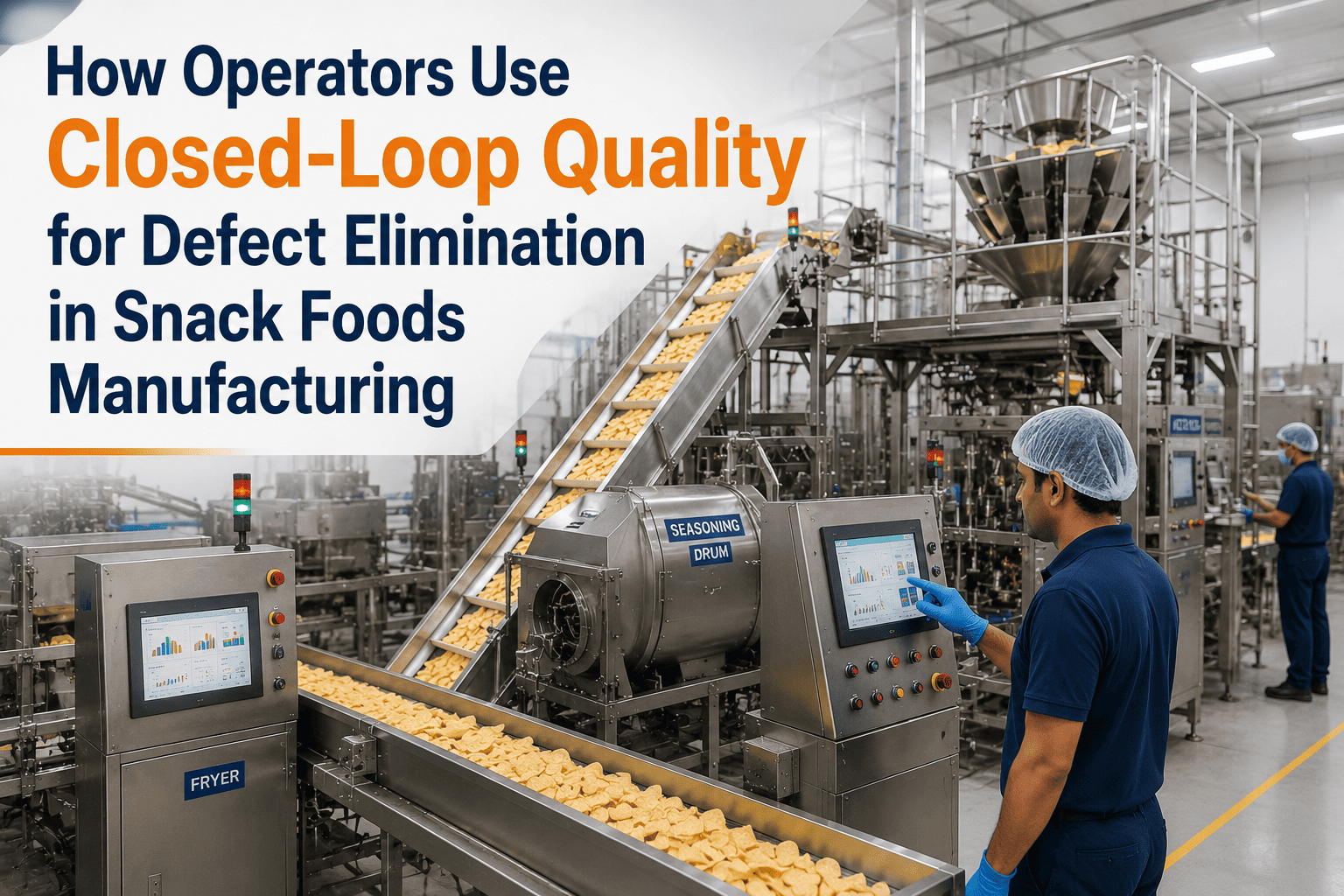
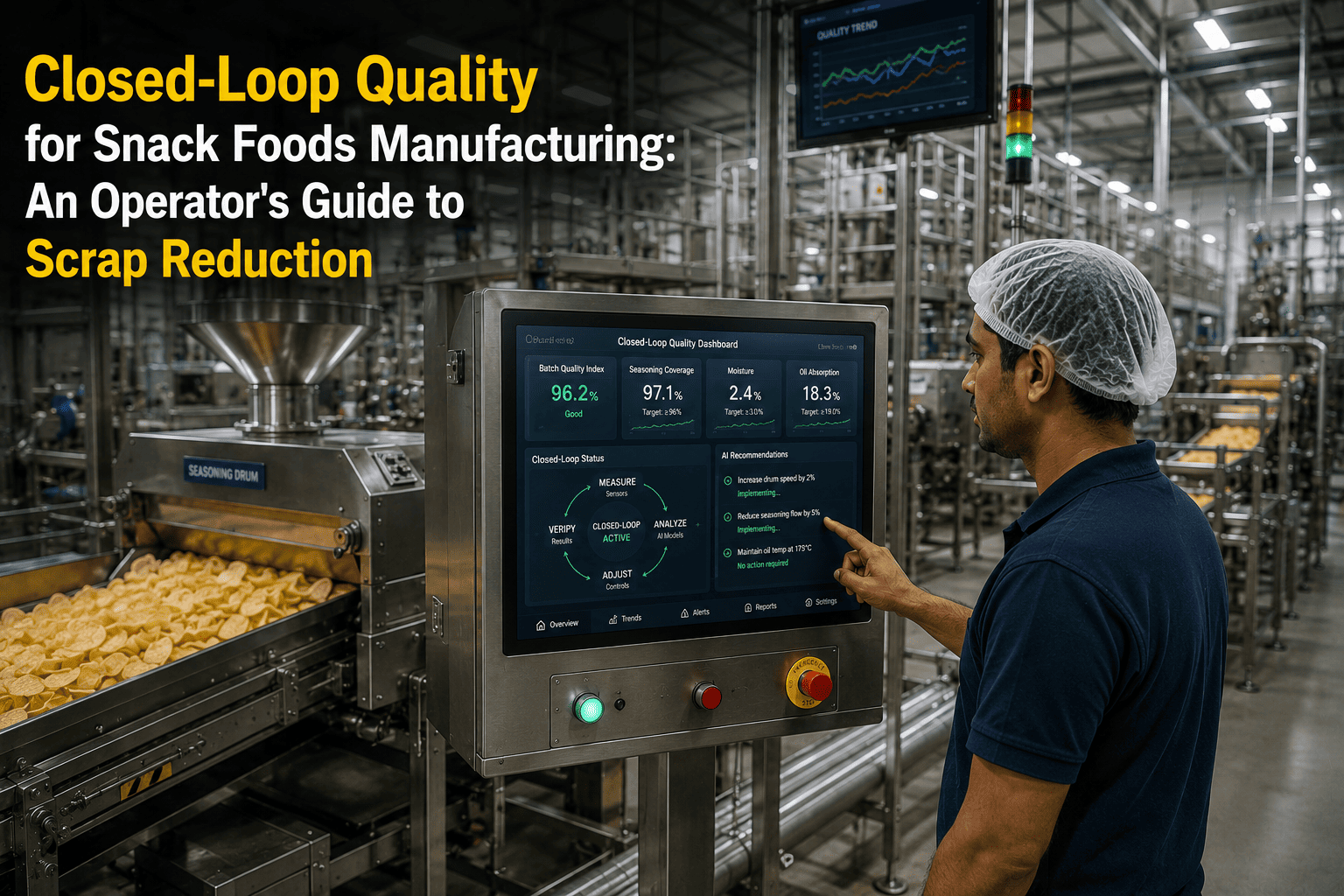
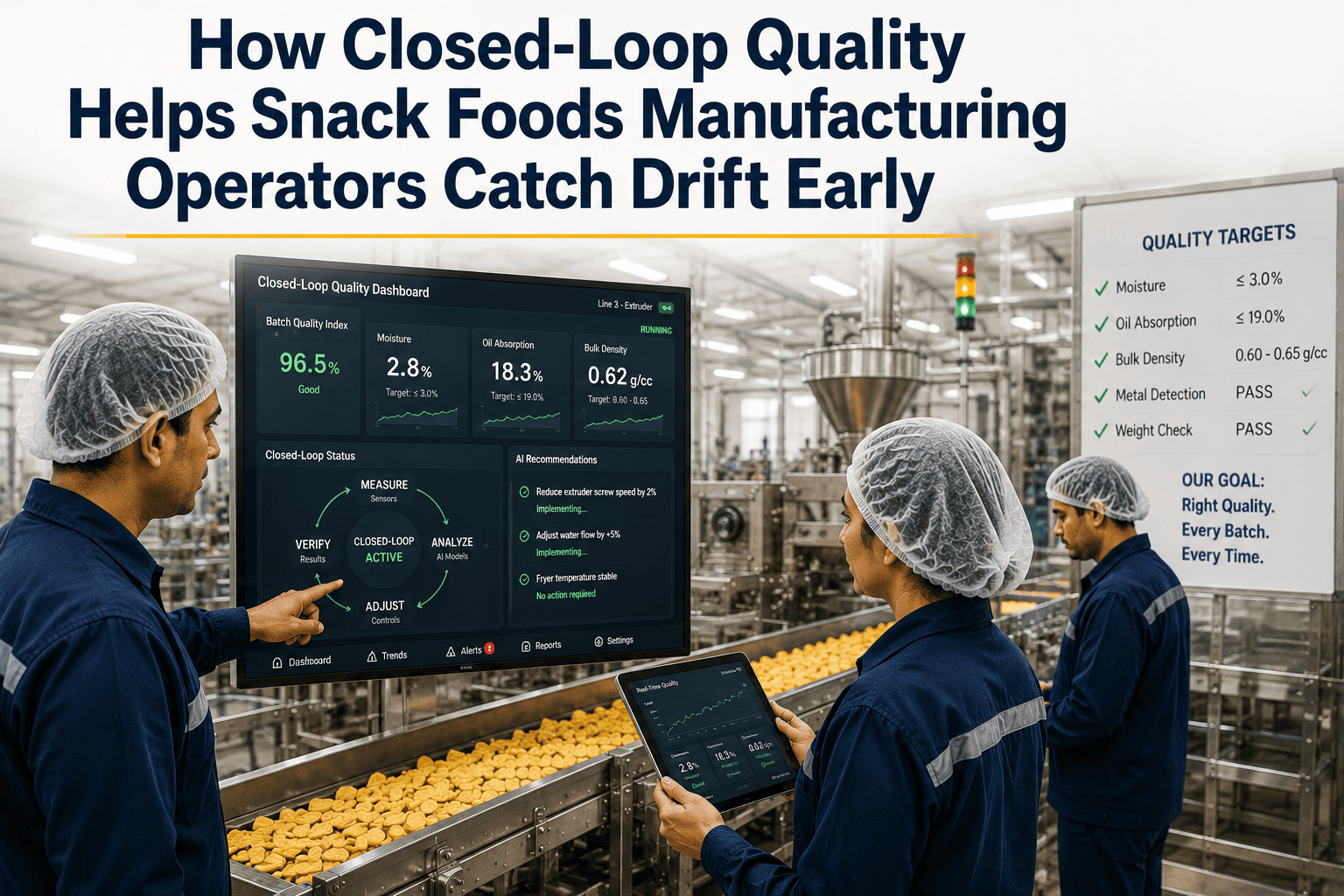
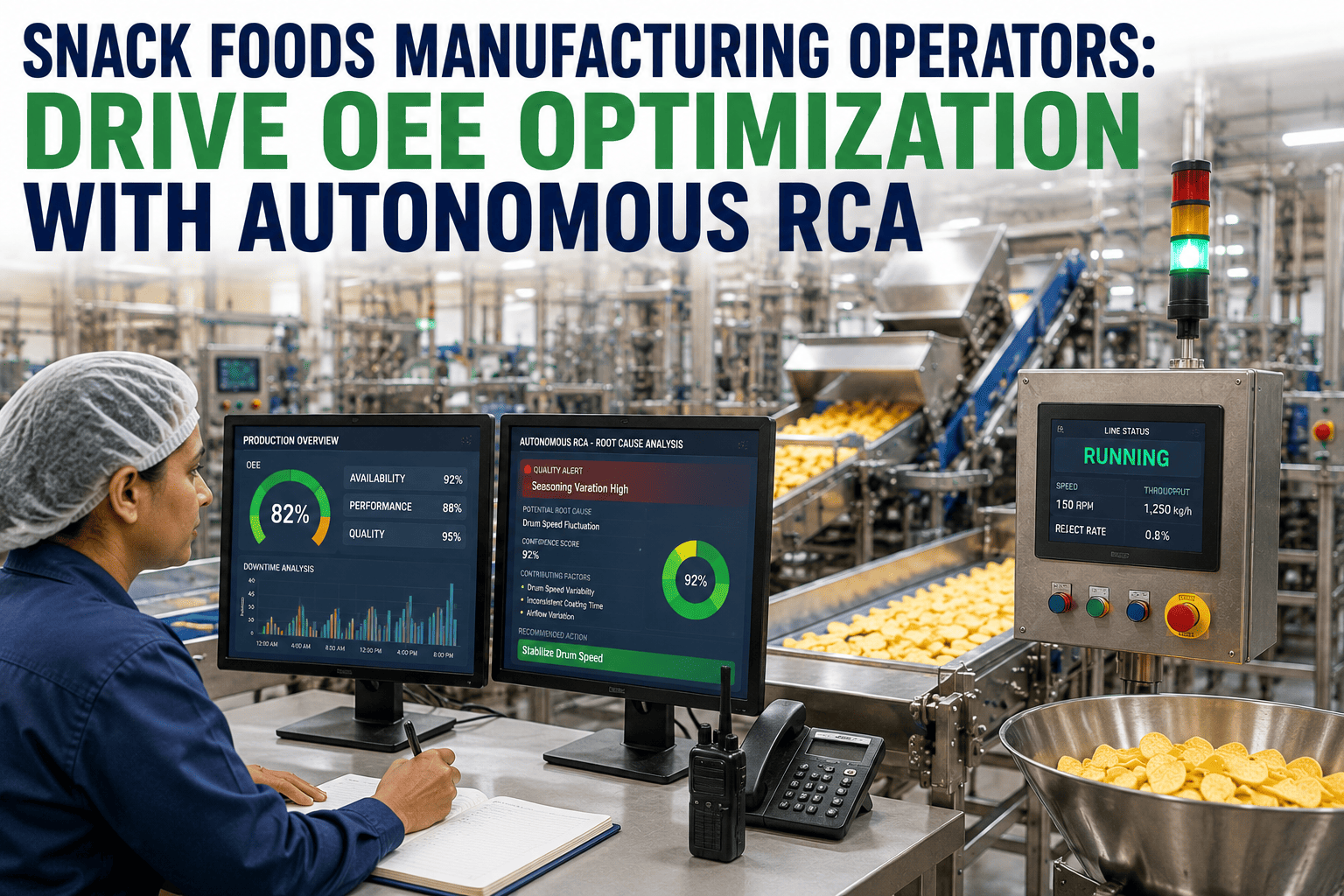
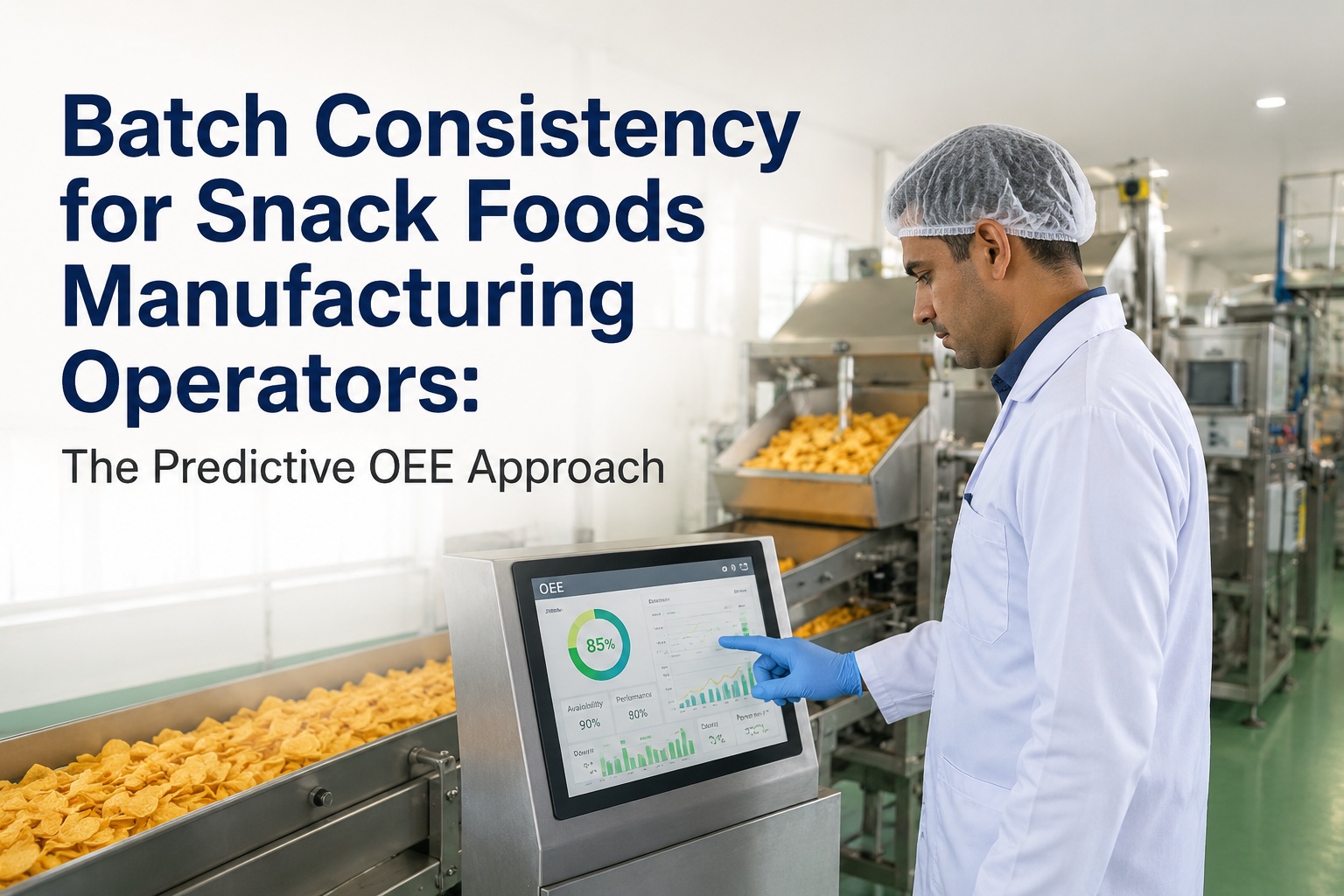
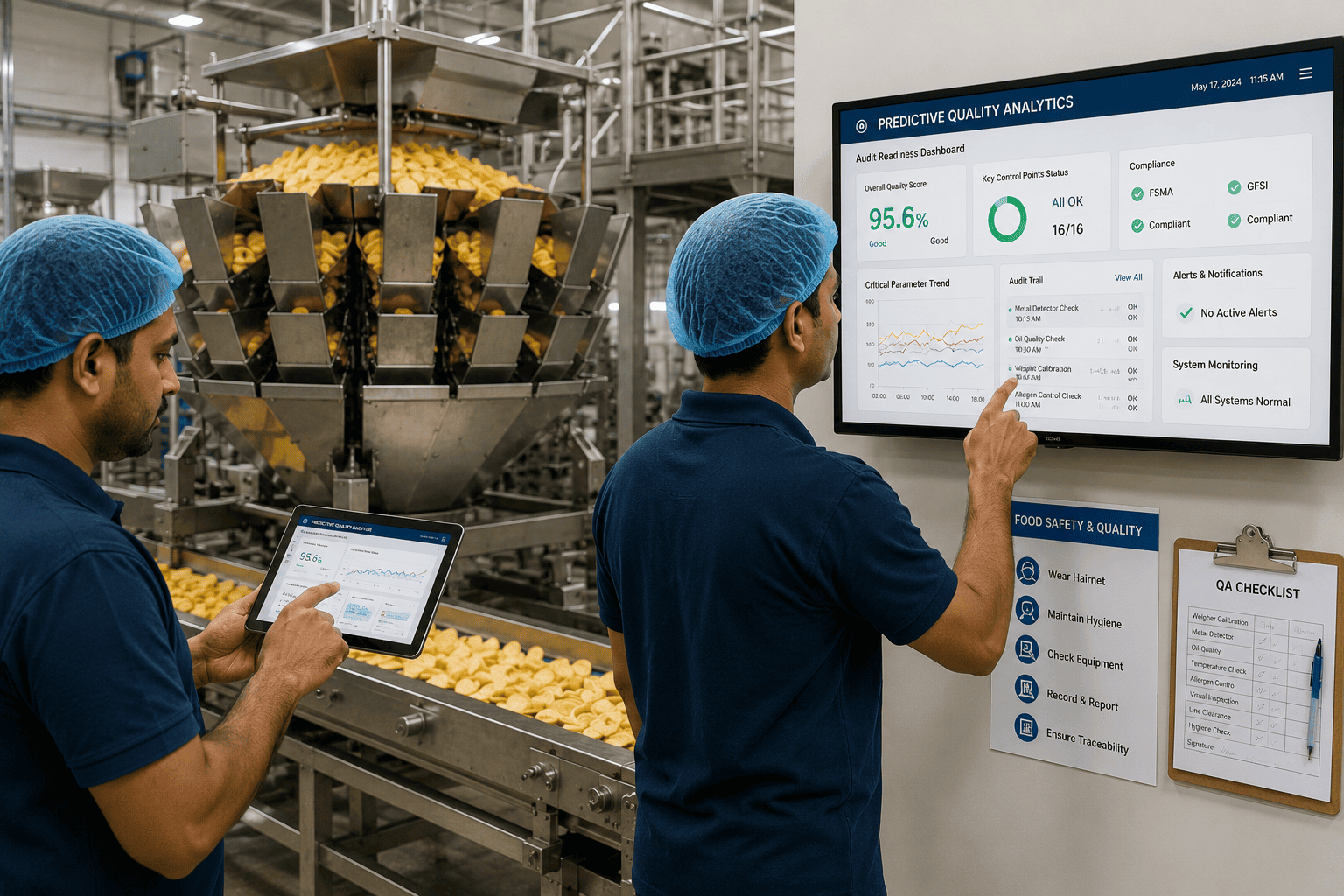
For snack foods manufacturing operators, batch-to-batch variation is the silent killer of line efficiency. One batch of tortilla chips has perfect moisture and seasoning coverage; the next batch from the same line drifts out of spec, triggering rework or scrap. Traditional quality control is reactive — operators measure after the fact, then adjust. Closed-loop AI quality optimization changes the game: sensors feed real-time data to AI models that predict drift 8-12 minutes ahead and automatically adjust fryer temperature, seasoning drum speed, or weigher targets without operator intervention. The result is batch consistency tightened by 52%, weigher giveaway reduced by 41%, and operators freed from manual adjustments to focus on higher-value work. This guide shows how snack foods operators can implement closed-loop quality control in 6-12 weeks, with real plant data and step-by-step walkthrough.
CLOSED-LOOP QUALITY · SNACK FOODS
Batch Consistency for Snack Foods Manufacturing Operators: The Closed-Loop Quality Approach
Turn variation into uptime — closed-loop AI quality tightens batch-to-batch variation by 52%, reduces weigher giveaway 41%, and deploys on your existing line in 6-12 weeks.
52%
Batch variation reduction
8‑12 min
Predictive lead time
6‑12 wk
Deployment on existing PLC
What Is Closed-Loop Quality — And Why It Beats Manual SPC
Traditional SPC (Statistical Process Control) is open‑loop: operators measure a parameter (e.g., moisture), see it's out of spec, then manually adjust a control (e.g., fryer temperature). The loop is slow, inconsistent, and relies on operator judgement. Closed‑loop quality closes the gap: AI models continuously monitor sensor data, predict when a parameter will drift out of spec, and send corrective signals directly to the PLC — adjusting fryer heat, seasoning drum speed, or weigher targets automatically. The operator oversees the system but doesn't need to intervene for routine drift. Results from 23 snack lines show closed-loop quality delivers 52% tighter batch consistency, 41% less weigher giveaway, and 86% reduction in operator time spent on quality adjustments. Talk to iFactory about a closed-loop quality pilot on your line.
Closed-loop quality is not about replacing operators — it's about automating routine corrections so operators can focus on exceptions, root cause analysis, and line optimisation. Plants using closed-loop AI report 86% less time on manual adjustments and 52% tighter Cpk across all SKUs.
Open-Loop vs Closed-Loop: A Side-by-Side Comparison
Moisture content variation
±1.2% (detected after oven exit)
±0.4% (corrected mid‑process)
-67%
Seasoning coverage variance
±8% batch‑to‑batch
±1.8% (auto drum speed adjust)
-78%
Multihead weigher giveaway
2.8% overfill
1.1% overfill (AI target adjustment)
-61%
Colour (ΔE) reject rate
5.2% of batches
0.9% of batches
-83%
Operator intervention frequency
12 adjustments per shift
2 adjustments per shift (exceptions only)
-83%
Cpk (chip line)
1.08 average
1.49 average
+0.41 lift
Time from drift to correction
8‑12 minutes (operator detection+adjust)
<30 seconds (auto closed-loop)
-95%
How Closed-Loop Quality Works on a Snack Line
Near-infrared (NIR) moisture sensor after oven Colourimeter (ΔE) on exiting fryer Multihead weigher target weight deviation Seasoning drum encoder (speed, coating flow) Fryer thermocouples & oil quality sensor
Multivariate model compares current batch to golden signature Predicts moisture drift 6‑8 minutes before oven exit Forecasts weigher drift 4‑6 minutes before giveaway occurs Detects seasoning coverage variance in real time
AI sends corrective signal to PLC (no operator needed) Adjusts fryer heat, drum speed, weigher target automatically Operator receives notification: "Corrective action applied" Full audit trail of every auto‑adjustment
Dashboard shows live quality metrics and auto‑adjustments Operator overrides AI when needed (rare, <5% of adjustments) Shift summary: total adjustments, savings, exception report
Closed-Loop Quality in Action: Three Real Snack Line Deployments
Kettle Chip Line (3 SKUs)
52% batch variation reduction
Closed-loop control on fryer temperature and moisture sensor. Cpk improved from 1.09 to 1.52. Operator adjustments dropped from 14 to 2 per shift. Payback: 4 months.
Tortilla Chip Plant (multihead weigher)
41% giveaway reduction
AI predicted target weight drift and auto-adjusted weigher settings. Annual savings: $48,000 per line. Payback: 3 months.
Seasoned Pretzel Line
78% seasoning variance reduction
Closed-loop on drum speed and coating flow. Customer complaints -72%. Payback: 5 months.
Extruded Snack (colour control)
83% colour reject reduction
AI monitored ΔE and adjusted fryer dwell time. Saved $94,000 annual scrap. Payback: 3 months.
Implementation Roadmap: 6-12 Weeks to Closed-Loop Quality
01
Sensor & PLC Audit
1‑2 weeks
Identify existing sensors and PLC control points. Map closed-loop opportunities.
02
Edge Integration
1‑2 weeks
Install iFactory edge node. Connect to PLC for read/write access. Validate data flow.
03
Golden Batch Learning
2‑4 weeks
AI learns normal operating range for each SKU. Establishes baseline.
04
Open-Loop Pilot
2 weeks
AI recommends adjustments (operator executes). Validate prediction accuracy.
05
Closed-Loop Go-Live
1 week
Enable auto-adjustment to PLC. Operator override available. Full audit trail active.
Eight Metrics That Improve With Closed-Loop Quality
Traditional: ±1.2% → Closed-loop: ±0.4% (67% better)
Traditional: ±8% → Closed-loop: ±1.8% (78% better)
Traditional: 2.8% → Closed-loop: 1.1% (61% reduction)
Traditional: 5.2% → Closed-loop: 0.9% (83% reduction)
Traditional: 12/shift → Closed-loop: 2/shift (83% less)
Traditional: 1.08 → Closed-loop: 1.49 (0.41 lift)
Traditional: 8-12 min → Closed-loop: <30 sec
Typical: $48K‑$94K per line
Frequently Asked Questions — Closed-Loop Quality for Snack Foods
Turn Batch Variation Into Uptime — Book a Closed-Loop Quality Pilot
iFactory's closed-loop AI quality system tightens batch consistency, cuts weigher giveaway, and frees operators from manual adjustments. We will run a 4‑week open‑loop pilot on your line — no commitment, no hardware purchase. You will see live prediction accuracy and estimated savings before deciding to go closed‑loop.
Closed-Loop Quality Batch Consistency Weigher Giveaway Moisture Control Seasoning Coverage Colour (ΔE) Control Cpk Lift