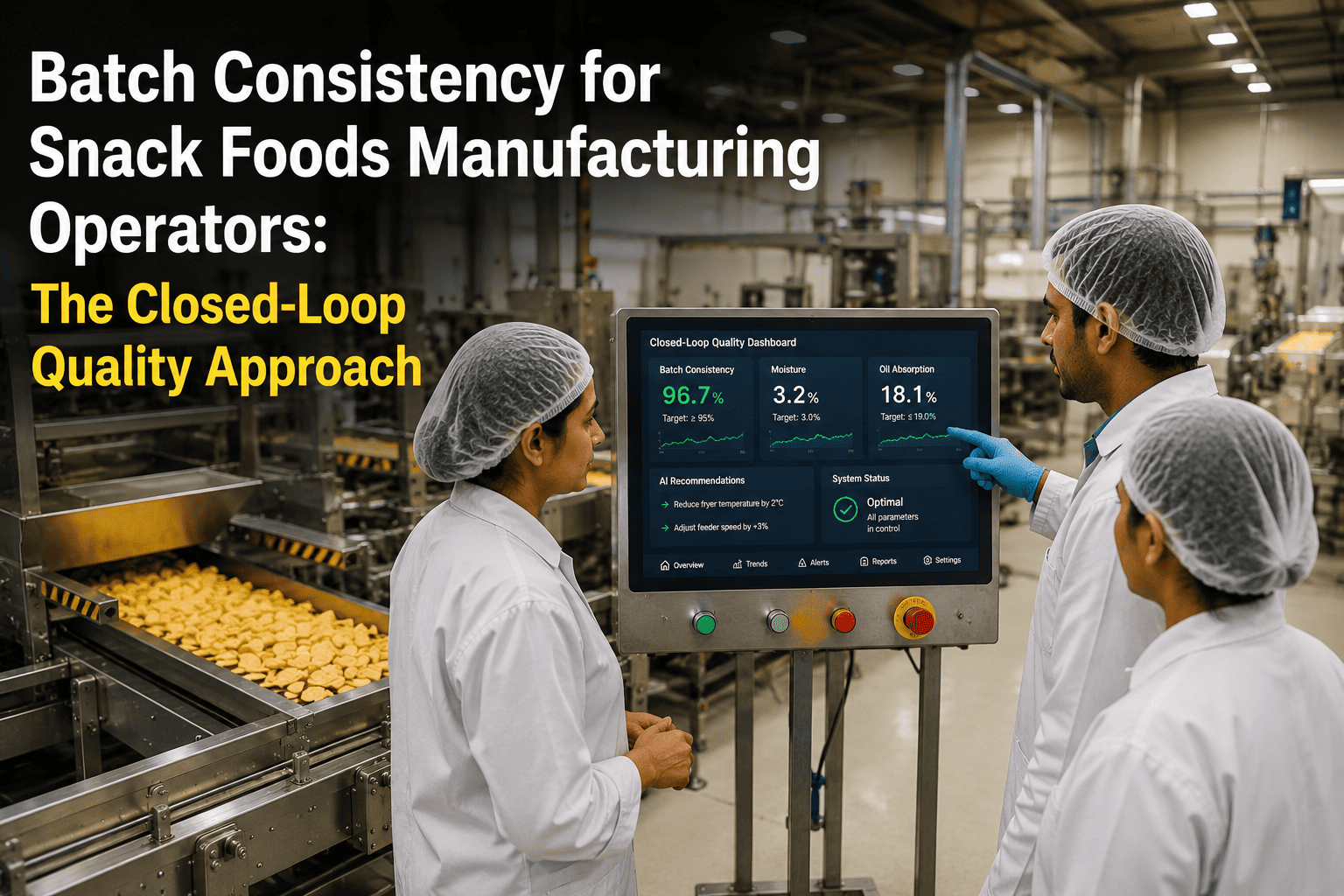
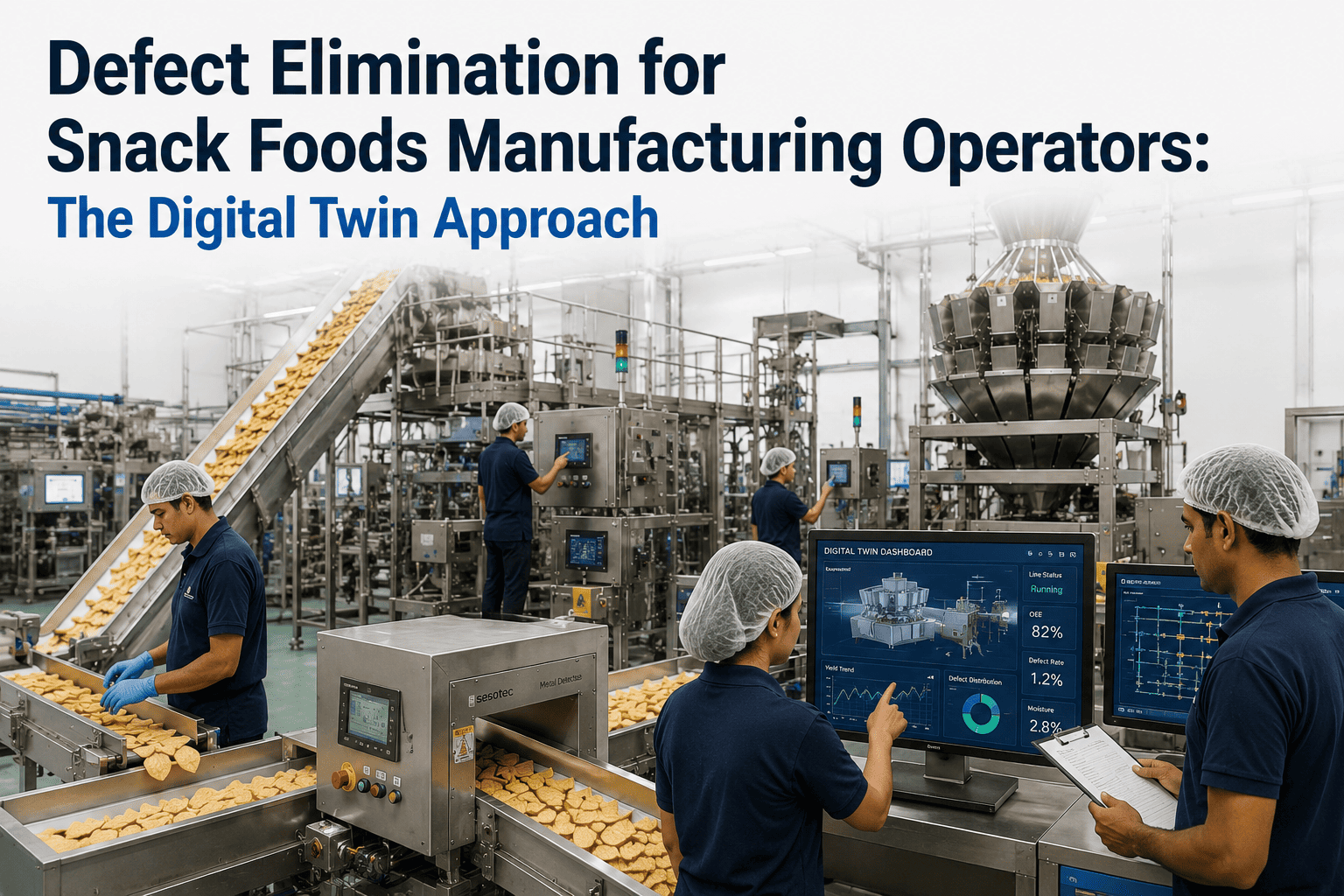
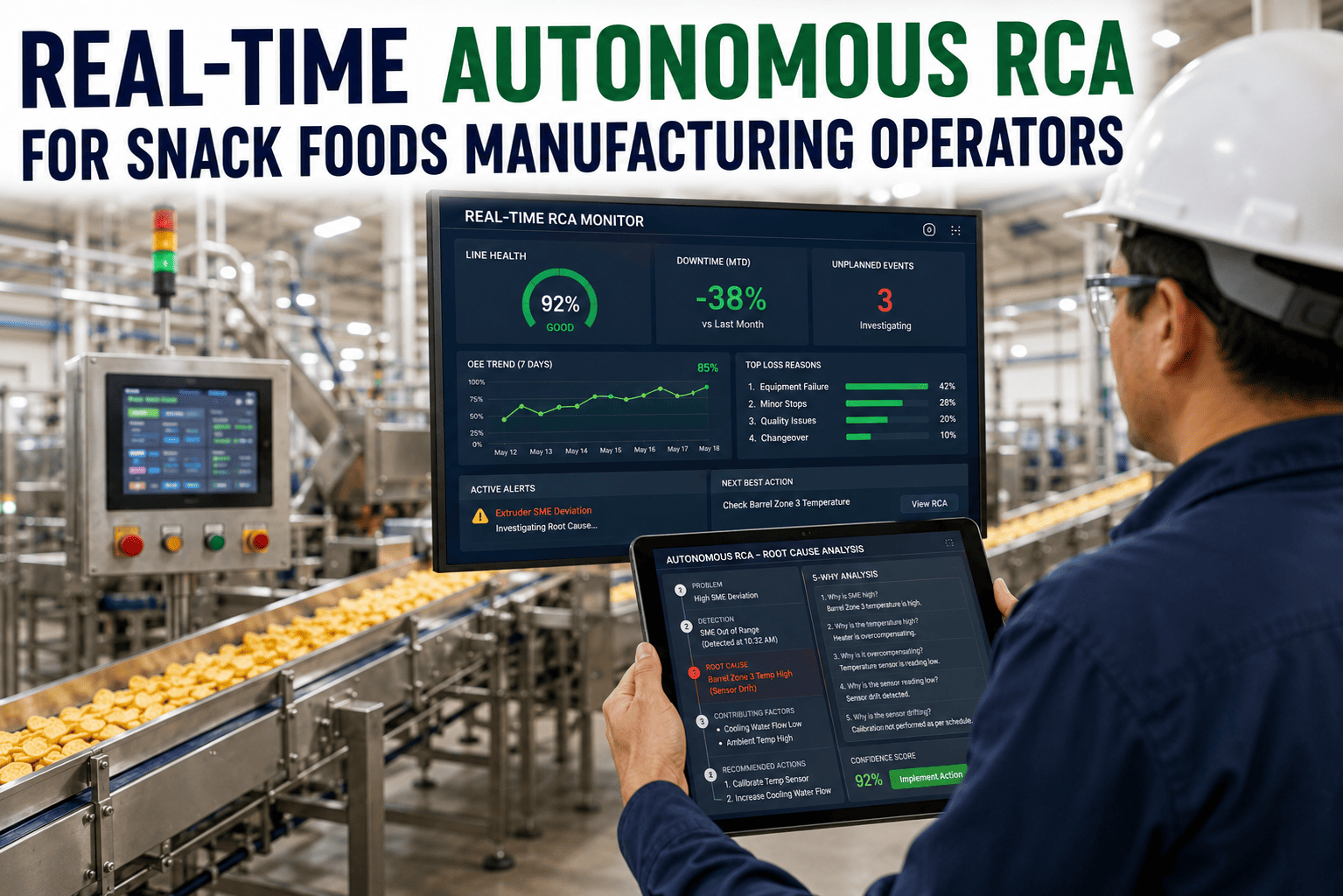
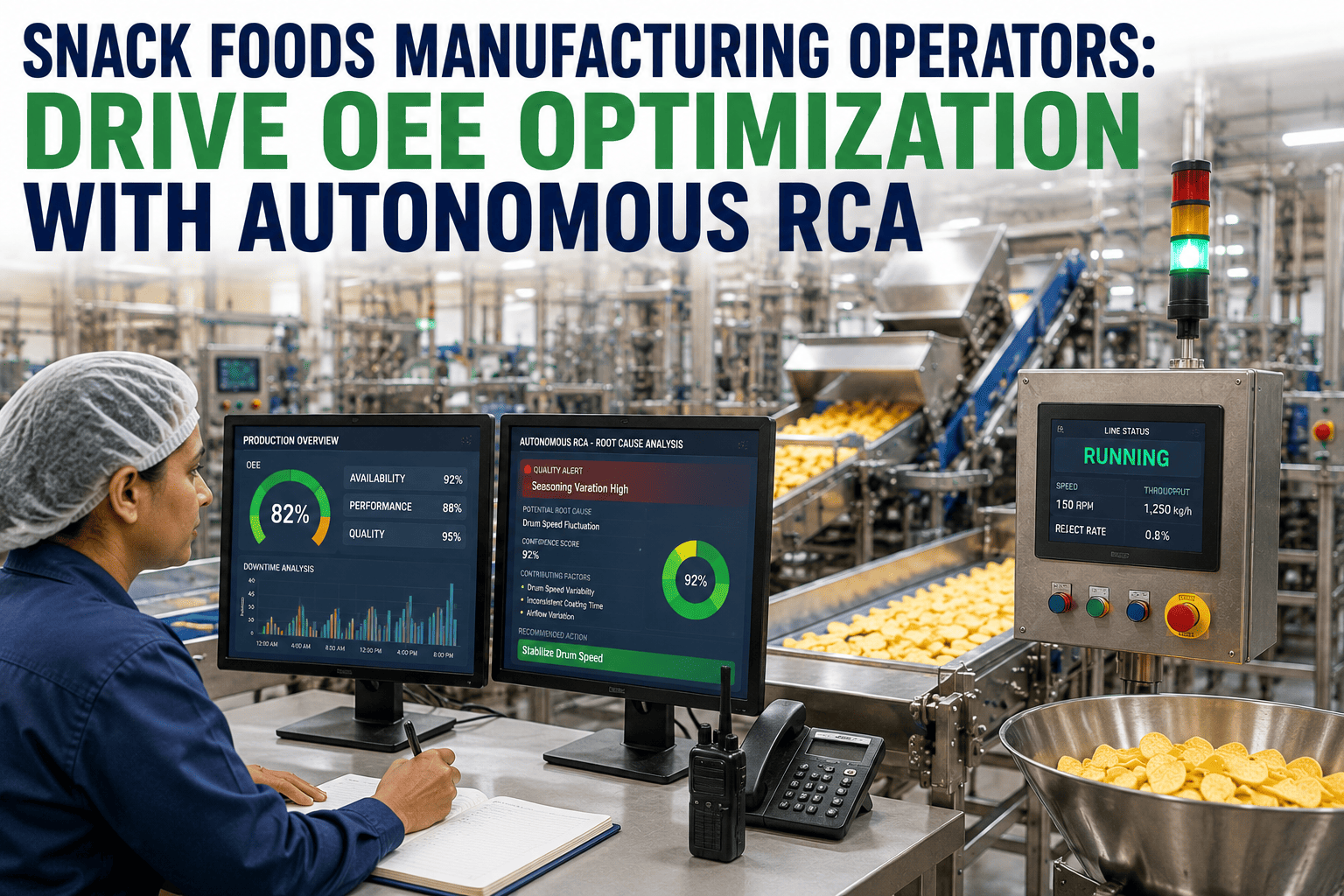
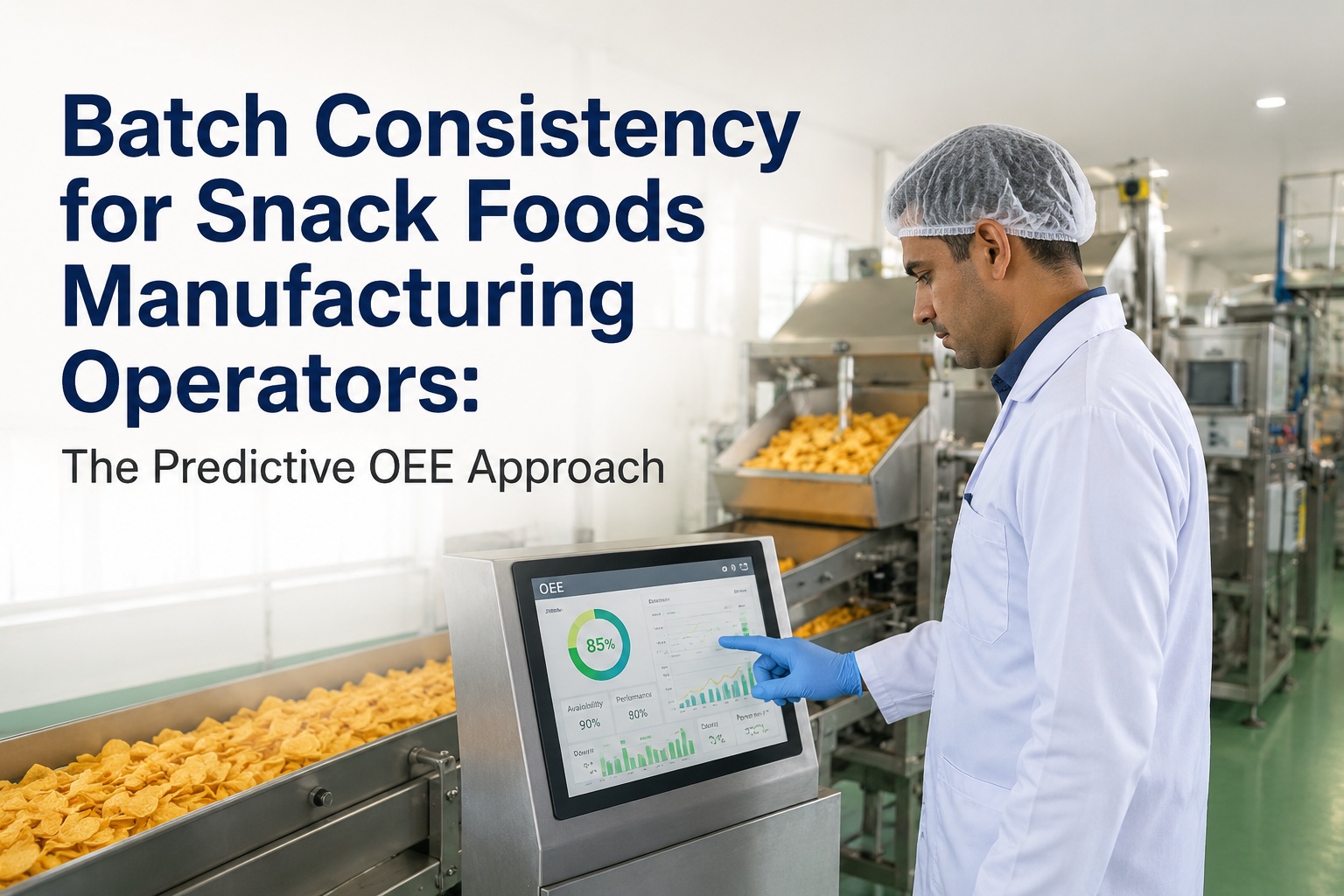
The night shift operator at a major snack foods plant watches the fryer temperature drift on his screen — 364°F, then 366°F, then 368°F. He knows the batch coming off line three will be darker, greasier, and out of spec. By the time QC calls it at 2 AM, 4,200 pounds of tortilla chips are already bagged for repurpose, and the line supervisor is calculating the $18,700 loss. This scene repeats across every shift, every day, in plants running corn snacks, potato chips, and extruded crisps. The operator has the data — he just can't act on it in time. That's the real cost of reactive quality control.
Stop Batch Drift Before It Costs You $18K Per Shift — AI SPC for Snack Foods
iFactory's on-premise AI monitors every fryer, oven, and extruder in real time, predicts out-of-spec batches 8 minutes before they hit the bagger, and closes the loop automatically — no cloud, no IT project, no data leaving your plant.
Why Batch Drift Is Eating Your Margin — Every Shift
In snack foods, consistency isn't just quality — it's throughput, yield, and brand trust. A 2°F drift in fryer temperature, a 0.5% moisture variance in the extruder, or a 10-second dwell-time shift in the oven cascades into color rejects, texture complaints, and lost production time. Your operators see the signals. Your systems log them. But nobody connects the dots until the QC hold tag goes up. Here's what that costs, shift after shift.
Reactive QC Misses the Window
By the time the lab runs a moisture test — 18 minutes after sample collection — another 3,200 pounds of product has passed through the line. If that batch is out of spec, you're either reworking it at 40% yield or writing it off entirely. For a 50,000 lb/day plant, that's $340,000 in annual scrap from one line.
Operator Alarms That Don't Mean Anything
A fryer temp alarm goes off 14 times per shift. Operators learn to ignore them because 12 of those are false triggers from a poorly tuned threshold. The 2 real events — the ones that signal oil degradation or burner drift — get missed. Result: 4–6% of daily throughput lands in the repurpose bin, at $0.42/lb loss.
Recipe Transfer Wipes Out Gains
When you switch from kettle-cooked chips to tortilla strips, the line needs 23 parameter changes — temperatures, belt speeds, oil flow, dwell times. Operators rely on paper binders or PDFs. One missed parameter costs 45 minutes of purge-and-recover. At 8,000 lb/hr, that's 6,000 pounds of transition waste per changeover.
No Correlation Between Sensors and Taste
Your fryer logs 200 data points per second. Your oven logs 150 more. But nobody knows which combination of oil temp, belt speed, and humidity produces the golden-brown, shelf-stable chip that consumers love. So every batch is a guess, and every customer complaint — 1.2 per 100,000 bags — costs $4,500 in investigation and rework.
No Cloud? No SPC at All
Most AI SPC tools require sending your sensor data to the cloud. Food plants with FSMA 204 compliance, retailer audits, or corporate security policies can't do that. So they keep running manual SPC charts on clipboards — 3 QC techs per shift, 2 hours of data entry, zero predictive insight.
You don't need more data. You need the right data, connected to the right action, before the batch goes bad. Book a 30-min walkthrough and we'll show you how one plant cut scrap by 67% in 8 weeks.
From Sensor Drift to First-Pass Yield — In Four Steps
iFactory sits on your plant network — no cloud, no VPN, no data leaving your facility. It ingests every data point from your fryers, ovens, extruders, and packaging lines, then builds a live statistical process control model that learns what "good" looks like for every product you run. Here's how it works, step by step.
Connect Everything, Leave Nothing Out
We tap into your existing PLCs, SCADA, and line sensors — fryer thermocouples, oven humidity probes, extruder torque meters, packaging checkweighers — and stream 100% of the data into the iFactory appliance on your plant floor.
Train the AI on Your Best Batches
iFactory analyzes 90 days of historical data to learn the sensor signatures of your highest-yield, best-quality batches — the ones that passed every QC check and got zero customer complaints.
Predict Drift Before It Becomes Waste
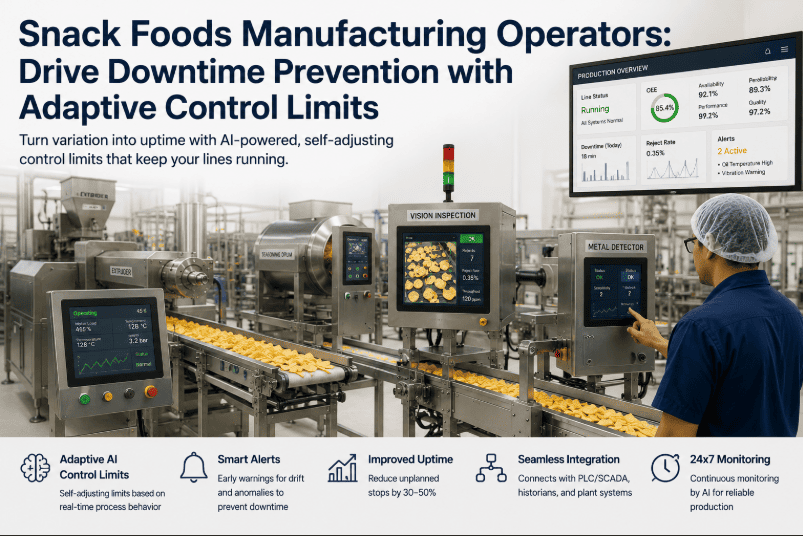
Every 30 seconds, the AI compares live sensor streams against the ideal model. If a fryer temp combination or extruder torque pattern starts diverging, iFactory sends an alert 8 minutes before the batch goes out of spec — with the exact corrective action.
Close the Loop Automatically
For approved parameters, iFactory writes setpoint adjustments directly back to the PLC — no operator intervention needed. For others, it sends a specific, contextual alert to the line display: "Increase belt speed by 3% to compensate for oil temp drift."
What You Get When AI Runs Your SPC
iFactory replaces manual SPC charts, static alarm thresholds, and reactive QC with a live, learning system that gets smarter with every batch. These are the capabilities your operations team will use, day one.
Live Control Charts for Every Line
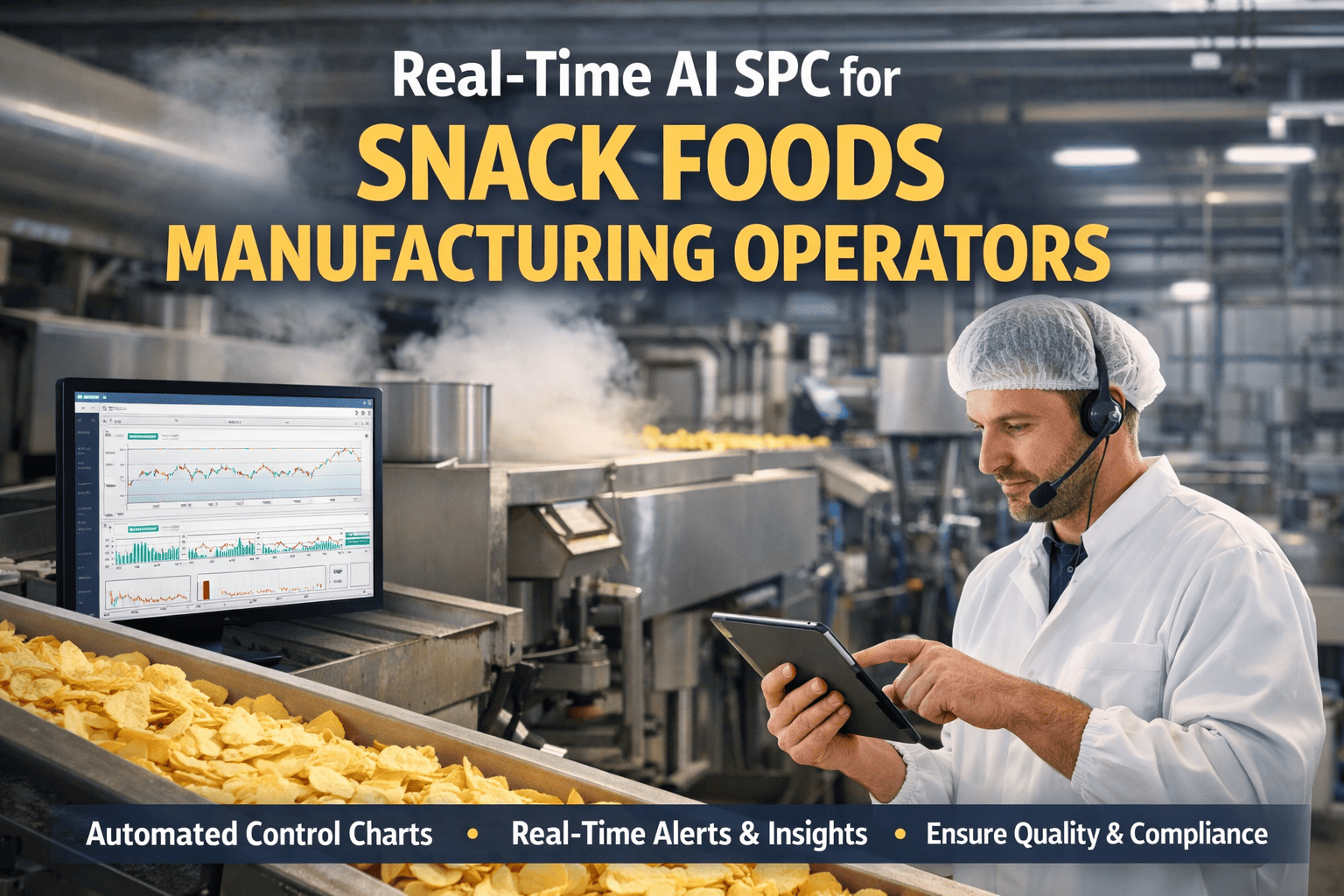
Every fryer, oven, and extruder gets a live X-bar and R chart updated every 15 seconds. Operators see trends forming — not after the fact, but while they can still correct. No more 20-minute lag between sample and action.
One-Click Product Changeovers
When switching from kettle chips to tortilla strips, iFactory loads the exact 23-parameter recipe — temperatures, speeds, oil flow, dwell times — and validates every setpoint before the first chip hits the fryer. Changeover waste drops from 6,000 lb to 800 lb.
8-Minute Early Warning System
The AI doesn't wait for a threshold breach. It detects the subtle sensor patterns that precede drift — a 0.3°F/min ramp in oil temp, a 0.1% humidity climb in the oven — and alerts the operator with a specific corrective action. False alarms drop by 92%.
Setpoint Adjustment Without Human Delay
For approved parameters, iFactory writes corrections directly to the PLC. Belt speed, burner modulation, oil flow — the AI adjusts in milliseconds, not minutes. The operator sees the change, but doesn't need to make it.
Zero Data Leaves Your Plant Network
iFactory runs on an NVIDIA appliance inside your facility. No cloud dependency, no VPN, no data egress. Compliant with FSMA 204, SQF, BRC, and every retailer audit your plant faces. Your data stays in your control.
One Dashboard for the Entire Plant
All six fryer lines, three ovens, and four extruders appear on a single live dashboard. The shift supervisor sees which line is drifting, which recipe is due for changeover, and which operator needs coaching — all from one screen.
What 94% Batch Consistency Looks Like on Paper
These are real results from snack food plants running iFactory. Not projections — actual numbers from production lines running 24/7, 340 days a year.
Turnkey Batch Consistency — No IT Project Required
iFactory is an end-to-end, on-premise solution. You hand over data-source access, and we deliver a working pilot in 6–12 weeks. Here's exactly what's included.
End-to-End Deployment
From PLC integration to live dashboard — we handle every connection, every data stream, every model training. Your team doesn't touch a line of code.
6–12 Week Pilot to ROI
We deploy the appliance, connect your data sources, train the AI on your best batches, and deliver measurable first-pass yield improvement within one quarter.
On-Premise, Zero Cloud
iFactory runs on an NVIDIA appliance inside your plant network. No data leaves your facility. No cloud subscription. No security review for data egress.
24x7 Managed Service
Our operations team monitors your iFactory instance around the clock — model drift, data gaps, system health. You get an uptime SLA and a dedicated support engineer.
Operator Training & Change Management
We train your shift supervisors, operators, and QC team on the new workflows — live control charts, recipe automation, alert response. Two-day on-site program included.
Continuous Model Improvement
The AI retrains itself weekly on new production data, incorporating seasonal raw material changes, new products, and process tweaks. Your consistency keeps improving.
Batch Consistency & AI SPC — Demystified
Stop Losing Margin to Batch Drift. Start Your Pilot in 6 Weeks.
Your operators have the data. iFactory gives them the action — before the batch goes bad. No cloud, no IT project, no data leaving your plant. Book a 30-minute walkthrough and we'll show you a live plant running 94% first-pass yield.