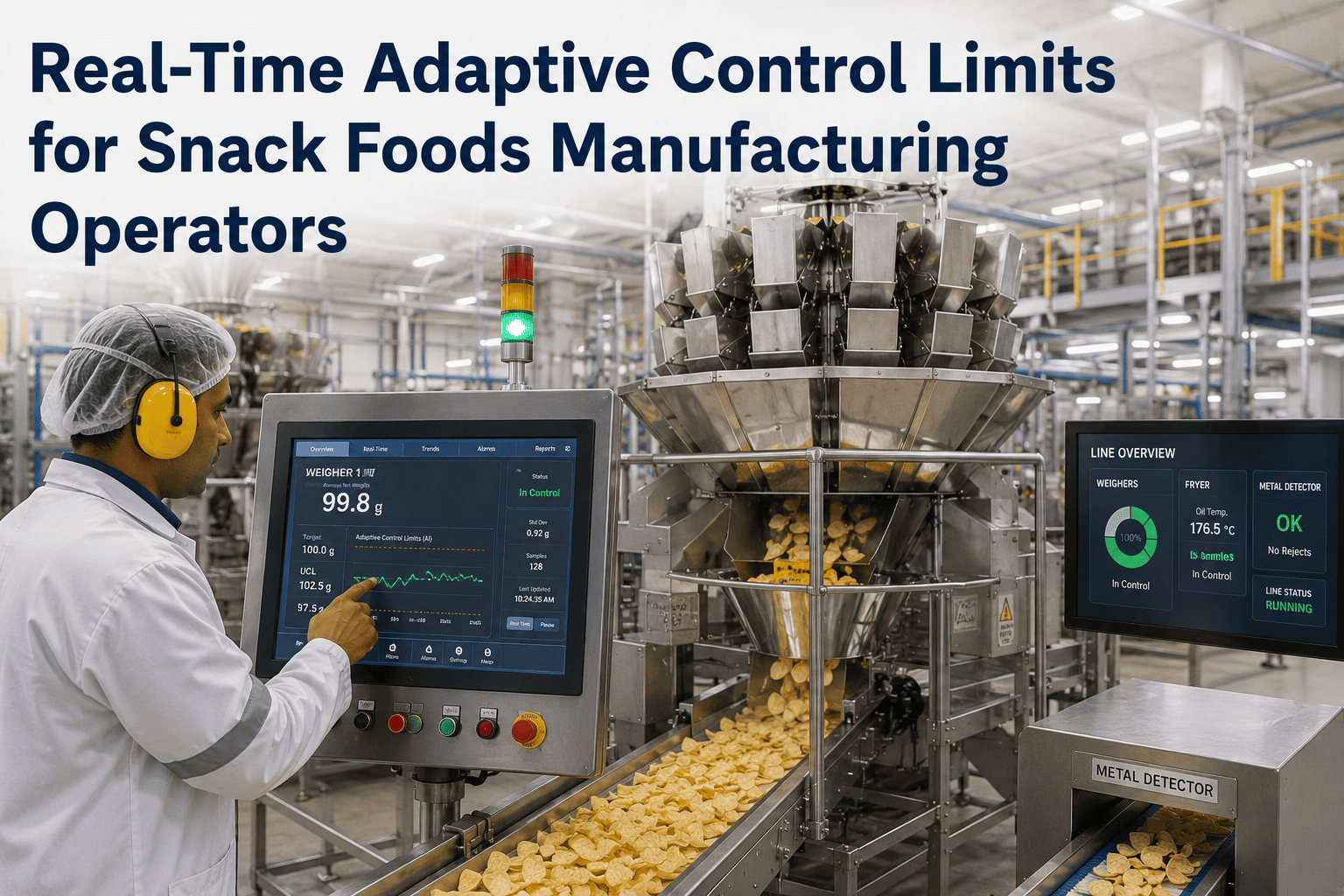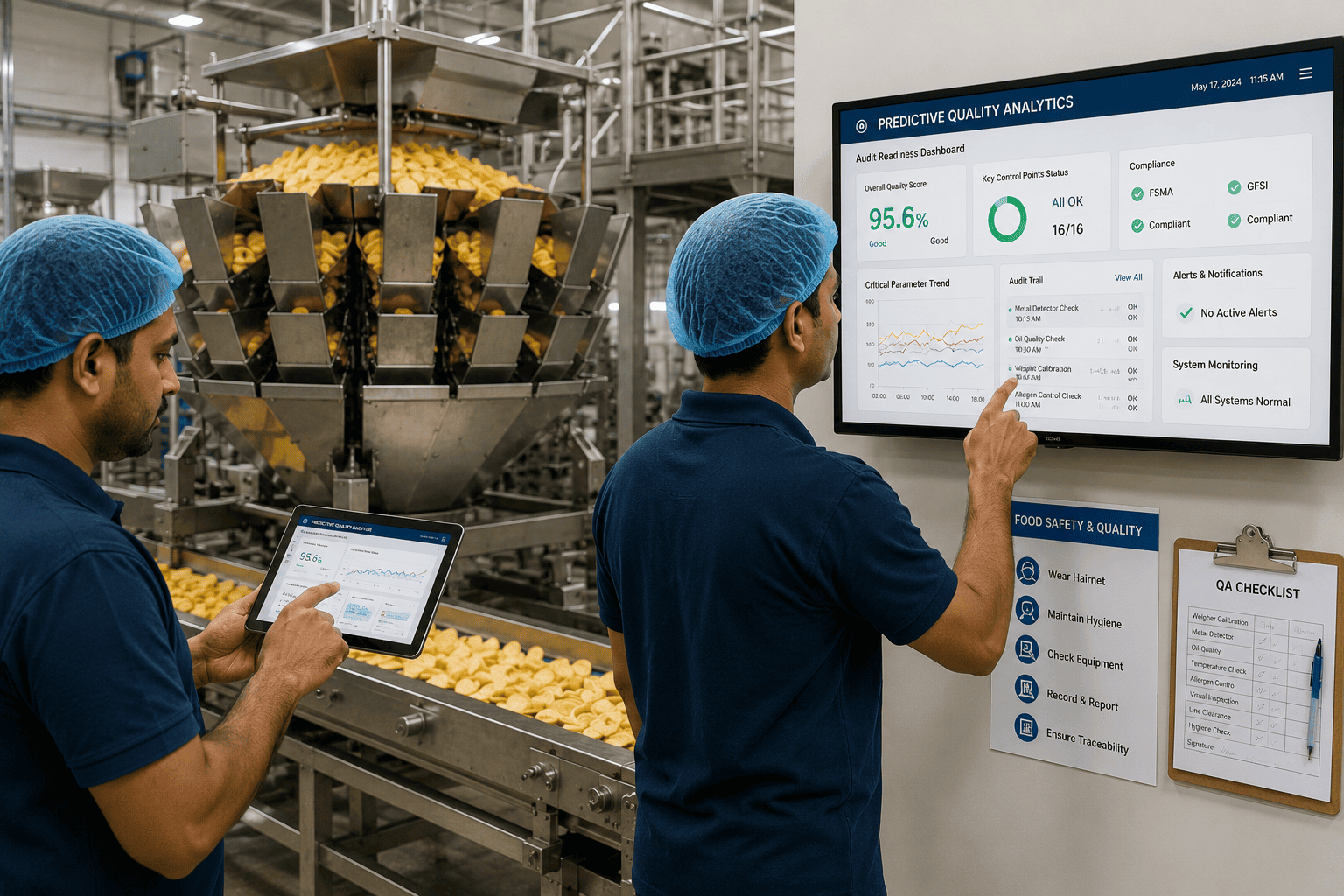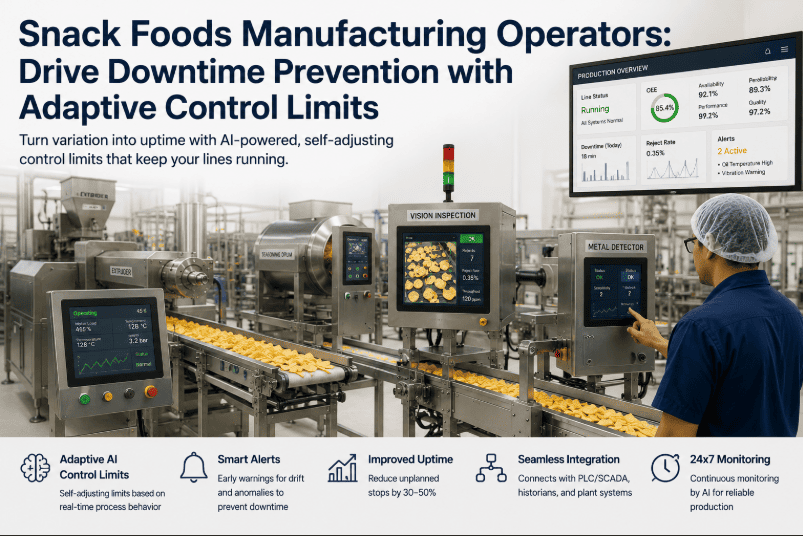
At 2:47 AM on a Tuesday, a snack foods line operator in Toledo watches the fryer temperature drift — 347°F, then 349°F, then 351°F. The control limit on his screen says 340°F to 360°F, set six months ago when the plant ran a different oil blend. He knows the chips coming off now are too dark, but the limit hasn't changed. By the time QA flags the batch at 6 AM, 14,000 pounds of product are downgraded to rework. The shift supervisor shrugs — "limits are limits." That shrug costs this plant $47,000 per incident, and across the industry, static control limits are the hidden tax on every line.
Snack food operators stop reactive line stops with adaptive control limits that learn from every batch
Replace static, outdated control limits with AI-native boundaries that adjust in real time. iFactory cuts unplanned downtime by 38% and reduces rework by 52% in snack food plants — without data leaving your network.
What changes when control limits learn
The difference between a line that reacts and a line that adapts is measured in pounds per hour and dollars per shift. Here's what that looks like on your floor.
Without iFactory
- Static control limits set quarterly — or when someone remembers
- Operator alarms trigger only after product is already out of spec
- Rework decisions made by gut feel, not real-time data
- Line stops average 47 minutes per shift for limit adjustments
- QA catches issues 4–6 hours late, costing $47K per incident
With iFactory
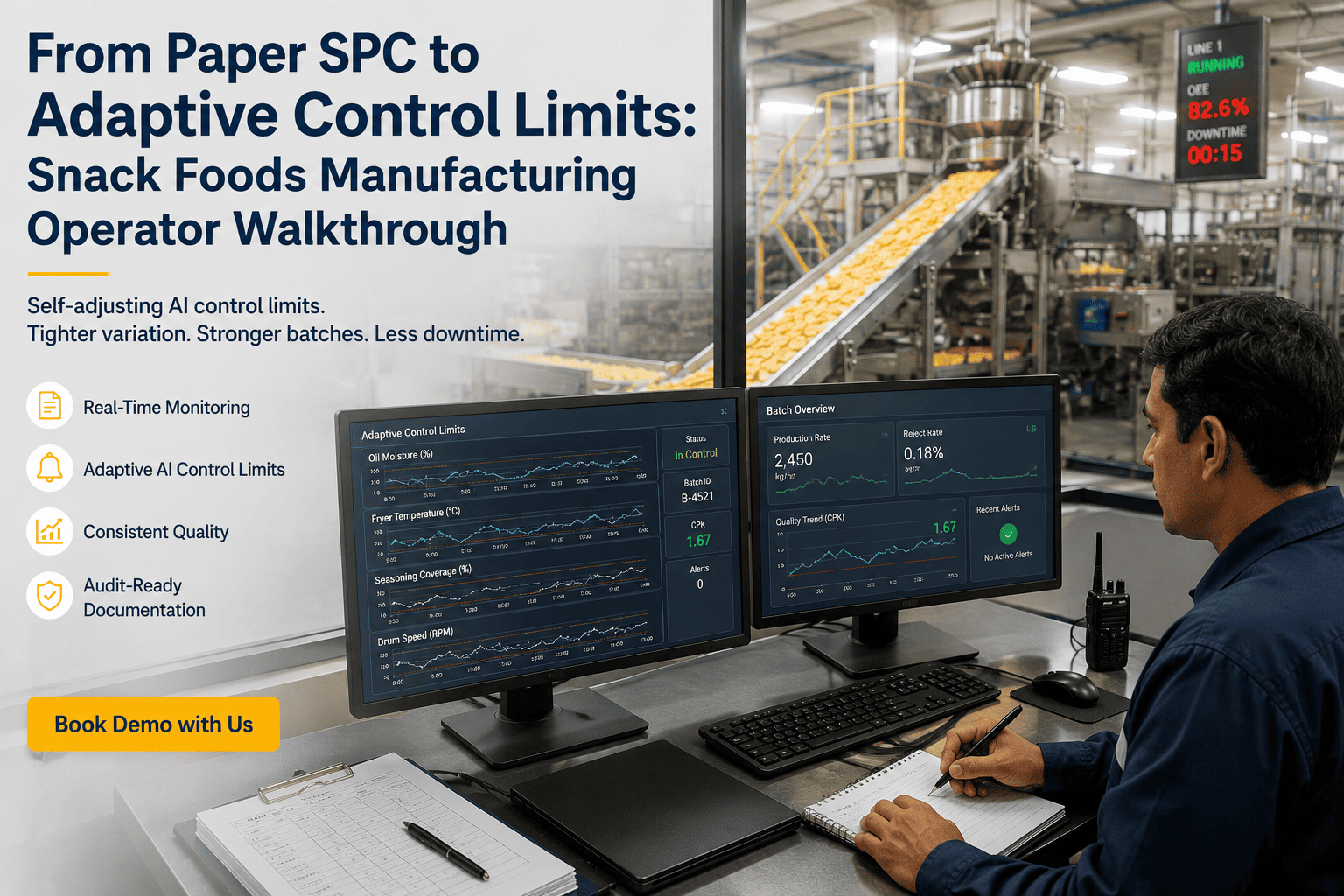
- Adaptive limits recalculated every 15 minutes based on live conditions
- Predictive alerts fire 20 minutes before a limit breach occurs
- Operators see corrective actions before product quality degrades
- Line adjustments happen in under 3 minutes — no downtime
- QA shift-left to real-time, with 92% fewer late-discovered defects
Every batch that drifts is a bet you're losing
Static control limits don't just fail — they cost. Here's where the money leaks in a typical snack foods plant running 3 shifts, 6 lines.
Oil temperature drift on fryer lines
When fryer oil temperature varies by more than 5°F from spec, product moisture content shifts. Static limits don't catch this until 300+ pounds of chips are already over- or under-cooked. Each drift event costs $12,000 in rework.
Coating applicator pressure drift
Seasoning adhesion depends on precise applicator pressure. A 2 PSI drift (common during oil blend changes) creates uneven coating. Static limits don't adapt to blend changes. Each incident costs $8,500 in wasted seasoning and rework.
Packaging film tension variability
Film tension drifts with humidity and roll changes. Static limits cause film breaks that stop the line 22 minutes per event. With 4 events per shift, that's 88 minutes of lost throughput per shift — $19,400 per day.
Baking oven zone temperature misalignment
Zone 3 drifts 4°F high during peak production. Static limits don't adjust for throughput changes. Product moisture variance increases by 1.2%, triggering a full line stop for recalibration. Each stop costs $31,000 in lost production.
Cooling tunnel conveyor speed mismatch
When cooling tunnel speed doesn't match oven output, product stacks and jams. Static limits miss the correlation. Each jam costs $6,700 in damaged product and cleanup, plus 14 minutes of line downtime.
Four steps to adaptive control that prevents downtime
iFactory installs on your plant network — no cloud, no data leaving your floor. In 6 to 12 weeks, your operators see control limits that learn.
Connect every data source on the line
iFactory ingests data from fryers, ovens, coaters, packaging machines, and your MES — all on-premise through a NVIDIA appliance. No cloud, no data egress.
Train adaptive models on your production history
Using 12 months of your batch data, iFactory learns the correlation between every sensor reading and product quality. The model understands how oil blend changes affect fryer temperature limits.
Deliver live adaptive control limits to operators
Every 15 minutes, iFactory recalculates upper and lower control limits for every critical parameter. Operators see limits that adjust for current conditions — not last quarter's assumptions.
Predict and prevent limit breaches before they happen
iFactory alerts operators 20 minutes before a limit is likely to breach, with a specific corrective action. No alarms at 3 AM for conditions that could have been corrected at 2:40 AM.
What iFactory delivers on your snack foods line
Four capabilities that turn static limits into adaptive intelligence — all running on your network, all delivering results in one quarter.
Real-time limit recalculation
Control limits update every 15 minutes based on live sensor data, product specifications, and environmental conditions. When oil blend changes or humidity spikes, limits adjust automatically — no manual intervention. Operators see the right boundaries for right now.
Predictive breach detection
Machine learning models identify limit breach patterns 20 minutes before they occur. Alerts include the specific parameter drifting, the corrective action needed, and the exact time window to act. No more reactive stops at 3 AM.
Multi-parameter correlation engine
iFactory connects fryer temperature, coating pressure, oven zones, and packaging tension into a single model. When one parameter drifts, the system predicts the downstream impact across all connected processes — and adjusts limits accordingly.
Operator action dashboard
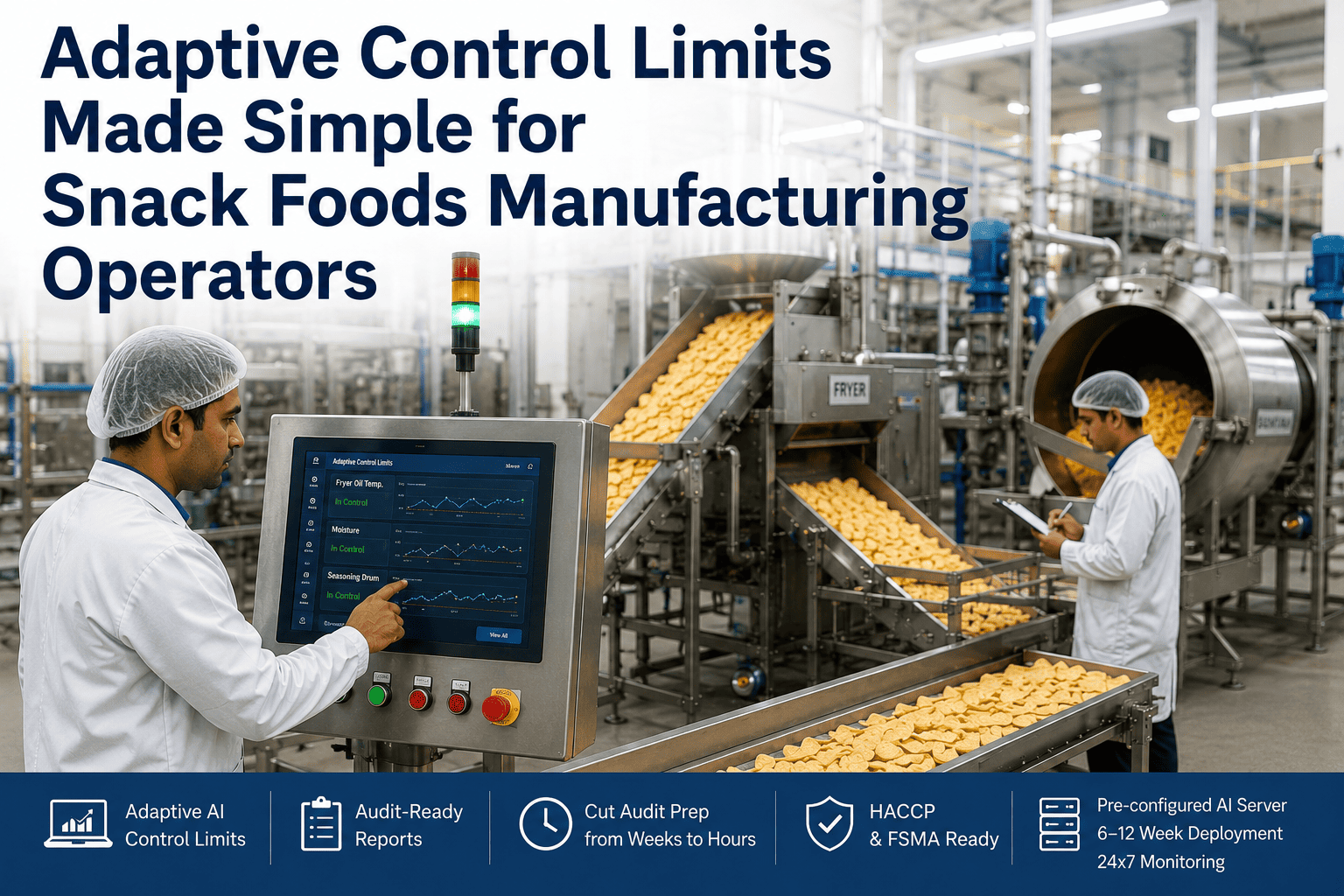
Every shift sees a single screen: current limits, predicted breaches, and one-tap corrective actions. No more chasing alarms across five different HMI screens. Operators act, not react.
Static control limits cost snack food plants $2.1M per year in rework and downtime. Adaptive limits cut that by 52%. Book a 30-min walkthrough and we'll show you live on your data.
Turnkey deployment, on-premise intelligence, zero data risk
iFactory is not a SaaS dashboard. It's a complete operational system that lives on your plant floor and delivers results in weeks.
End-to-end deployment in 6–12 weeks
We connect your data sources, train the models, and deliver a working pilot. No months-long IT projects. You hand over data-source access, we hand back a live system.
100% on-premise — no cloud dependency
iFactory runs on a NVIDIA appliance inside your plant network. Zero data leaves your floor. No cloud subscriptions, no data egress fees, no security audit nightmares.
Pilot to ROI in one quarter
Our pilots show measurable results within 12 weeks. You see the downtime reduction, the rework savings, and the operator adoption before you commit to a full rollout.
24x7 managed service
iFactory's operations team monitors your system around the clock. If a model needs retraining or a sensor feed drops, we handle it. Your operators focus on production, not software.
Works with existing infrastructure
iFactory connects to any PLC, SCADA, MES, or historian you already have. No rip-and-replace. No forklift upgrades. Your existing investments stay in place.
Operator training included
Every shift gets hands-on training on the adaptive control dashboard. Operators learn in 2 hours, not 2 weeks. No new certifications required.
Questions snack food operators ask about adaptive control limits
Stop reacting to limit breaches that could have been prevented
iFactory delivers adaptive control limits on your snack foods line in 6 to 12 weeks. No cloud, no data leaving your network, no months of integration. Book a 30-minute walkthrough and we'll show you what your plant could save.