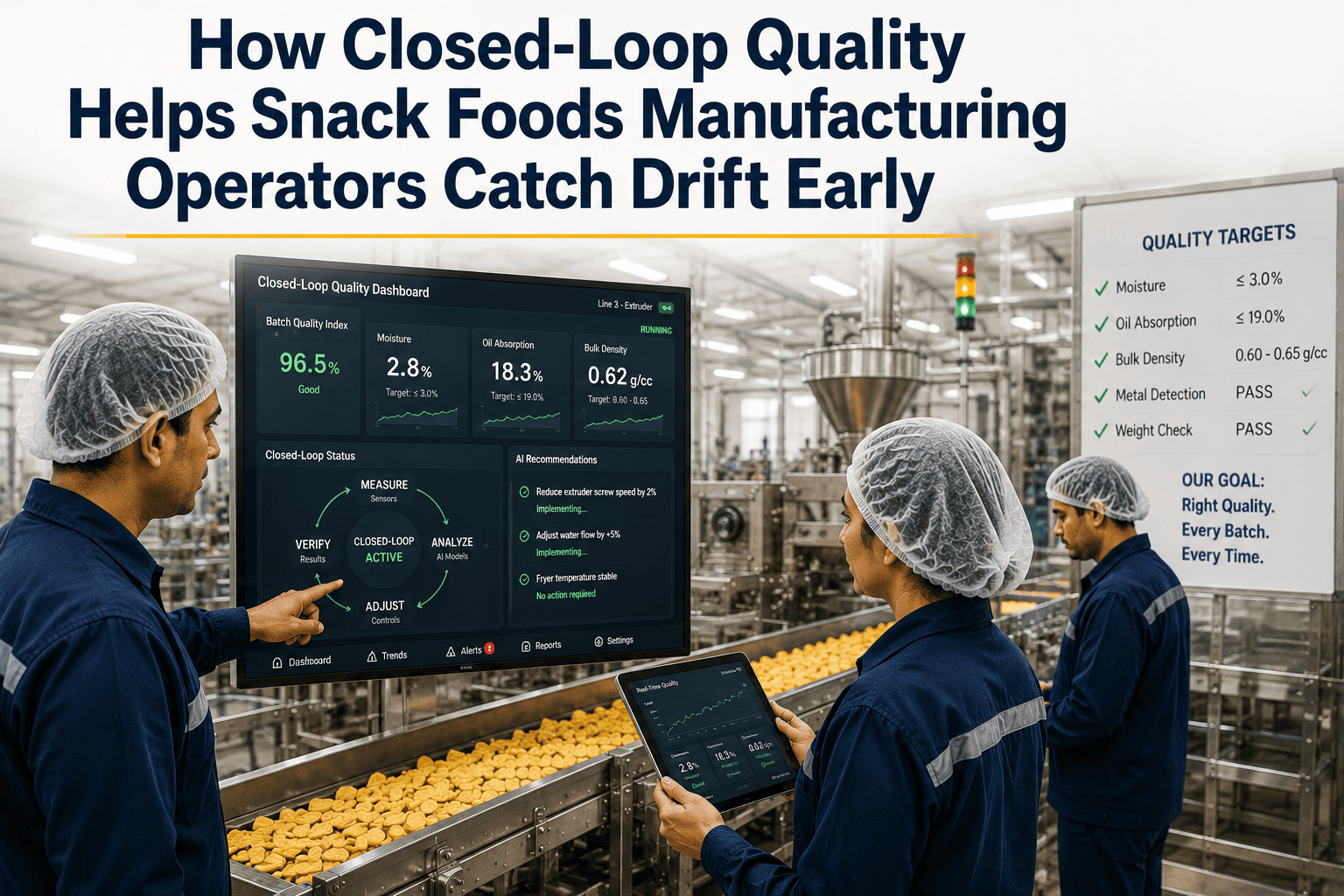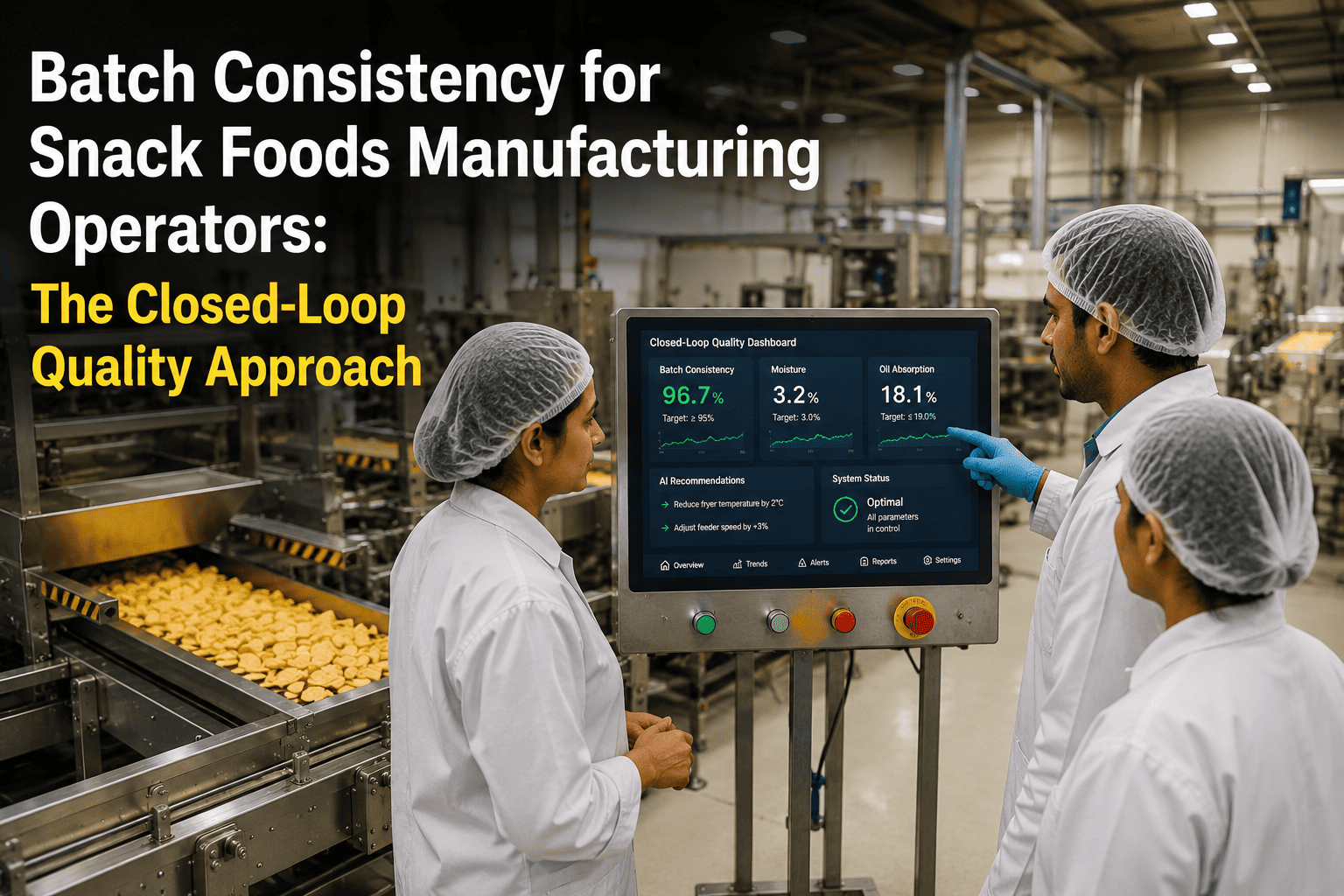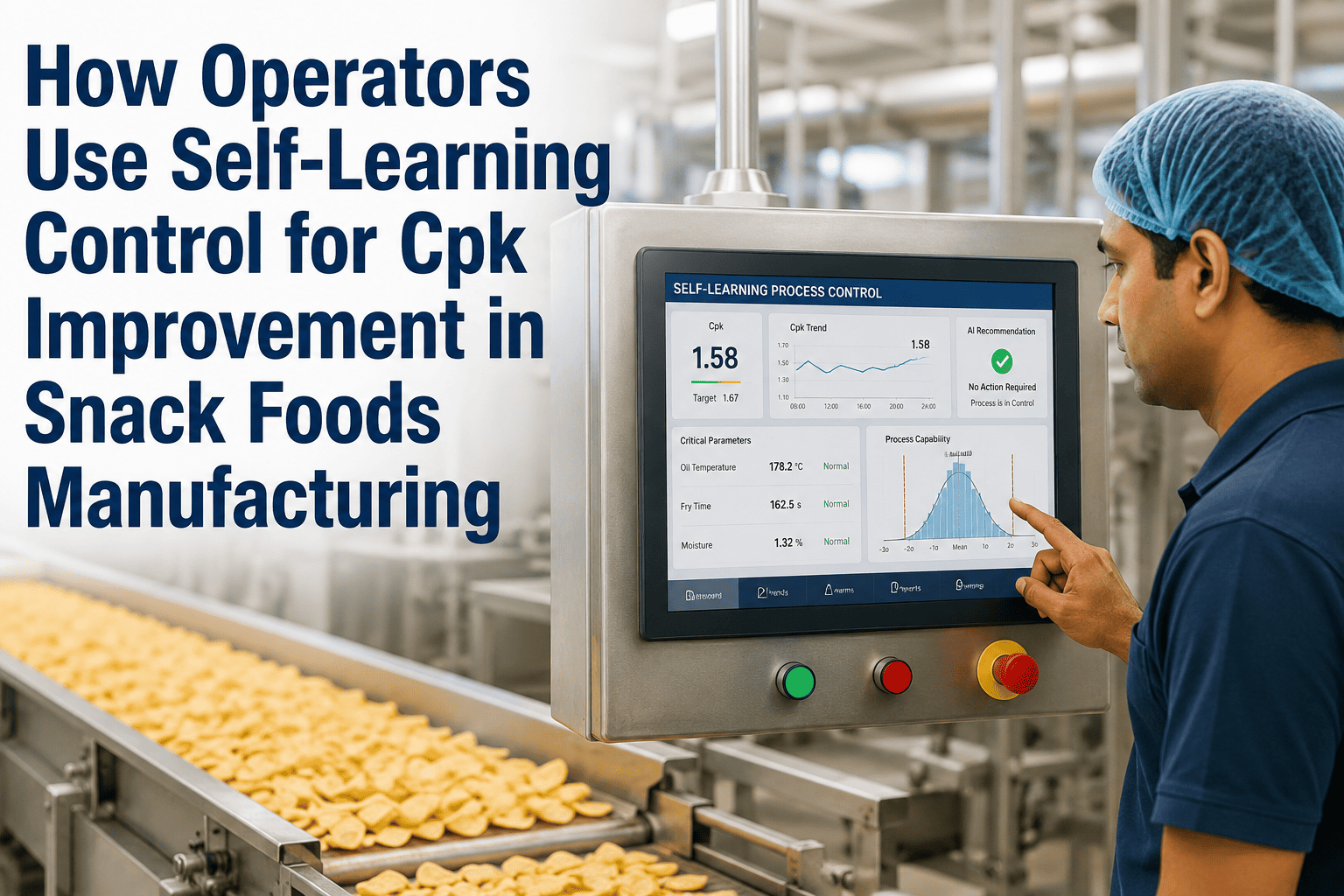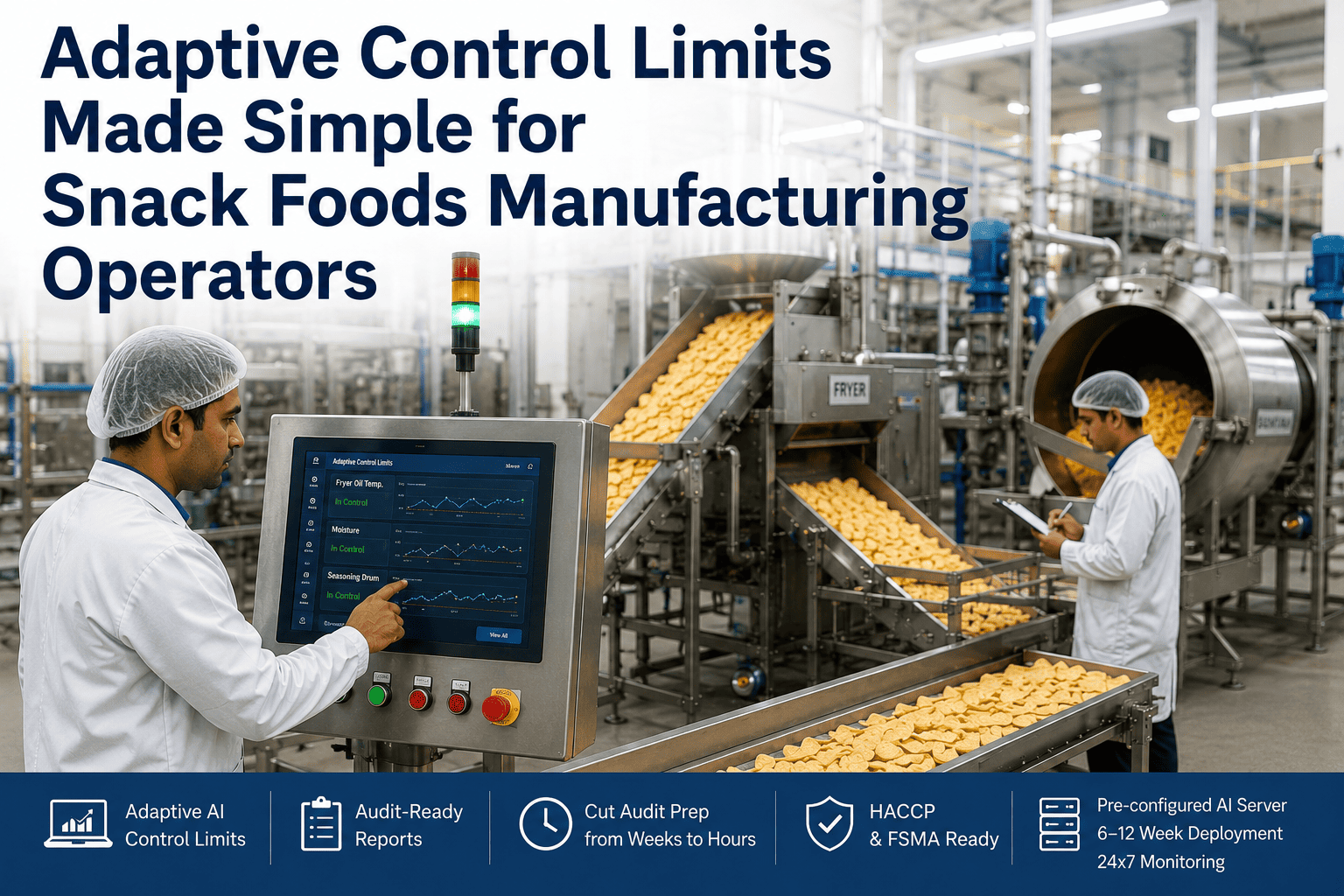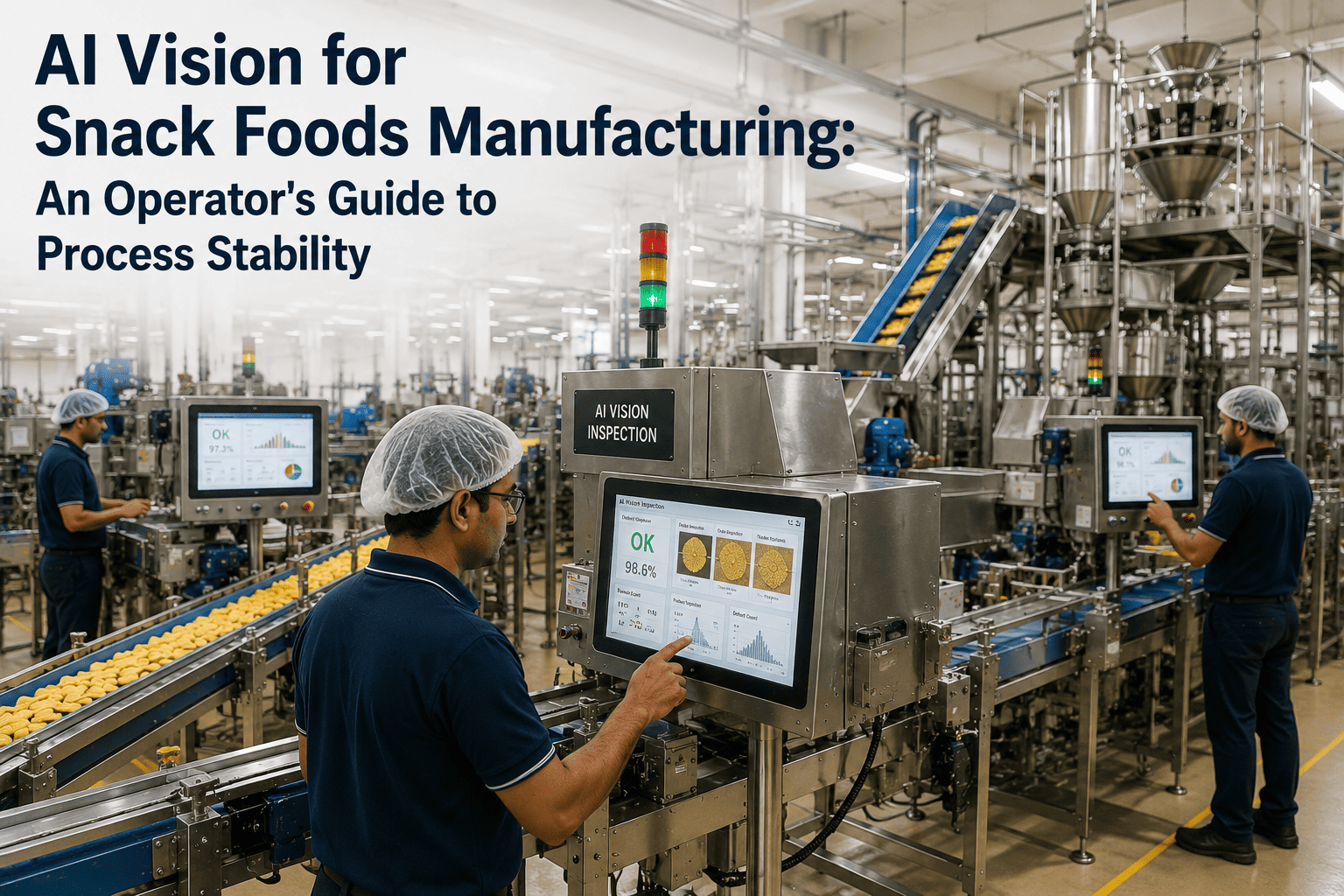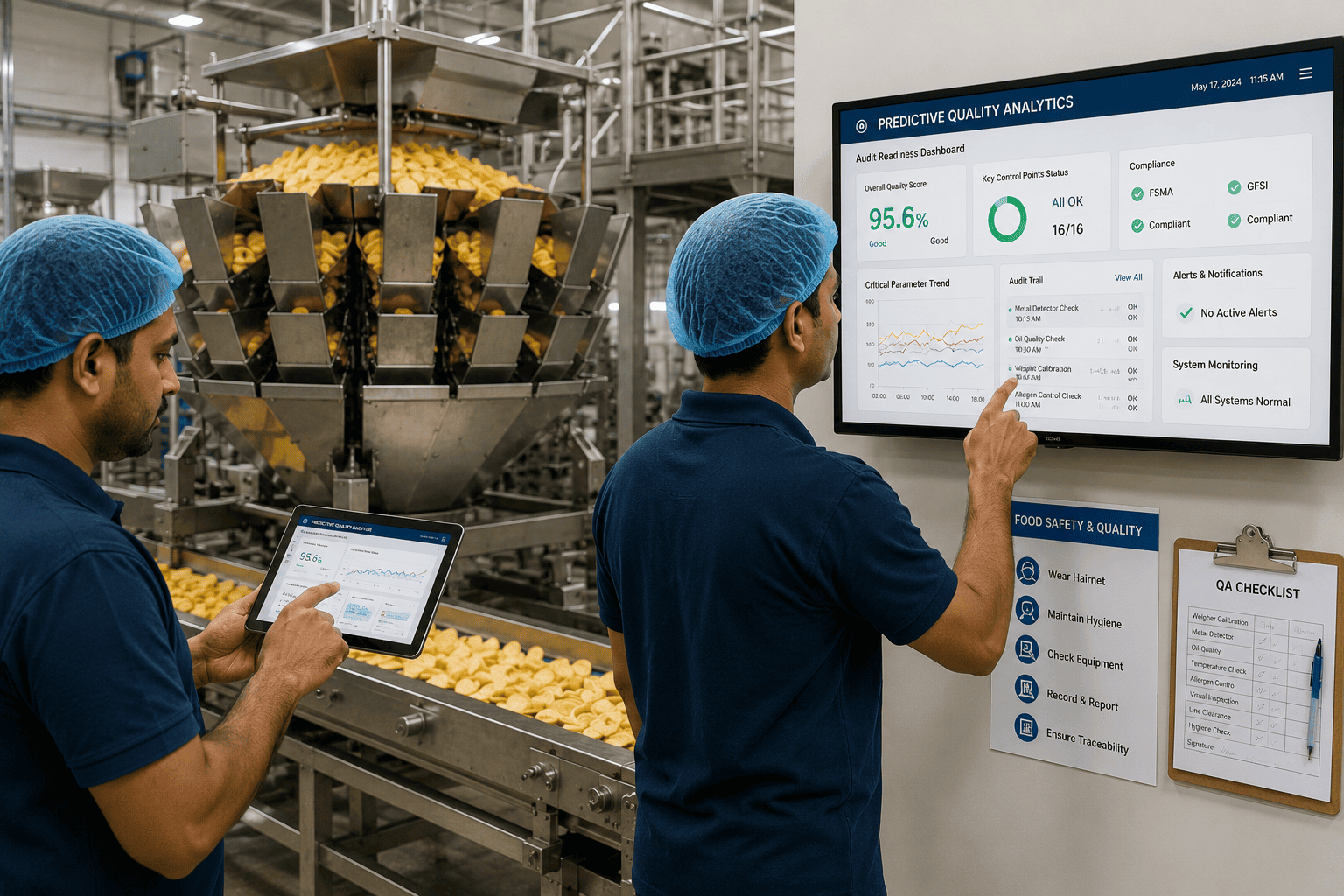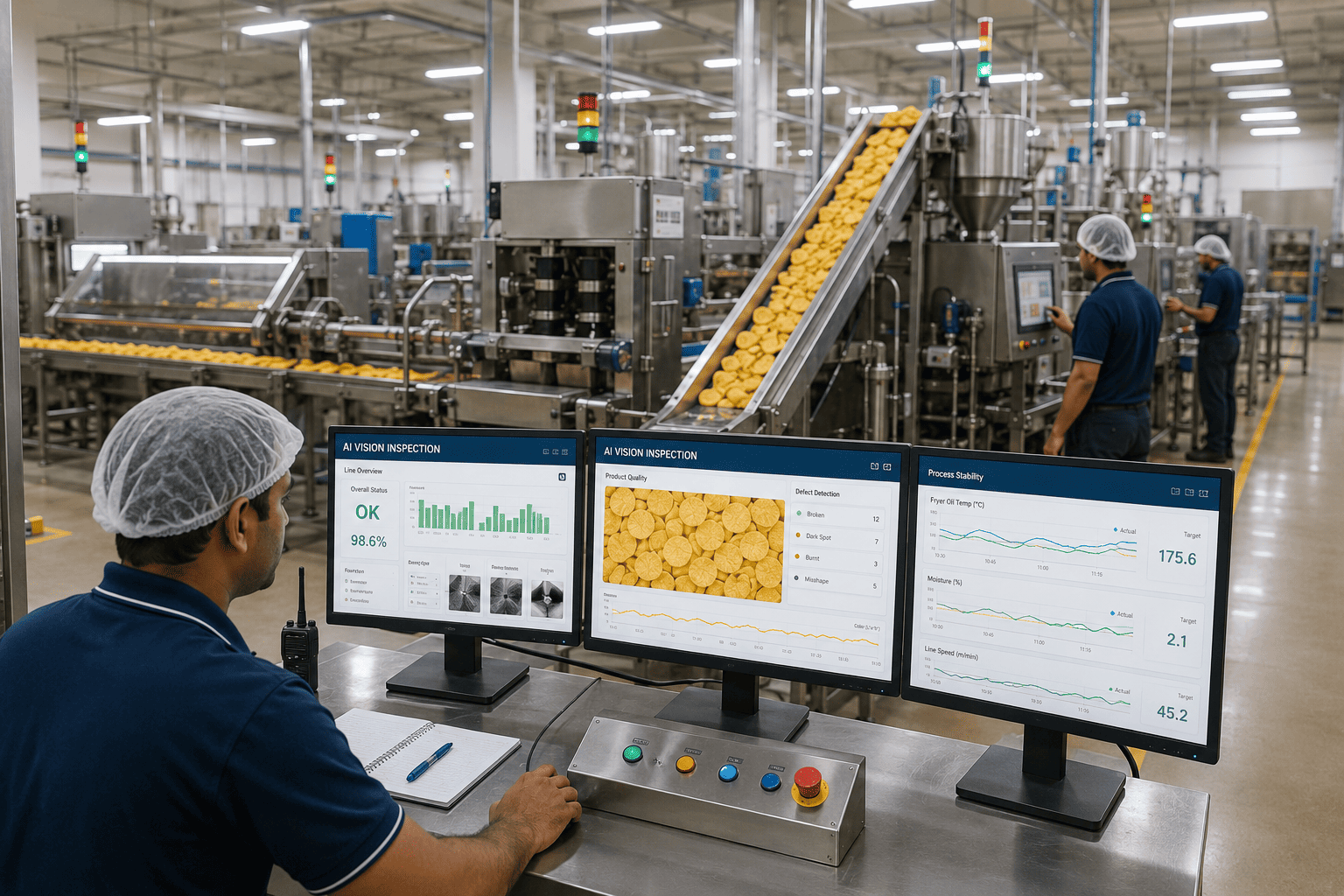
Six months ago, the night shift line operator at a major tortilla chip plant watched the same fryer temperature drift 4°F every Tuesday at 2 a.m., triggering a 15-minute manual correction that cost 1,200 units of throughput. Today, that same operator monitors real-time chip color, oil degradation, and moisture content from a single dashboard — and the line hasn't deviated from spec in 72 consecutive production runs. The difference wasn't a new fryer or more operators. It was AI vision that sees what human eyes miss, catching process instability before it ever reaches the product.
From reactive firefighting to proactive process stability: AI vision that watches every chip, every second
Deploy an on-premise AI vision system that monitors color, shape, oil absorption, and moisture across every production line — and delivers a 40% reduction in process deviations within the first 8 weeks of operation.
What 8 weeks of AI vision delivers to your snack food line
These are real results from a 48,000 sq ft kettle chip facility that deployed iFactory's AI vision platform across three parallel lines. Every metric is measured from the first day of pilot deployment to the end of week eight.
Six AI vision capabilities that stabilize your snack food process
iFactory's platform runs entirely on an NVIDIA appliance inside your plant network. No cloud dependency, no data leaving your four walls. Every capability is delivered as a turnkey pilot in 6–12 weeks.
Real-time chip color grading
AI vision tracks every chip's color against your spec — detecting over-browning or under-cooking at line speed. Alerts trigger when the moving average drifts 1.5% outside target, not after a full batch fails QC.
Surface moisture prediction
Using visual texture analysis, the model predicts moisture content within ±0.3% of lab results — without waiting for a 20-minute oven test. You correct fryer temperature or dwell time in real time.
Oil absorption tracking
Vision models estimate oil uptake per chip based on surface gloss and pore structure. When absorption drifts 2% above target, the system flags potential fryer temperature or oil degradation issues instantly.
Shape and size consistency
Every chip is measured for length, width, and curvature. Out-of-spec shapes — broken chips, doubles, or irregular cuts — are counted and mapped to the cutter or conveyor section causing the issue.
Burn and blister detection
AI identifies localized defects like scorch marks, blistering, or oil spotting at 120 chips per second. Each defect is logged with a timestamp and camera ID, enabling root cause analysis within minutes.
Predictive drift alerts
Beyond simple threshold alarms, the model learns normal process variation and predicts when a parameter will drift out of spec — giving operators 8–12 minutes of lead time to adjust before product is affected.
Three hidden costs of process instability that erode your margins
Every snack food plant experiences these — but most don't see them until the quarterly P&L review. AI vision makes them visible in real time.
Scrap and rework from delayed detection
A 0.5% moisture drift that goes undetected for 12 minutes produces 1,800 lbs of out-of-spec product. At $1.20/lb, that's $2,160 in lost material per incident — and most plants have 3–5 such events per shift.
Operator cognitive overload
Line operators juggle fryer temperature, oil level, conveyor speed, and seasoning application — all while visually inspecting 100+ chips per minute. Human visual inspection catches only 60–70% of defects. The rest reach the customer.
Reactive maintenance and unplanned downtime
When a vision system catches a burner flame pattern shift or an oil filtration issue early, you schedule maintenance during changeover. Without it, you get a 45-minute unplanned stop at 2 a.m. that costs $8,400 in lost throughput.
Most snack food plants lose 6–8% of throughput to process instability — and don't know until the end of the shift. AI vision makes it visible in real time. Book a 30-min walkthrough and we'll show you how one plant cut deviations by 72% in eight weeks.
From camera mount to process control in four steps
iFactory's on-premise AI vision platform deploys in 6–12 weeks. No cloud, no data egress, no IT project. Here's exactly what happens.
Mount and connect
We install industrial cameras above your existing conveyor lines — no line modifications needed. Cameras connect to the on-premise NVIDIA appliance via PoE. No cloud dependency, no data leaving your plant.
Train on your product
We collect 48 hours of baseline imagery from your lines. Our AI models learn your specific color specs, shape tolerances, and moisture targets — not generic benchmarks from a different plant.
Deploy dashboards and alerts
Operators see real-time color, moisture, oil, and shape data on a single screen. Alerts push to the line HMI, a mobile device, or a wearable — whichever your team uses. No new software to learn.
Validate and optimize
We compare AI predictions against lab results for two weeks. Once accuracy exceeds 97%, we turn on automated alerts. Your team sees the first ROI within 30 days of go-live.
Four promises that make this different from any vision system you've seen
End-to-end, turnkey delivery in 6–12 weeks
We handle everything — camera selection, mounting, model training, dashboard setup, and operator training. You hand over data-source access; we hand back a working pilot.
On-premise, zero cloud dependency
All processing happens on an NVIDIA appliance inside your plant network. No data leaves your four walls. No monthly cloud fees. No cybersecurity review required.
Pilot-to-ROI in one quarter
We guarantee measurable process improvement within 8 weeks of deployment. If you don't see a 40% reduction in process deviations, we'll extend the pilot at no cost.
24x7 managed service
Our operations team monitors your models remotely. If a model drifts, we retrain it — typically within 4 hours. You never manage AI infrastructure. You focus on running the line.
Answers to the questions operations leaders ask most
Stop catching deviations after the batch. Start seeing them before they happen.
Your line is already producing the data. iFactory's AI vision platform turns that data into real-time process control — on-premise, in 6–12 weeks, with measurable ROI in the first quarter. Book a 30-minute walkthrough and we'll show you what your chips are telling you.