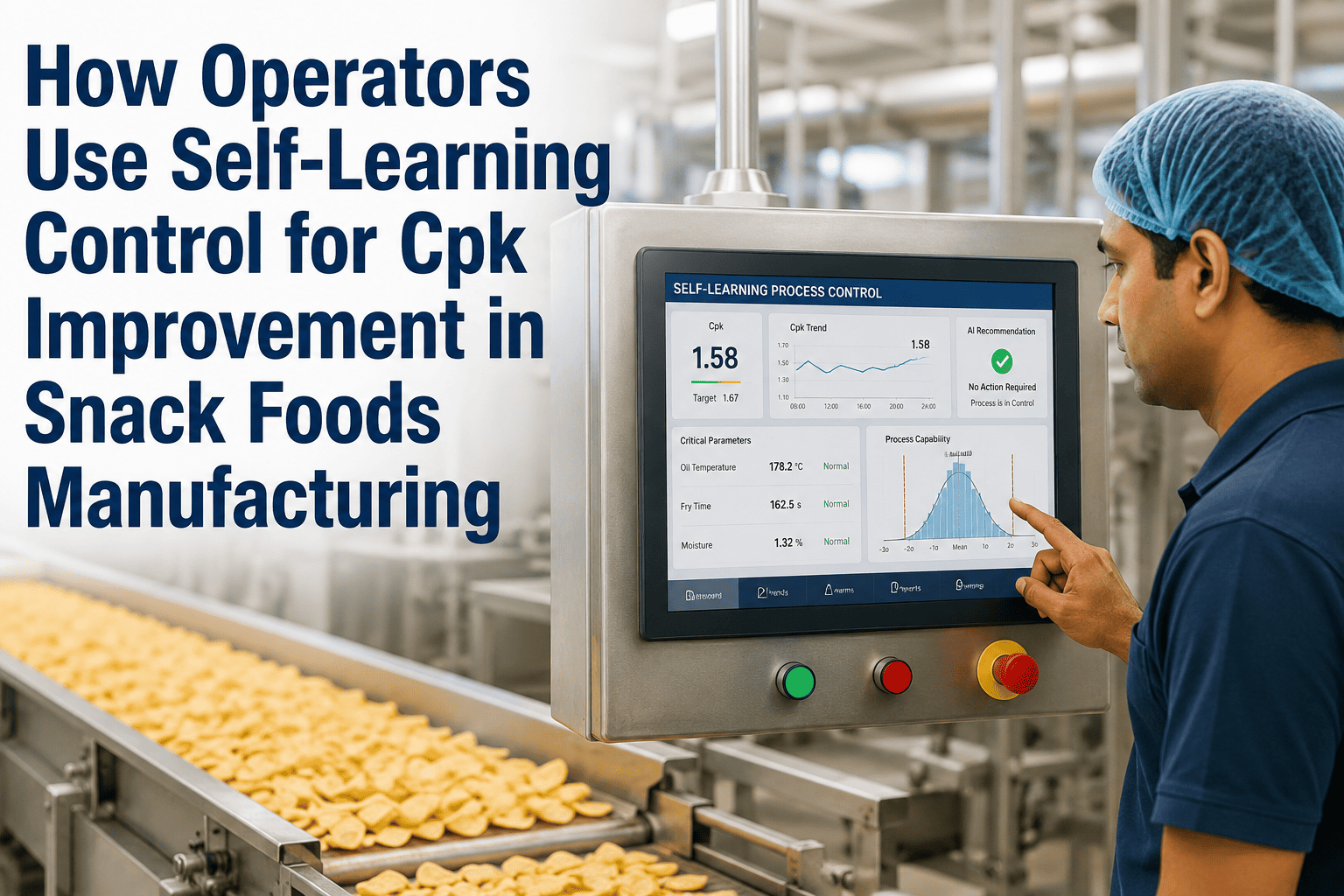
The line supervisor at a Midwest snack-foods plant used to spend the first two hours of every shift hunting for drifting weights, calling lab techs for moisture results, and patching together last night's SPC charts from three different spreadsheets. Six months later, the same supervisor walks in, pulls up a single dashboard, and sees every line's real-time Cpk, moisture distribution, and weight trend for the past 12 hours — all updated every 15 seconds without anyone touching a keyboard. The rework rate dropped 40%. The only thing that changed was the system feeding the data.
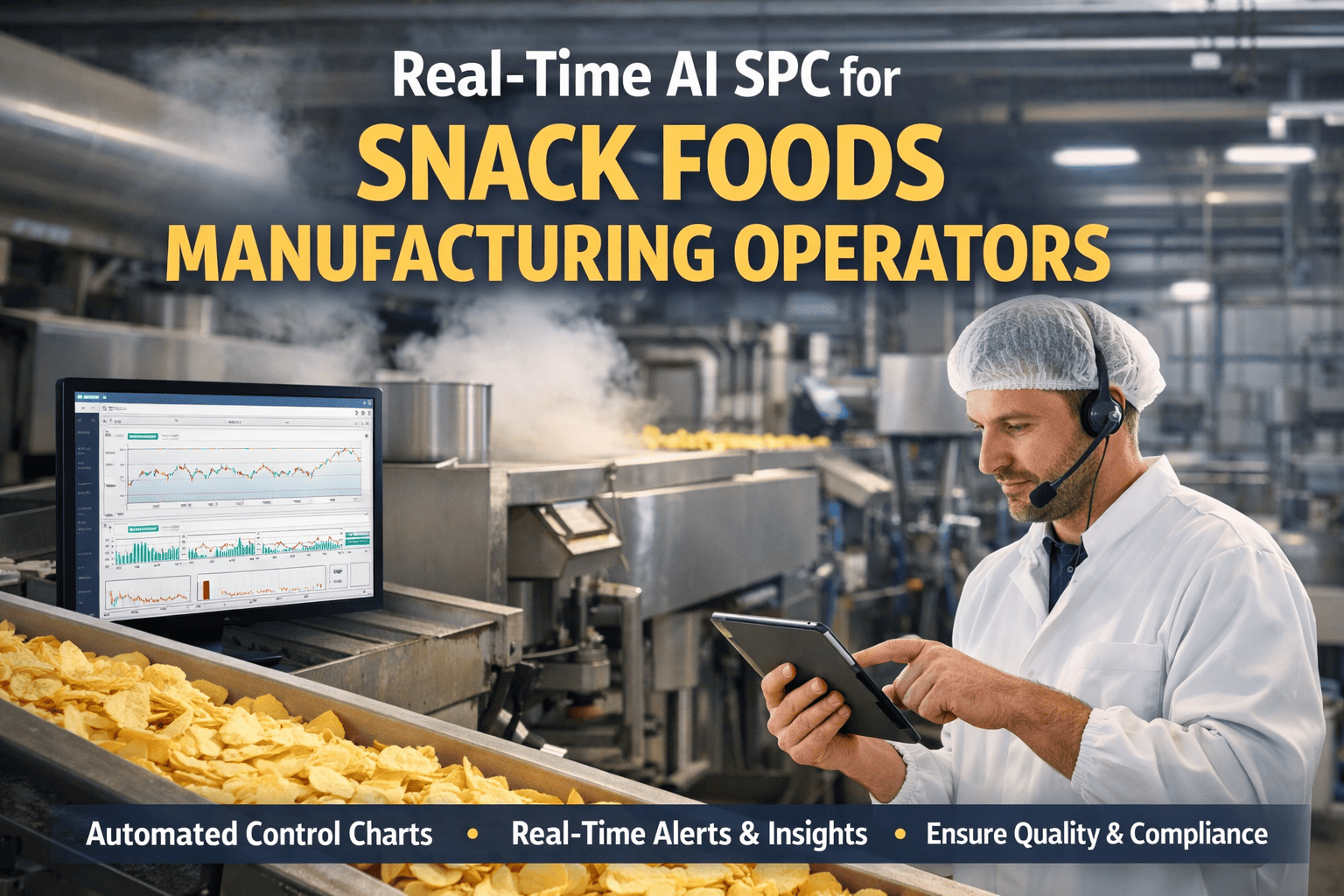
Real-Time AI SPC for Snack Foods: Stop Drifting Weights & Moisture Before They Cost You a Shift of Rework
iFactory ingests your existing line sensors, checkweighers, and moisture analyzers — then applies statistical process control at 15-second intervals, flagging every violation with the exact adjustment needed, before your operators see a spec breach.
What Real-Time AI SPC Delivers in Snack Foods
These are not projections from a white paper. They are the actual range of outcomes across iFactory deployments in tortilla chip, potato chip, and extruded snack lines running three shifts per day.
The Six Capabilities That Make Real-Time SPC Work on a Snack Line
These are the specific functions iFactory delivers — no configuration needed beyond connecting your data sources.
15-Second SPC on Every Parameter
Weight, moisture, oil content, thickness, and color — all running X-bar and R charts at 15-second intervals. Control limits auto-calculate from your historical process capability.
Western Electric Rule Violation Alerts
The system flags Zone A, B, and C violations instantly — plus trend rules like 6-in-a-row increasing. Operators get a screen pop with the exact parameter and suggested adjustment.
OEE Integration at the Line Level
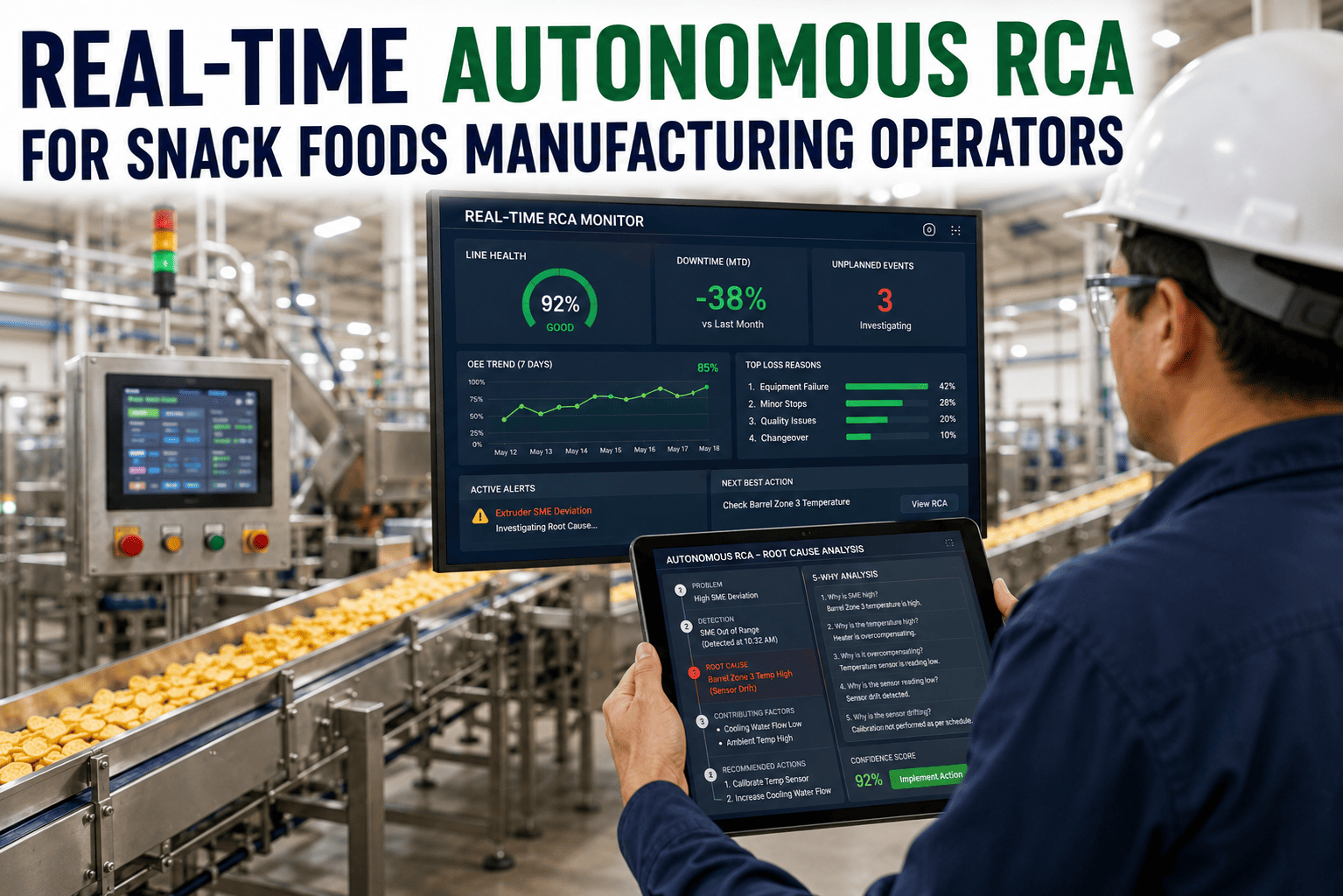
SPC violations that cause a line stop or slow-down are automatically logged against OEE. You see quality-related downtime as a separate category, not buried in "other."
Moisture-to-Weight Correlation Model
iFactory builds a real-time model linking moisture readings to final pack weight. When moisture drifts, the system predicts the weight impact before the checkweigher confirms it.
Shift-to-Shift Capability Comparison
Each shift sees its own Cpk, Ppk, and violation count for the previous shift. Supervisors use the data to coach operators, not guess who was running the line.
Automated SPC Reports for USDA / FDA Audits
Generate a complete SPC report for any date range with one click. Includes control charts, capability indices, and violation logs — ready for audit submission.
Three Costs of Manual SPC That Your P&L Already Knows
These are the operational pains that real-time AI SPC eliminates — each one costing your plant real margin every shift.
Drifting Weights That Hit the Checkweigher Reject Gate
A 1-gram drift on a 10-ounce bag of tortilla chips means the checkweigher rejects 12–15% of production until an operator catches it. At 80 bags per minute, that's 4,800–6,000 bags per hour sent to rework or scrap. Real-time SPC flags the trend 15–20 minutes before the reject gate starts firing.
Moisture Variability That Wastes Oil and Shrinks Shelf Life
Moisture swings of 0.5% in a fried snack can change oil absorption by 3–5%, raising both ingredient cost and spoilage risk. Manual moisture checks every 30 minutes miss the swings between samples. Real-time SPC catches every excursion at the fryer exit.
Operator Over-Adjustment That Widens the Distribution
When an operator sees a single high weight and tweaks the depositor, they often overshoot — creating a new drift in the opposite direction. Real-time SPC shows the trend, not the last point. Operators learn to trust the system's control limits instead of reacting to noise.
The average snack line loses $180,000–$350,000 per year in rework and give-away from weight and moisture drifts that manual SPC never catches in time. Book a 30-min walkthrough and we'll show you the actual numbers from a line running your product type.
From Sensor Data to Operator Action in Four Steps
No new sensors. No cloud data egress. No months of configuration.
Connect Your Existing Data Sources
iFactory connects to your line PLCs, checkweighers, moisture analyzers, and vision systems over your plant network — no cloud, no data leaving the facility.
Auto-Build Control Limits from 90 Days of History
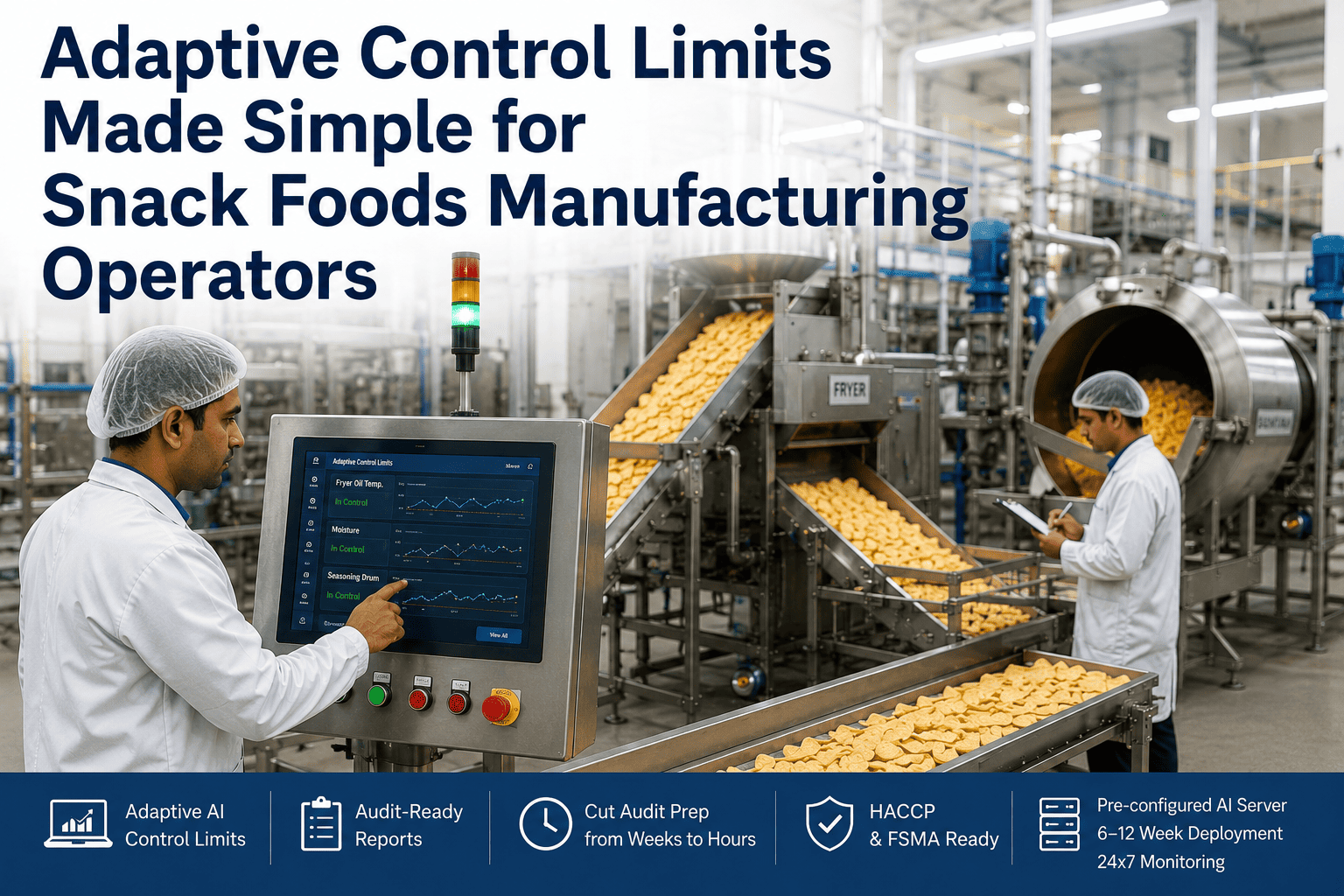
The system ingests 90 days of historical data per line, calculates natural process capability, and sets control limits at 3 sigma — no manual chart setup.
Real-Time SPC Charts Stream to Every Operator Screen
Every 15 seconds, new data points appear on live X-bar and R charts at the line HMI, supervisor office, and QA lab — all synchronized across the plant.
Alerts and Adjustments in the Same Cycle
When a violation triggers, the system flags the parameter, shows the trend direction, and suggests the adjustment (e.g., "Increase depositor fill time by 0.2 seconds"). Operators confirm or override — the action is logged.
Four Promises That Define the iFactory Difference
End-to-End Turnkey Deployment
You provide data-source access. We deliver a working pilot on your line in 6–12 weeks. No integration consultants, no custom code.
On-Premise, Zero Cloud Dependency
iFactory runs on an NVIDIA appliance inside your plant network. No data egress, no third-party servers, no monthly cloud bills.
Pilot to ROI in One Quarter
Every deployment targets measurable KPI improvement within 90 days. If we don't hit the agreed targets, you don't pay for the pilot.
24×7 Managed Service Included
Our operations team monitors your SPC system around the clock. If a data feed drops or a model needs retraining, we fix it before your next shift starts.
Questions We Get from Every Snack-Foods Operations Team
Stop chasing drifts. Start controlling your process in real time.
Thirty-minute screen share. We'll connect to your line data and show you what real-time AI SPC looks like on your actual parameters. No pitch deck. No demo data.