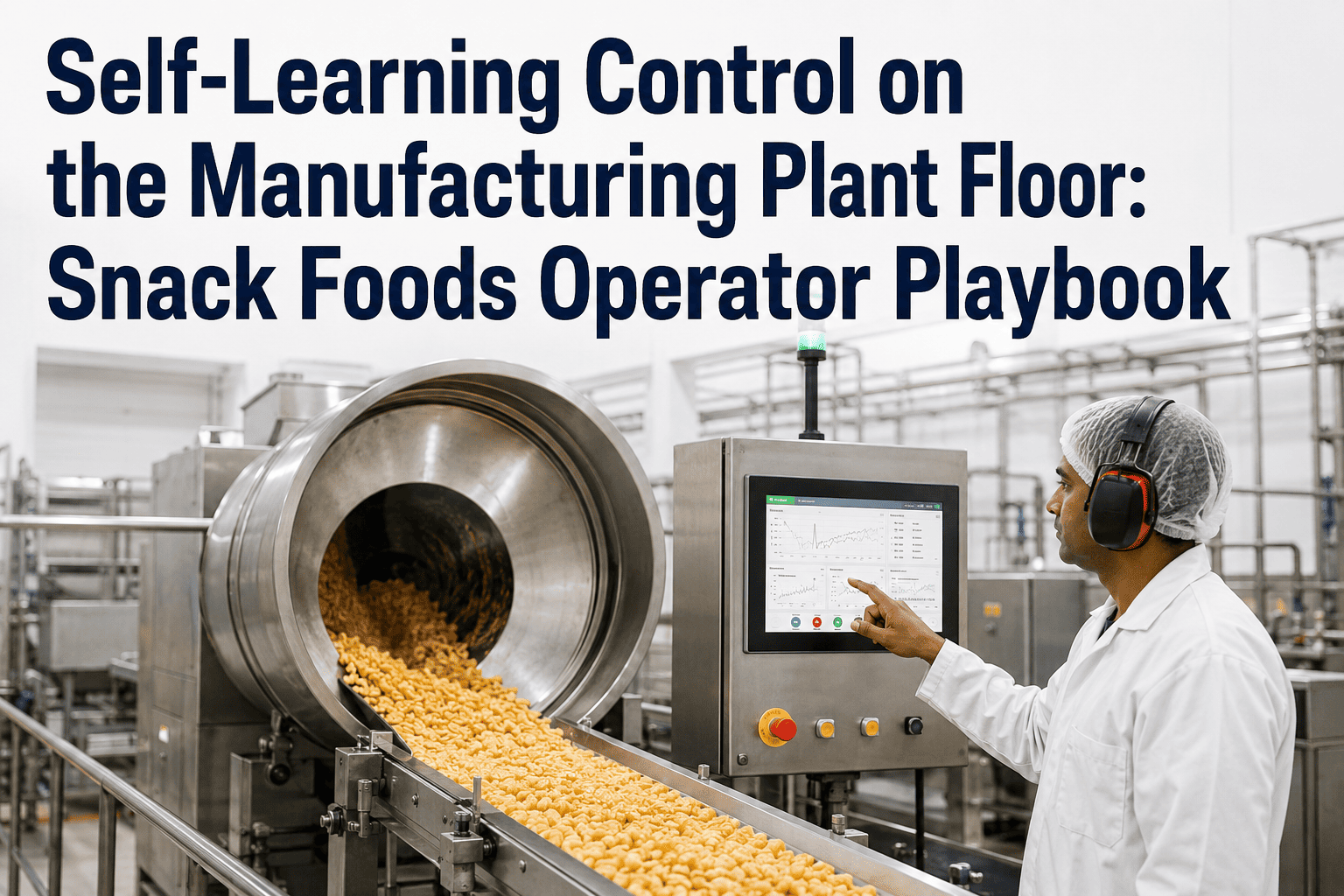
Self-Learning Control on the Manufacturing Plant Floor: Snack Foods Operator Playbook

By james Hart on June 3, 2026

self-learning-controlon-the-manufacturing-plant-floor-snack-foods-operator-playbook

You're an experienced snack foods operator. Your line runs seasoner drums, extruders, fryers, baggers. Every shift brings drift challenges: a seasoner drum coating inconsistently, an extruder SME (Specific Mechanical Energy) creeping, product density drifting. You spend 40% of your day reacting — adjusting parameters, calling maintenance, managing quality alerts. Self-learning AI process control puts you back in control by detecting drift before it becomes a problem and recommending (or automatically making) corrections. Instead of guessing which parameter adjustment will fix the issue, the system tells you exactly what to adjust and when. This operator playbook walks through real plant-floor scenarios, shows how self-learning control changes your daily workflow, and explains what to do when the system needs your input. Book Demo with Us to see how operators use self-learning control every day.

SNACK FOODS · OPERATOR PLAYBOOK · PLANT FLOOR AI

Self-Learning Control on the Manufacturing Plant Floor: Snack Foods Operator Playbook

Real operator tasks and workflows · Drift detection you can trust · Guided corrective actions · Maintain process control all shift · No guessing required.

50-60%
Reactive adjustment time eliminated
1-2 hrs
Daily operator time freed for quality focus
95%+
Recommendation accuracy (system knows your line)
24/7
Monitoring (shift changes, overnight, weekends)

The Plant Floor Reality: Why Operators Spend Their Day Reacting

A typical snack foods shift without self-learning control: You start at 8 AM. Line is running well — seasoner drum coating evenly, product density stable. By 10:30 AM, quality alerts: "seasoner drum coating uneven on side B." You check the drum. Looks normal visually. You adjust the spray nozzle angle slightly. Test batch: still uneven. You call maintenance. They check motor speed (okay), bearing play (okay). An hour is spent troubleshooting a symptom nobody understands. Meanwhile, 2–3 hours of product with inconsistent seasoning queues up. By noon, you've lost 2 hours to one undefined problem. With self-learning control, the system detected drum coating drift 90 minutes earlier, identified it as "drum bearing wear increasing friction — recommend lubrication and motor current increase +0.2A to compensate." You act before the problem becomes visible. Zero product loss. Zero mystery.

Operator Tasks: Before & After Self-Learning Control

Before: Your Current Shift Tasks
7:55 AM — Pre-Shift Checks
Visual inspection of all equipment. Check yesterday's logs. Make notes of issues.
8:15 AM — Startup & Parameter Entry
Load parameters from yesterday (extruder temp 182°C, moisture 13.2%, seasoner speed 120 rpm). Run first batch. Adjust if needed based on experience.
10:30 AM — Quality Alert
Seasoner drum coating uneven. You investigate: check spray nozzle, motor speed, bearing play. No obvious cause found. Call maintenance. Spend 45 min troubleshooting.
12:00 PM — Parameter Adjustments
Based on morning problems, you guess at adjustments. Increase spray pressure (+10%), reduce motor speed (-5 rpm). Test batch quality mixed. Continue trial-and-error.
2:30 PM — Drift Correction
Product density drifting. You adjust extruder screw speed by feel. Hoping adjustment helps. May take 2-3 test batches to converge.
4:00 PM — End of Shift
Document issues in logbook. Hand off problems to next shift. Shift ended reactively — spent most of day firefighting.
Total time on reactive adjustments: ~3–4 hours
After: With Self-Learning Control
7:55 AM — Pre-Shift Checks
Dashboard shows overnight monitoring: "All parameters nominal. Bearing wear on seasoner drum detected (minor). Recommendation: motor current +0.1A to compensate." You review and approve.
8:15 AM — Startup & System Load
System loads optimal parameters for today's product (from 50+ previous runs). Extruder temp 182°C, moisture 13.2%, seasoner speed 120.2 rpm (adjusted for bearing wear). First batch runs at target quality. No manual adjustment needed.
10:30 AM — Predictive Alert
System detects: "Seasoner drum bearing friction increasing. Coating uniformity will degrade in 2 hours without adjustment." Recommendation: apply bearing lubricant + reduce motor speed -1.5 rpm. You execute the 5-minute preventive action.
12:00 PM — Monitoring Only
System continuously optimizes parameters. You focus on observing product quality, checking for equipment issues, documenting batch data. Zero manual adjustments needed.
2:30 PM — System Confirms Stability
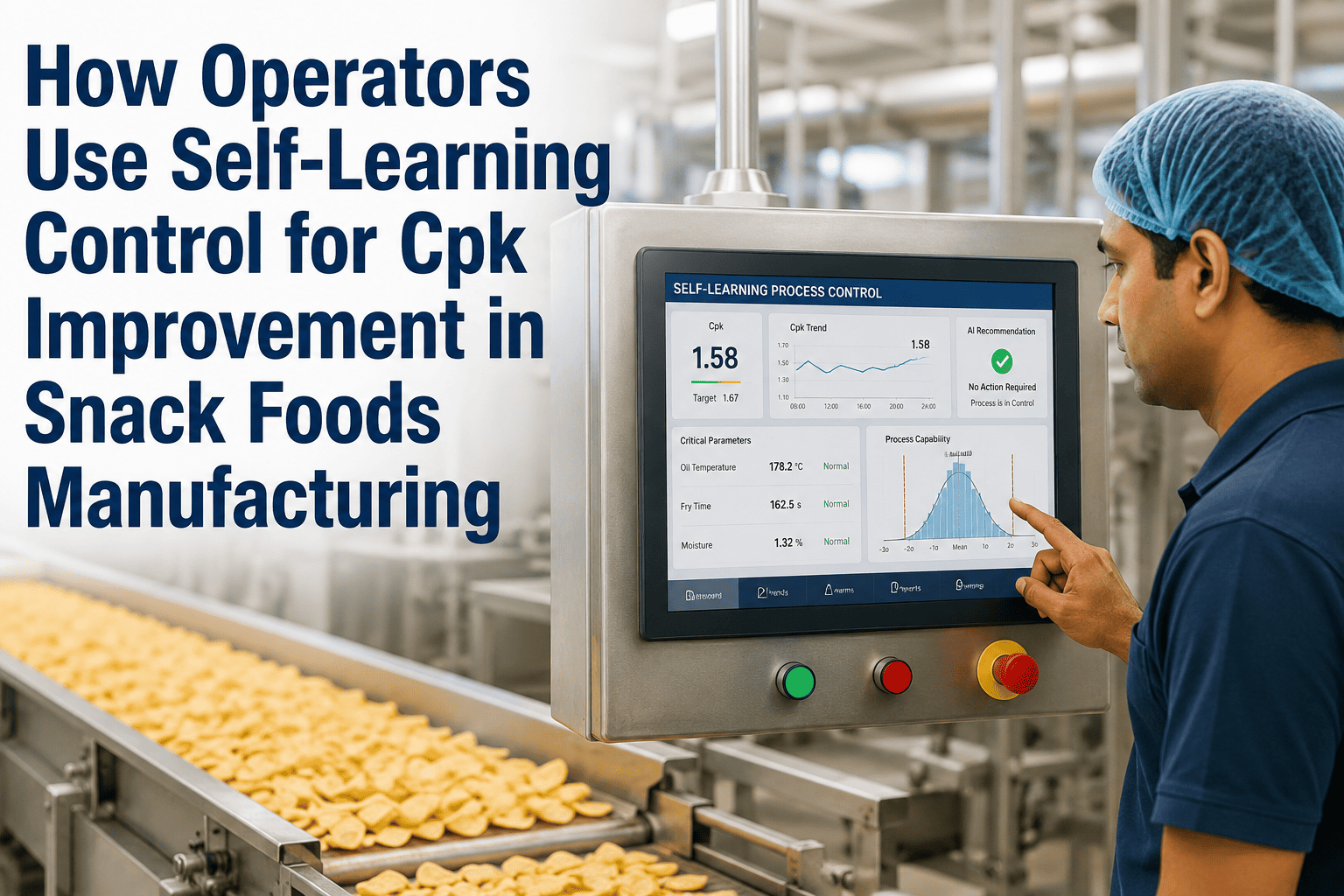
Dashboard: "Process in statistical control. Product density 97.2–97.8g (target ±0.5g). Cpk 1.42." You confirm visually (spot check product) and continue monitoring.
4:00 PM — Shift Handoff
Handoff to next shift: "System stable. No issues. Bearing wear minor — recommend monitoring." Next operator starts shift with full system history. Continuity maintained.
Total time on reactive adjustments: ~20–30 minutes (5-minute bearing action + spot checks)

Your Daily Playbook: Operating With Self-Learning Control

Hour 1: Shift Start (8:00 AM – 9:00 AM)
1
Check Overnight Alerts
Dashboard shows overnight monitoring summary. Any anomalies? Equipment issues? Material changes? Review 5–10 alerts (takes 5 min). Approve system recommendations for bearing, motor current, calibration adjustments.
2
System Loads Optimal Parameters
You select today's product from menu (SKU A: "Cheese Puffs," SKU B: "Seasoned Rings"). System loads best-known parameters for current season and material batch. Display shows: temp, moisture, speed, spray, conveyor settings.
3
Run First Batch & Monitor
Line starts. You observe first 5–10 units coming off. Quality looks good? Product density, seasoning coverage, texture normal? System will continue optimizing in real-time. You don't need to adjust manually.
Hour 2-3: Mid-Morning (9:00 AM – 11:00 AM)
4
Monitor Dashboard & Alerts
Every 15 minutes, quick glance at process dashboard. All green? Cpk trending up? Production rate on track? Most shifts will show "All Parameters Nominal" — no action needed. System owns the continuous tuning.
5
Spot-Check Product Quality
Periodically (every 30 min), pull a sample from each equipment zone. Weigh, check density, feel texture, inspect seasoning coverage. Compare to specification. System is optimizing for consistency; your visual checks confirm reality matches the data.
6
Act on Predictive Alerts
System alerts: "Seasoner drum vibration increasing — lubrication recommended." You spend 5 minutes applying bearing lubricant. Alert clears. System re-optimizes. Prevention complete before problem becomes visible.
Hour 4-6: Mid-Shift (11:00 AM – 1:00 PM)
7
Handle Alerts Proactively
System: "Material moisture increased (incoming batch 12.5% vs yesterday 11.9%). Recommendation: reduce water injection -0.3%." You make the adjustment (30 seconds). System confirms impact on next batch. Drift prevented.
8
Document Shift Notes
Log any observations: "Bearing lubrication applied 11:15. Material batch change at 11:30. Extruder screw speed adjusted -0.3% per system alert." System captures this for next shift and for continuous learning.
Hour 7-8: End of Shift (1:00 PM – 4:00 PM)
9
Review Shift Summary
Dashboard shows: "Shift Summary — Cpk 1.38 (target 1.33, exceeded). Process in control. 6 proactive alerts, 6 actions taken. Zero reactive firefighting." Print shift report for handoff.
10
Handoff to Next Shift
Tell next operator: "Bearing lubrication done. Material batch 12.5% moisture — system adjusted accordingly. Equipment running clean. System ready for their product." Next operator starts shift with full context.

Real Drift Scenarios: What Alerts Look Like & What You Do

Alert: Seasoner Drum Bearing Wear (Vibration Signature Change)
What You See on Dashboard: "Seasoner drum bearing vibration increased 12% (from 2.3g to 2.6g). Coating uniformity will degrade in 4–6 hours if uncorrected."
Your Action:
  1. Apply bearing lubricant to seasoner drum (5-min task).
  2. System automatically increases motor current +0.15A to maintain speed despite higher friction.
  3. Next batch: vibration returns to 2.3g. System confirms "bearing wear compensated."
  4. Continue shift normally. No quality impact.
Without self-learning: You wouldn't know bearing wear was starting. Coating would gradually degrade over 4–6 hours. Quality alert happens. Emergency adjustments made. 3–4 test batches wasted.
Alert: Extruder SME Drift (Energy Per Unit Increasing)
What You See on Dashboard: "Extruder SME trending upward (52.8 kWh/ton → 54.2 kWh/ton). Product density will increase 0.4g per 100 units. Correction recommended: reduce screw speed -3 rpm."
Your Action:
  1. System has already identified root cause and recommended correction.
  2. You approve the screw speed reduction (-3 rpm). System applies it automatically.
  3. Next batch: SME returns to baseline 52.8 kWh/ton. Product density stable.
  4. Shift continues without product loss.
Without self-learning: You might notice density drifting after 30 minutes. Adjust screw speed by guesswork (-2 rpm, doesn't work, now -4 rpm). Takes 2–3 test batches to converge. 20–30 units with off-spec density produced.
Alert: Material Batch Moisture Change (Incoming QC Triggered)
What You See on Dashboard: "New material batch moisture 12.6% (vs yesterday 11.8%). System detected. Recommendation: reduce water injection -0.4%, increase barrel temperature +1.2°C to maintain product density."
Your Action:
  1. New batch arrives. QC scans batch ID. System pulls moisture data (12.6%).
  2. System makes recommended adjustments automatically or asks for your approval.
  3. First batch of new material: density 97.4g (on target). No ramp-up loss.
  4. Continue production at optimal parameters for new material.
Without self-learning: Material change happens. You run first batch with yesterday's parameters. Density 97.9g (0.4g too heavy). You adjust by intuition. Second batch 97.2g (0.2g too light). Third batch 97.5g (close). By then you've wasted 3 batches. With self-learning, zero waste.
Override Scenario: You Disagree With System Recommendation
System Alert: "Recommend moisture injection -0.2% to maintain density trend." Your Observation: You pulled a sample and density looks good. You think moisture is already correct.
Your Action:
  1. You can override the recommendation. Skip the adjustment.
  2. System logs your decision: "Operator overrode moisture adjustment at 11:45. Observed density stable despite system recommendation."
  3. System learns: "In similar conditions, operator knowledge prevented false positive. Adjust recommendation algorithm."
  4. Next time similar conditions occur, system's recommendation improves.
Self-learning control improves because of operator feedback. You're not fighting the system; you're teaching it. Operator experience + AI learning = best results.

What Self-Learning Control Gives You on the Plant Floor

Time Freed for Quality Focus
Before: 3–4 hours/shift on reactive adjustments
After: 20–30 minutes on preventive alerts
Gain: 2–3 hours for deep quality monitoring, equipment inspection, continuous improvement
Zero Guessing in Adjustments
Before: "Maybe reduce speed 2%? Or increase temp?" Trial and error.
After: "System says reduce speed 3 rpm. Approved." Precision-guided.
Shift Handoff Becomes Easy
Before: "Equipment acting weird. Temperature drifting. Not sure what's wrong." Incoming operator has no context.
After: "System stable. One bearing lubrication done. Material batch 12.5% moisture — system adjusted. Full history in dashboard." Continuity.
Confidence in Consistency
Before: "Hope tomorrow's operator can maintain today's yield." Operator-dependent.
After: "System maintains consistency 24/7. New operator, veteran operator, overnight shift — all achieve same quality." Operator-independent performance.

Frequently Asked Questions

You can override any recommendation. System logs your action and learns from the outcome. If your override consistently improves results, system adjusts. If it worsens results, system alerts you next time. You're not locked into system control — you guide it with your expertise.
You choose the mode. Advisory mode: system recommends, you approve. Autonomous mode: system makes adjustments automatically, you monitor. Most operators prefer advisory mode the first month, then shift to autonomous once they trust the system. You can switch modes anytime.
System can compensate for gradual wear (increasing motor current for bearing friction). But sudden failures (bearing seizes, valve sticks hard) require shutdown. System detects these as "unrecoverable anomalies" and alerts you immediately: "Equipment failure detected. Manual intervention required." You call maintenance. System provides diagnostics to help maintenance understand what happened.
Yes. Understanding helps you evaluate system recommendations. If system says "increase motor current," knowing why (bearing friction increase) helps you recognize if recommendation makes sense. New operators ramp up faster because system explains its logic: "Bearing wear detected, recommendation: +0.1A to maintain speed." Understanding accelerates learning and builds confidence.
No — it shifts your role. Less time firefighting equipment problems, more time on quality assurance, process optimization, equipment maintenance planning, and training new operators. You stop being a reactive troubleshooter and become a proactive quality guardian. Many experienced operators find this more fulfilling because you can actually improve things instead of just keeping up.

Become the Expert Operator Your Plant Needs

Self-learning control handles the continuous tuning. You focus on quality, equipment health, and continuous improvement. Shift from reactive firefighting to proactive optimization. Empower your shift team with AI that works with you, not against you.
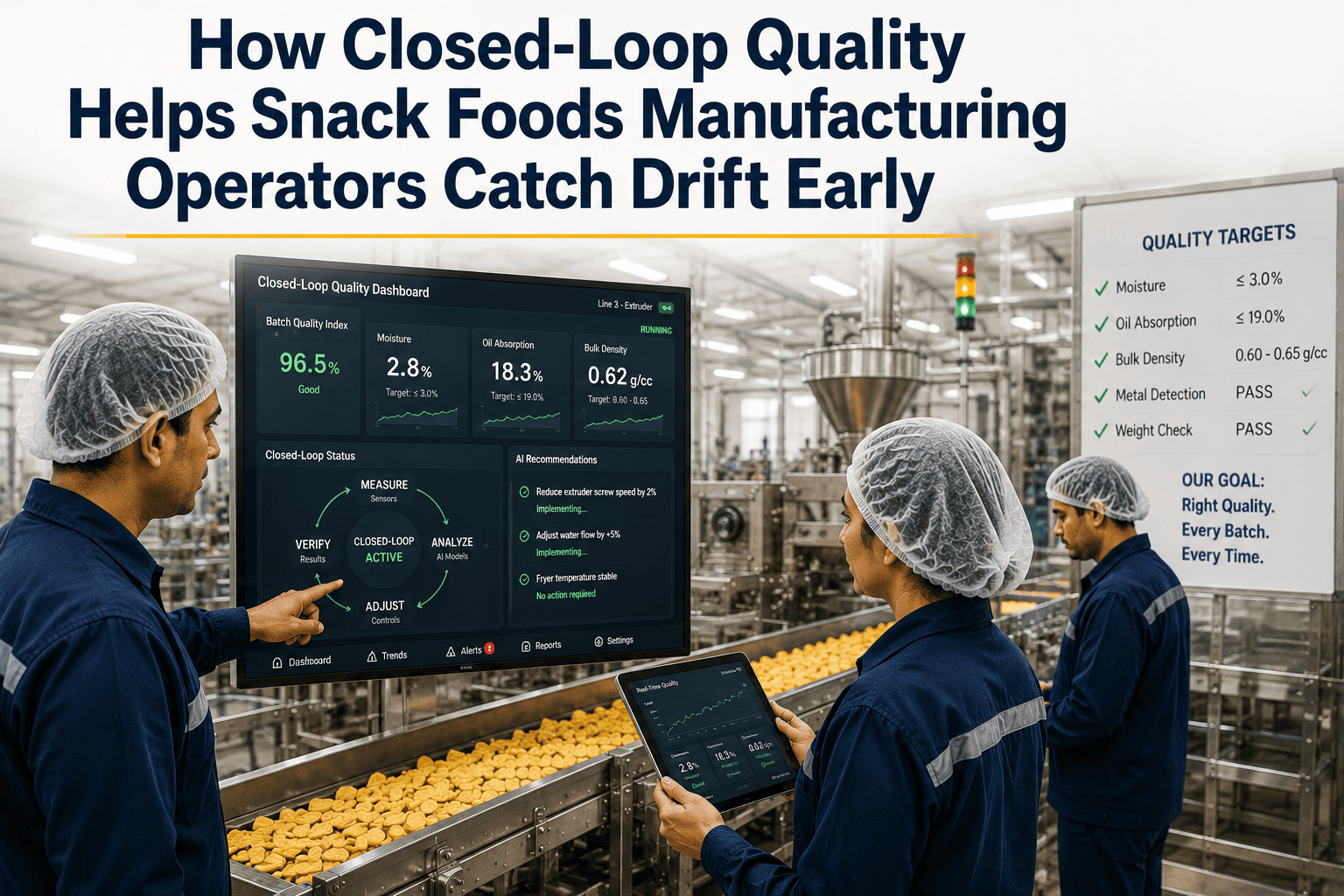
Real Operator Workflows Predictive Alerts Guided Corrective Actions Override & Learn Shift Handoff Continuity

Share This Story, Choose Your Platform!