Self-Learning Control for Snack Foods Manufacturing: An Operator's Guide to Yield Improvement

By Jack Ryder on June 3, 2026

self-learning-control-for-snack-foods-manufacturing-an-operator-s-guide-to-yield-improveme

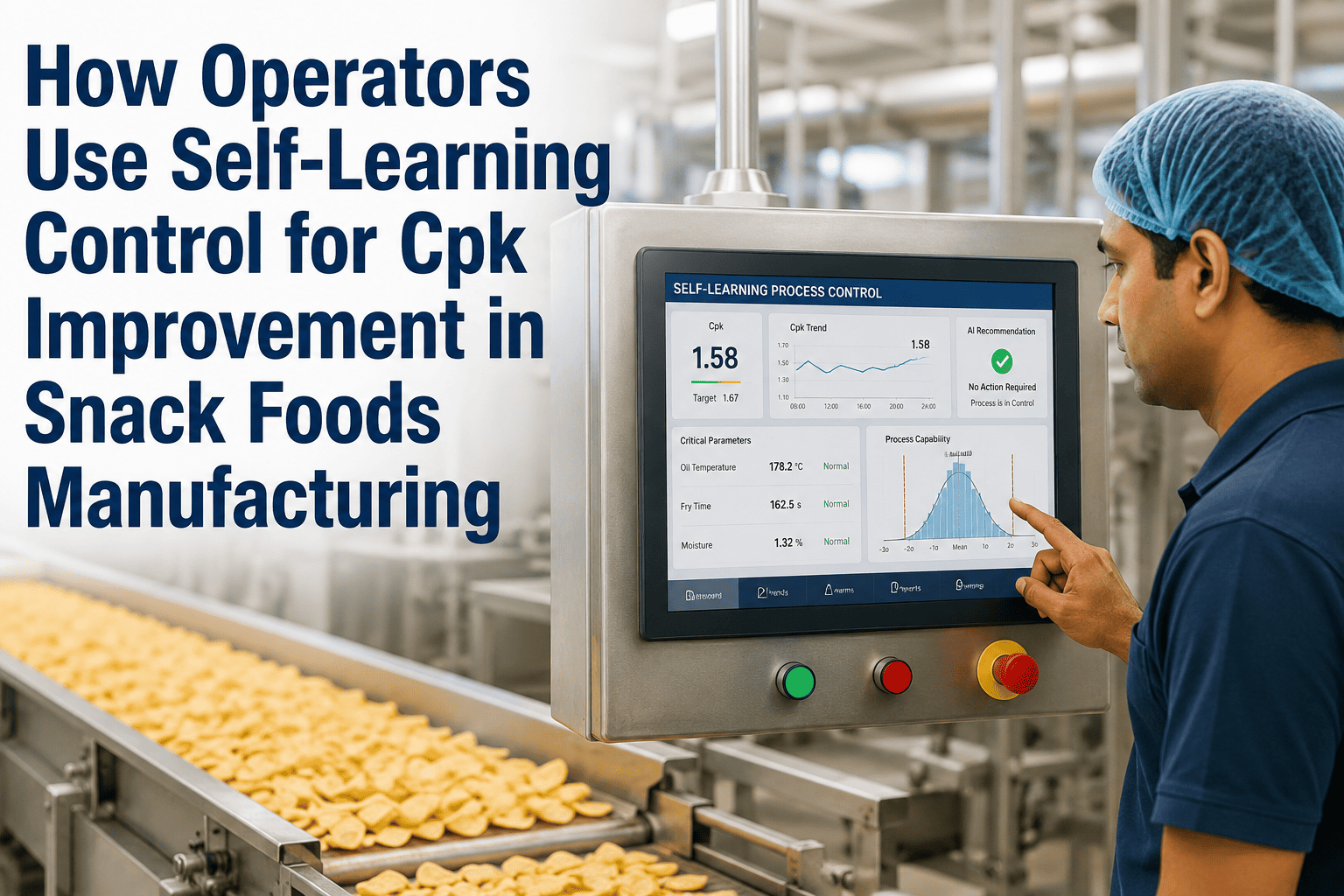
Snack foods manufacturing lives in the margin between profit and loss. A 2-3% yield loss on a line running 500 cases/minute is 100-150 cases wasted per hour. Over a shift, that's $3-5K in lost product cost. Traditional process control uses static setpoints: "extruder temperature = 180°C, moisture = 12.5%." Operators manually adjust when they see drift. Self-learning AI process control continuously observes how adjustments affect yield, learns the optimal control curve for current conditions, and tunes parameters autonomously in real-time. Instead of operators fighting drift, the system prevents it. Leading snack foods plants are recovering 3-6% yield through self-learning control — transforming routine operations into profit protection. This guide explains how self-learning control works, which snack foods processes benefit most, and why deployment takes 1-2 weeks instead of 6-12 months. Book Demo with Us to see yield recovery in action.

SNACK FOODS · YIELD OPTIMIZATION · AI CONTROL

Self-Learning Control for Snack Foods Manufacturing: An Operator's Guide to Yield Improvement

Autonomous parameter tuning · Continuous learning from adjustments · 3-6% yield recovery · Moisture & temperature optimization · Real-time operator alerts.

3-6%
Yield improvement from self-learning tuning
4-8 pts
First-pass yield increase (extruder to fryer)
1-2 wks
Deployment (vs 6-12 months traditional control)
24/7
Continuous optimization (no manual intervention)

Why Manual Process Control Costs Snack Foods Manufacturers Yield

A snack foods extruder has 15-20 parameters: screw speed, barrel temperature (zone 1-4), die pressure, feed rate, moisture injection. A fryer has 5-8 parameters: oil temperature, residence time, conveyor speed, moisture adjustment. Traditional control sets these static: "extruder temp = 180°C" for all products, all seasons, all ambient conditions. When product changes (different SKU, different raw material batch), operators manually adjust based on experience. When ambient temperature shifts (winter vs summer production), parameters drift. Manual tuning takes trial-and-error: adjust, run test batch, measure yield, adjust again. Self-learning control observes every adjustment and its yield impact, builds a personalized tuning model for current conditions, and tunes automatically. Operators intervene only when conditions fundamentally change (new product, new line, new equipment).

Manual Tuning vs Self-Learning Control: Daily Yield Impact
Manual Control (Operator Tuning)
Start of Shift (8 AM)
Operator sets parameters from yesterday: temp 180°C, moisture 12.5%. Overnight, ambient temperature dropped 8°C. Product moisture is slightly high (13.1%) from storage condition change.
9:30 AM - Drift Observed
Yield 94.2% (target 96%). Operator guesses: maybe moisture too high. Adjusts injection down 0.3%. Tests next batch. Still 94.5%. Adjustment made yield worse.
11:00 AM - Manual Correction
Operator adjusts barrel temp up (+3°C to 183°C) to compensate for cold ambient. Rebalances moisture. Yield improves to 95.1%. Still 0.9 points below target. Operator accepts "good enough."
End of Shift (4 PM)
Average yield: 94.8% (target 96%). Loss: 1.2% = 60-90 cases wasted. Typical daily loss from manual tuning drift.
Daily Impact: 1-2% yield loss from tuning lag + parameter creep
Self-Learning Control (Continuous Optimization)
Start of Shift (8 AM)
Self-learning system loaded with yesterday's models. Ambient sensor detects 8°C temperature drop. Material sensor confirms 13.1% moisture input. System pre-adjusts parameters based on learned relationships.
8:15 AM - Predictive Tuning
First batch runs with adjusted parameters. Yield 95.7% (very close to 96% target). System observes: "current temp/moisture combo produced 95.7% yield. Similar input conditions predicted to yield 96.1% with +0.5°C adjustment."
8:45 AM - Autonomous Tuning
System applies +0.5°C adjustment. Next batch: 96.2% yield (above target). System learns: "at 8°C ambient drop + 13.1% input moisture, this control curve achieves 96%+ yield." Locks in optimal parameters.
End of Shift (4 PM)
Average yield maintained: 96.0% (on target). Continuous learning kept parameters optimized all shift. Zero manual intervention needed. Zero yield loss from tuning lag.
Daily Impact: Zero yield loss. Self-learning system maintained optimal control all shift.

Four Ways Self-Learning Control Recovers Snack Foods Yield

01
Ambient Condition Drift — Season Change, Weather, Time of Day Shifts Production
Summer ambient temperature: 32°C. Extruder set to 180°C. Winter: 12°C ambient. Same 180°C setpoint now produces different product because relative heat loss to ambient changed. Humidity varies seasonally. Plant cooling loads differ by season. Manual control doesn't adapt to slow, gradual ambient changes. Self-learning control monitors ambient sensors and continuously adjusts setpoints to maintain product consistency across seasons and times of day.
Seasonal compensation2-3% yield stability improvement
02
Raw Material Variation — Moisture, Density, Particle Size Batches Differ
Flour batch A: 11.8% moisture. Flour batch B: 12.4% moisture. Same extruder settings produce different density and texture. Operators estimate moisture and adjust injection rate by guesswork. Self-learning control receives actual material moisture data (from incoming inspection or real-time sensors) and automatically adjusts injection rate, screw speed, and barrel temperature to maintain target product specifications despite incoming material variation.
Material variation absorption3-4% yield improvement across material batches
03
Product SKU Changes — Manual Re-Tuning Lost Time & Yield During Changeovers
Line runs Product A (light, crispy target). Changeover to Product B (dense, oily target). Operators manually adjust 8-10 parameters. First 30 batches of Product B are test batches while tuning converges. Average yield during changeover: 92-93%. After 2-3 hours, tuning settles and yield reaches 95%. Self-learning control pre-loads the optimal parameter set for each SKU based on previous production runs. Changeover happens in 15 minutes. First batch of new SKU hits 95% yield immediately. Zero ramp-up loss.
SKU changeover time reduction 80%First-batch yield improvement 3-4 points
04
Operator Experience Variation — New Operators vs Veteran Operators Tune Differently
Veteran operator's intuition: temperature ±2°C, moisture ±0.3%, yield 95.5%. New operator follows procedures: temperature ±5°C, moisture ±0.8%, yield 92.8%. Manual tuning depends on operator experience. New operators struggle to maintain target yield. Self-learning control removes operator experience dependency: system owns the tuning logic. All operators achieve the same yield regardless of experience level. New operators ramp up faster; operator absences don't destabilize production.
Operator independenceNew operator yield gap eliminatedConsistent quality across shifts

How Self-Learning Control Learns & Optimizes

Learning Stage What System Observes How It Learns Operator Impact
Baseline (Day 1-2) Current parameters + yield results. Operator makes adjustments (as usual). System records every adjustment and resulting yield. System builds initial model: "when temp increases 2°C, yield increases 0.3 pts. When moisture decreases 0.4%, yield increases 0.5 pts." Operators continue normal manual tuning. No change to workflow yet.
Pattern Recognition (Day 3-5) Cross-product patterns emerge. Material variation effects. Ambient condition effects. Multi-parameter interactions. System identifies: "for Product A, optimal temp = 182°C ± ambient*0.1. For Product B, optimal = 185°C ± ambient*0.15. Moisture always -0.2% for SKU change." System starts making recommendations: "recommend +1°C for current material batch" (as alerts).
Autonomous Control (Day 6+) Real-time product properties, ambient, SKU. System predicts optimal parameters before next batch. System autonomously adjusts 2-3 key parameters (temp, moisture, speed). Continuously refines model based on yield results. Operators monitor dashboards. System handles tuning. Operators only override if unusual product quality or equipment issue detected.
Continuous Optimization (Ongoing) Every batch result feeds the model. Rare events (extreme material, equipment drift) trigger model updates. System converges toward optimal control curve for each product/season combination. Yield tightens and stabilizes at target ± 0.5%. Yield becomes predictable and stable. Operators shift focus from tuning to monitoring quality and equipment.

Three Operator Scenarios Where Self-Learning Control Recovers Yield

SCENARIO 1 Seasonal Shift: Winter Production Yield Recovery (Ambient Temperature Drop) Quarterly

Situation: November arrives. Ambient temperature drops from 28°C (summer) to 18°C. Operators still run with summer parameters. Extruder produces product that's too dry (relative heat loss increased). Yield drops from 96% to 93.8%. Operators call maintenance. Manual retuning takes 3-4 hours. Loss for the shift: $4-6K.

Self-Learning Control: System monitors ambient sensor. Detects 10°C drop. From historical data, knows: "10°C ambient drop requires -0.8°C barrel adjustment to maintain moisture." System makes adjustment automatically. First batch of day runs at 95.8% yield. System observes: "still slightly dry." Makes +0.3°C adjustment. Second batch: 96.0% yield (on target). System locks in optimal curve. Yield maintained all shift. Zero manual intervention. Zero changeover ramp-up time.

Ambient Change10°C drop (summer to winter transition)
Manual Tuning Time3-4 hours + test batches = 2-3% yield loss
Self-Learning Time15 minutes (first 2 batches) = zero loss
Daily Yield Recovery2% = 100-150 cases saved
Book Demo
SCENARIO 2 Product SKU Changeover: First-Batch Yield (Zero Ramp-Up Loss) Multiple times daily

Situation: 10 AM changeover: Product A → Product B. Different density, moisture target, texture. Operators manually adjust 8-10 parameters. Tuning process: batch 1 (92.1%), batch 2 (93.4%), batch 3 (94.8%), batch 4 (95.2%), batch 5 (95.9%) — converges around 95.1%. Time elapsed: 75 minutes. 4 test batches wasted = $800-1200 loss.

Self-Learning Control: System pre-loaded with 20+ previous Product B runs. Optimal parameters for Product B already known. When SKU changes, system loads: temp 183°C, moisture 13.2%, speed 165 rpm. First batch of new SKU runs at 95.8% yield immediately. System observes yield trend and makes 1-2 fine adjustments. By batch 2: 96.1% yield. Changeover complete in 15 minutes with zero test batches.

Changeover TypeProduct A → Product B (major parameter shift)
Manual Process Time75 minutes tuning + 4 test batches
Self-Learning Time15 minutes setup + 1-2 fine-tune batches
Daily Impact (5 changeovers)5 × 60 min saved + 0 test batches = 5 hours + $5-7K recovered
Book Demo
SCENARIO 3 New Operator Ramp-Up: Consistent Yield from Day 1 Shift staffing

Situation: New operator starts. Veteran operator achieved 95.7% average yield. New operator follows documented procedures but lacks intuition. First week yields: 92.1%, 92.8%, 93.5%, 94.2% (improving but still 1.5-2 points below target). 1-week ramp-up cost: $8-12K in lost yield.

Self-Learning Control: New operator has AI system managing tuning. System knows optimal parameters and continuously refines. Operator monitors dashboards and product quality. Day 1 yield: 95.2% (close to veteran performance). System continues learning. By day 3, new operator achieves 95.7% average (same as veteran). Ramp-up curve flattens. Zero yield loss during onboarding.

Operator ExperienceNew hire (0 experience on this line)
Manual Tuning Ramp-Up2-3 weeks to reach veteran yield. 1-2% daily loss during ramp.
With Self-Learning ControlDay 1: 95% yield. Day 3: 95.7% yield (veteran level).
Onboarding Benefit2-week acceleration in productivity. $8-12K yield recovery in first week.
Book Demo

Yield Recovery Results From Self-Learning Control

3-6%
Total yield improvement from self-learning control
Combination of seasonal compensation, material variation absorption, SKU changeover optimization, and operator consistency.
4-8pts
First-pass yield increase (extruder through fryer)
Ramp-up loss eliminated. Changeover time 80% reduction. Continuous optimization prevents specification drift.
$50-100K
Annual yield recovery per line
3% yield recovery on 500 cases/min = 150 cases/hour = $3-5K/shift = $60-100K/year per line.
1-2 wks
Deployment time (vs 6-12 months traditional control projects)
Pre-configured AI model. PLC/SCADA integration. Operator training included. System begins learning day 1.

Frequently Asked Questions

No. Self-learning control uses existing PLC/SCADA data. Minimal sensor additions are optional (ambient temperature, material moisture) for faster learning, but core system works with standard equipment outputs. Integration takes 1-2 weeks via OPC-UA or Modbus connection. No capital equipment investment required.
Baseline models develop in 24-48 hours (3-4 shifts). System begins making recommendations by day 3. Autonomous control begins day 6-7 at 85-90% accuracy. Full optimization (95%+ accuracy) reached by week 3-4 as system learns product-specific and seasonal variations. Yield improvements begin immediately; full 3-6% benefit realized by week 4-6.
Yes. Operators can override any parameter at any time. When override occurs, system logs it and learns from the outcome. If operator-set parameters consistently outperform AI recommendations, system adjusts its model. If override worsens yield, system alerts operator: "Your adjustment reduced yield 0.8 pts. Recommend reverting to system control." This feedback loop makes system smarter over time.
System learns new specifications in 1-2 shifts. Operator enters new target yield (e.g., 97% instead of 95.5%). System recalibrates its model: "to reach 97%, need temp +0.5°C, moisture -0.3%." Parameters adjust automatically. Learning restarts but converges faster because base model exists. Specification changes take 8-24 hours to optimize fully.
Yes. Control works with equipment that has PLC output (Rockwell, Siemens, Schneider, legacy systems). Newer equipment with Industry 4.0 connectivity integrates faster. Older equipment may need data logger (~$3K) to provide sensor feedback, but most lines have sufficient control signals for self-learning to work. Ask about your specific equipment — Book Demo with Us.

Deploy Self-Learning Control for Yield Recovery

Autonomous parameter tuning learns from every batch. Recover 3-6% yield across seasonal shifts, material variation, product changes, and operator differences. 1-2 week deployment. Begin learning day 1.
Autonomous Tuning Seasonal Compensation Material Variation Handling SKU Changeover Optimization Operator Independence

Share This Story, Choose Your Platform!