The third-shift operator at a major snack-food plant watches the real-time control chart for a critical-to-quality parameter — fried chip thickness — drift from 1.80 mm to 1.92 mm over four hours. He knows the spec is 1.70 mm to 1.90 mm. He also knows that out-of-spec chips hit the packaging line at 600 bags per minute, and that a single 20-minute over-thickness run means 12,000 bags of rework or write-off. He has no AI to tell him why it drifted, how long until it hits the limit, or which of his six fryer zones to adjust first. He has only his intuition and a clipboard log from two hours ago.
Snack-food CPK from 0.67 to 1.33 — in one quarter, with an operator-facing AI that predicts drift before the bag hits the scale
iFactory replaces reactive SPC chart-watching with live, operator-actionable AI that predicts CPK drift 30–90 minutes early, pinpoints the root-cause zone, and cuts rework costs by 40% in the first 12 weeks. No cloud. No data science team. Just your plant data and a pilot that ships in 6 weeks.
What changes when your operators stop chasing charts and start preventing defects
The difference between a plant that reacts to CPK failure and one that prevents it is not more data — it's knowing which data matters and what to do about it. Here is what that shift looks like.
Without iFactory
- Operator sees a point outside control limits on a chart — 30 minutes after it happened
- Root cause is a guess: "maybe zone 3 is running hot" — no data to confirm
- CPK is calculated weekly in Excel — too late to act on any single shift
- Rework pile grows: 1,200 lbs of off-spec chips per shift during drift events
- Quality manager spends 3 hours per week generating SPC reports nobody reads
With iFactory
- Operator gets a live alert: "CPK trending to 0.85 in 47 minutes — adjust fryer zone 3 oil temp by +2°C"
- Root cause is identified by AI: correlation between fryer oil velocity and chip thickness drift
- CPK is predicted hourly, displayed on a single screen, with a 90-minute forecast
- Rework drops to under 200 lbs per shift — most shifts see zero drift events
- Quality manager gets a daily AI summary: "3 drift events prevented, CPK stable at 1.25"
Every minute you wait for a CPK report costs you — in rework, lost throughput, and rejected loads
The snack-foods industry runs on tight margins. A 0.10 mm drift in chip thickness, a 2% variance in seasoning coverage, or a 5-second deviation in bake time can turn a 50,000-bag production run into a $15,000 rework event. Here is what that adds up to in a typical 500-bag-per-minute plant.
Off-spec chip thickness rework
When thickness drifts above 1.90 mm, chips absorb 12% more oil and break on the packaging line. Average 18-minute drift event produces 10,800 bags of rework at $0.28/bag = $3,024 per event.
Seasoning coverage variance write-offs
When seasoning application drifts below spec, the entire 15-minute run (9,000 bags) must be rejected by the retailer. Average 3 such events per week = 27,000 bags rejected.
CPK reporting labor cost
Quality engineers spend 8 hours per week pulling data, updating charts, and emailing reports. At $55/hour loaded cost, that is $440/week in non-value-add work.
Lost throughput from unscheduled line stops
When a CPK drift goes uncaught and triggers a full line stop for recalibration, the plant loses 45 minutes of production at 500 bags/min = 22,500 bags of lost throughput at $0.12 margin/bag.
Retailer chargebacks for out-of-spec loads
Major retailers charge $500–$2,000 per rejected pallet plus freight costs. One major snack manufacturer reported $240,000 in annual chargebacks from a single plant.
Four steps from data-source connection to operator action — no data science required
iFactory is not a dashboard you configure. It is an AI-native platform that connects to your existing sensors, PLCs, and historians, learns the relationships between process parameters and CPK, and then tells your operators what to do — in plain language, in real time.
Connect your data sources
We connect to your fryer zone controllers, seasoning applicators, oven temperature sensors, packaging line scales, and quality lab data — all on your plant network, no cloud egress.
Train the AI on your process
iFactory ingests 30 days of historical data and learns the nonlinear relationships between 80+ process parameters and your CPK metrics. No manual feature engineering.
Deploy live predictions to operators
The AI generates a 90-minute forecast of CPK for every critical quality parameter, displayed on a single screen in the control room — with a plain-English recommendation for corrective action.
Track improvement and close the loop
The system logs every prediction, every operator action, and every outcome — building a continuous improvement loop that drives CPK from 0.67 to 1.33 in 90 days.
What you get when AI SPC runs in your plant
These are not features on a roadmap. These are live capabilities shipping with every iFactory pilot — deployed on your network, connected to your equipment, and delivering predictions within 6 weeks.
Live CPK forecast with 90-minute horizon
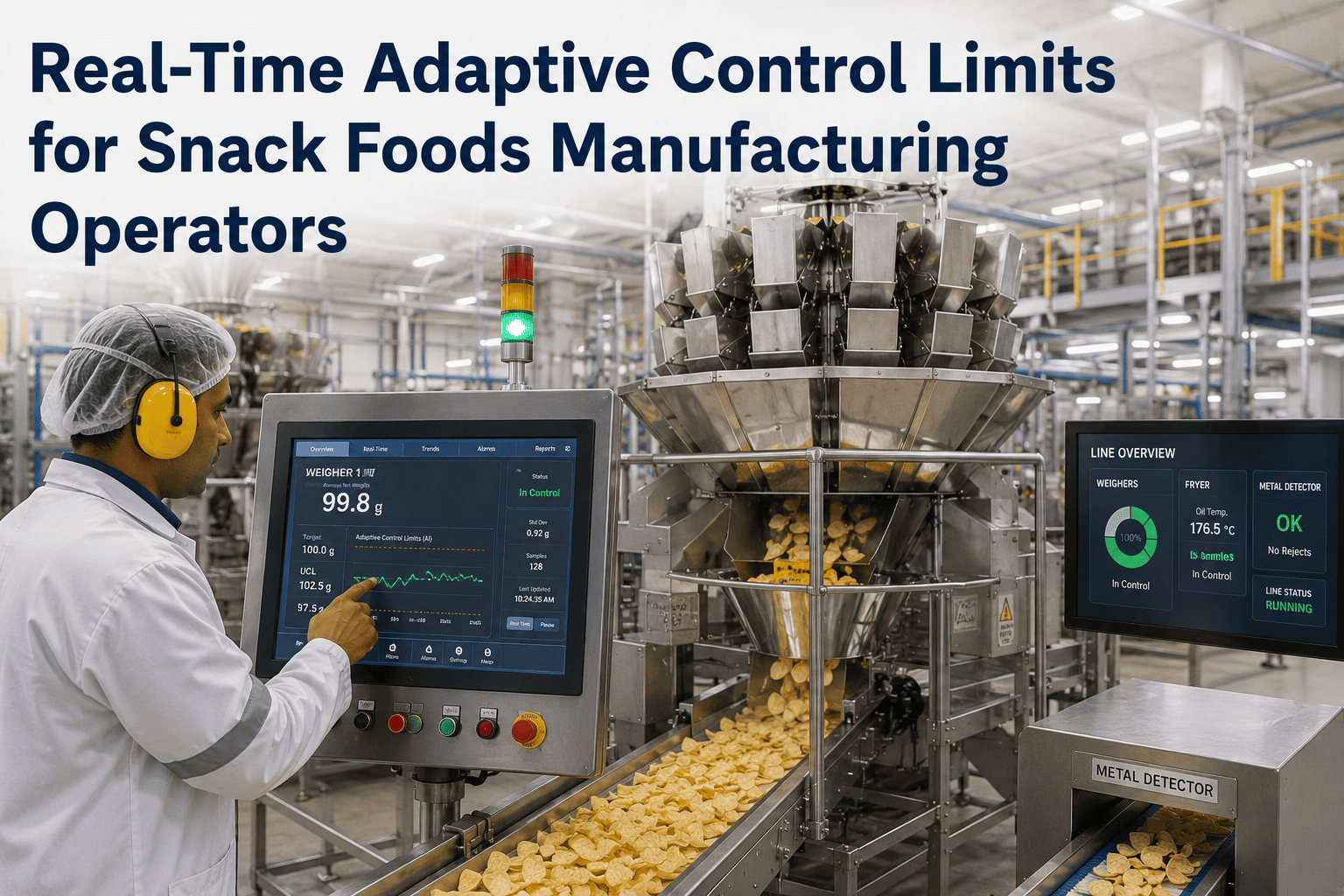
Not a historical chart. A prediction. The AI tells you: "CPK for chip thickness will fall below 1.0 in 73 minutes if fryer zone 3 oil temperature is not reduced by 1.5°C." Updated every 60 seconds.
Root-cause identification in plain English
When CPK drifts, the system identifies which parameter is driving it — "seasoning drum speed correlation to coverage CPK is 0.89" — so operators adjust the right thing, not the first thing.
Multi-parameter correlation engine
iFactory models interactions between 80+ process parameters simultaneously. It knows that chip thickness depends not just on fryer temperature but on oil velocity, potato feed rate, and conveyor speed — and how they interact.
Operator action log with outcome tracking
Every prediction and every operator response is logged automatically. The system learns which actions are most effective — and feeds that knowledge back into the model. Continuous improvement, automated.
Your operators already know something is wrong — they just don't know it 47 minutes before it happens. Book a 30-min walkthrough and we'll show you how iFactory gives them that 47 minutes back.
Everything you need to go from reactive SPC to AI-driven CPK control — delivered as a turnkey service
iFactory is not software you install and configure. It is a managed service that arrives pre-configured to your plant's equipment and data sources, runs on a dedicated NVIDIA appliance on your plant floor, and delivers first predictions in 6 weeks. Here is exactly what is included.
End-to-end pilot delivery in 6 weeks
We connect to your data sources, train the AI, and deliver live predictions to your operators — all within 6 weeks of project kickoff. No delays. No scope creep.
On-premise deployment — zero cloud dependency
The entire system runs on a dedicated NVIDIA appliance on your plant network. No data leaves your facility. No cloud subscription. No security review delays.
Operator-facing interface in plain English
No dashboards to configure. No SQL queries. The AI speaks to operators: "Reduce fryer zone 3 oil temperature by 1.5°C to prevent CPK drift." That is the interface.
24x7 managed service from iFactory engineers
Our team monitors the system, updates models as your process changes, and handles any issues. You get one phone number for support — we handle the rest.
CPK improvement guarantee — 1.0+ in 90 days
We commit to measurable CPK improvement in your critical quality parameters. If we don't deliver, you don't pay for the pilot. That is how confident we are in the technology.
Continuous model retraining as your process evolves
When you change a recipe, swap a supplier, or modify a process parameter, the AI retrains automatically. Your predictions stay accurate even as your plant changes.
Questions operations leaders ask about AI-driven SPC for snack foods
Stop watching charts. Start preventing CPK drift.
Your operators already know the numbers are drifting. Give them the tool that tells them why, how long until it matters, and what to do about it — 90 minutes before the first bag goes off-spec. iFactory delivers that in 6 weeks, on your network, with a CPK improvement guarantee.