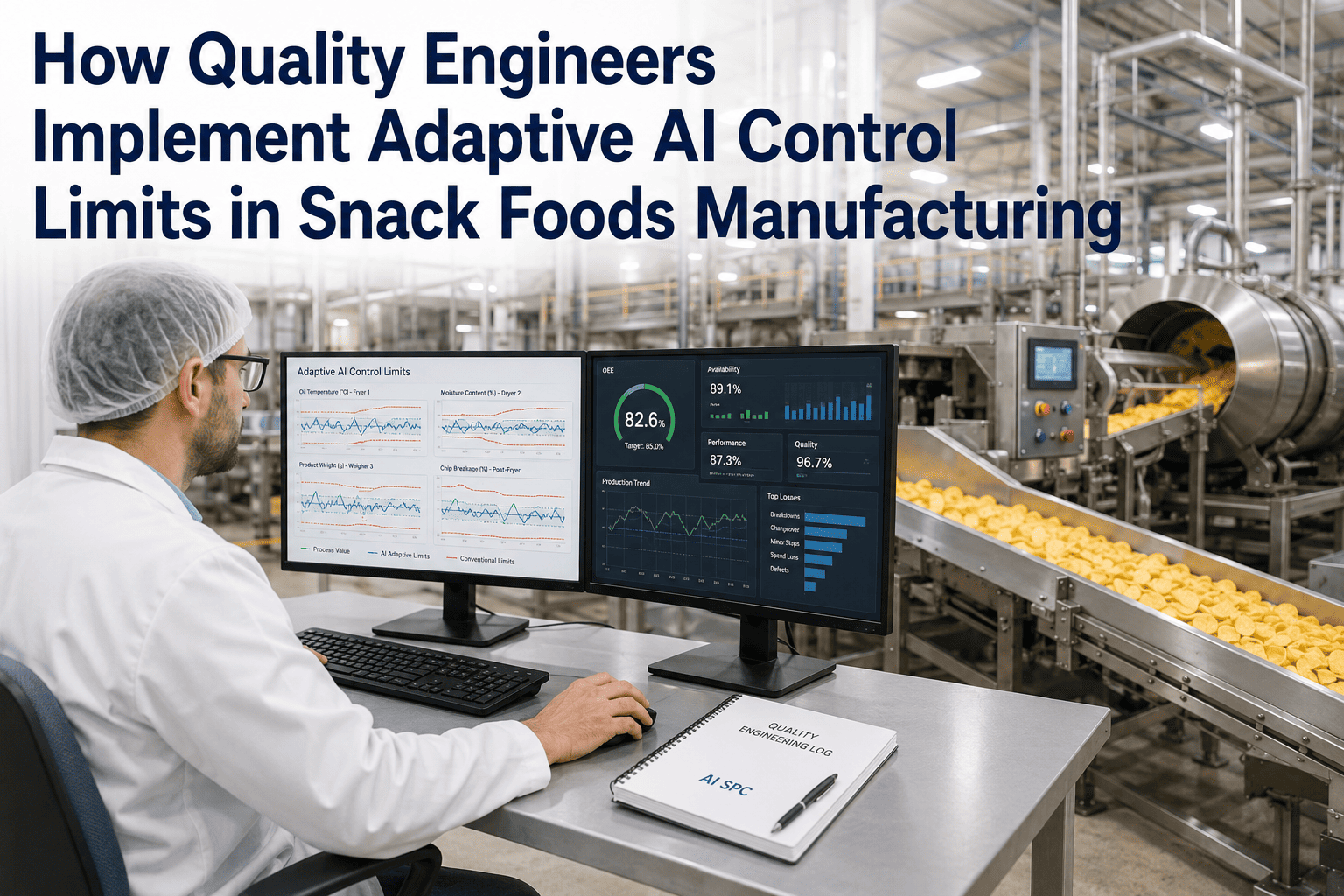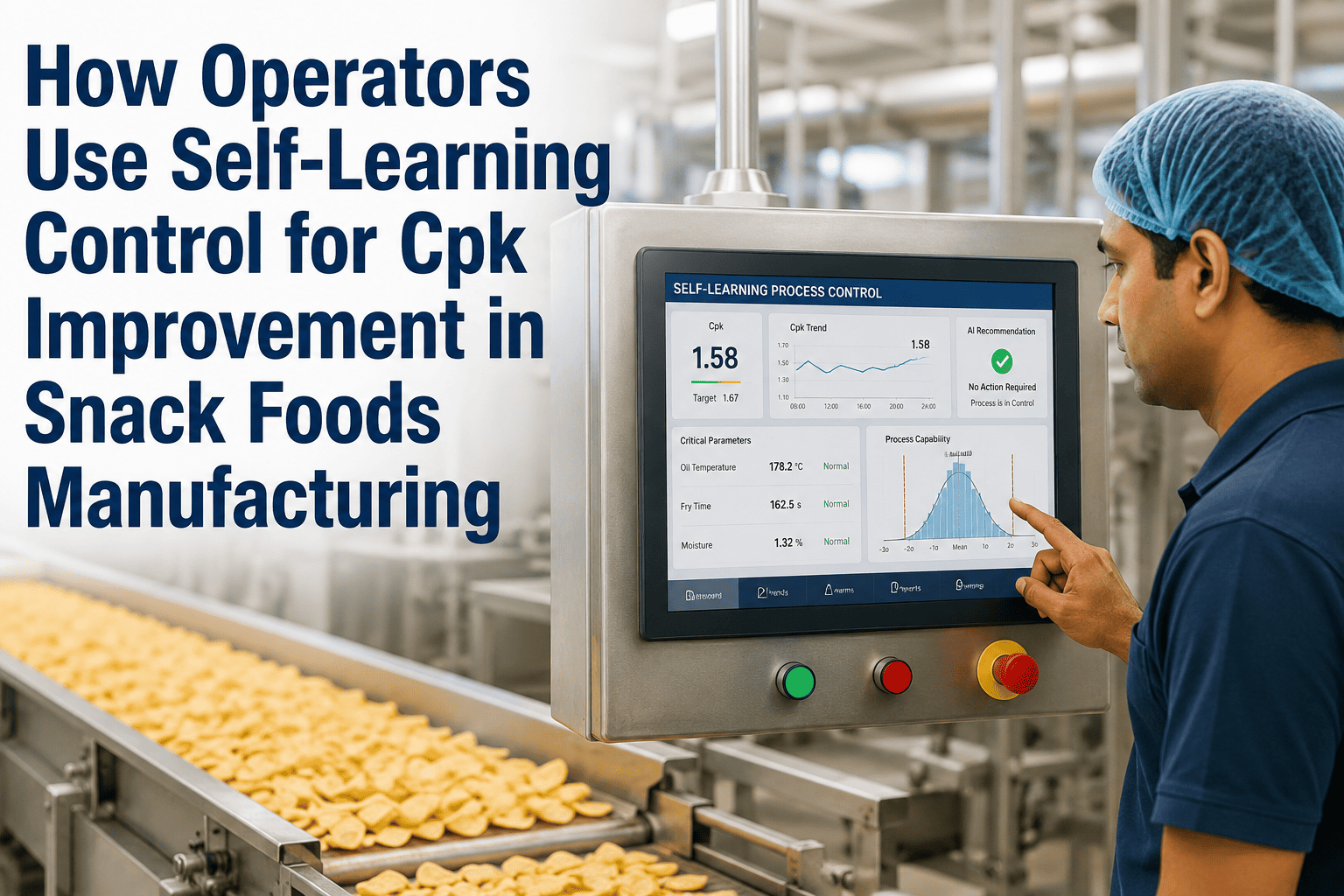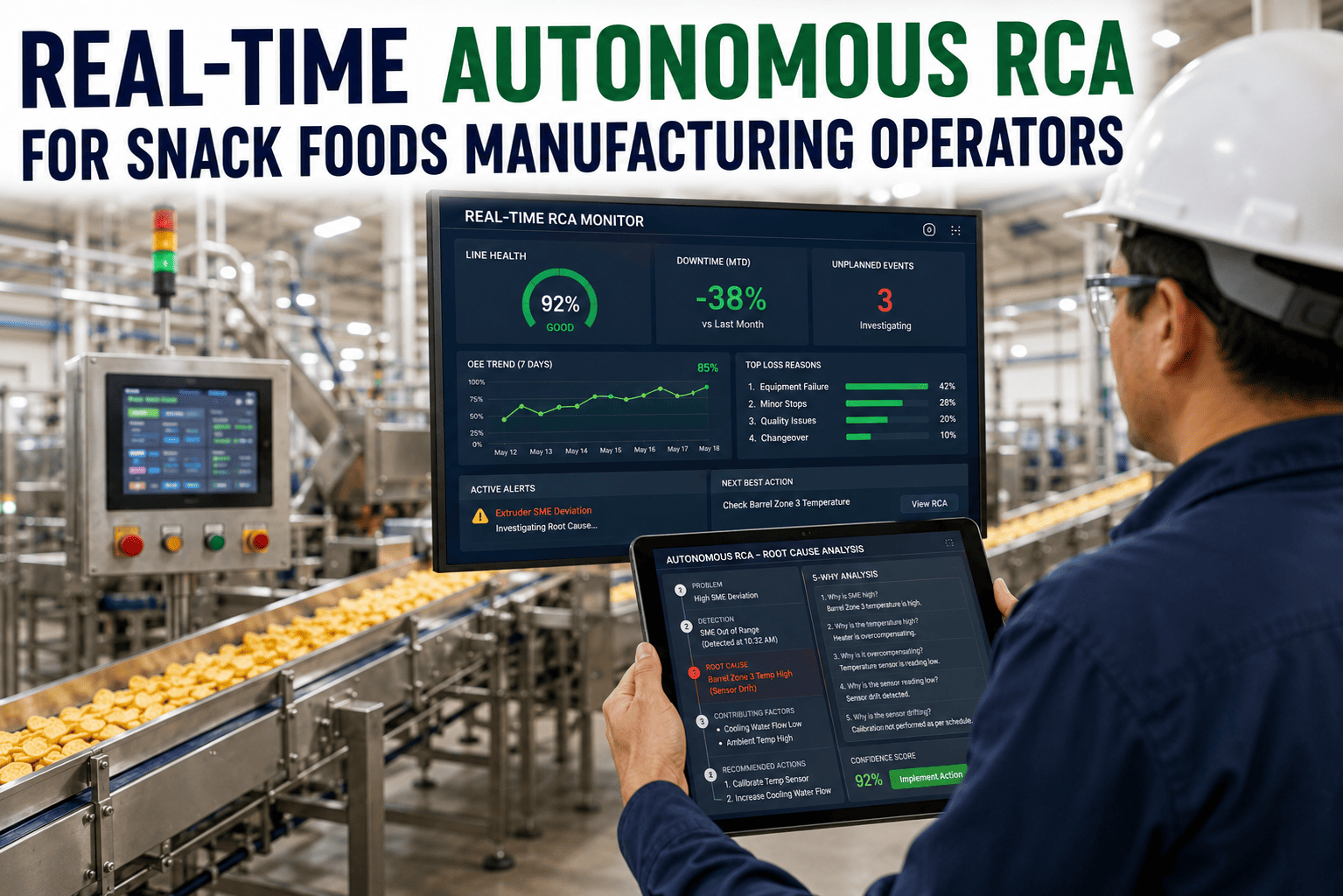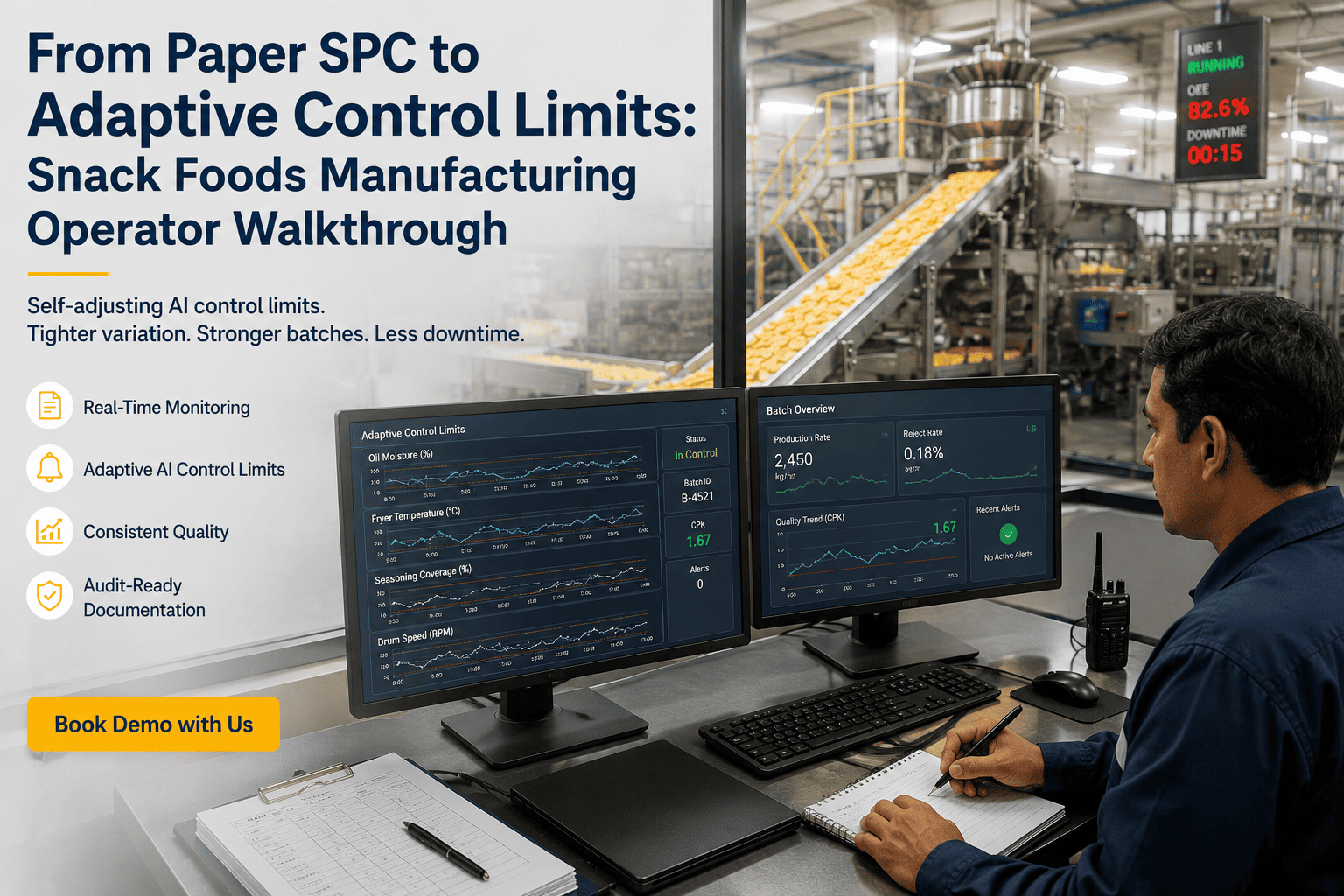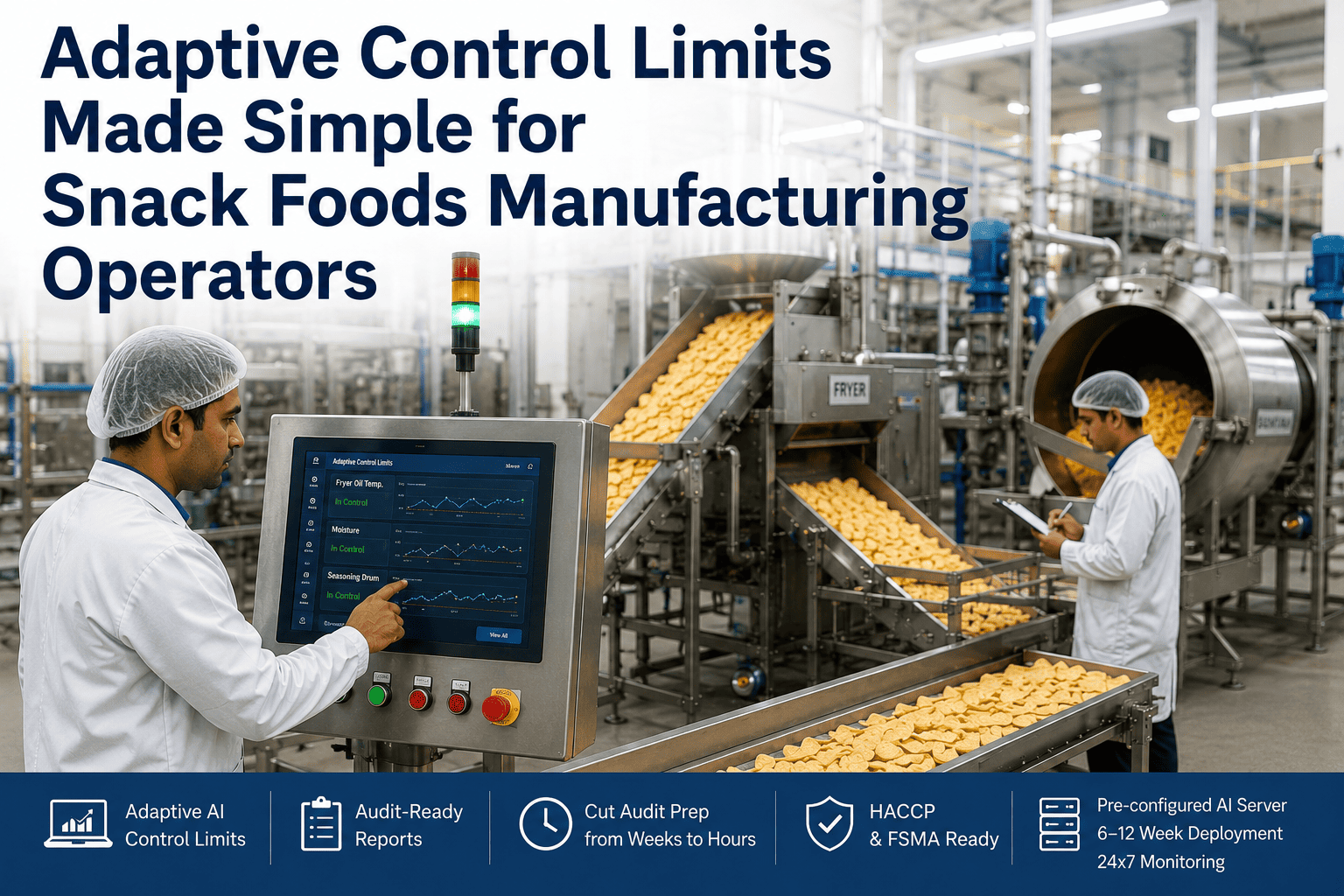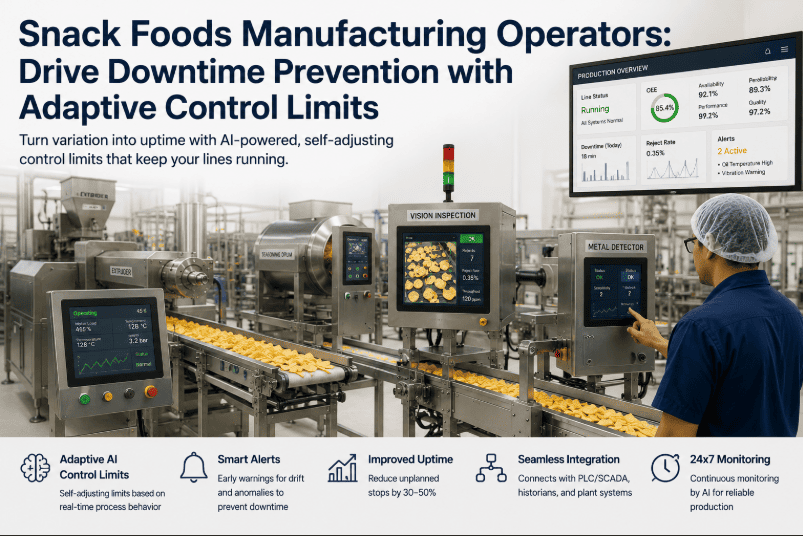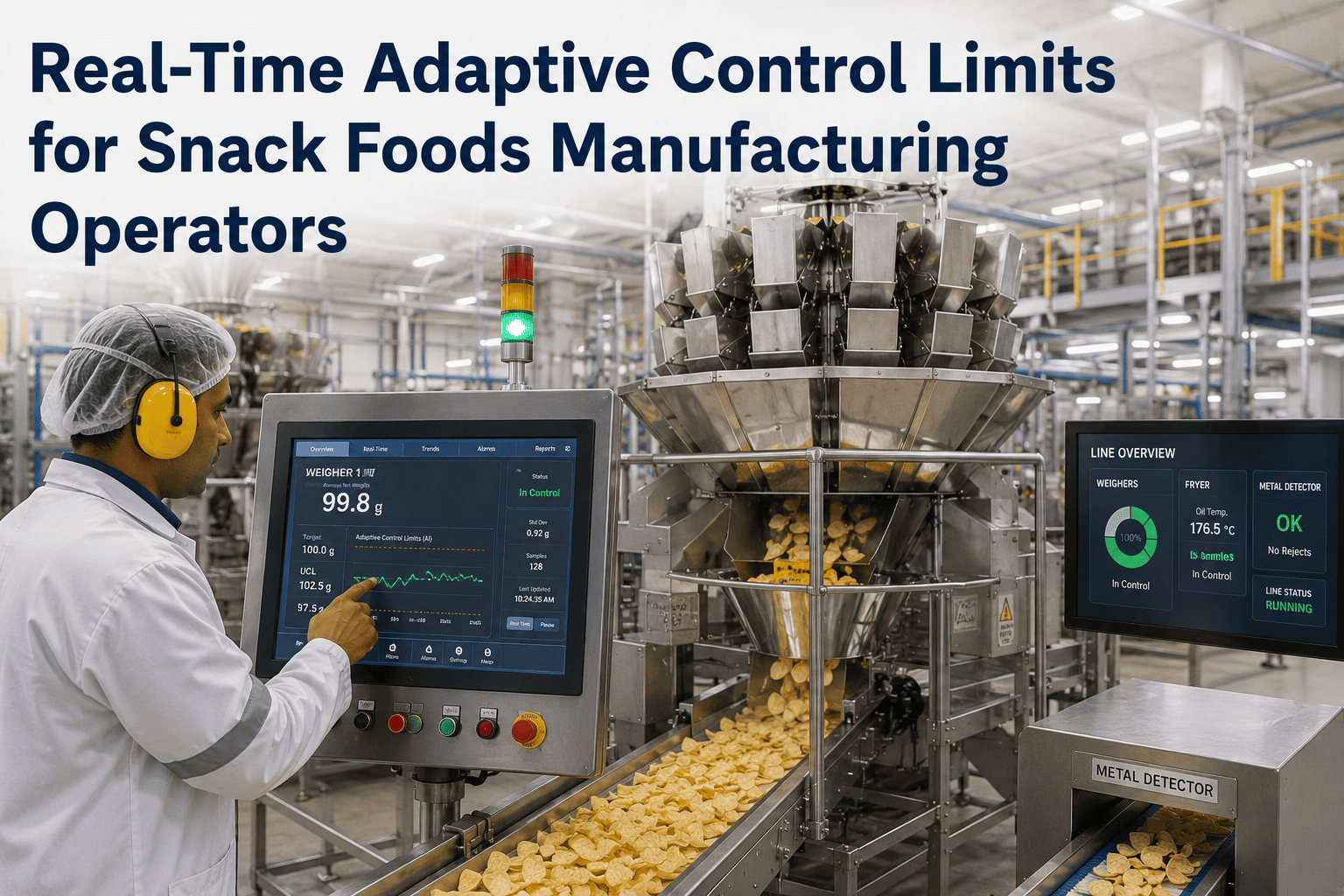
Static control limits cannot adapt to reality. Your snack line operates differently every shift — temperature varies, humidity changes, product density shifts, equipment drifts. Static limits set once assume these variations never happen. They trigger false alarms or miss real problems. Adaptive AI control limits self-tune in real time, learning your equipment's behavior and adjusting limits automatically. Operators get reliable alerts. Compliance stays continuous. This guide explains how adaptive limits work and why snack foods operators need them.
Real-Time Adaptive Control Limits for Snack Foods Manufacturing Operators
Self-tuning control limits that adapt to your actual line conditions. Eliminate false alarms. Catch real drift faster. Maintain FDA/SQF compliance automatically.
Why Operators Need Adaptive Limits — Not Static
Static control limits (UCL/LCL) are set once at startup. They assume your line behaves identically every shift. Reality is different. Temperature swings 5-10°C between startup and production. Fryer oil oxidizes and changes viscosity. Ambient humidity affects seasoning coating thickness. Product moisture content varies batch to batch. Equipment calibration drifts. None of these factors trigger alerts in static limit systems — they're invisible to a limit set weeks ago and never adjusted. See how adaptive limits handle your actual conditions — Book Demo with Us.
The Problem: Static Limits Create Two Failures
Static limits set conservatively trigger 5+ alarms per shift for normal variation. Operator sees: weight 101g, limit 100g, alert fires. But at 75% humidity (current condition), 101g is completely normal. System doesn't know humidity is 75%. Limit doesn't know. Alarm fires anyway. Operator disables alerts. Real drift gets ignored in the noise. Auditor finds documented ignored alarms and flags the system as non-responsive.
Static limits set loose to avoid false alarms fail to catch real problems. Weigher Head 1 drifts from 100g to 100.5g over 4 hours. Static limit is 98-102g. Drift is invisible. By hour 4, 500,000 units × 0.5g = 250kg of giveaway has shipped. Audit inspection finds no SPC documentation showing this excursion was caught or addressed. Audit finding: inadequate process control.
Product A (corn chips) has 3-5% weight variation naturally. Product B (cheese puffs) has 6-8% due to aeration. Static limits tuned for A fire constantly during B. Engineering or quality has to manually recalibrate limits before B runs. Changeover takes extra 30-45 minutes waiting for limit changes. Contact Support to see changeover time reduction with adaptive limits.
How Adaptive Limits Work — The Four-Step Cycle
Every second, sensors on your weighers, fillers, fryers, and extruders send data: weight, temperature, pressure, flow rate, humidity. Thousands of data points per minute feed into the adaptive system.
AI learns normal patterns: "At 72°F humidity, weigher heads naturally vary 0.2%." "Product B during startup shows 7% weight swing for first 20 units." These are normal, not drift. System learns what normal is for your equipment.
Control limits automatically adjust. At 72°F humidity with Product A starting, limits set to 99.8-100.2g. Product B starts? Limits shift to 99-101g automatically. Humidity spikes to 85%? Limits adjust for expected variation at 85%. All automatic, no manual input.
When true drift occurs, you get alert: "Weigher Head 2 trending to 100.8g — exceeds 100.5g limit for current 72°F/Product A conditions. Adjust head 2 now." Alert includes context. You know it's real, not noise. Adjustment happens. Compliance logged automatically.
What Adaptive Limits Solve — Three Real Scenarios
Weigher Head 1 calibrates to 100.0g. After 6 hours of production, it drifts to 100.3g. Static limits of 99-101g don't catch this. But 0.3g × 500,000 units/day = 150kg of undetected giveaway.
System detects Head 1 trending at hour 2 (before drift compounds). Alerts operator at hour 3. "Head 1 trending +0.2g. Adjust within 30 minutes." Operator adjusts. Drift stopped. Zero scrap. Compliance maintained.
Fryer fill rate varies as oil ages. Fresh oil (Day 1): 95-105g fill normal. Oxidized oil (Day 5): 98-108g normal. Static limits work Day 1, false alarm constantly Day 5. Manual recalibration required every oil change.
System learns oil-age pattern. Automatically adjusts limits daily as oil ages. Day 5 limits accommodate expected viscosity change. Real drift still detected. False alarms eliminated. No manual work required.
Product A control limits 98-102g. Product B needs 96-104g due to different aeration. Line switches to B. Static limits fire 3-4 times during startup. Operator manually widens limits. B completes with incomplete SPC data.
Operator scans Product B barcode. System recognizes B. Control limits automatically adjust to B's learned variation band (96-104g). True drift in B still caught. SPC data captured continuously. Zero manual adjustments. Compliance trail complete.
Operator Dashboard — What You Actually See
See current limits: "99.8-100.2g for Product A at 72°F humidity." Visual shows why limits are where they are. You understand the logic.
"Weight 100.8g. Limit for current conditions: 100.5g. DRIFT DETECTED. Adjust Head 2." Signal is clear. You act immediately. No guessing.
Scan Product B barcode. Limits auto-adjust. Start production. No manual limit changes. No waiting. No delays.
System adjusts limits automatically based on conditions. You never enter static values. No spreadsheets. No engineering approvals. Limits update themselves.
Every limit adjustment logged. Every alert recorded. Every action documented. Audit readiness automatic. No manual paperwork.
System learns your equipment's unique patterns. More accurate over time. Adapts to seasonal changes, new products, equipment aging. Gets better, never worse.
Why Auditors Prefer Adaptive Limits
Auditor sees: "Limit adjusted to 99-101g because humidity is 75%." Logic is transparent. vs Static limits hidden in spreadsheet with no explanation.
1,800 data points per shift (every second) vs 40 data points (every 30 min sampling). Excursions caught 12+ hours earlier with continuous data.
ALCOA+ compliance automatic. Records are attributable, legible, contemporaneous, original, accurate. No handwriting. No human error. No audit vulnerability.
Automated SPC report vs manual assembly of notebooks and charts. Auditor reviews generated reports in hours. Not days hunting for documents.
Frequently Asked Questions
Self-tuning limits, zero false alarms, automatic compliance. 1-2 week deployment. 24x7 monitoring. Integrated with your existing PLC/SCADA.