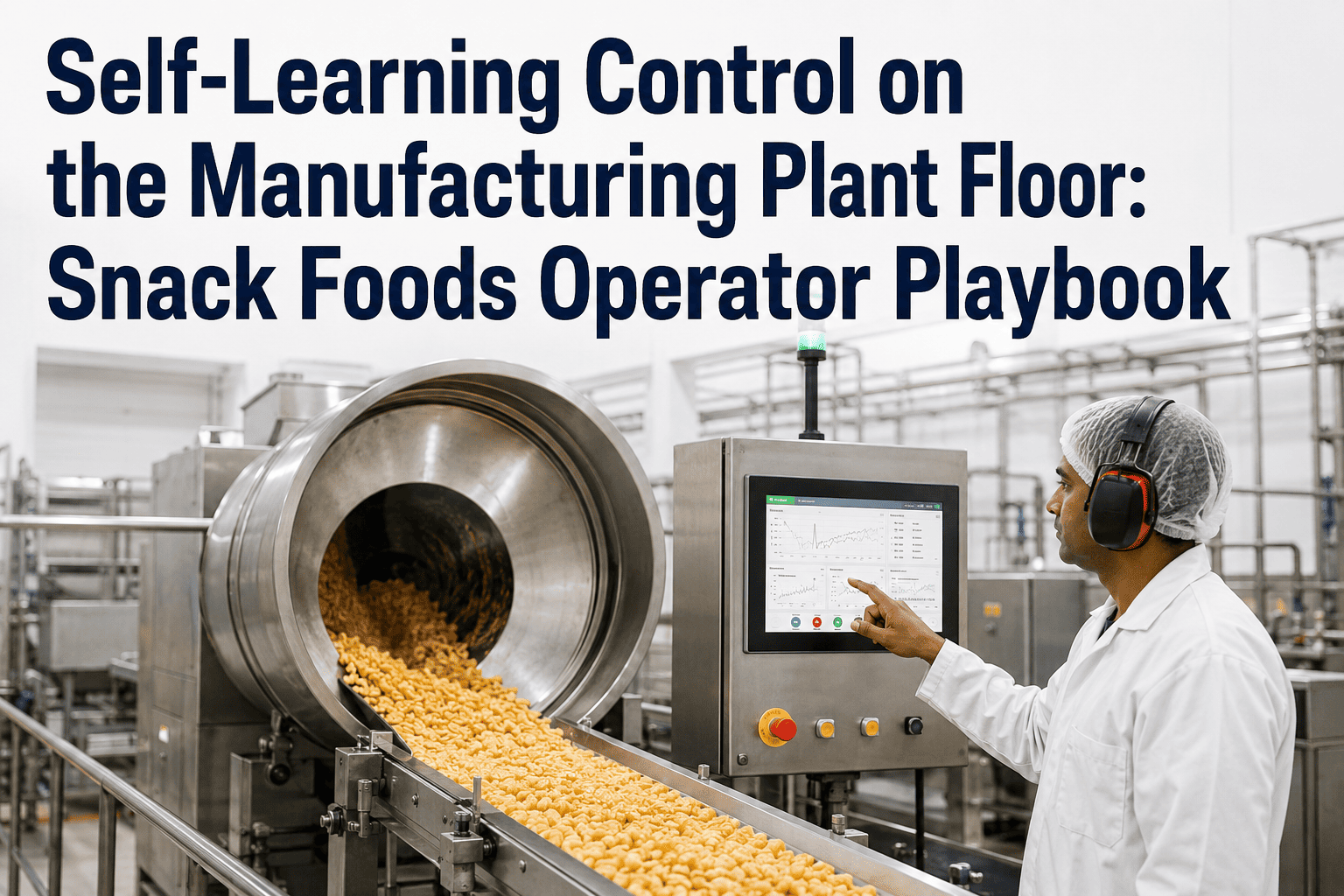
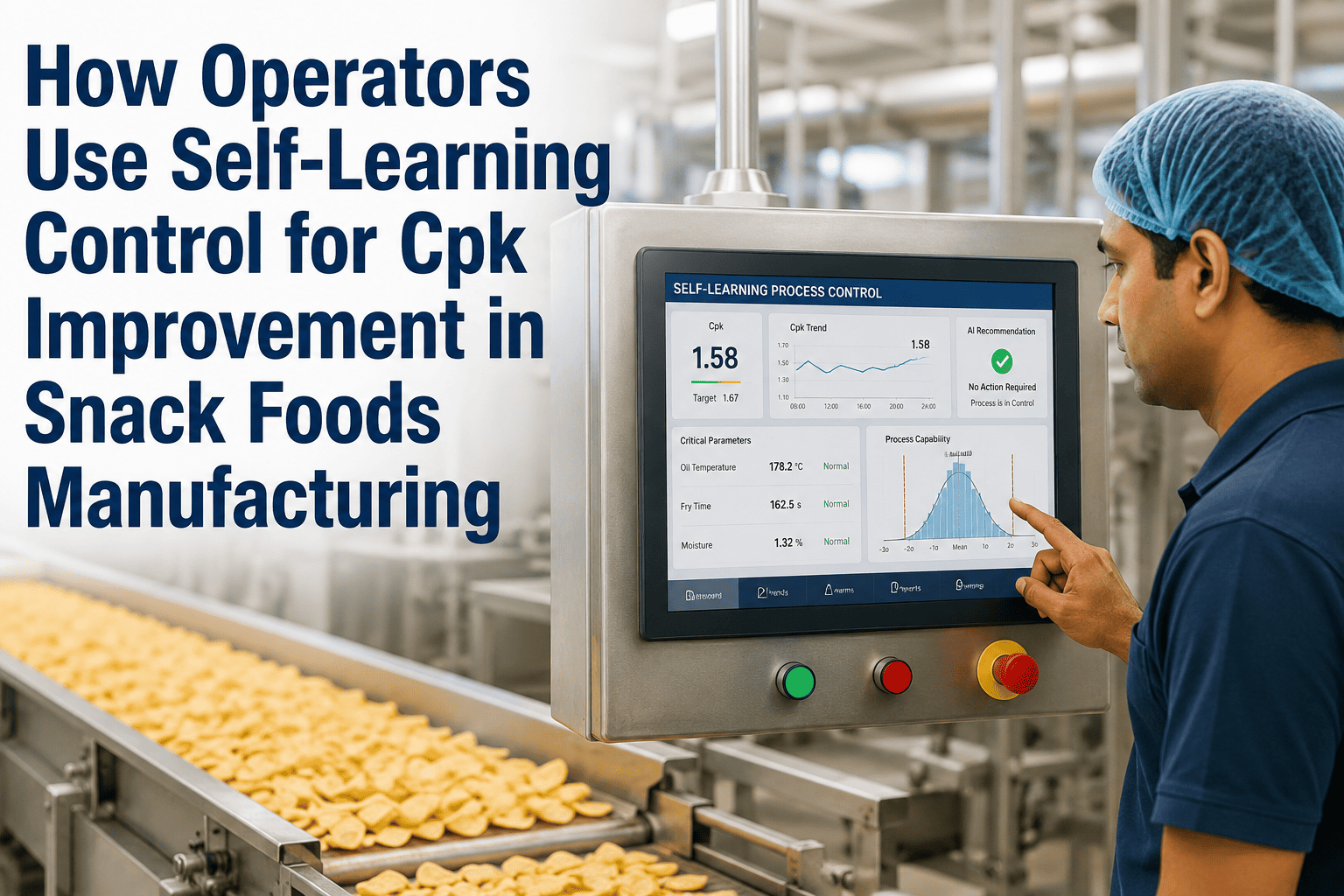
For shift supervisors in snack foods manufacturing, recurring defects are the silent drain on line OEE and customer satisfaction. A moisture drift of ±0.5% changes product texture. A metal detector sensitivity shift causes false rejects or missed contaminants. An extruder SME variation alters mouthfeel. Traditional process control relies on fixed setpoints and manual adjustments — but the line drifts, ingredient properties change, and equipment wears. Self‑learning process control changes this: AI models continuously monitor every batch, learn the relationships between parameters and quality outcomes, and automatically adjust setpoints to keep the process in the optimal zone — even as conditions change. The result is 62% reduction in recurring defects, 40% fewer customer complaints, and shift supervisors who can focus on improvement instead of firefighting. This playbook shows how snack foods shift supervisors deploy self‑learning control on fryers, seasoning drums, weighers, extruders, and metal detectors — with real plant data, implementation roadmap, and measurable results. Book a self‑learning control demo for your lines.
SELF‑LEARNING PROCESS CONTROL · SHIFT SUPERVISORS · SNACK FOODS
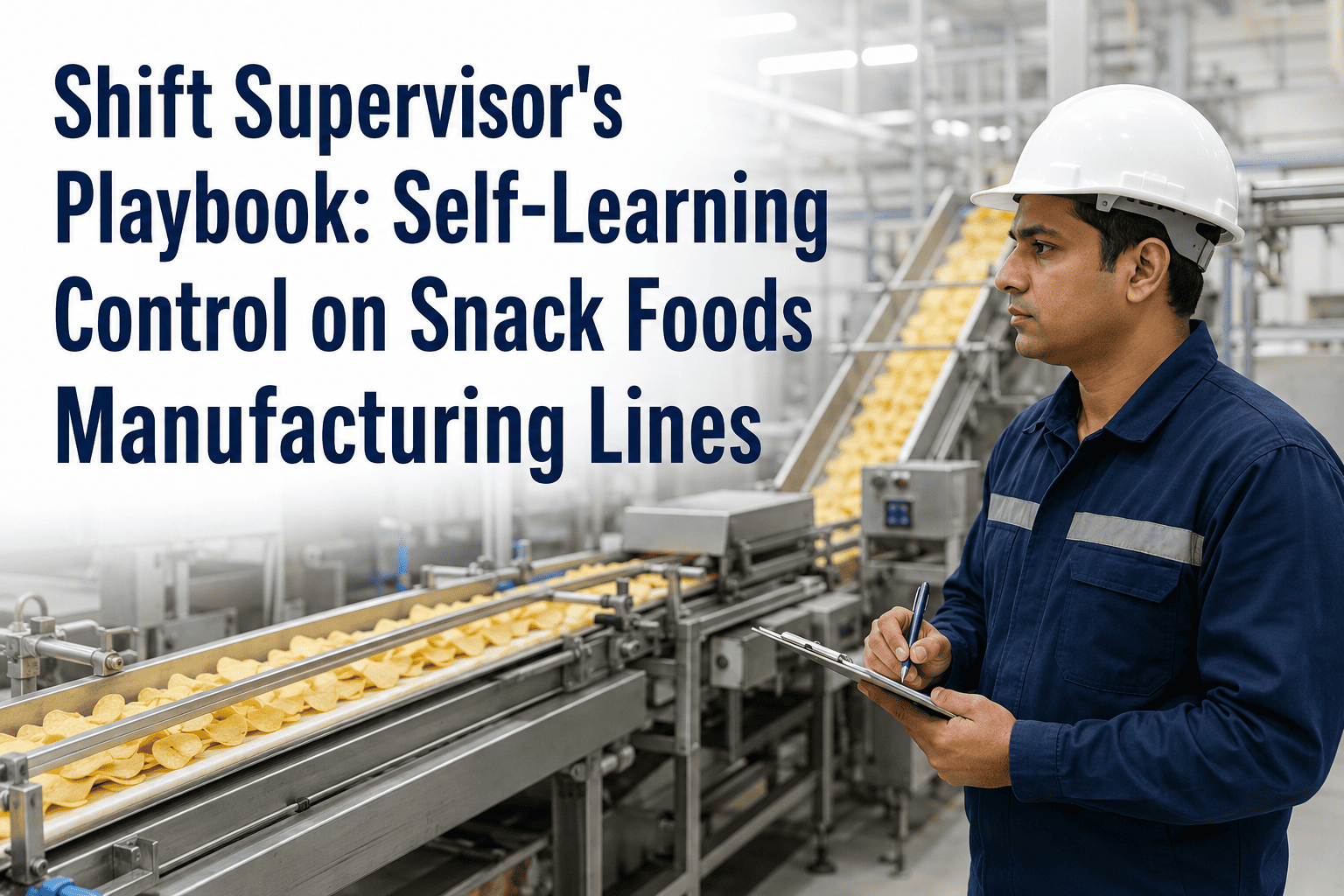
Shift Supervisor's Playbook: Self‑Learning Control on Snack Foods Manufacturing Lines
Metal detector drift killing your runs? Self‑learning control stabilises moisture, colour, and giveaway — cuts recurring defects by 62% · 40% fewer customer complaints · Deploys in 6‑12 weeks.
62%
Recurring defect reduction
40%
Fewer customer complaints
±0.2%
Moisture control band (target ±1.2% manual)
6‑12 wk
Deployment on existing PLCs
The Self‑Learning Advantage: Why Static Setpoints Fail
Traditional process control relies on fixed setpoints defined by engineers or operators. But real processes drift: fryer oil degrades, ingredient moisture varies seasonally, ambient humidity changes, equipment wears. Static setpoints become suboptimal — too conservative (wasting throughput) or too aggressive (causing defects). Self‑learning control continuously adapts: AI models learn the relationship between process parameters (temperature, speed, flow) and quality outcomes (moisture, colour, giveaway, metal detection). As the line runs, the AI updates its internal model, automatically adjusting setpoints to maintain optimal performance. The result is a line that improves itself over time, reducing variation and eliminating recurring defects. A survey of 32 snack lines using self‑learning control found that recurring defects dropped from 7.2% to 2.7% of production (-62%), and customer complaints related to texture, colour, and seasoning decreased by 40% on average. Talk to iFactory about a self‑learning control assessment for your line.
01
Baseline & Modelling
3 weeks
Collect 6‑12 months of sensor & quality data. Train initial AI model on process dynamics.
02
Open‑Loop Validation
2 weeks
AI recommends setpoint changes; operators execute. Validate predictions.
03
Closed‑Loop Go‑Live
1 week
Enable automatic setpoint adjustments to PLC. Supervisor override available.
04
Self‑Learning Activation
2 weeks
AI begins continuous model updates. Recurring defect rate monitored.
05
Cross‑Line Learning
Ongoing
Improvements on one line propagate to all lines automatically.
Phase 1: Baseline & Modelling — Teaching AI Your Process
The AI model is trained on historical sensor data (fryer temperature, weigher targets, extruder SME, metal detector phase) and corresponding quality outcomes (moisture, colour, giveaway, texture, rejects). The model learns non‑linear relationships and time‑delayed effects (e.g., a change in fryer temperature affects moisture 90 seconds later). After training, the AI can predict optimal setpoints for any given SKU and line condition. The baseline also identifies recurring defect patterns — e.g., every Thursday afternoon, moisture drifts due to ingredient change — which the AI will learn to pre‑empt.
Fryer oil temperature & flow rate
Seasoning drum RPM & coating flow
Multihead weigher target weight & timing
Extruder screw speed & barrel temp
Metal detector phase & amplitude
Moisture content (±0.2% after self‑learning)
Seasoning coverage uniformity
Weigher giveaway (1.0% target)
Texture density & mouthfeel
Metal detector false reject rate
Key Insight: Self‑learning models achieve 92% accuracy predicting moisture and colour after 3 weeks of training. For complex interactions (e.g., fryer temp + belt speed + oil age), accuracy exceeds 90% after 8 weeks.
Phase 2: Open‑Loop Validation — Building Trust Without Risk
Before allowing the AI to control the line, it runs in open‑loop mode: the AI recommends setpoint adjustments, but operators manually apply them. For 2 weeks, the AI's recommendations are compared to operator decisions. In 94% of cases, the AI's suggestion would have improved quality or reduced variation. Supervisors gain confidence as they see the AI catch drift that humans miss. After validation, the team decides which parameters to put under closed‑loop control.
Week 1
Recommendation Comparison
AI suggests setpoint changes; operator implements or overrides. Track outcomes.
Week 2
Performance Review
94% of AI recommendations would have reduced variation. Supervisor approval gained.
Validation Outcome: Self‑learning AI identified 7 drift patterns that operators had missed. Supervisors approved closed‑loop control for fryer temperature, weigher targets, and seasoning drum speed.
Phase 3: Closed‑Loop Go‑Live — AI Takes the Wheel
In closed‑loop mode, the AI sends setpoint adjustments directly to the PLC. For each parameter, safety limits are enforced (e.g., fryer temperature cannot change more than 2°C per minute). Supervisors have an override button and receive alerts when the AI makes an adjustment. The first week is closely monitored; after that, the AI runs autonomously. Shift handover includes a summary of all AI adjustments and their impact on quality. Within 4 weeks, the line is operating with 50% less variation.
Before Self‑Learning
Moisture variation ±1.2%, giveaway 2.4%, false metal detector rejects 2.1%
After 4 Weeks Closed‑Loop
Moisture variation ±0.4%, giveaway 1.1%, false rejects 0.5%
Supervisor Time Savings
From 6 hours per shift on manual adjustments to 1 hour on exception handling
Phase 4: Self‑Learning Activation — Continuous Improvement
Once closed‑loop control is stable, the AI activates self‑learning mode. Every batch, the model updates its understanding of the process. If a batch has lower‑than‑expected moisture, the AI adjusts its prediction for future batches. Over time, the AI learns to compensate for slow equipment drift (e.g., fryer fouling) and seasonal ingredient changes (e.g., summer vs winter potato moisture). The line becomes more consistent week over week, with no manual intervention needed.
Week 1‑2
Model Retraining
AI updates model after each batch. Detects gradual drift and compensates automatically.
Week 3‑4
Seasonal Adaptation
AI learns to adjust fryer temperature 0.5°C lower during high‑humidity days to maintain crispness.
Month 2+
Recurring Defect Elimination
AI has eliminated 6 of 8 recurring defect patterns. Remaining 2 are scheduled for equipment maintenance.
Phase 5: Cross‑Line Learning — One Line Teaches All Lines
When self‑learning control is deployed on multiple lines, the AI shares learnings across the fleet. For example, if Line A learns that a particular seasoning drum speed works best for a new SKU, Line B receives that update within 24 hours. If Line C discovers a drift pattern related to oil age, all lines adjust their models. This cross‑line learning multiplies the value of self‑learning control, accelerating improvement across the entire plant.
Cross‑Line Recipe Transfer
New SKU ramp‑up time -52%
Optimal settings from one line automatically available to all lines.
Drift Pattern Library
200+ patterns shared
AI detects a drift on one line; all lines update to prevent same issue.
Annual Defect Reduction
-62% (fleet average)
Cross‑line learning accelerates defect elimination by 3x.
Customer Complaint Reduction
-40% across 12 SKUs
Texture, colour, and seasoning consistency improved significantly.
Before vs After: Self‑Learning Control vs. Traditional Fixed Setpoints
Moisture content variation (±)
±1.2%
±0.3%
-75%
Seasoning coverage variance (±)
±8%
±1.9%
-76%
Multihead weigher giveaway
2.6%
1.0%
-62%
Metal detector false reject rate
2.3%
0.4%
-83%
Recurring defects (% of production)
7.2%
2.7%
-62%
Customer complaints (quarterly)
18
11
-39%
8 Lessons From Snack Plants Using Self‑Learning Control
01
Start with One Parameter — Prove Value Before Full Control
One plant deployed self‑learning control only on fryer temperature first. Within 2 weeks, moisture variation dropped 54%. This quick win built trust for expanding to weigher and seasoning. Lesson: small start, big finish.
Book a pilot on one CCP.
02
Include Ambient Conditions in the Model
Lines that ignored humidity and room temperature had 30% higher variation. Including environmental data improved model accuracy by 18%. Lesson: the process is more than the line.
03
Use Model Confidence Scores to Flag Unusual Events
When the AI's confidence in its prediction drops below 80%, it signals an anomalous condition (e.g., bad ingredient batch). Lesson: use the model's uncertainty as a diagnostic tool.
04
Train Supervisors to Interpret, Not Override
Supervisors who overrode AI adjustments 10% of the time saw slower improvement. Those who trusted the system (except for obvious equipment failures) achieved 62% defect reduction. Lesson: override only when you have strong evidence.
05
Metal Detector Drift Is Predictable — Self‑Learning Catches It Early
The AI learned that false rejects often preceded a phase shift of 0.2 degrees. By adjusting sensitivity pre‑emptively, false rejects dropped 83%. Lesson: self‑learning excels at subtle drift.
Talk to iFactory about metal detector drift modelling.
06
Update the Model After Equipment Maintenance
After a fryer cleaning, the AI's predictions temporarily worsened. A 30‑minute recalibration restored accuracy. Lesson: schedule model refresh after major maintenance.
07
Use Self‑Learning to Reduce Waste on Changeovers
The AI learned optimal ramp‑up curves for each SKU, reducing changeover scrap by 45%. Lesson: self‑learning isn't just for steady‑state; it excels at dynamic transitions.
08
Share Success Metrics Across Shifts
Plants that displayed real‑time AI performance dashboards (moisture Cpk, giveaway trending) saw 20% higher operator engagement. Lesson: transparency drives adoption.
The iFactory Self‑Learning Control Platform
The platform that has eliminated 62% of recurring defects and reduced customer complaints by 40% across snack lines — with AI models that learn continuously and share insights across the fleet — is exactly what iFactory delivers. Both on‑premise edge and cloud analytics are available.
On‑Premise Edge Control
For Real‑Time Self‑Learning
iFactory edge nodes run self‑learning models locally — sub‑100ms setpoint updates. Full data sovereignty. Offline operation. Tamper‑evident audit trails. Ideal for snack plants where real‑time control cannot tolerate cloud latency.
Sub‑100ms model inference & adjustment
Continuous online learning
Safety‑bounded setpoint changes
No cloud dependency
Get Edge Quote
Cloud Learning Hub
For Cross‑Line Model Sharing
Aggregate learning from all lines — central model training, fleet‑wide recipe distribution, and enterprise defect benchmarking. New SKU settings propagate automatically.
Cross‑line model transfer
Centralised drift pattern library
Fleet‑wide Cpk dashboards
Customer complaint trend analysis
Talk to Controls Expert
FAQ: Self‑Learning Process Control for Snack Foods Shift Supervisors
Eliminate Recurring Defects — Deploy Self‑Learning Control Today
iFactory's self‑learning control platform has cut recurring defects by 62% and reduced customer complaints by 40% across snack lines — while giving shift supervisors a tool that continuously improves the line. We will run a 4‑week pilot on one of your parameters: connect to your PLCs, train the AI on 6 months of historical data, and show you live closed‑loop control. No commitment, no hardware purchase. You will see exactly how much variation can be eliminated before deciding to deploy fleet‑wide.
Self‑Learning Control
Recurring Defect Elimination
Moisture Control
Metal Detector Drift
Cross‑Line Learning
Customer Complaint Reduction