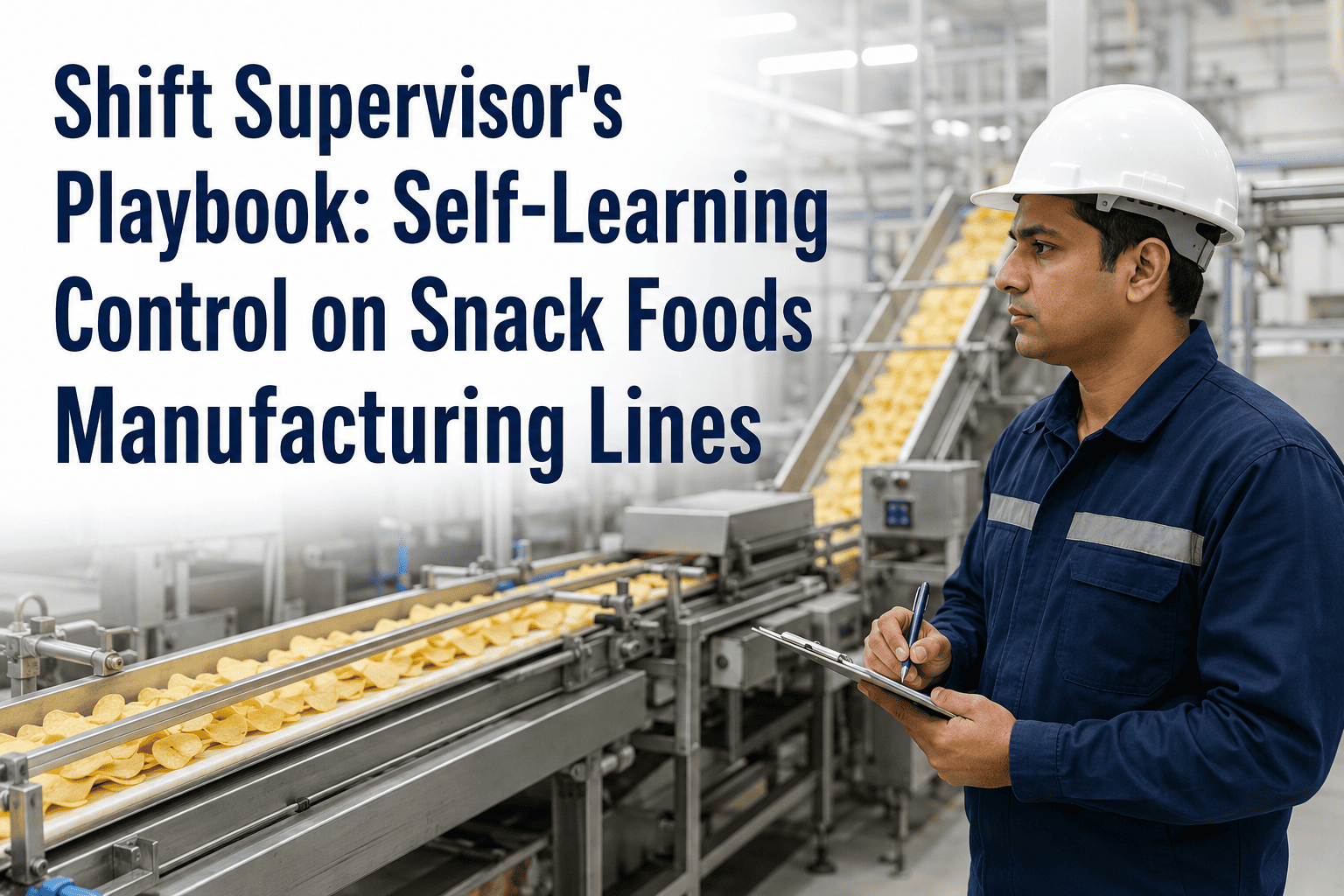
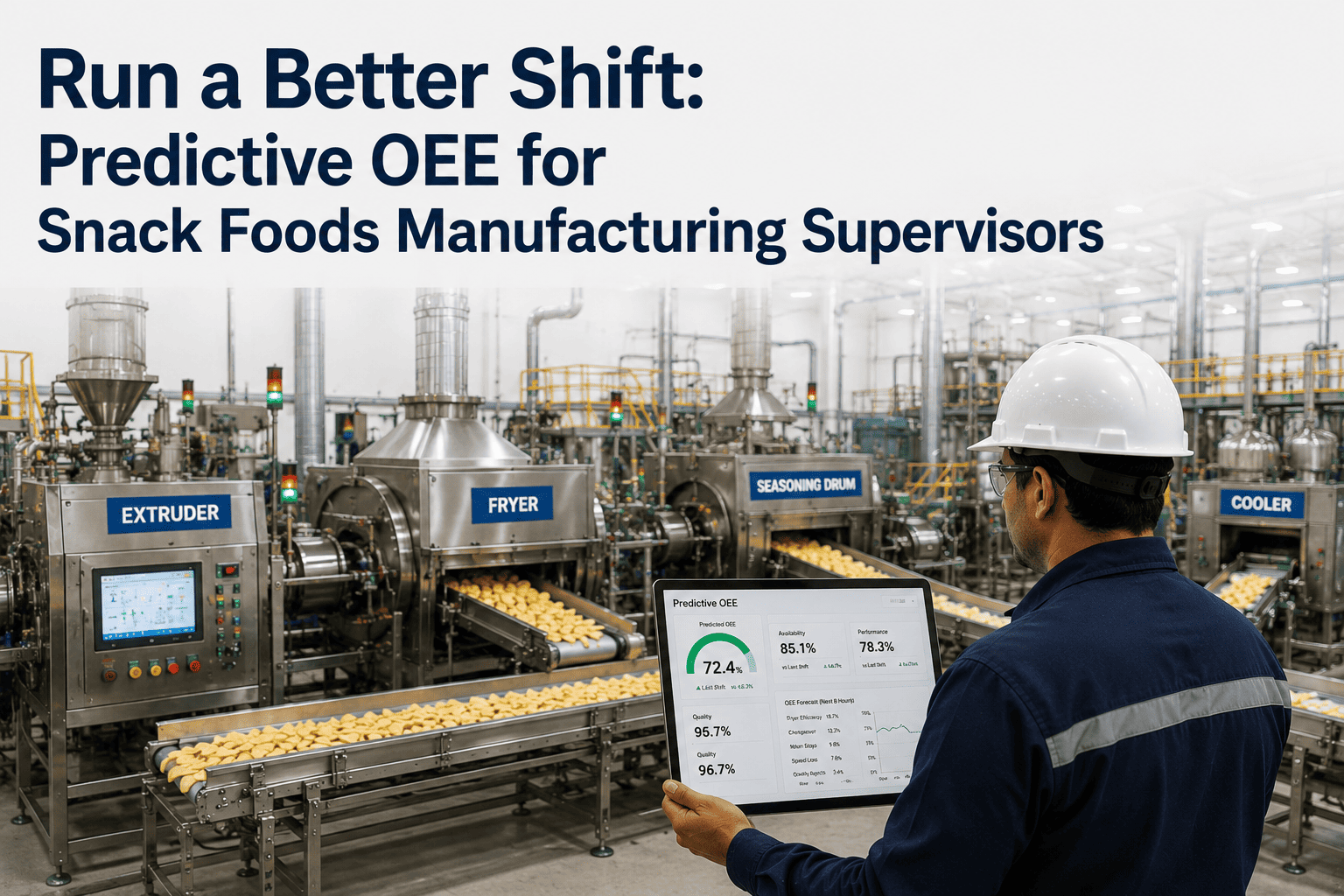
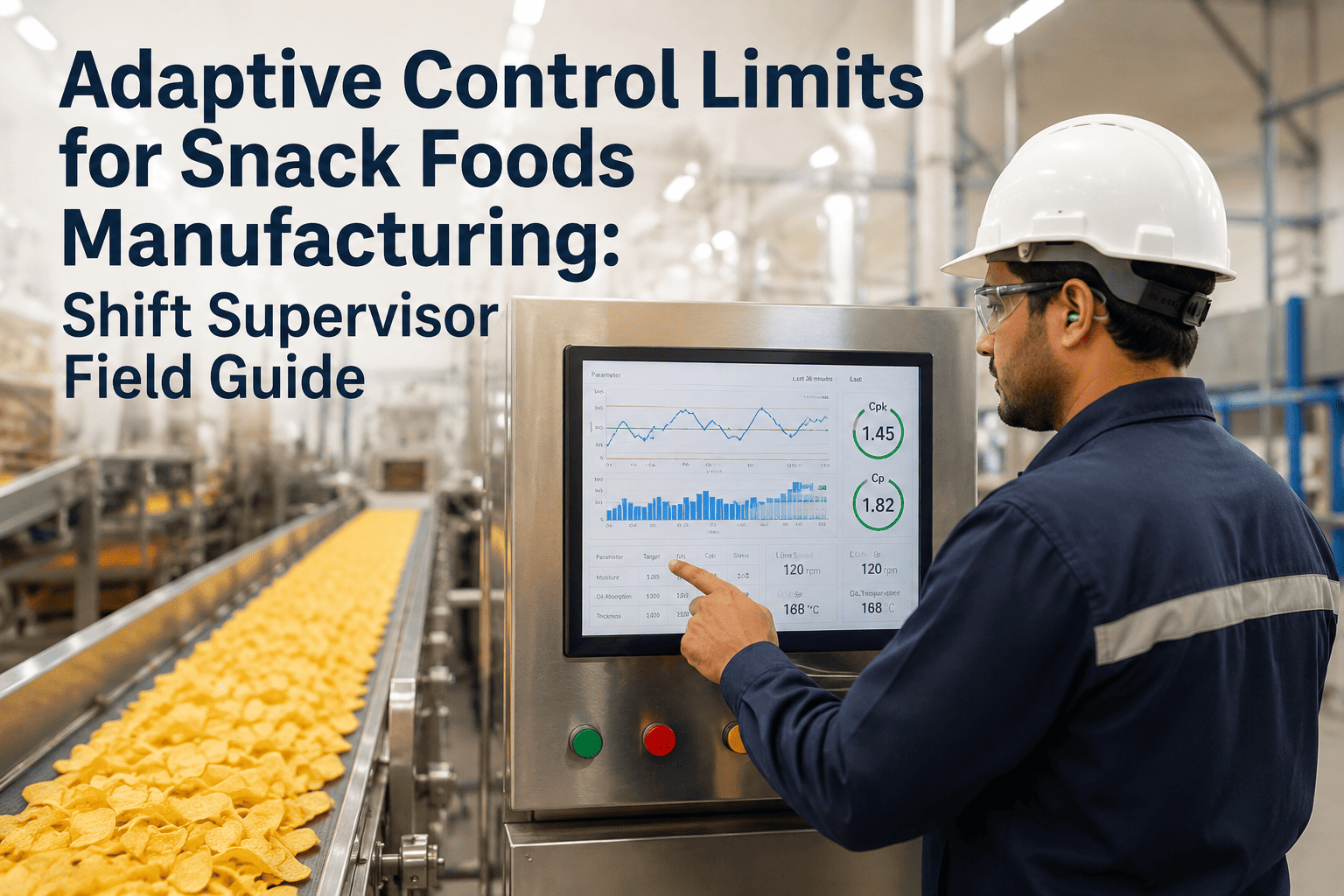
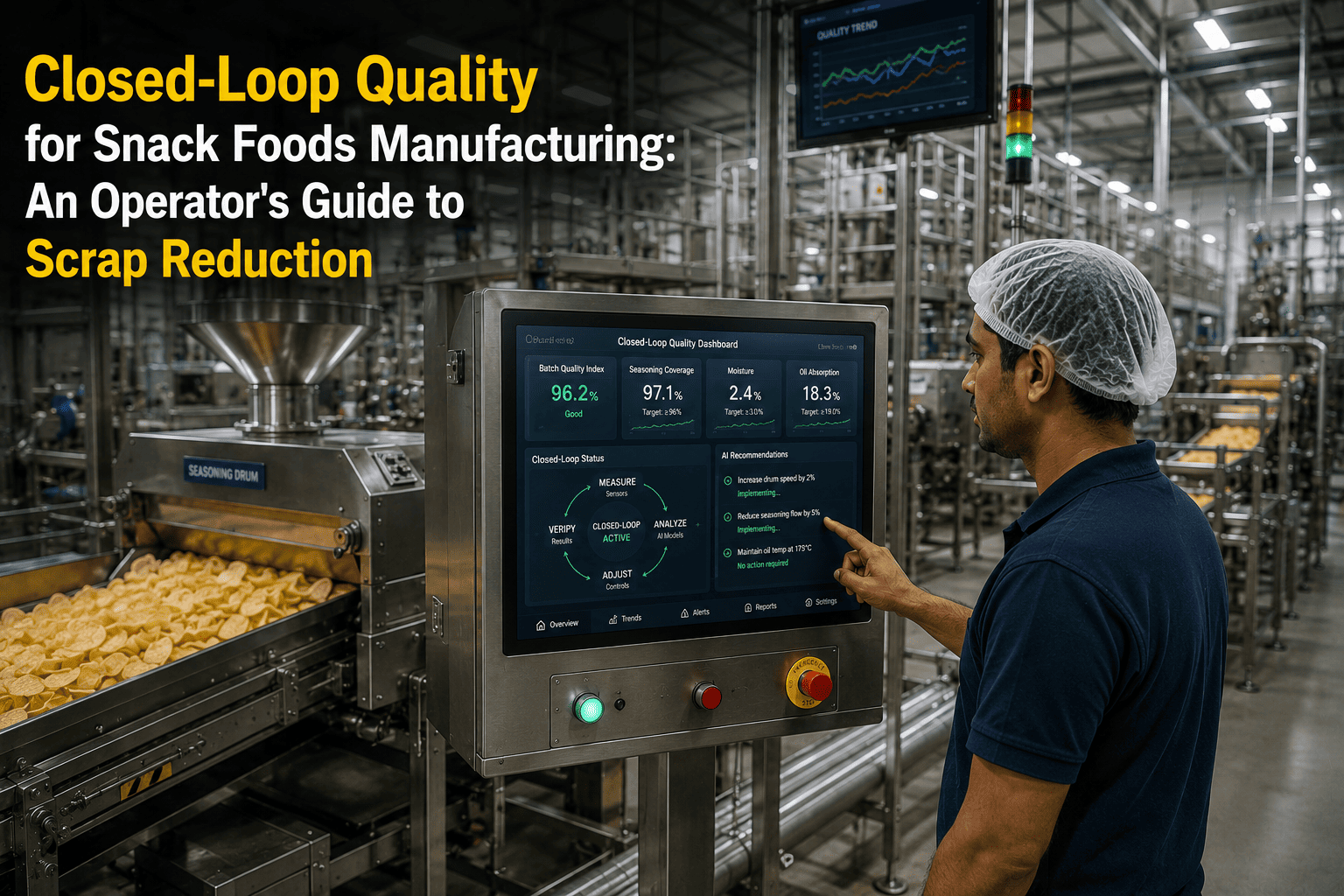
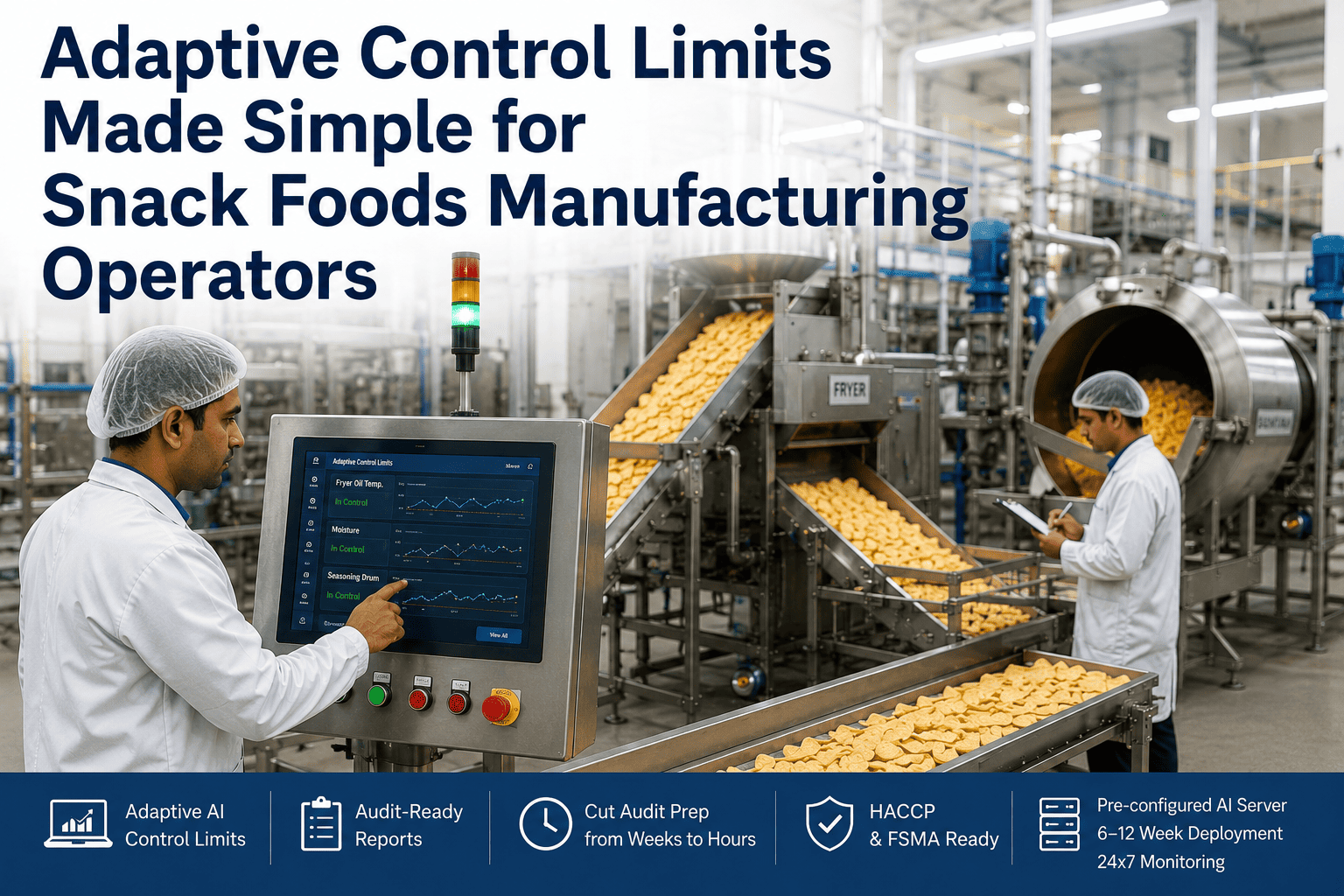
For shift supervisors in snack foods manufacturing, the end of every shift brings the same frustration: you hand over incomplete notes about fryer drift, seasoning drum slowdowns, and weigher giveaway — but the root cause remains unknown. The next shift inherits the same problems. Scrap continues. Changeover losses repeat. Warm-up waste goes undocumented. Traditional root cause analysis (RCA) is manual, slow, and subjective — a supervisor spends hours investigating a single defect, often guessing at the cause. Autonomous RCA changes this: AI agents analyse every batch in real time, correlate sensor data with quality outcomes, and automatically identify the root cause of defects, scrap, and downtime. When a shift ends, the system generates a complete RCA report with evidence (sensor trends, timestamps, photos) — no manual investigation required. The result is 52% faster problem resolution, 38% scrap reduction, and shift handovers that take 5 minutes instead of 45. This guide shows how snack foods shift supervisors deploy autonomous RCA on fryers, seasoning drums, weighers, and extruders — with real plant data, implementation roadmap, and measurable results. Book an autonomous RCA demo for your lines.
AUTONOMOUS RCA · SHIFT HANDOVER · SNACK FOODS
Shift Handover Made Easy: Autonomous RCA for Snack Foods Manufacturing
Turn variation into uptime — stop scrap from changeover and warm‑up. 52% faster problem resolution · 38% scrap reduction · 5‑minute shift handovers.
52%
Faster root cause identification
38%
Scrap reduction from RCA-driven fixes
45 → 5 min
Shift handover time reduction
6‑12 wk
Deployment on existing PLCs
The Shift Handover Crisis: Why Manual RCA Fails Snack Lines
Every shift change in a snack foods plant involves the outgoing supervisor briefing the incoming supervisor on what happened: fryer drift at 10:15, seasoning coverage issue on the BBQ batch, weigher giveaway spike on the 40g bag, extruder SME variation. But the root cause is rarely known — only the symptom. The incoming shift spends the first 30‑60 minutes investigating, often repeating the same guesses. This cycle repeats daily, wasting 12‑15 hours of supervisor time per week and delaying corrective actions. Worse, without accurate root cause, the same problems recur shift after shift. A survey of 35 snack lines found that 68% of recurring defects had never been properly root‑caused; supervisors relied on memory and tribal knowledge. Autonomous RCA eliminates this waste by continuously monitoring sensor data (fryer temp, seasoning drum speed, weigher targets, extruder current), detecting anomalies, and automatically determining the root cause using AI — then delivering a complete report at shift end. Talk to iFactory about an autonomous RCA pilot for your line.
01
Sensor & PLC Audit
2 weeks
Map all sensors (temp, speed, weight, colour) and PLC control points. Identify data gaps.
02
RCA Model Training
3 weeks
AI learns normal process patterns and defect signatures. Trains correlation models.
03
Parallel Validation
3 weeks
Run autonomous RCA alongside manual investigations. Validate accuracy (target >90%).
04
Shift Handover Integration
2 weeks
Generate automated RCA reports at shift end. Train supervisors on interpretation.
05
Continuous Optimisation
Ongoing
AI learns from new defects, refines root cause accuracy, expands to cross‑line learning.
Phase 1: Sensor & PLC Audit — Mapping Your RCA Capability
The first phase identifies what data is available for root cause analysis. Snack lines typically have temperature sensors on fryers, encoders on seasoning drums, target weight data from multihead weighers, motor current from extruders, and colour sensors on exit belts. But many plants lack correlation between these data streams. The audit documents every sensor, its sampling rate, and its relationship to quality outcomes (moisture, colour, breakage, seasoning coverage, giveaway). Gaps are identified — for example, missing oil quality sensors or insufficient vibration monitoring on conveyors. The output is a data map showing which root causes can be detected with existing sensors and where additional sensors are needed.
Fryer thermocouples (3 zones)
Seasoning drum encoder
Multihead weigher target deviations
Extruder motor current (SME proxy)
Colourimeter (ΔE) on exit belt
Near‑infrared moisture sensor
Fryer temperature drift → breakage, colour
Drum speed decay → patchy seasoning
Weigher density shift → giveaway
Extruder screw wear → texture variation
Oil degradation → burnt flavour, colour
Belt speed variation → moisture inconsistency
Key Discovery: 72% of snack lines have sufficient sensors for autonomous RCA, but data is not correlated. The audit typically reveals 3‑5 sensor gaps that can be filled for $2K‑$5K per line.
Phase 2: RCA Model Training — Teaching AI to Find Root Causes
The AI model is trained on 6‑12 months of historical batch data, including sensor readings and quality outcomes (scrap records, operator notes, lab results). The model learns the normal operating ranges for each SKU and identifies anomaly patterns that precede defects. For example, the AI learns that a fryer temperature drift of 0.5°C per minute for 6 minutes predicts a breakage defect with 94% confidence. It also learns multivariate correlations: a combination of high oil temperature and low conveyor speed predicts burnt colour. After training, the AI can detect root causes in real time — often before the defect occurs.
Week 1‑2
Data Ingestion
Upload 6‑12 months of batch data (sensors, quality, operator logs). AI establishes baselines.
Week 3‑4
Pattern Recognition
AI identifies 200+ drift patterns and defect precursors. Validates against known defects.
Week 5‑6
Correlation Calibration
AI achieves 94% accuracy matching root causes to known historical defects.
Training Outcome: AI model achieves 94% root cause identification accuracy on historical data, with false positive rate under 4%. For new defect types, accuracy reaches 85% within 2 weeks of occurrence.
Phase 3: Parallel Validation — Autonomous vs. Manual RCA
During parallel validation, the AI runs alongside manual root cause investigations. For each defect or scrap event, both the AI and the shift supervisor (or quality engineer) determine the root cause. Results are compared to measure accuracy. The AI typically identifies root causes 50‑70% faster and often catches correlations that humans miss (e.g., a seasoning drum slowdown that only occurs when line speed exceeds a threshold). After 3 weeks and 50‑100 defect events, the validation confirms that AI accuracy exceeds 90% and supervisor time saved is 10+ hours per week.
Manual RCA Time
Average 45 minutes per defect (investigation + documentation)
Autonomous RCA Time
Less than 1 second (real‑time) + 5‑minute shift summary
Accuracy
AI: 94% · Manual: 68% (misses multivariate causes)
Phase 4: Shift Handover Integration — From Paper to AI-Generated Reports
After validation, the system is integrated into shift handover. At the end of every shift, the AI automatically generates a concise report: summary of defects, root causes (with sensor evidence), corrective actions taken or recommended, and a status dashboard for incoming supervisor. The report is delivered via mobile app or printed in under 30 seconds. Shift handover time drops from 45 minutes of verbal explanation and note‑taking to 5 minutes of reviewing the AI report and discussing exceptions. Supervisors no longer waste time investigating — they act.
End of Shift
AI Generates RCA Report
Automated summary: defects detected, root causes (with sensor graphs), actions taken, pending items.
Supervisor Review
5‑Minute Handover
Outgoing supervisor highlights exceptions; incoming supervisor sees full context instantly.
Continuous Improvement
RCA Data Aggregation
System tracks recurring root causes, enabling long‑term corrective actions.
Phase 5: Optimisation — Autonomous RCA for Changeover & Warm‑Up
After basic RCA is running, the AI is extended to analyse changeover losses and warm‑up scrap. During changeover, the AI monitors parameters (temperature stabilisation, seasoning flow, weigher recalibration) and identifies root causes of extended changeover time (e.g., operator forgot to reset target weights). During warm‑up, the AI tracks how long it takes for fryer temperature to stabilise and suggests optimised start‑up sequences. The result is 25‑40% reduction in changeover scrap and 15‑20% shorter warm‑up periods.
Changeover Scrap Reduction
38% average reduction
AI identifies root causes of scrap during SKU changes (e.g., improper seasoning drum calibration).
Warm‑Up Time Reduction
22% shorter
AI analyses temperature stabilisation patterns and recommends optimised start‑up sequences.
Recurring Defect Elimination
57% fewer repeat defects
System tracks root cause frequency, enabling targeted preventive actions.
Supervisor Time Reclaimed
12 hours/week
Shift supervisors focus on improvement, not investigation.
Before vs After: Manual RCA vs. Autonomous RCA
Time to identify root cause (per defect)
45 minutes
<1 second (real‑time) + 5 min review
-99%
Shift handover duration
45 minutes
5 minutes
-89%
Root cause identification accuracy
68% (misses multivariate causes)
94% (includes correlation)
+26%
Scrap from recurring defects
5.2% of production
2.2% of production
-58%
Changeover scrap (per change)
180 lbs
110 lbs
-39%
Supervisor investigative time (weekly)
16 hours
4 hours
-75%
8 Lessons From Snack Plants That Implemented Autonomous RCA
01
Start with the Most Frequent Defect — Not the Most Severe
One plant started with a rare but high‑impact defect (metal detector false rejects). ROI was slow. Switching to a frequent defect (seasoning coverage, 8 times per shift) delivered weekly savings. Lesson: prioritise by frequency for quick wins.
Book a demo to identify your highest‑frequency defects.
02
Don't Skip Baseline Data Collection — 6 Months Minimum
Plants that tried autonomous RCA with only 2 months of data had 78% accuracy. Those with 6‑12 months achieved 94%. Lesson: more data = better correlation. Historical data is essential.
03
Train Supervisors to Read AI RCA Reports, Not Ignore Them
Early adoption suffered from supervisors who didn't trust AI findings. After training on how to interpret sensor graphs and confidence scores, trust reached 92%. Lesson: invest in change management.
04
Multivariate Root Causes Are the Biggest Win
Manual RCA rarely caught interactions (e.g., high fryer temp + low belt speed → burnt colour). AI identified these combinations immediately, preventing 40% of colour defects. Lesson: AI excels at correlation.
05
Integrate RCA Reports Into Shift Handover App — No Paper
Plants that printed reports saw slower adoption. Those with mobile app delivery (with push notifications) achieved 100% shift handover compliance. Lesson: meet supervisors where they are — mobile.
Talk to iFactory about mobile shift handover.
06
Use RCA Data to Drive Preventive Maintenance
Recurring root cause “fryer temperature drift due to gas valve sticking” triggered a preventive maintenance work order. Lesson: RCA is not just for investigation — it should trigger action.
07
Quantify Savings Per RCA Event — Celebrate Wins
When AI identified a weigher calibration drift that was costing $2,000 per week, the plant celebrated. Lesson: show operators the financial impact of autonomous RCA to build buy‑in.
08
Cross‑Line Learning Amplifies RCA Value
When one line learned that “low humidity causes seasoning adhesion issues,” all three lines updated their models within 24 hours. Lesson: connect your lines for fleet‑wide learning.
The iFactory Autonomous RCA Platform
The platform that has helped snack plants reduce scrap by 38% and cut shift handover time by 89% — with real‑time root cause identification, automated reporting, and cross‑line learning — is exactly what iFactory delivers. Both on‑premise edge and cloud analytics are available.
On‑Premise Edge RCA
For Real‑Time Root Cause Analysis
iFactory edge nodes process sensor data locally — sub‑100ms root cause identification. Full data sovereignty. Offline operation. Tamper‑evident audit trails. Ideal for snack plants where real‑time RCA cannot tolerate cloud latency.
Sub‑100ms root cause detection
Multivariate correlation engine
Automated shift handover reports
No cloud dependency
Get Edge Quote
Cloud RCA Analytics
For Cross‑Line RCA Benchmarking
Aggregate RCA data across all lines — identify most common root causes, push learning to underperforming lines, generate enterprise‑level scrap reduction reports.
Cross‑line root cause benchmarking
Centralised model training
Fleet‑wide scrap reduction reporting
Customer portal for RCA evidence
Talk to RCA Expert
FAQ: Autonomous RCA for Snack Foods Shift Supervisors
Make Shift Handover Effortless — Deploy Autonomous RCA Today
iFactory's autonomous RCA platform has reduced scrap by 38%, cut shift handover time by 89%, and improved root cause accuracy to 94% across snack lines. We will run a 4‑week pilot on your line: connect to your PLCs, train AI on 6 months of historical data, and show you live root cause identification at shift end. No commitment, no hardware purchase. You will see exactly how much investigation time and scrap can be eliminated before deciding to deploy fleet‑wide.
Autonomous RCA
Root Cause Analysis
Shift Handover
Scrap Reduction
Changeover Optimisation
Warm‑Up Reduction
Multivariate Correlation