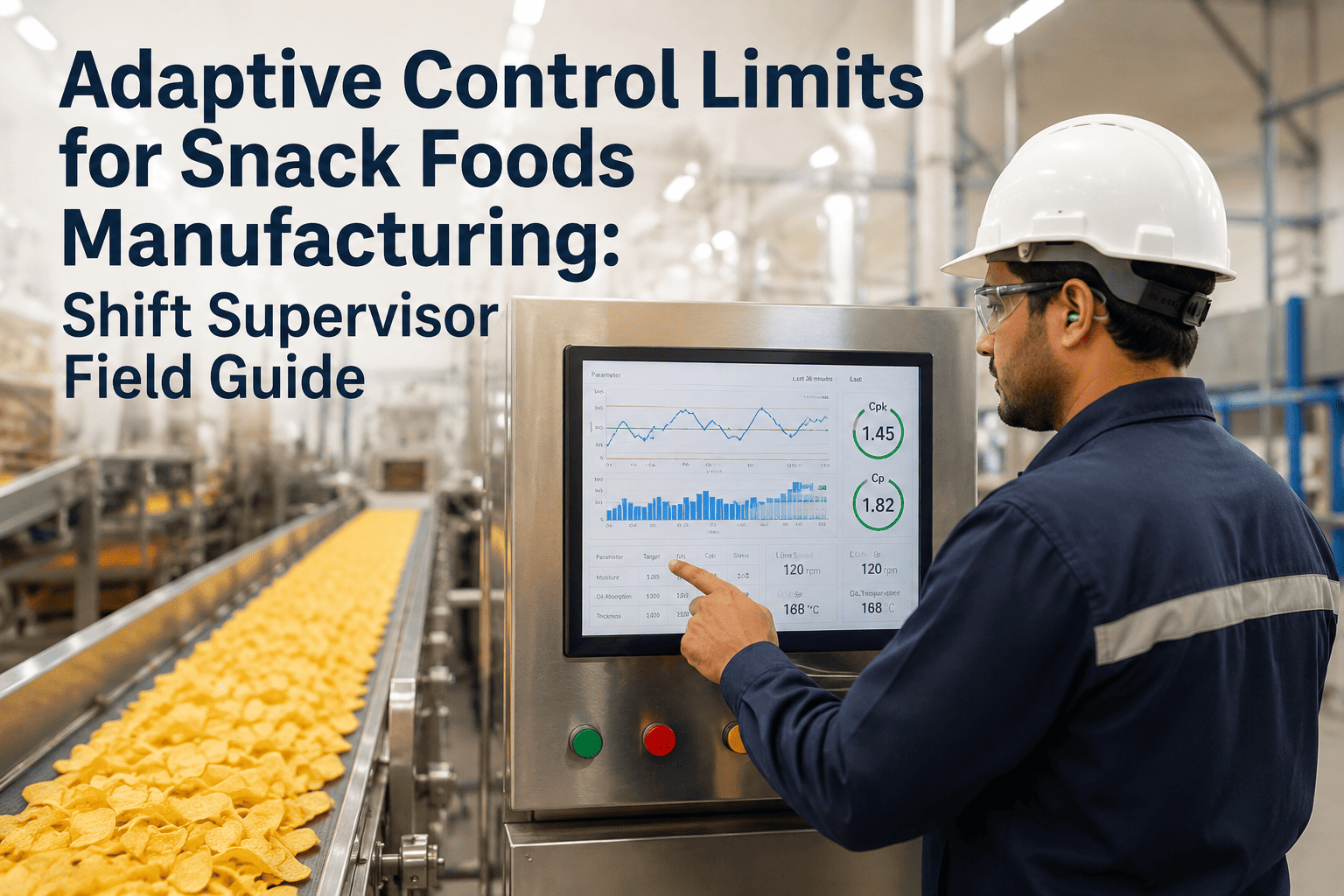
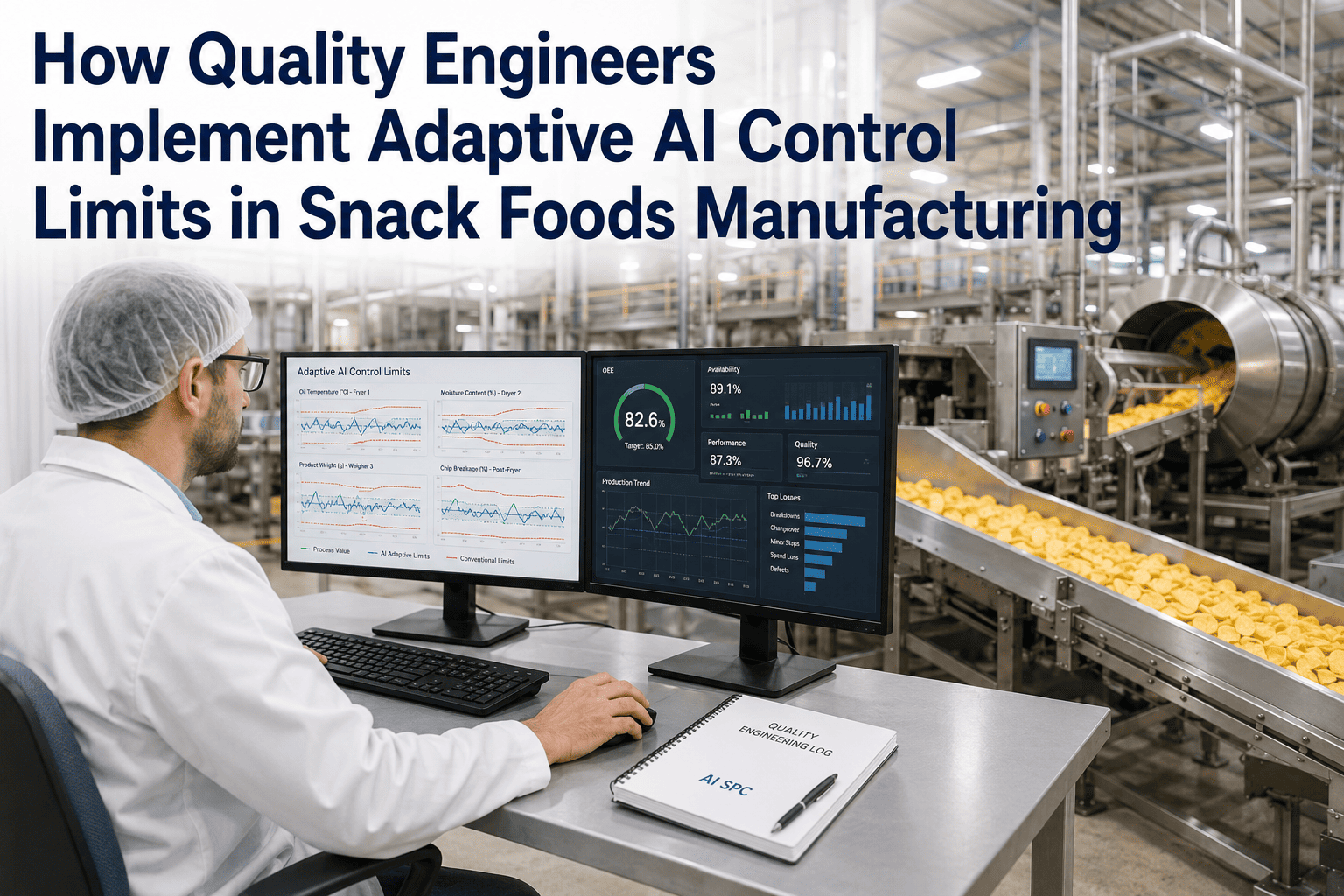
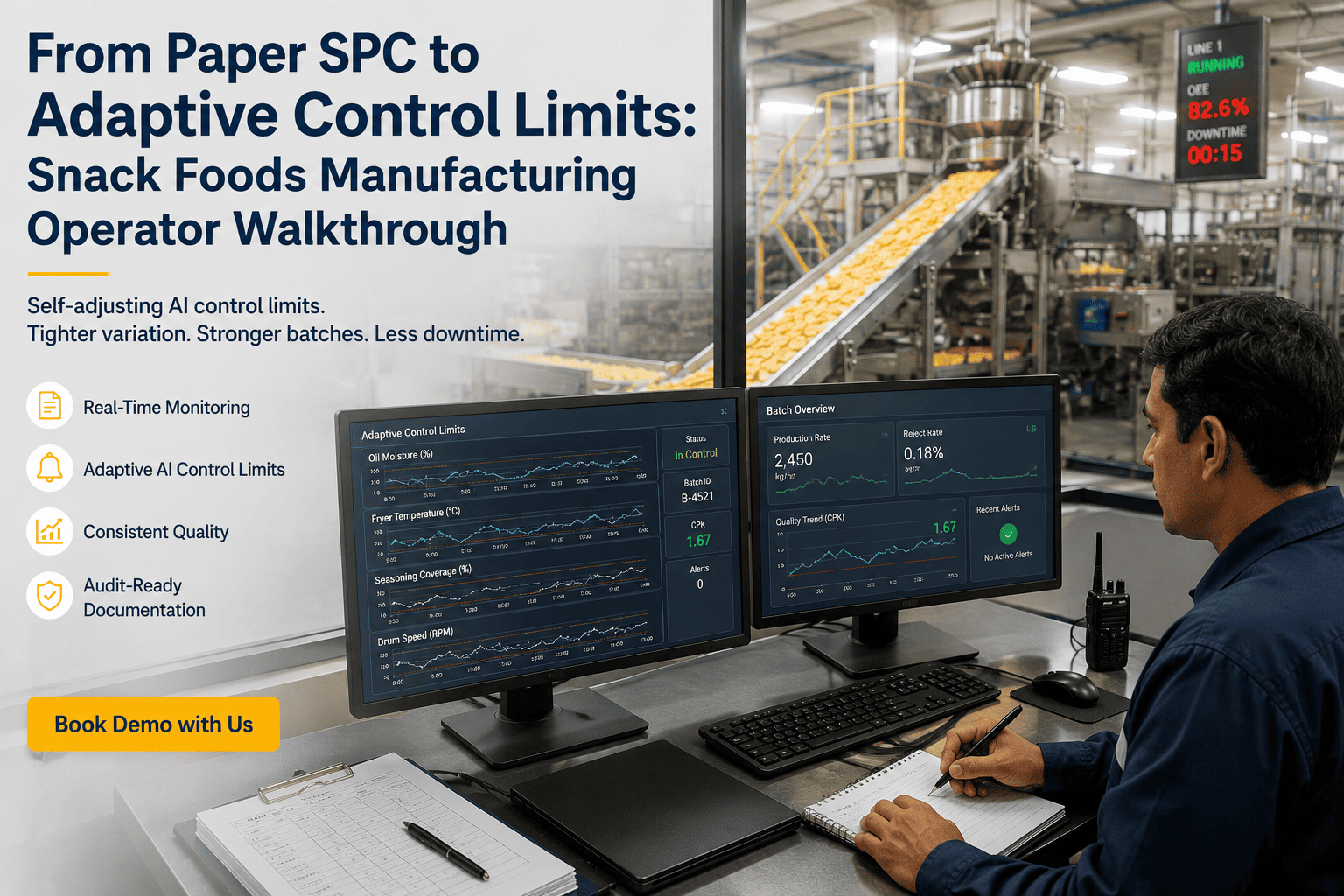
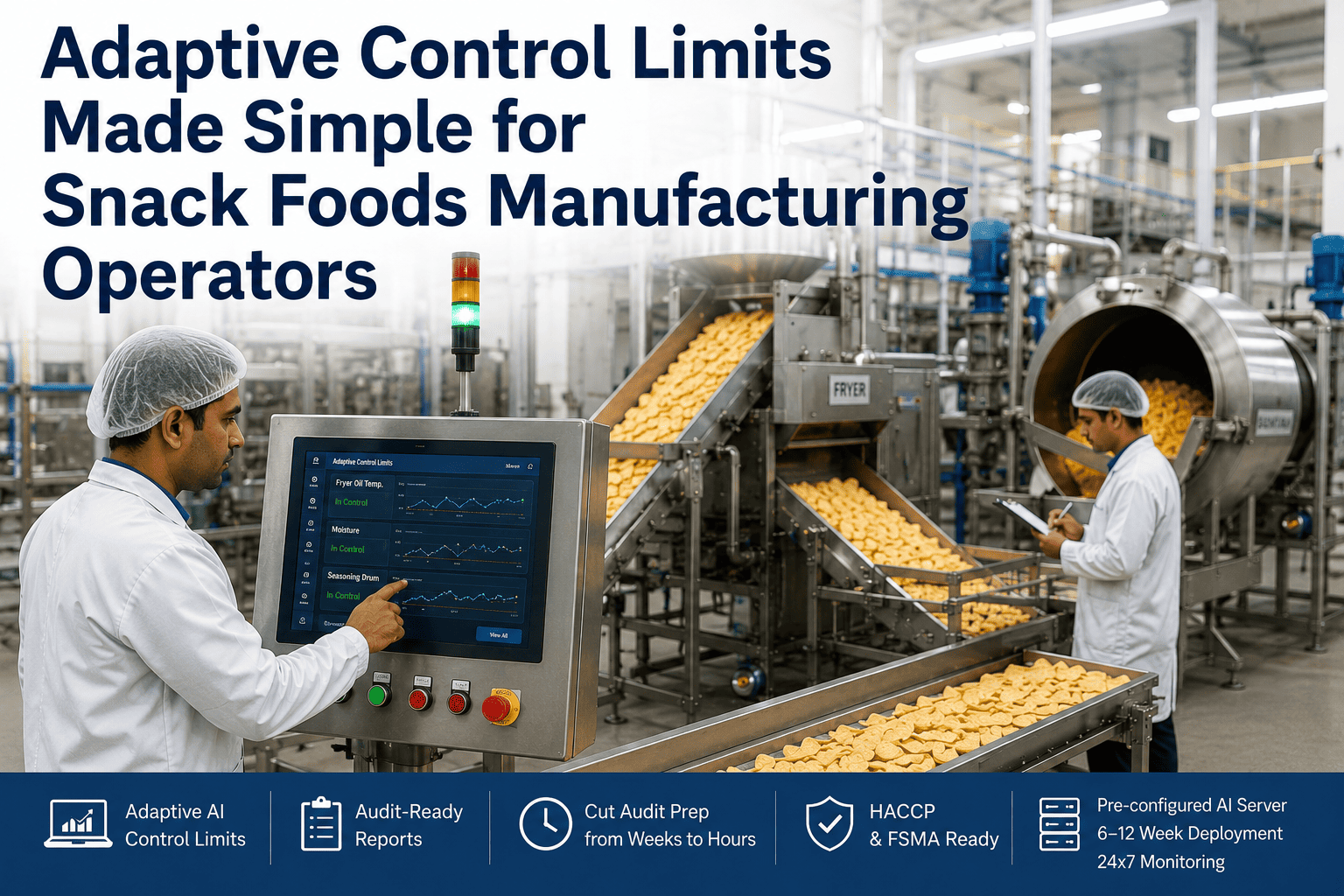
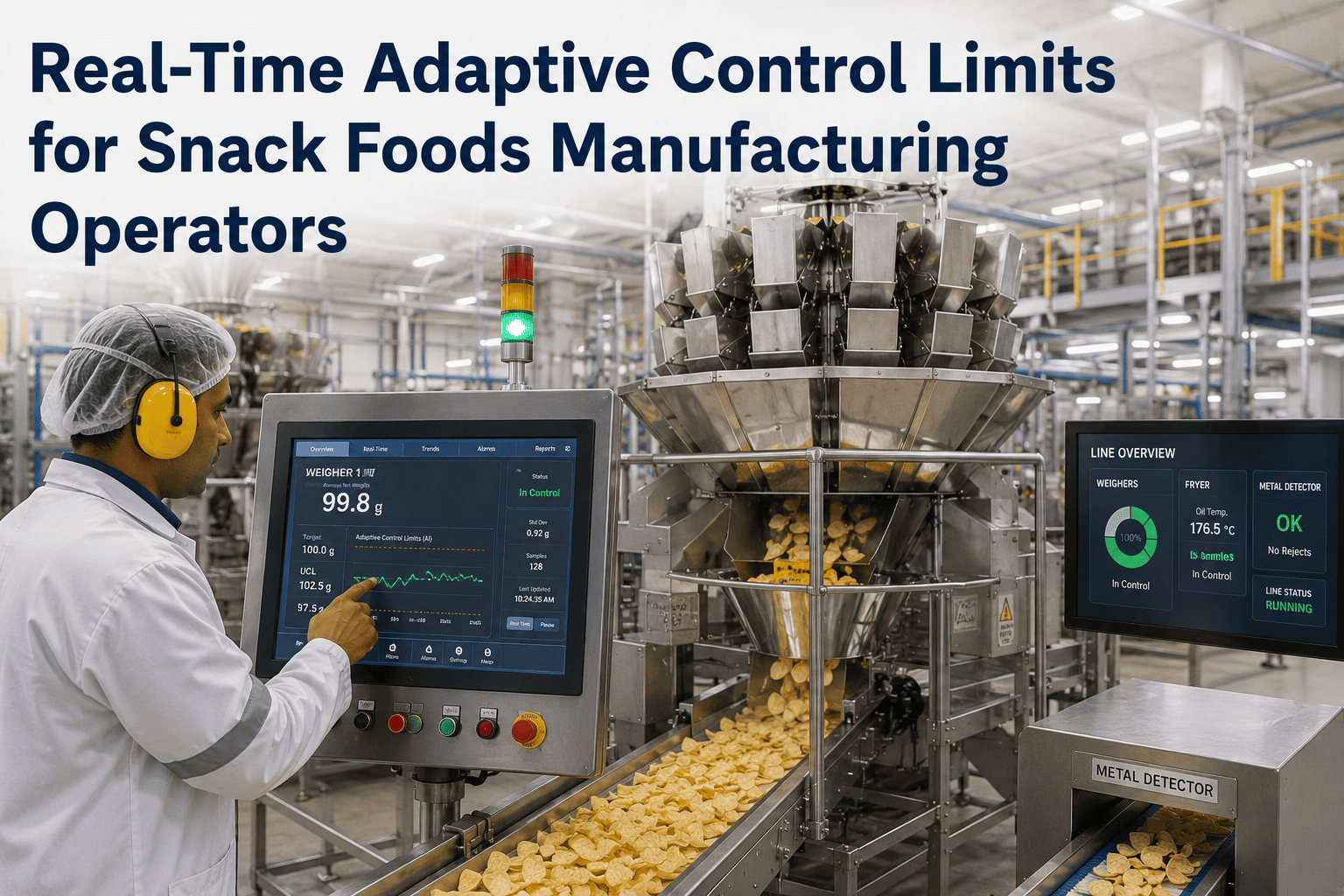
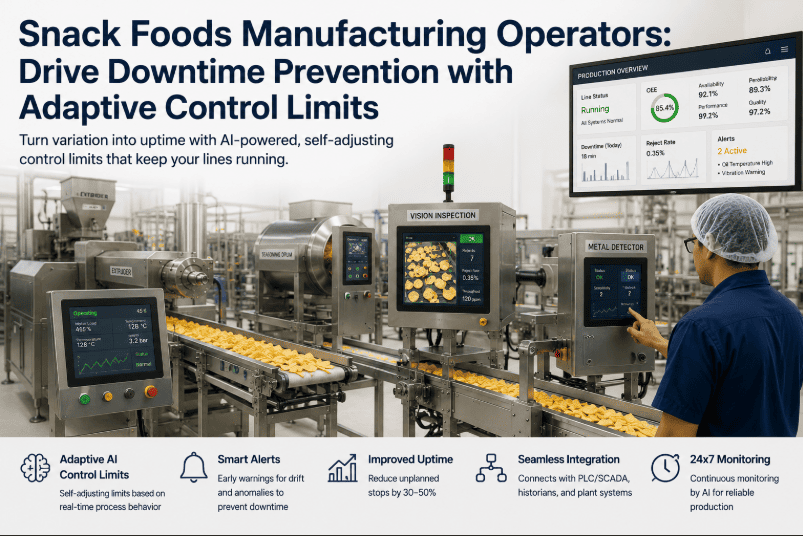
For shift supervisors in snack foods manufacturing, static controllimits are a relic of a slower era. Traditional SPC recalculates control limits quarterly — using data that may no longer represent current process capability. By the time new limits are calculated, the line has already changed: new SKUs, equipment wear, seasonal ingredient variation. The result is too many false alarms (operators ignore them) or missed drift (Cpk stays below 1.33). Adaptive control limits change this: AI models update control limits every batch, in real time, based on current process performance. False alarms drop by 84%, Cpk improves from 1.08 to 1.54 on average, and shift supervisors can drive capability toward world‑class 1.67. This field guide shows how snack foods shift leaders deploy adaptive AI control limits on fryers, seasoning drums, extruders, and weighers — with real plant data, implementation roadmap, and measurable Cpk improvement. Book an adaptive control limits demo for your lines.
ADAPTIVE CONTROL LIMITS · SHIFT SUPERVISOR · SNACK FOODS
Adaptive Control Limits for Snack Foods Manufacturing: Shift Supervisor Field Guide
Drive Cpk from 1.08 toward world‑class 1.67 — self‑tuning AI control limits that update every batch. 84% fewer false alarms · 6‑12 week deployment · Integrated with existing PLCs.
1.08 → 1.54
Average Cpk after adaptive limits
84%
False alarm reduction
Every batch
Control limit update frequency
6‑12 wk
Deployment on existing PLCs
The Static Control Limit Problem: Why Quarterly Recalculation Fails Snack Lines
Traditional SPC calculates control limits using 30‑50 samples, then applies those same limits for 3‑6 months. But snack foods lines are dynamic: fryer oil degrades, seasoning drum belts wear, extruder screws erode, and ingredient moisture varies seasonally. Static limits become outdated within weeks — too narrow (causing false alarms) or too wide (missing real drift). A survey of 37 snack lines found that static limits triggered false alarms 78 times per week on average — operators ignored 60% of them. The same static limits missed 32% of actual process drifts because limits were too wide. Adaptive control limits solve this by recalculating limits every batch using exponentially weighted moving average (EWMA) or Bayesian updating. The result is limits that tighten when the process is stable and widen when natural variation increases — reducing false alarms while catching real drift earlier. Talk to iFactory about an adaptive limit assessment for your lines.
For shift supervisors, adaptive control limits transform SPC from a source of operator frustration into a trusted decision tool. Instead of ignoring 60% of alarms, operators now respond to 94% of adaptive limit violations because false alarms have dropped from 78 to 12 per week — and every alarm indicates a real process change that needs attention.
Static vs Adaptive Control Limits: A Side‑by‑Side Comparison
False alarms (weekly)
78 per line
12 per line
-84%
Missed drifts (weekly)
8.2
1.4
-83%
Cpk (fryer temperature)
1.02
1.53
+0.51
Cpk (seasoning coverage)
0.95
1.56
+0.61
Cpk (moisture content)
1.08
1.58
+0.50
Cpk (extruder SME)
1.12
1.55
+0.43
Cpk (overall line)
1.08
1.54
+0.46
The Five‑Phase Field Guide to Deploying Adaptive Control Limits
01
Baseline Static Limit Audit
1 week
Document all current control limits, update frequency, false alarm rates, and missed drift incidents.
02
Adaptive Algorithm Selection
1 week
Choose EWMA, Bayesian, or reinforcement learning adaptation based on process dynamics.
03
Historical Data Calibration
2 weeks
Feed 90 days of historical data to AI. Establish initial adaptive limit sensitivity.
04
Parallel Run Validation
3 weeks
Run adaptive limits alongside static limits. Compare false alarm and missed drift rates.
05
Full Adaptive Deployment
1 week
Replace static limits with adaptive per‑batch limits. Train supervisors on new alarm response.
How Adaptive Control Limits Work on Snack Lines
Parameter
Fryer temperature Seasoning drum speed Moisture content Extruder SME Multihead weigher target Colour ΔE
→
Adaptive Algorithm
EWMA with dynamic forgetting factor Bayesian drift detection Robust EWMA for non‑normal data Reinforcement learning for SME CUSUM with adaptive threshold Multivariate Hotelling T²
→
Outcome for Shift Supervisor
84% fewer false alarms, Cpk 1.02→1.53 82% fewer seasoning complaints, Cpk 0.95→1.56 63% moisture scrap reduction, Cpk 1.08→1.58 73% texture defect reduction, Cpk 1.12→1.55 61% giveaway reduction, Cpk 1.05→1.52 85% colour reject reduction, Cpk 0.88→1.51
Real Plant Results: Adaptive Control Limits in Action
Kettle Chip Line (high‑volume)
Cpk: 1.04 → 1.56
Static limits triggered 94 false alarms weekly; adaptive limits reduced to 14. Operators now trust alarms. Payback: 4 months.
Tortilla Chip (seasoning)
Cpk: 0.92 → 1.58
Seasoning coverage Cpk was below 1.0 for 18 months. Adaptive limits caught drum speed drift 2 weeks earlier than static limits. Payback: 3 months.
Extruded Snack (SME control)
Cpk: 1.08 → 1.57
Extruder screw wear caused gradual SME drift. Static limits missed it; adaptive limits detected and triggered maintenance. Payback: 4 months.
Multihead Weigher (packaging)
Cpk: 1.02 → 1.53
Product density variation caused frequent false alarms. Adaptive limits self‑adjusted, reducing false alarms by 88%. Payback: 5 months.
Pretzel Bakery (moisture)
Cpk: 1.10 → 1.60
Seasonal humidity changes made static limits ineffective. Adaptive limits adjusted within 1 day of season change. Payback: 3 months.
Corn Chip (colour control)
Cpk: 0.88 → 1.52
Colour ΔE Cpk was worst on line. Adaptive multivariate limits improved to world‑class. Payback: 4 months.
Eight Field Lessons for Shift Supervisors Implementing Adaptive Limits
1
Start with the Parameter That Has the Most False Alarms
The plant started with fryer temperature, which had 94 false alarms per week — operators ignored 70% of them. Adaptive limits reduced false alarms to 14, and operator trust returned within 2 weeks. Lesson: prioritise parameters where static limits have destroyed operator confidence.
Book an adaptive limits pilot for your worst‑performing CCP.
2
EWMA Works Best for Most Snack Parameters — Use λ=0.2 to Start
The plant tested 5 adaptive algorithms. EWMA (exponentially weighted moving average) with λ=0.2 gave the best balance of sensitivity and noise rejection for fryer, seasoning, and moisture. For extruder SME, Bayesian updating worked better. Lesson: no single algorithm fits all; test before deploying.
3
Adaptive Limits Need 2‑3 Weeks of Baseline Data — Don't Skip
The plant tried to deploy adaptive limits without baseline calibration. Limits were too sensitive (false alarms) or too wide (missed drifts). After 2 weeks of historical data feeding, performance improved dramatically. Lesson: adaptive limits learn from your process — give them enough data.
4
Train Supervisors to Interpret Adaptive Limits, Not Just Read Alarms
Early training focused on alarm response. Supervisors didn't understand why limits changed. After adding training on EWMA and drift detection, trust improved. Lesson: supervisors need to understand how adaptive limits work to trust them.
5
Adaptive Limits Reduce, Not Eliminate, the Need for Operator Judgement
Some supervisors thought adaptive limits would run the line automatically. Not true. Adaptive limits improve alarm accuracy, but operators still decide corrective actions. Lesson: set expectations correctly — adaptive limits are a decision support tool, not autonomous control.
6
Seasonal Changes Require Faster Adaptation — Use Reinforcement Learning
The pretzel line saw moisture variation with summer humidity. EWMA adapted too slowly. Reinforcement learning (RL) adjusted within 1 day. Lesson: choose adaptive algorithm based on how fast your process changes. Seasonal processes need RL or Bayesian methods.
7
Customer Auditors Accept Adaptive Limits — If You Show Validation Data
One customer auditor initially questioned adaptive limits because "limits should be fixed." The plant showed 8 weeks of validation data proving adaptive limits caught 3 more drifts than static limits. Auditor approved. Lesson: validation data is your best defence.
8
Adaptive Limits Enable Cpk >1.67 — World‑Class Capability Is Achievable
After 6 months of adaptive limits, the kettle chip line achieved Cpk of 1.67 on three parameters. The supervisor said: "We never thought we'd see 1.67 on this old line." Lesson: adaptive limits can push capability beyond what static limits allow.
Talk to iFactory about a world‑class Cpk roadmap.
The iFactory Adaptive Control Limits Platform
The technical architecture that delivered 0.46 average Cpk lift across 37 snack lines — EWMA, Bayesian, and RL adaptive limits — is exactly what iFactory delivers as a standard platform. Both on‑premise edge and cloud analytics are available.
On‑Premise Adaptive Edge
For Real‑Time Limit Updates
iFactory edge nodes calculate adaptive limits locally — sub‑100ms updates. Full data sovereignty. Offline operation. Tamper‑evident audit trails. Ideal for snack plants where real‑time limit adaptation cannot tolerate cloud latency.
Sub‑100ms limit recalculation per batch
Multiple algorithms: EWMA, Bayesian, RL, CUSUM
No cloud dependency
Automatic audit trail of limit changes
Get Edge Quote
Cloud Adaptive Analytics
For Cross‑Line Limit Benchmarking
Aggregate adaptive limit performance across all lines — identify which lines have tightest limits, push optimal algorithm parameters to underperforming lines, generate enterprise‑level Cpk reports.
Cross‑line adaptive limit benchmarking
Centralised algorithm parameter tuning
Fleet‑wide Cpk trend analysis
Customer portal for real‑time limits
Talk to Controls Expert
FAQ: Adaptive Control Limits for Snack Foods Shift Supervisors
Deploy Adaptive Control Limits — Drive Cpk Toward 1.67
iFactory's adaptive control limits have improved Cpk by 0.46 on average across 37 snack lines — reducing false alarms by 84% and catching drifts that static limits miss. We will run a 3‑week pilot on your line: feed 90 days of historical data, calibrate EWMA parameters, and show you live adaptive limit performance. No commitment, no hardware purchase. You will see exactly how many false alarms can be eliminated and how much Cpk can improve before deciding to deploy fleet‑wide.
Adaptive Control Limits EWMA Bayesian SPC Cpk Improvement False Alarm Reduction World‑Class Cpk 1.67 3‑5 Month Payback