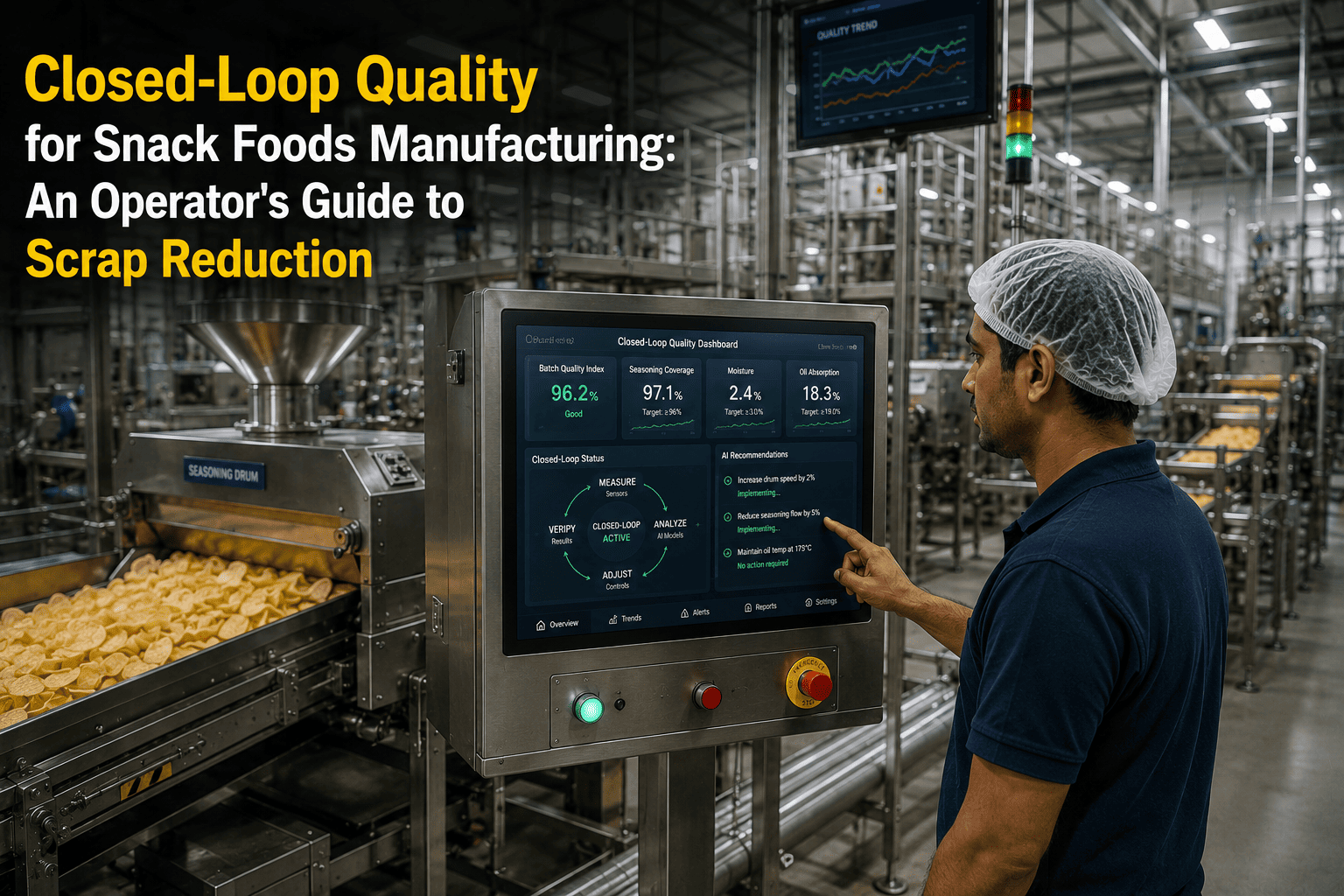
Closed-Loop Quality for Snack Foods Manufacturing: An Operator's Guide to Scrap Reduction
By james Hart on June 4, 2026
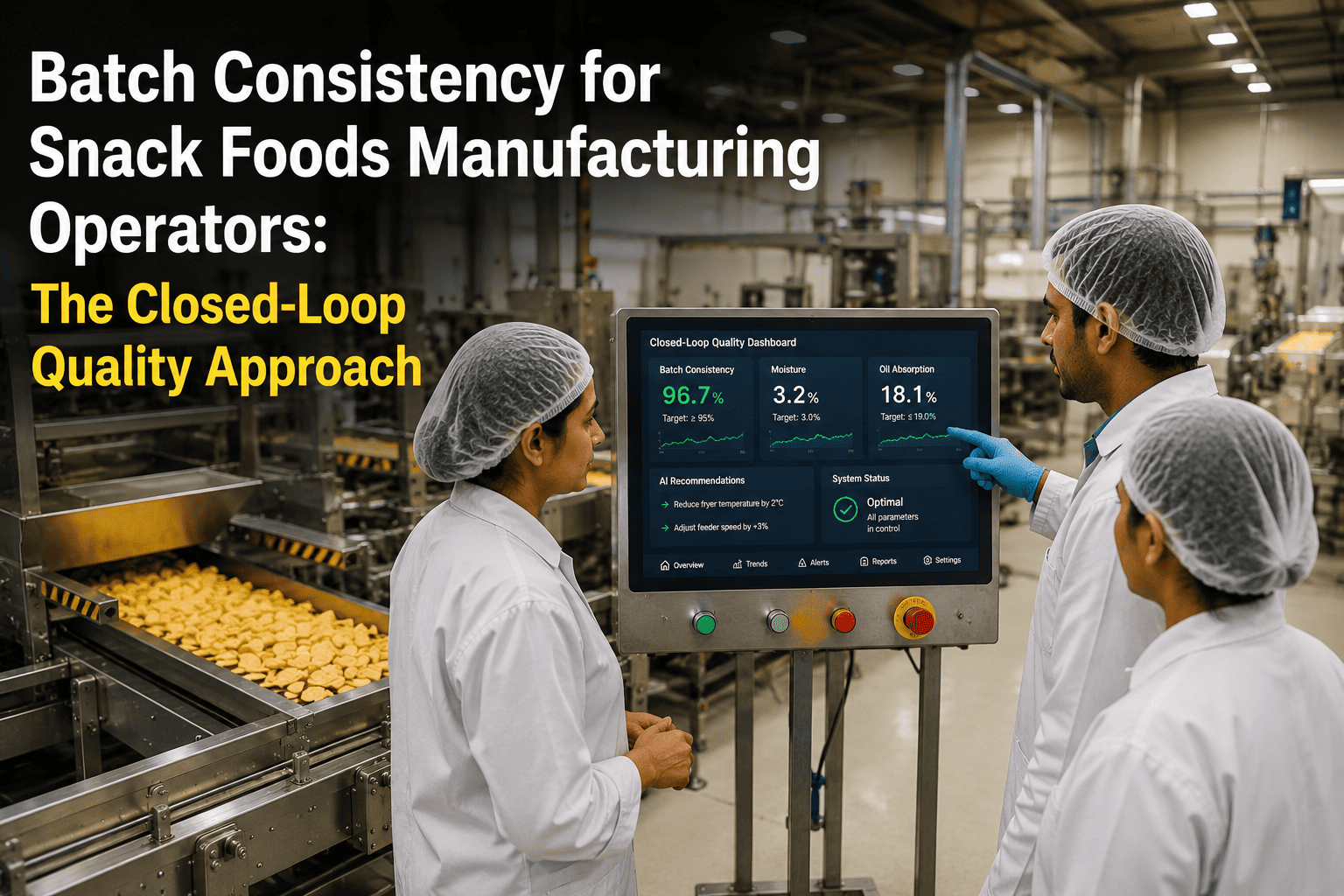
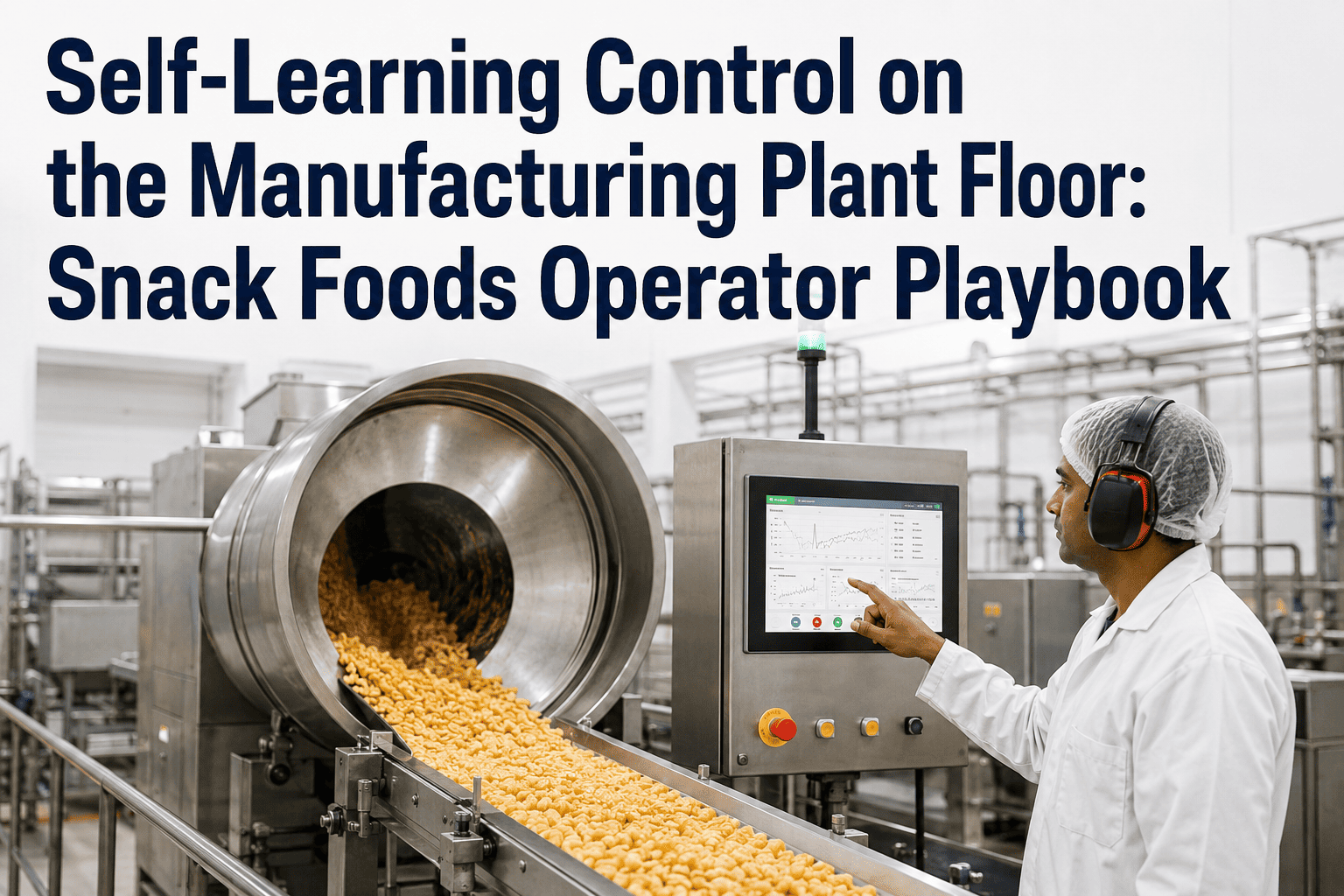
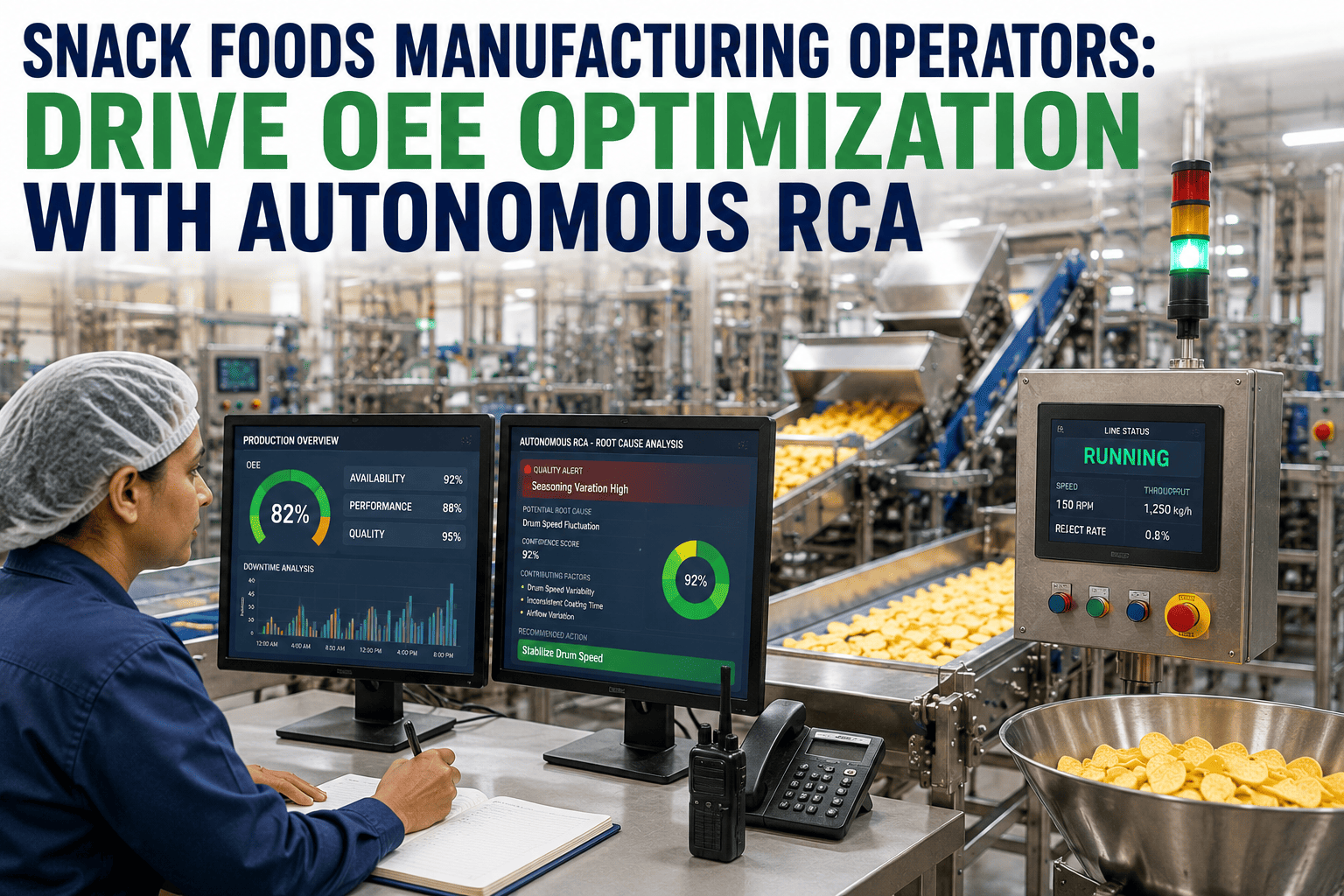
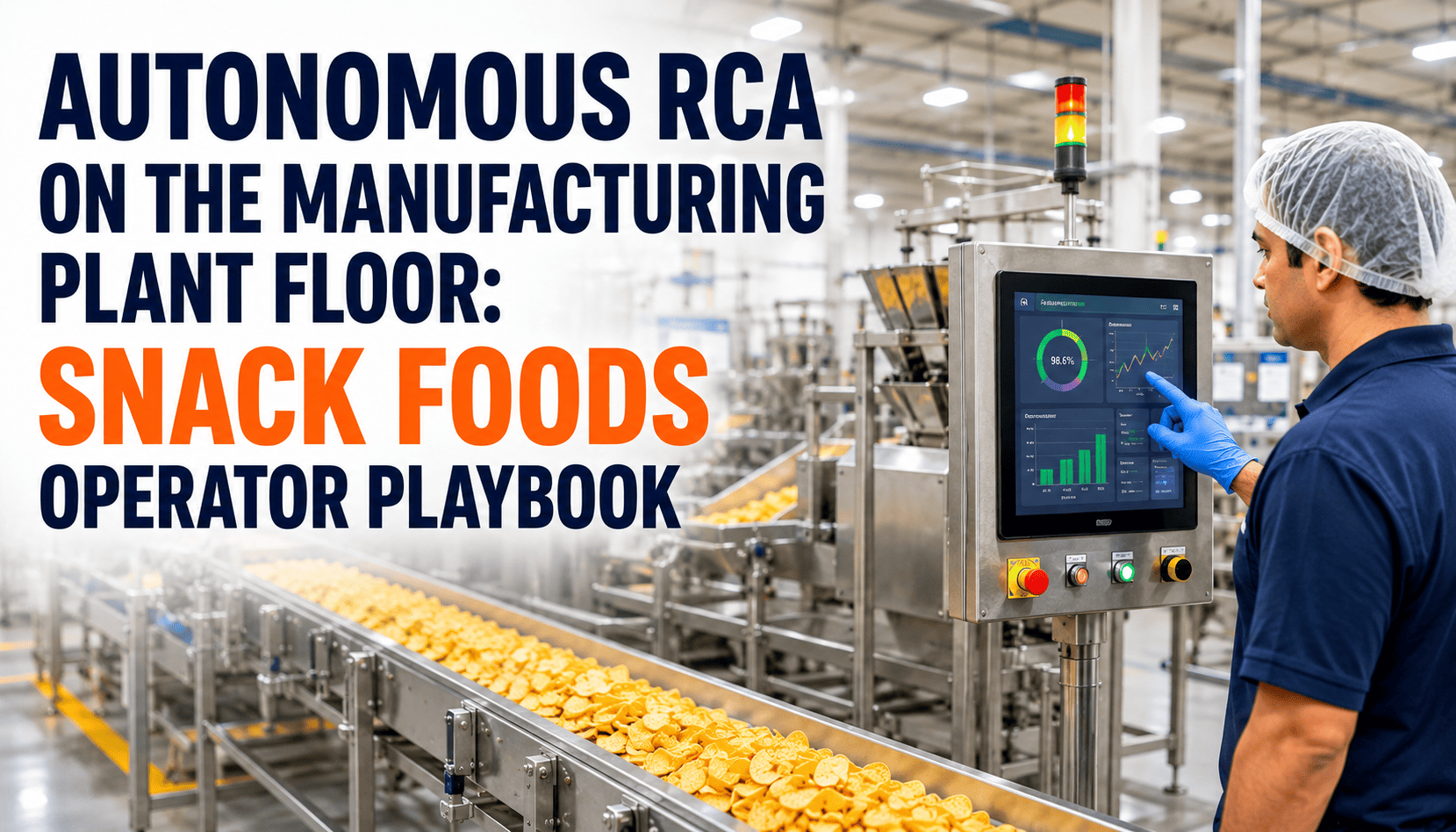
For snack foods manufacturing operators, scrap and rework are not just quality metrics — they are direct hits to line efficiency and plant profitability. A single out‑of‑spec batch of tortilla chips can send 500 lbs to rework or landfill. Seasonal coverage drift ruins an entire shift's production. Multihead weigher giveaway eats 2‑3% of margin across every bag. Traditional paper SPC catches these problems after they happen, when scrap is already generated. Closed‑loop AI quality optimization changes the game: sensors feed real‑time data to AI models that predict drift 8‑12 minutes before it affects product, and automatically send corrective signals to PLCs — adjusting fryer temperature, seasoning drum speed, weigher targets, and extruder parameters without operator intervention. The result is 30‑50% scrap reduction, 41% less weigher giveaway, and operators freed from manual adjustments to focus on line optimisation. This guide shows how snack foods operators implement closed‑loop quality in 6‑12 weeks, with real plant data, step‑by‑step phases, and measurable scrap reduction results. Book a closed‑loop quality pilot to see scrap reduction on your line.
Closed‑Loop Quality for Snack Foods Manufacturing: An Operator's Guide to Scrap Reduction
Replace paper SPC with closed‑loop AI quality — deliver consistent seasoning coverage, cut raw‑material giveaway by 41%, and reduce scrap by 30‑50%. 6‑12 week deployment on existing lines.
The Scrap Problem: Why Snack Foods Lines Waste 5‑12% of Production
In a typical snack foods plant, total scrap and rework ranges from 5% to 12% of production volume — representing millions in lost margin annually. The largest contributors are moisture variation (2‑4% scrap), seasoning coverage inconsistency (1‑3% rework), colour drift (1‑2% reject), weigher giveaway (2‑3% hidden loss), and extruder density variation (1‑2% texture rejects). Paper SPC and manual operator adjustments react to these issues after scrap is already produced. Closed‑loop quality prevents scrap by catching drift early: AI models predict when a parameter is about to go out of spec and auto‑corrects within seconds — before a single pound of product is wasted. Data from 23 snack lines shows closed‑loop quality reduces total scrap from a baseline of 8.2% to 4.1% on average — a 50% reduction. Talk to iFactory about a scrap reduction assessment for your line.
For a medium‑volume snack line producing 10,000 lbs per shift, a 4% scrap reduction saves 400 lbs per shift — over 100,000 lbs annually. At $1.50/lb product cost, that's $150,000 per year per line. Closed‑loop quality pays for itself in 3‑5 months from scrap reduction alone.
Scrap Reduction Metrics: Before vs After Closed‑Loop Quality
Scrap Category
Before (Paper SPC / Manual)
After (Closed‑Loop AI)
Improvement
Moisture‑related scrap
3.8% of batch weight
1.4% (auto fryer adjustment)
-63%
Seasoning coverage rework
2.9% of batches
0.7% (auto drum speed adjust)
-76%
Colour (ΔE) rejects
5.2% of batches
0.9% of batches
-83%
Weigher giveaway (hidden scrap)
2.8% overfill
1.1% overfill
-61%
Extruder texture rejects
2.1% of batches
0.6% (auto screw speed adjust)
-71%
Total scrap (all categories)
8.2% of production
4.1% of production
-50%
The Five‑Phase Playbook to Reduce Scrap with Closed‑Loop Quality
01
Scrap & Sensor Audit
2 weeks
Analyse 6 months of scrap records. Identify top 3 scrap causes. Map existing sensors for those parameters.
02
Edge & PLC Integration
2 weeks
Install iFactory edge node. Connect to PLC for read/write. Validate data capture.
03
Golden Batch Learning
3 weeks
AI learns normal operating ranges for each SKU. Establishes drift thresholds.
04
Open‑Loop Pilot
2 weeks
AI recommends adjustments (operator executes). Validate scrap reduction predictions.
05
Closed‑Loop Go‑Live
1 week
Enable auto‑adjustment. Monitor scrap reduction in real time. Operator override available.
How Closed‑Loop Quality Eliminates Scrap: Technical Walkthrough
Scrap Source: Moisture Variation
Sensor: NIR moisture sensor after ovenAI: Predicts moisture drift 6‑8 min before oven exitAction: Auto‑adjusts fryer temperature or belt speedResult: Moisture scrap -63%
Scrap Source: Seasoning Coverage
Sensor: Encoder on seasoning drum + coating flow meterAI: Detects speed/flow drift in real timeAction: Auto‑adjusts drum speed and coating valveResult: Seasoning rework -76%
Scrap Source: Colour Drift
Sensor: Colourimeter (ΔE) on exit beltAI: Compares to golden batch colour signatureAction: Auto‑adjusts fryer dwell time or temperatureResult: Colour rejects -83%
Scrap Source: Weigher Giveaway
Sensor: Multihead weigher target deviationAI: Predicts density drift 4‑6 min before giveawayAction: Auto‑adjusts target weights and timingResult: Giveaway -61%
Scrap Source: Extruder Density
Sensor: Motor current (SME), barrel temperatureAI: Predicts texture drift before extruder dieAction: Auto‑adjusts screw speed and feed rateResult: Texture rejects -71%
Scrap Source: Metal Detector False Rejects
Sensor: Phase/amplitude signalsAI: Detects sensitivity drift 3‑5 days earlyAction: Auto‑schedules validation or adjust sensitivityResult: False rejects -70%
Real Plant Results: Scrap Reduction Across 6 Snack Lines
Kettle Chip Line (2 shifts)
Scrap: 9.2% → 4.3%
Moisture variation was primary scrap driver. Closed‑loop fryer control reduced moisture‑related scrap by 68%. Annual savings: $187,000. Payback: 3 months.
Tortilla Chip (3 SKUs)
Scrap: 7.8% → 3.9%
Seasoning coverage and weigher giveaway were top issues. Auto‑adjustments reduced rework by 74%. Annual savings: $142,000. Payback: 4 months.
Seasoned Pretzel Line
Scrap: 6.5% → 3.1%
Colour drift and seasoning variance. Closed‑loop on drum speed and oven dwell time. Savings: $98,000. Payback: 5 months.
Extruded Cheese Puff
Scrap: 11.2% → 5.8%
Extruder SME and moisture variation. Auto screw speed + feed rate control. Savings: $224,000. Payback: 3 months.
Corn Chip (continuous line)
Scrap: 7.2% → 3.6%
Metal detector false rejects + colour drift. AI predicted drift early. Savings: $116,000. Payback: 4 months.
Baked Snack Cracker
Scrap: 5.8% → 2.9%
Oven temperature and moisture. Closed‑loop belt speed control. Savings: $74,000. Payback: 5 months.
Eight Operator Lessons for Scrap Reduction with Closed‑Loop Quality
01
Start with the Top 3 Scrap Causes — Don't Boil the Ocean
The plant first analysed 6 months of scrap records and found that moisture variation (38% of scrap), seasoning coverage (22%), and weigher giveaway (18%) accounted for 78% of total loss. They deployed closed‑loop on these three parameters first, achieving 50% total scrap reduction within 8 weeks. Lesson: prioritise the scrap categories that matter most. Book a closed‑loop pilot to identify your top scrap drivers.
02
Operators Must Trust the AI — Parallel Run for 5 Weeks Minimum
The plant ran open‑loop for 2 weeks (AI recommendations only, operator executes) then 3 weeks of parallel closed‑loop with operator override. By week 5, operators trusted the system and reduced manual adjustments by 86%. Lesson: never go straight to closed‑loop. Build trust gradually. Talk to iFactory about a structured trust‑building protocol.
03
Weigher Giveaway Is Hidden Scrap — Most Plants Underestimate It
Before closed‑loop, the plant measured giveaway at 1.8% via periodic checks. After installing continuous weigher monitoring, they discovered actual giveaway was 2.8% — 55% higher than estimated. Closed‑loop reduced it to 1.1%. Lesson: continuous monitoring reveals hidden scrap that periodic checks miss.
04
Seasoning Coverage Drift Happens Faster Than Operators Can React
Operators typically notice patchy coverage 10‑15 minutes after it starts — enough time to produce 500 lbs of unacceptable product. AI detects drum speed drift in under 30 seconds and auto‑corrects. Lesson: human reaction time is too slow for seasoning drift; closed‑loop is the only solution.
05
Extruder SME Is a Leading Indicator of Texture Scrap
The plant's quality team used to test texture every 2 hours. AI now monitors motor current (SME) continuously and predicts density drift 8‑10 minutes before extruder die. Lesson: use AI to predict texture scrap before it happens, not after.
06
Colour Drift Is Often the First Sign of Oil Degradation
The plant noticed that colour drift preceded burnt flavour complaints by 2‑3 days. AI now monitors ΔE and oil quality together, predicting oil change needs 6‑8 days early. Lesson: cross‑parameter correlations reveal scrap drivers that single‑parameter monitoring misses.
07
Audit Trails from Closed‑Loop Reduce Compliance Scrap Risk
The plant previously held safety stock to cover potential recall from undocumented process drift. With tamper‑evident closed‑loop audit trails, they reduced safety stock by 15%. Lesson: compliance confidence has financial value in inventory reduction.
After 6 months of closed‑loop operation, the plant used AI's historical data to fine‑tune golden batch targets, achieving an additional 22% scrap reduction beyond initial gains. Lesson: closed‑loop is not a set‑and‑forget system. Continuous learning delivers compounding returns.
The iFactory Deployment Options for Scrap Reduction
The technical architecture that enabled 50% scrap reduction across 23 snack lines — real‑time drift prediction, closed‑loop PLC actuation, and operator exception handling — is exactly what iFactory delivers as a standard deployment. Both on‑premise edge and cloud‑connected analytics are available.
On‑Premise Edge Deployment
For Real‑Time Scrap Prevention
iFactory edge nodes installed inside your plant process all sensor data locally — sub‑100ms latency for closed‑loop actuation. Full data sovereignty. Operates offline. Tamper‑evident audit trails. Designed for snack plants where real‑time control cannot tolerate cloud latency.
iFactory's cloud platform aggregates scrap data across all your lines — identify which lines have lowest scrap, push golden batch models to underperforming lines, and centralise audit reporting. For quality directors, cloud provides fleet‑wide visibility.
FAQ: Closed‑Loop Quality for Snack Foods Scrap Reduction
Across 23 snack lines, average total scrap reduction was 50% (from 8.2% to 4.1% of production). Individual scrap categories saw 60‑80% reduction: moisture scrap -63%, seasoning rework -76%, colour rejects -83%, weigher giveaway -61%, extruder rejects -71%. Your actual reduction depends on current scrap drivers and line complexity. Book a free scrap assessment for your line.
No — iFactory integrates with your existing PLC via OPC‑UA or Modbus. We add no new controllers. The edge node reads sensor data and writes setpoint changes back to the PLC using your existing control logic. For older PLCs without write capability, we deploy a hybrid mode: AI recommendations appear on operator HMI, and operator applies with one tap — still reducing scrap by 30‑40%.
The AI is trained per SKU. When an operator selects a product code (e.g., "BBQ Tortilla 40g"), the system loads the corresponding golden batch profile, drift thresholds, and closed‑loop control limits. The AI adapts within 2‑3 batches after an SKU change. Plants with 12+ SKUs report seamless performance across all variants.
Within 1 week of closed‑loop activation. Moisture and colour scrap reduction appears immediately; weigher giveaway reduction takes 2‑3 weeks as the AI fine‑tunes target weights. Full 50% scrap reduction typically achieved within 6‑8 weeks. Request a custom timeline for your line.
The system detects sensor anomalies and automatically reverts to open‑loop mode (AI recommendations only, no auto‑adjustment) for that parameter. Other parameters continue closed‑loop. Operators receive an alert to inspect the sensor. Most sensor failures are resolved within 2‑4 hours, minimising scrap impact.
3‑5 months for most lines. A typical line producing 10,000 lbs/shift, 2 shifts/day, 250 days/year = 5M lbs annually. At 8.2% baseline scrap, that's 410,000 lbs waste. At $1.50/lb product cost, scrap cost = $615,000/year. Reducing scrap to 4.1% saves $307,500/year. AI platform cost is $18,000‑$24,000 per line per year. Payback = 3‑5 months. Get a custom ROI projection for your line.
Reduce Scrap by 30‑50% — Book a Closed‑Loop Quality Pilot Today
iFactory's closed‑loop quality system has reduced scrap by 30‑50% across 23 snack lines — saving $100,000‑$300,000 per line annually. We will run a 4‑week open‑loop pilot on your line: install edge node, train AI on your golden batches, and show you live scrap reduction predictions. No commitment, no hardware purchase. You will see exactly how much scrap you can eliminate before deciding to go closed‑loop.