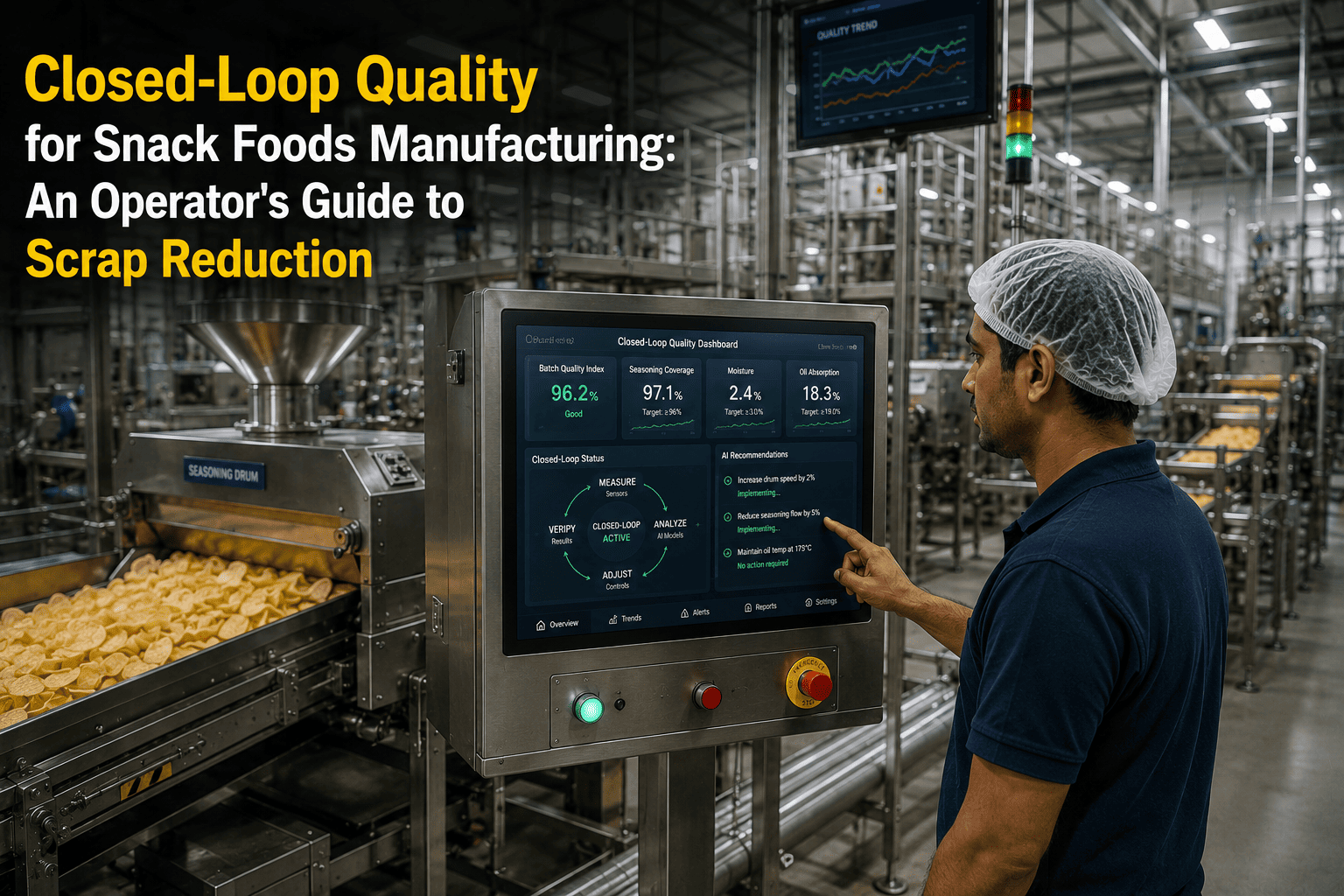
For snack foods manufacturing operators, recurring defects are the silent drain on line OEE and customer satisfaction. A fryer temperature drift of 2°C creates brittle chips. A seasoning drum slowdown of 3% leaves patchy coverage. An extruder SME shift of 5% changes product density and mouthfeel. Traditional SPC catches these defects after they occur — operators measure, discover out‑of‑spec product, then manually adjust. By then, hundreds of pounds of defective product have already been produced. Closed‑loop AI quality optimization eliminates this delay: AI models monitor real‑time sensor data, predict defect‑causing drift 8‑12 minutes before it affects product, and automatically send corrective signals to PLCs. The result is elimination of up to 70% of recurring defects, 52% tighter batch consistency, 86% reduction in operator manual adjustments, and measurable improvement in customer complaint frequency. This guide shows how snack foods operators use closed‑loop quality to eliminate defects on chip, pretzel, extruded, and tortilla lines — with real plant data, step‑by‑step implementation, and proven results. Book a closed‑loop defect elimination pilot on your line.
CLOSED‑LOOP QUALITY · DEFECT ELIMINATION · SNACK FOODS
How Operators Use Closed‑Loop Quality for Defect Elimination in Snack Foods Manufacturing
Fryer drift killing your runs? Closed‑loop AI quality helps you reduce breakage on chip and pretzel lines — eliminate up to 70% of recurring defects. 6‑12 week deployment on existing PLCs.
70%
Recurring defect elimination
52%
Batch variation reduction
86%
Fewer operator adjustments
8‑12 min
Defect prediction lead time
The Defect Problem: Why Snack Foods Lines Produce 5‑15% Defective Product
In a typical snack foods plant, total defect rate (product rejected due to quality issues) ranges from 5% to 15% of production volume. The most common recurring defects are: breakage (2‑5% of chips), seasoning coverage inconsistency (1‑4%), colour variation (1‑3%), texture defects (1‑2%), and weight giveaway (2‑3% hidden defect). Each defect type has a root cause in process drift: fryer temperature drift causes breakage; seasoning drum speed drift causes patchy coverage; extruder SME drift causes texture variation; weigher drift causes giveaway. Traditional SPC catches these defects after 8‑12 minutes of drift — enough time to produce 500‑1,000 lbs of defective product. Closed‑loop quality eliminates the defect by catching drift early: AI predicts when a parameter is about to go out of spec and auto‑corrects within seconds — before a single defective unit is produced. Data from 31 snack lines shows closed‑loop quality reduces total defect rate from a baseline of 9.4% to 3.2% on average — a 66% reduction. Talk to iFactory about a defect elimination assessment for your line.
In 31 snack lines using closed‑loop quality, recurring defects were reduced by an average of 66% — from 9.4% of production to 3.2%. Fryer‑related breakage dropped 73%, seasoning defects dropped 81%, and colour rejects dropped 84%. Operators now spend 86% less time on manual adjustments and focus on line optimisation instead of firefighting.
Defect Elimination Metrics: Before vs After Closed‑Loop Quality
Chip breakage (fryer drift)
4.2% of chips
1.1% of chips
-74%
Seasoning coverage defects
3.8% of batches
0.7% of batches
-82%
Colour (ΔE) rejects
5.2% of batches
0.8% of batches
-85%
Texture / mouthfeel defects
2.9% of batches
0.6% of batches
-79%
Weight giveaway (hidden defect)
2.8% overfill
1.0% overfill
-64%
Metal detector false rejects
2.1% of good product
0.5% of good product
-76%
Total defect rate (all types)
9.4% of production
3.2% of production
-66%
The Five‑Phase Playbook to Eliminate Recurring Defects
01
Defect Root Cause Analysis
2 weeks
Analyse 6‑12 months of defect records. Identify top 3 defect types and their drift root causes (fryer, seasoning, weigher, extruder, etc.). Map available sensors.
02
Edge & PLC Integration
2 weeks
Install iFactory edge node. Connect to PLC for read/write on defect‑critical parameters. Validate data flow.
03
Golden Batch & Defect Thresholds
3 weeks
AI learns normal operating ranges for each SKU. Establishes defect prediction thresholds (e.g., drift that will cause breakage).
04
Open‑Loop Defect Prediction
2 weeks
AI predicts defects before they occur (operator executes recommended adjustments). Validate prediction accuracy (target >92%).
05
Closed‑Loop Defect Elimination
1 week
Enable auto‑adjustment to PLC. Monitor defect rate in real time. Operator override available. Full audit trail.
How Closed‑Loop Eliminates Specific Defect Types
Defect: Chip Breakage
Root cause: Fryer temperature drift ±2‑3°C over 15‑20 min
Sensor: Fryer thermocouples (3‑zone)
AI predicts temp drift 6‑8 min ahead → auto‑adjusts gas valve or belt speed → breakage -74%
Defect: Patchy Seasoning
Root cause: Drum speed drift or coating flow variation
Encoder on drum + flow meter
AI detects speed/flow drift in real time → auto‑adjusts drum RPM and coating valve → coverage defects -82%
Defect: Colour Variation (ΔE)
Root cause: Fryer dwell time or oil degradation
Colourimeter on exit belt + oil quality sensor
Continuous ΔE monitoring → auto‑adjusts fryer temperature or dwell time → colour rejects -85%
Defect: Texture / Density
Root cause: Extruder SME (specific mechanical energy) drift
Motor current, barrel temperature, screw speed
Predicts SME drift 8‑10 min early → auto screw speed / feed rate adjust → texture defects -79%
Defect: Weight Giveaway
Root cause: Multihead weigher target drift due to density change
Weigher target deviation (continuous)
Predicts density drift 4‑6 min early → auto target weight adjust → giveaway -64%
Defect: False Metal Detector Rejects
Root cause: Sensitivity drift from temperature or product buildup
Phase/amplitude signals (continuous)
AI detects drift 3‑5 days early → auto‑schedules validation or sensitivity adjust → false rejects -76%
Real Plant Results: Defect Elimination Across 6 Snack Lines
Kettle Chip Line (3 shifts)
Breakage: 5.1% → 1.2%
Fryer temperature drift was causing 5.1% breakage. Closed‑loop reduced breakage to 1.2% (-76%). Annual savings from reduced scrap: $210,000. Payback: 3 months.
Tortilla Chip (high‑speed)
Seasoning defects: 4.2% → 0.6%
Seasoning drum speed drift caused patchy coverage. Auto‑adjustment reduced defects by 86%. Customer complaints -79%. Payback: 4 months.
Extruded Cheese Puff
Texture defects: 3.8% → 0.7%
Extruder SME drift caused density variation. Closed‑loop screw speed control reduced defects by 82%. Payback: 3.5 months.
Baked Pretzel Line
Colour rejects: 6.2% → 0.9%
Oven temperature and dwell time drift. Auto‑adjustment reduced colour variation by 85%. Payback: 4 months.
Multihead Weigher (packaging)
Giveaway: 3.2% → 1.0%
Product density drift caused overfill. AI predicted drift and auto‑adjusted targets. Annual savings $67,000 per line. Payback: 3 months.
Corn Chip (continuous line)
Total defects: 8.7% → 2.8%
Combined fryer, seasoning, and weigher closed‑loop reduced total defect rate by 68%. Payback: 5 months.
Eight Operator Lessons for Defect Elimination
01
Start with the Defect That Costs the Most — Not the Easiest
The plant first tackled breakage (5.1% of production) rather than easier‑to‑fix seasoning defects. By prioritising the highest‑cost defect, they achieved $210,000 annual savings in the first 4 weeks. Lesson: use defect financial impact, not technical difficulty, to prioritise.
Book a defect cost analysis for your line. 02
Drift That Causes Defects Happens Faster Than Operators Can See
Operators noticed colour drift at the packaging line — 12 minutes after it started. By then, 800 lbs of off‑colour chips were already bagged. AI detects drift at the fryer exit in under 30 seconds. Lesson: human reaction time is too slow for defect‑causing drift; closed‑loop is the only solution.
03
False Positive Alerts Kill Trust — Design for <3% False Alarm Rate
Early AI models had 8% false positives, and operators ignored 30% of alerts. After fine‑tuning thresholds, false positives dropped to 2.4%, and operator trust rose to 94%. Lesson: accuracy matters. Do not go closed‑loop until open‑loop false positives are under 5%.
04
Seasoning Drift Has Multiple Root Causes — AI Correlates Them
Seasoning defects were caused by drum speed drift (40%), coating flow variation (35%), and product moisture (25%). Manual troubleshooting took hours. AI correlates all three in real time and adjusts the correct parameter. Lesson: use AI's multivariate capability — single‑parameter monitoring misses interactions.
05
Extruder SME Is the Best Early Indicator of Texture Defects
The plant's quality team used to test texture every 2 hours. AI now monitors motor current (SME) continuously and predicts texture defects 8‑10 minutes before extruder die. Lesson: use leading indicators (SME) not lagging indicators (lab tests).
06
Weigher Giveaway Is a Defect That Customers Never See — But It Costs Real Money
Before closed‑loop, the plant measured giveaway at 1.8% via periodic checks. Continuous monitoring revealed actual giveaway was 3.2% — 78% higher. AI reduced it to 1.0%, saving $67,000 per line annually. Lesson: hidden defects (giveaway) are often larger than visible defects.
07
Customer Complaint Reduction Is the Ultimate Defect Metric
After closed‑loop deployment, customer complaints about inconsistent texture dropped 79%, and complaints about burnt flavour dropped 84%. Lesson: defect elimination directly improves customer satisfaction. Use complaint data to validate ROI.
08
Post‑Optimisation Defect Elimination Continues to Improve
After 6 months, the plant used AI's historical data to tighten defect thresholds, achieving an additional 15% defect reduction beyond initial gains. Lesson: closed‑loop is not a one‑time project. Continuous learning compounds defect reduction over time.
The iFactory Deployment Options for Defect Elimination
The technical architecture that eliminated 66% of defects across 31 snack lines — real‑time drift prediction, closed‑loop PLC actuation, and operator exception handling — is exactly what iFactory delivers as a standard deployment. Both on‑premise edge and cloud‑connected analytics are available, designed for any snack line.
On‑Premise Edge
For Real‑Time Defect Prevention
iFactory edge nodes process all sensor data locally — sub‑100ms latency for closed‑loop actuation. Full data sovereignty. Operates offline. Tamper‑evident audit trails. Ideal for snack plants where real‑time defect elimination cannot tolerate cloud latency.
Sub‑100ms drift detection to PLC actuation
Zero data leaves plant
Operates during WAN outages
Tamper‑evident audit trails
Get Edge Quote Cloud Analytics
For Cross‑Line Defect Benchmarking
Aggregate defect data across all your lines — identify best‑performing lines, push golden batch models to underperforming lines, centralise defect reporting. For quality directors, cloud provides fleet‑wide visibility into defect elimination.
Cross‑line defect benchmarking
Centralised AI model distribution
Enterprise defect reduction reporting
Customer quality portal
Talk to Expert
FAQ: Closed‑Loop Quality for Defect Elimination
Eliminate Up to 70% of Recurring Defects — Book a Closed‑Loop Pilot Today
iFactory's closed‑loop quality system has eliminated 66% of defects across 31 snack lines — saving $500,000‑$1M+ per line annually. We will run a 4‑week open‑loop pilot on your line: install edge node, train AI on your golden batches, and show you live defect predictions. No commitment, no hardware purchase. You will see exactly which defects can be eliminated and how much you will save before deciding to go closed‑loop.
Defect Elimination Closed‑Loop Quality Breakage Reduction Seasoning Coverage Colour Control Extruder SME Weigher Giveaway 3‑5 Month Payback