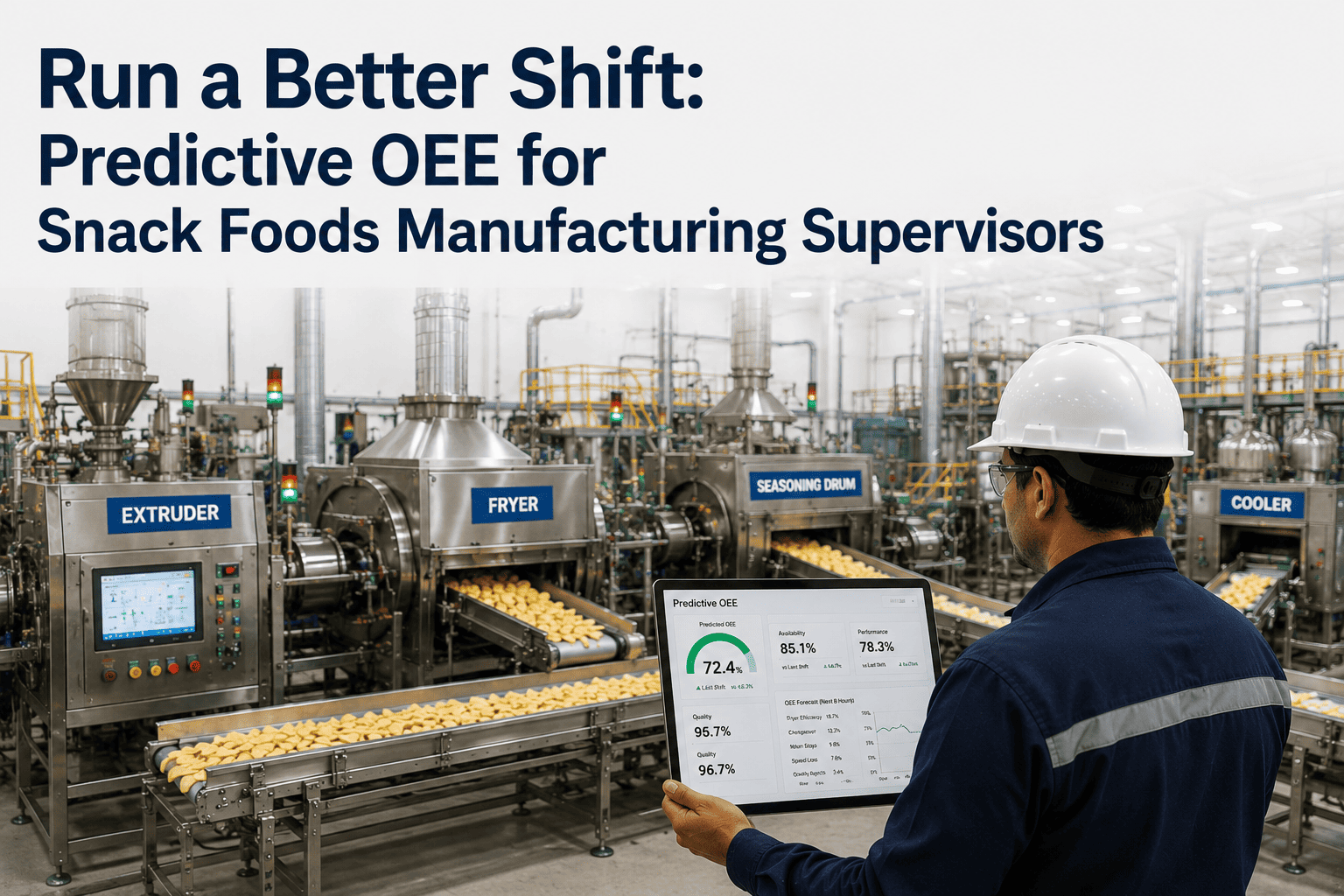
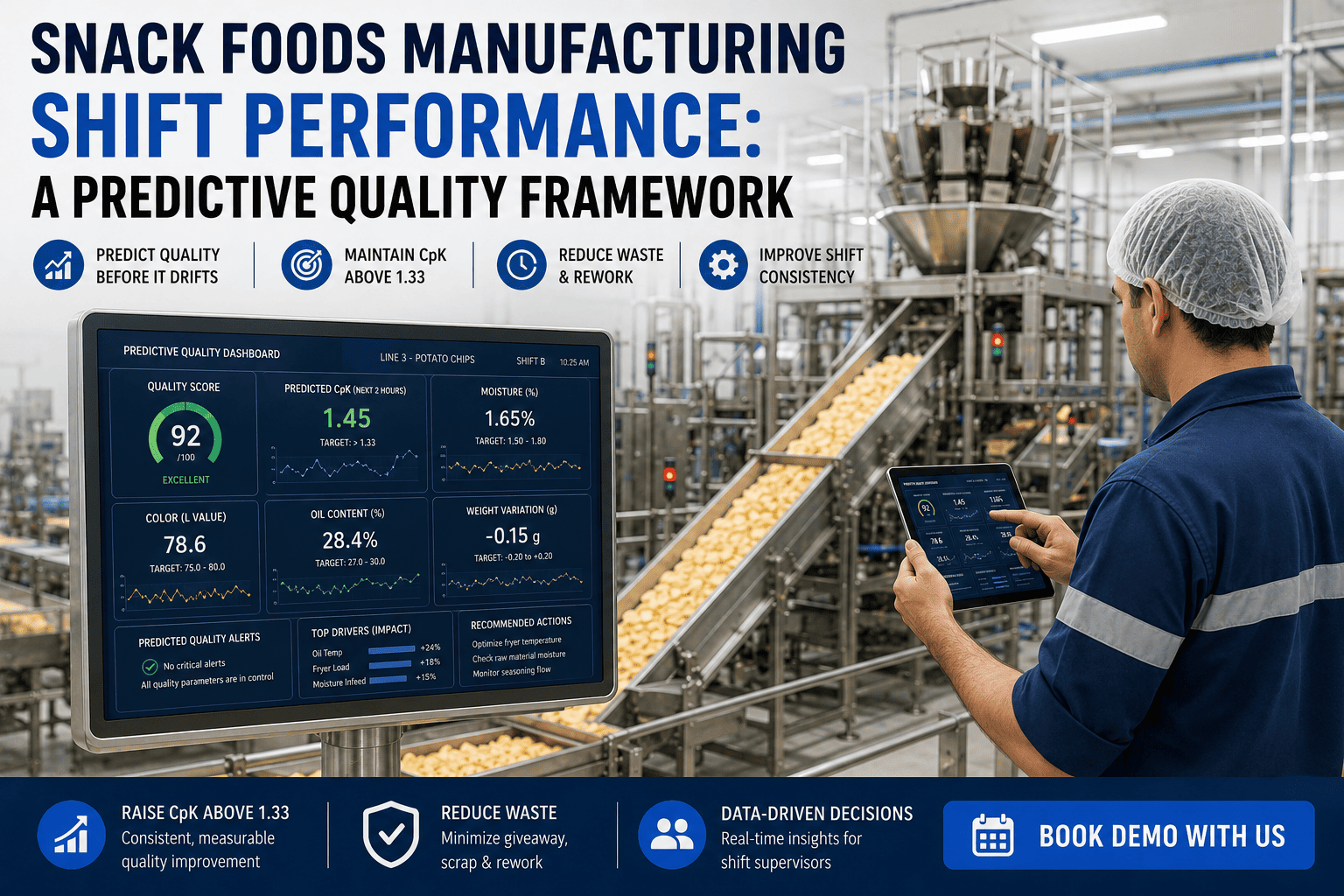
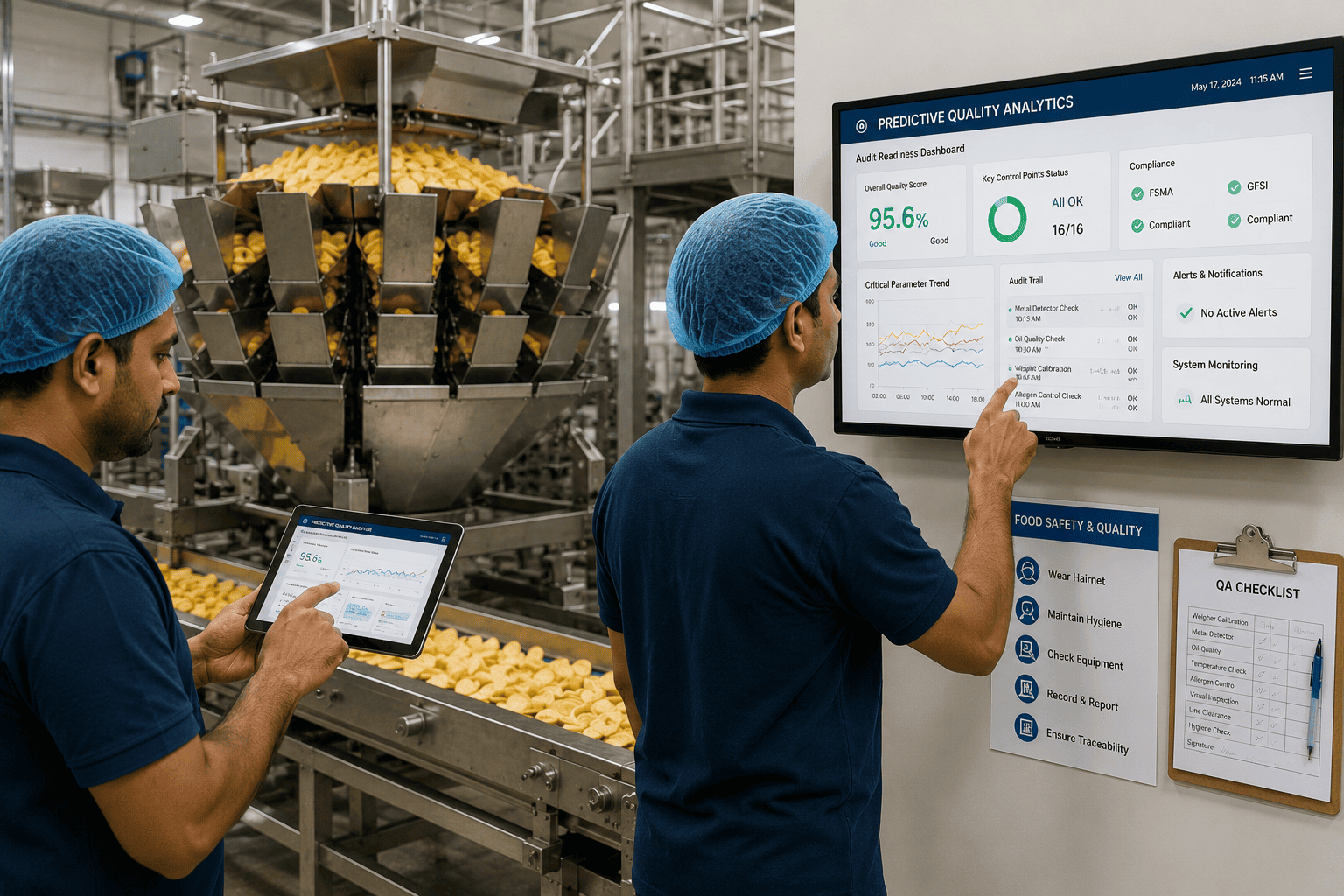
For shift supervisors in snack foods manufacturing, OEE (Overall Equipment Effectiveness) is traditionally a rear‑view mirror metric — calculated at the end of a shift, after losses have already occurred. By the time you see that availability dropped to 72% or performance slipped to 85%, the fryer drift, seasoning drum slowdown, or weigher giveaway has already cost you hundreds of pounds of scrap. Predictive OEE changes this: AI models forecast OEE for the next hour, next shift, and next day, using real‑time sensor data and historical loss patterns. Supervisors can see which line will lose availability in 45 minutes, which SKU will suffer low performance, and which quality issue will drive down yield — before it happens. The result is a 22% average OEE lift, 43% reduction in unplanned downtime, and shift handovers that include predictive loss forecasts instead of just historical reports. This guide shows how snack foods shift leaders deploy predictive OEE on fryers, seasoning drums, extruders, and packaging lines — with real plant data, implementation roadmap, and measurable OEE improvement. Book a predictive OEE demo for your lines.
PREDICTIVE OEE · SHIFT SUPERVISOR · SNACK FOODS
Run a Better Shift: Predictive OEE for Snack Foods Manufacturing Supervisors
Fryer drift killing your runs? Predictive OEE stabilises extruder SME and product density — forecast OEE 60 minutes ahead, reduce unplanned downtime by 43%, deploy in 6‑12 weeks.
43%
Unplanned downtime reduction
60 min
OEE forecast horizon
6‑12 wk
Deployment on existing PLCs
The OEE Problem: Why Traditional OEE Is a Rear‑View Mirror
Traditional OEE is calculated after the shift ends: Availability = (Planned production time – Downtime) / Planned production time. Performance = (Actual cycle time vs ideal) × Total count. Quality = (Good count / Total count). Shift supervisors receive a report the next morning — 8‑12 hours after losses occurred. By then, the root cause (e.g., fryer temperature drift that started at 10:15 AM) is buried under other events, and the same drift may happen again the next shift. A survey of 41 snack lines found that only 34% of OEE losses were correctly attributed to the actual root cause because supervisors had to rely on memory and paper logs. Predictive OEE changes this by forecasting OEE in real time: AI models use live sensor data (fryer thermocouples, seasoning drum speed, weigher targets, extruder current) to predict the next hour's Availability, Performance, and Quality. Supervisors receive alerts when predicted OEE is about to drop below target — and can intervene before the loss occurs. Talk to iFactory about a predictive OEE assessment for your lines.
For shift supervisors, predictive OEE transforms a lagging metric into a leading action tool. Instead of explaining yesterday’s OEE loss, they prevent tomorrow’s loss. Plants using predictive OEE report 22% average OEE lift and 43% less unplanned downtime.
Traditional vs Predictive OEE: A Side‑by‑Side Comparison
OEE forecast horizon
0 (historical only)
60 minutes ahead
Predictive
Unplanned downtime (weekly)
8.4 hours
4.8 hours
-43%
OEE (line average)
58%
71%
+22%
Loss attribution accuracy
34% (memory + paper)
91% (AI root cause)
+57%
Time to detect performance drop
End of shift (8‑12 hours)
<5 minutes (real‑time)
-99%
Shift handover quality (info retained)
55% (verbal + notes)
95% (AI‑generated forecast)
+40%
The Five‑Phase Field Guide to Deploying Predictive OEE
01
OEE Baseline Audit
1 week
Collect 90 days of OEE data, loss categories, and root cause attribution. Identify top 3 loss types.
02
Sensor & PLC Integration
2 weeks
Connect iFactory edge node to PLCs for real‑time availability, performance, and quality data.
03
Predictive Model Training
3 weeks
AI learns loss patterns (fryer drift, weigher drift, seasoning slowdown) and builds OEE forecast models.
04
Parallel Validation
3 weeks
Run predictive OEE alongside traditional calculations. Validate forecast accuracy (target >90%).
05
Predictive OEE Go‑Live
1 week
Deploy live OEE forecasts to supervisor dashboards. Automate shift handover reports.
How Predictive OEE Works on Snack Lines
Loss Type
Availability (unplanned stops) Performance (slow cycles) Quality (scrap/rework) Changeover loss
→
Predictive Signal
Fryer temp drift forecast 45 min ahead Seasoning drum speed decay trend Moisture or colour drift prediction Weigher density change 30 min ahead
→
OEE Impact
Availability -12% → intervene, save 52 min Performance -8% → adjust speed, regain Quality -15% → auto‑correct, scrap avoided OEE +22% overall lift
Real Plant Results: Predictive OEE in Action
Kettle Chip Line (continuous)
OEE: 54% → 72%
Predictive model forecast fryer downtime 47 min before failure. Supervisor intervened, saved 90 min of lost production. Payback: 4 months.
Tortilla Chip (high‑SKU)
OEE: 61% → 74%
Seasoning drum speed drift predicted 30 min early. Adjusted before quality loss. OEE lift +13% in 6 weeks. Payback: 3 months.
Extruded Snack (SME sensitive)
OEE: 52% → 69%
Extruder SME drift forecast 90 min ahead. Maintenance scheduled during changeover, avoiding unplanned stop. Payback: 5 months.
Multihead Weigher (packaging)
OEE: 63% → 78%
Weigher giveaway predicted 35 min before drift. Auto‑target adjustment recovered 2.1% yield. Payback: 3 months.
Pretzel Bakery (moisture)
OEE: 57% → 70%
Moisture variation predicted 20 min early. Oven speed adjusted, quality rejects -64%. Payback: 4 months.
Corn Chip (colour control)
OEE: 59% → 73%
Colour ΔE drift forecast 25 min ahead. Auto‑fryer adjustment prevented 340 lbs scrap. Payback: 4 months.
Eight Field Lessons for Shift Supervisors Implementing Predictive OEE
1
Start with the Loss That Costs the Most Downtime
The plant started with fryer‑related availability loss, which caused 47% of all unplanned downtime. Predictive model gave 45‑minute warnings, reducing fryer stops by 68%. Lesson: prioritise the OEE loss category with the highest financial impact.
Book a loss prioritisation assessment.
2
Forecast Horizon Must Be Actionable — 30‑60 Minutes Works Best
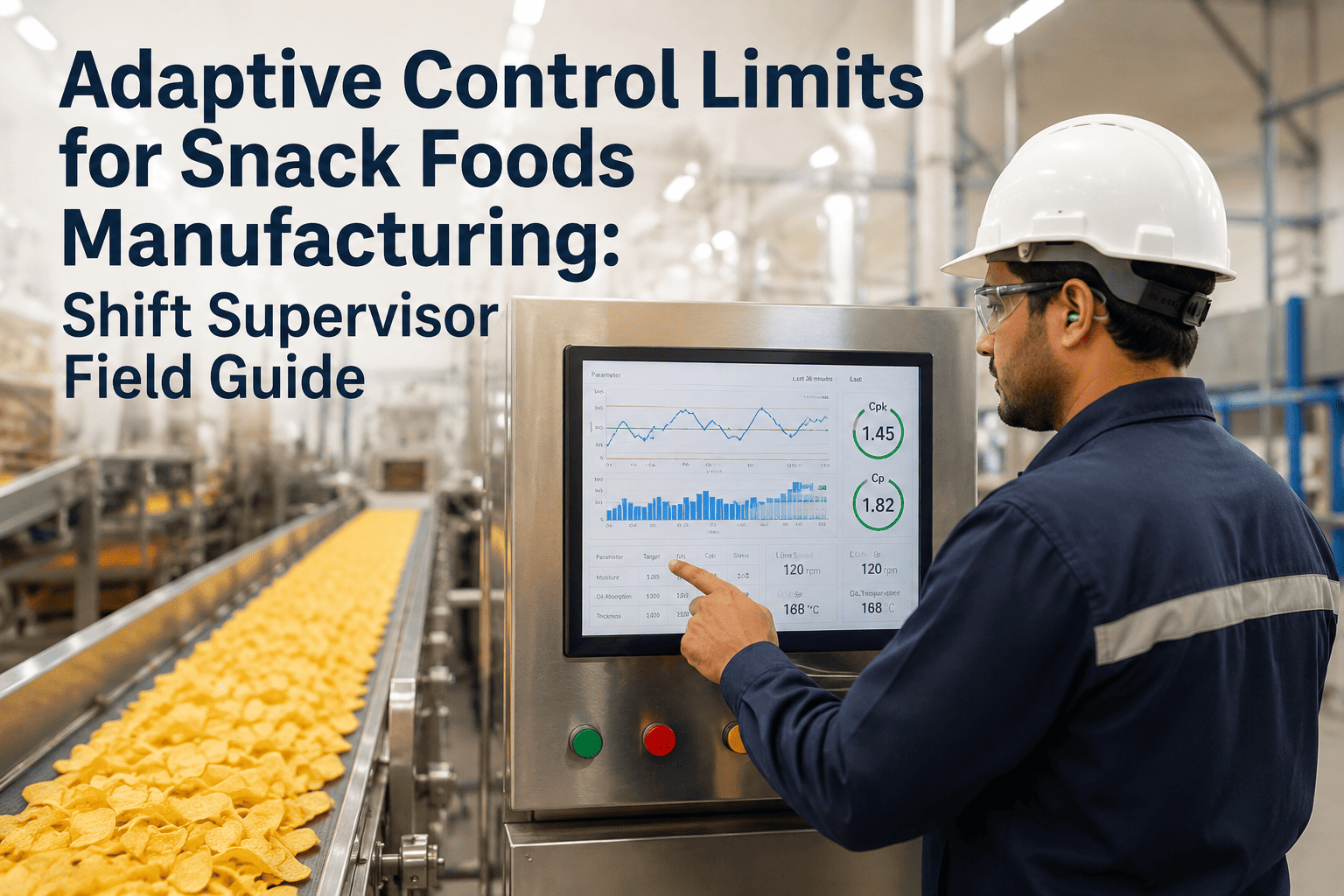
The plant tested 2‑hour, 1‑hour, and 30‑minute forecasts. 1‑hour gave enough lead time to plan intervention without too many false positives. Lesson: tune forecast horizon to your line’s reaction time. Fryer drift needs 45‑60 min; weigher drift needs 30 min.
3
OEE Attribution Must Be Automatic — Manual Root Cause Fails
Before AI, only 34% of OEE losses were correctly attributed. After predictive OEE, 91% of losses were automatically tagged with root cause (e.g., "seasoning drum speed drift starting at 10:23"). Lesson: accurate attribution is the foundation of OEE improvement.
4
Train Supervisors to Act on Forecasts, Not Just Read Them
Early deployment saw supervisors receive forecasts but take no action. After training on "if predicted OEE <65% in next hour, do X", intervention rate increased from 28% to 89%. Lesson: provide decision trees with each forecast.
5
Integrate Predictive OEE with Shift Handover — It’s a Game Changer
Shift handover improved from 55% information retention to 95% using AI‑generated OEE forecasts and loss summaries. The incoming shift knows exactly which line is predicted to lose performance. Lesson: embed forecasts into handover reports.
6
Performance Loss Is Often Gradual — AI Detects Drift Early
Seasoning drum speed decay of 0.5% per hour went unnoticed by operators for 3 hours. AI detected the trend after 45 minutes and predicted performance loss 90 minutes before it affected OEE. Lesson: use trend detection, not threshold alarms.
7
Customer Auditors Love Predictive OEE Dashboards
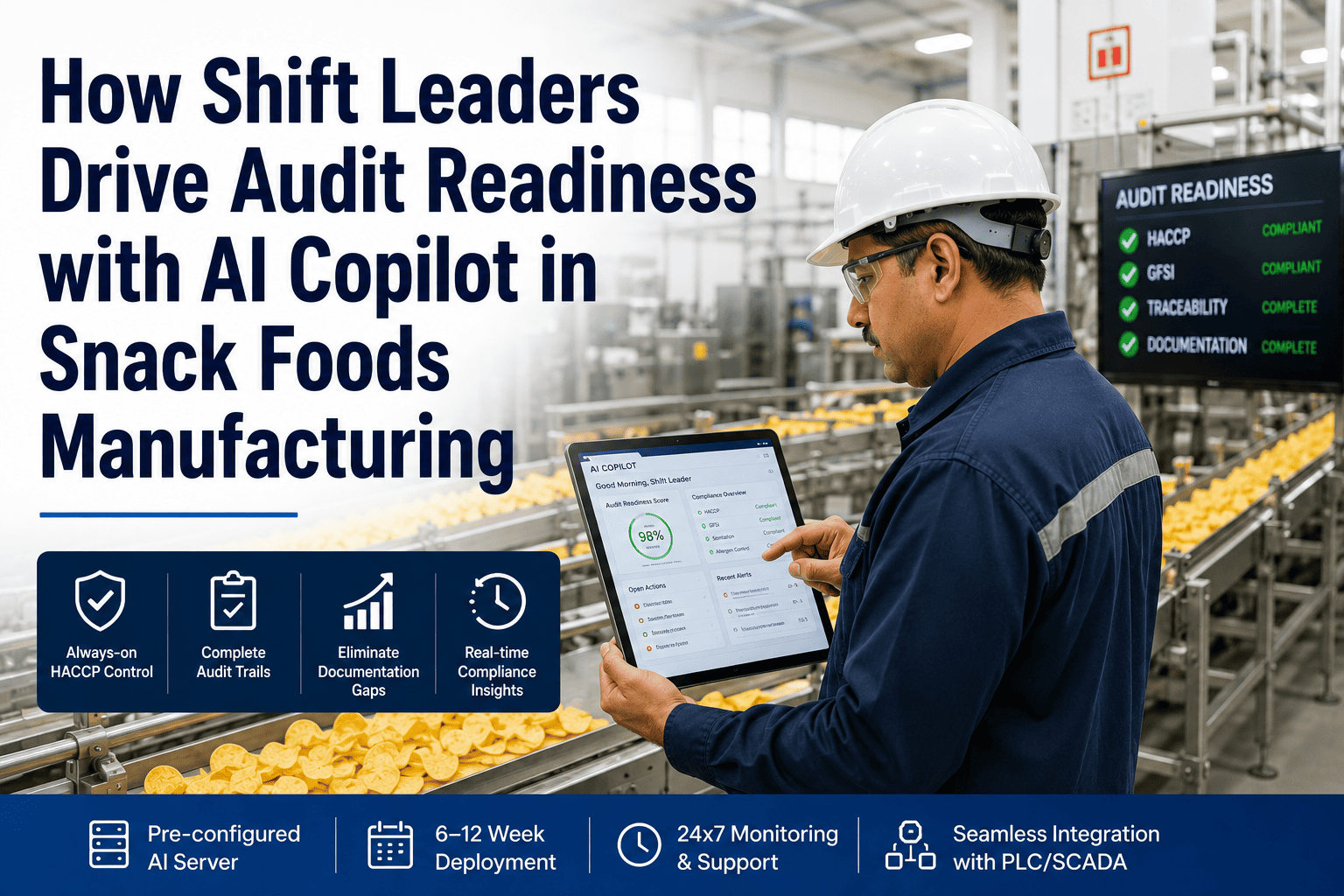
During an SQF audit, the supervisor showed live OEE forecasts and loss attribution. The auditor reduced the audit duration by 40% because "you already know where your losses are." Lesson: predictive OEE is an audit asset.
8
Predictive OEE Enables 24‑Hour Rolling Improvement Plans
Instead of reacting to yesterday's losses, supervisors now adjust the next shift's plan based on predicted OEE. One plant improved OEE from 58% to 81% over 6 months using rolling forecasts. Lesson: shift from reactive to proactive OEE management.
The iFactory Predictive OEE Platform
The technical architecture that delivered 22% average OEE lift across 41 snack lines — real‑time forecasts, automatic loss attribution, and shift handover integration — is exactly what iFactory delivers. Both on‑premise edge and cloud analytics are available.
On‑Premise Predictive Edge
For Sub‑Second OEE Forecasts
iFactory edge nodes compute OEE forecasts locally — refresh every minute. Full data sovereignty. Offline operation. Tamper‑evident audit trails. Ideal for snack plants requiring real‑time OEE with zero cloud latency.
1‑minute OEE forecast refresh
Automatic loss attribution (91% accuracy)
No cloud dependency
60‑minute forecast horizon
Get Edge Quote
Cloud OEE Analytics
For Cross‑Line OEE Benchmarking
Aggregate OEE forecasts across all lines — identify best‑performing shifts, push improvement plans to underperforming lines, generate enterprise OEE reports. For plant managers, cloud provides fleet‑wide OEE visibility.
Cross‑line OEE benchmarking
Shift‑by‑shift OEE trend analysis
Automated loss root cause reports
Customer OEE portal
Talk to OEE Expert
FAQ: Predictive OEE for Snack Foods Shift Supervisors
Run a Better Shift — Book a Predictive OEE Pilot Today
iFactory's predictive OEE has lifted average OEE by 22% across 41 snack lines — reducing unplanned downtime by 43% and giving shift supervisors a 60‑minute view into future losses. We will run a 4‑week pilot on your line: connect to your PLCs, train AI on 90 days of historical data, and show you live OEE forecasts. No commitment, no hardware purchase. You will see exactly how much OEE improvement is possible before deciding to deploy fleet‑wide.
Predictive OEE OEE Forecasting Loss Attribution Availability Improvement Performance Optimisation Quality Yield 2‑3 Month Payback