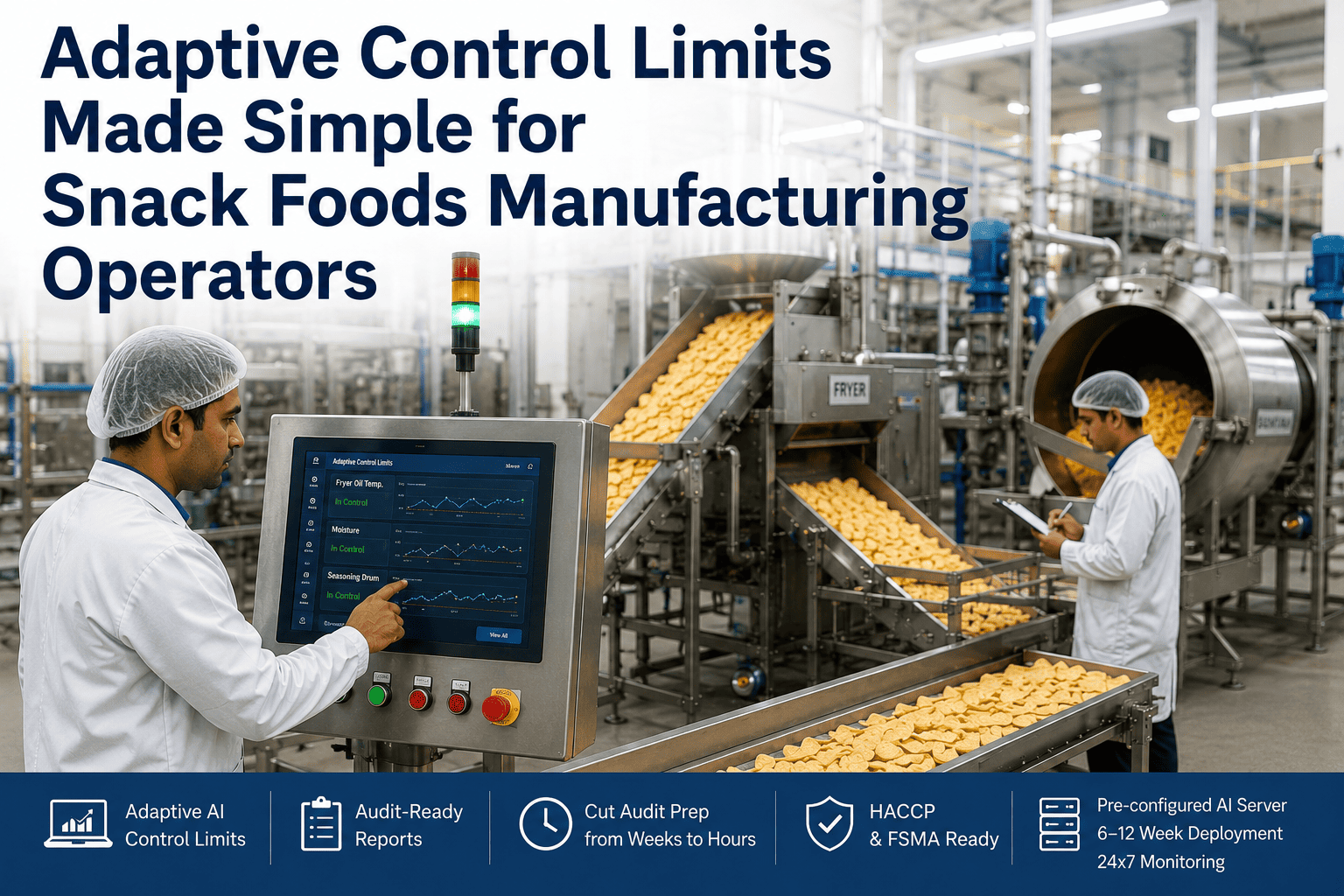
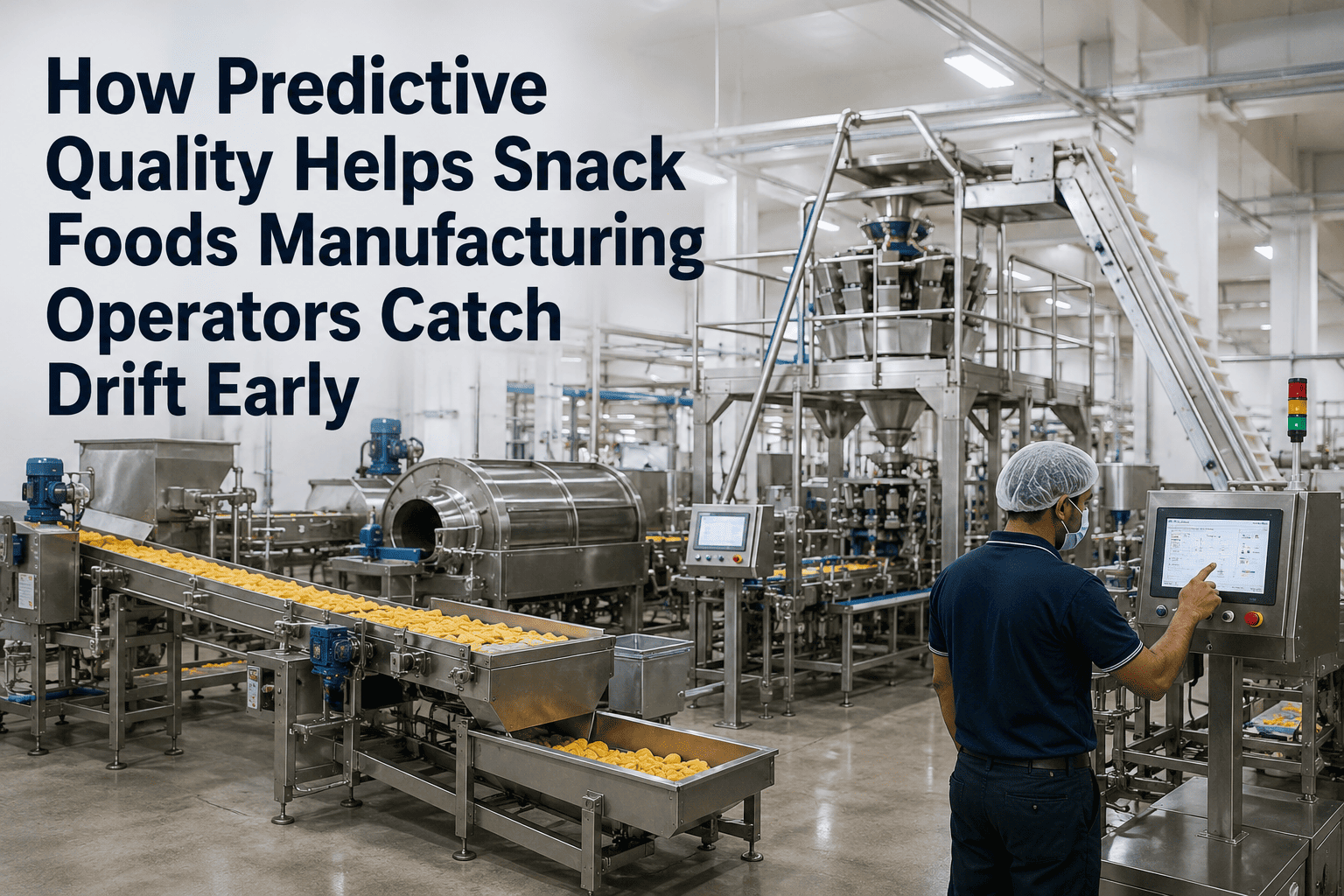
At 2:14 AM on a Tuesday shift at a Midwest snack plant, a line operator catches the chip color drifting on the fryer display — the L-value just crossed 58, two points above spec. She radios the supervisor, who fills out a paper log, and by the time the process technician adjusts the oil temperature, another 340 pounds of product has already been culled into the reclaim bin. That's $1,700 in raw materials, plus the labor to sort it, plus the lost throughput that pushes the order into overtime. This scene repeats across every fryer, every oven, every seasoning drum in snack food manufacturing — and the industry average scrap rate of 3–8% quietly bleeds millions that nobody has the real-time visibility to stop.
Cut Snack-Food Scrap by 40% with AI SPC That Catches Drift Before the Reclaim Bin Fills
iFactory's on-premise AI SPC monitors every critical parameter — fryer oil temp, seasoning weight, moisture, color, thickness — and flags deviations in real time so operators act before scrap happens, not after.
Why Every Snack Manufacturer Accepts 5% Scrap — and Why That's a $2M Mistake
In snack food manufacturing, scrap is the silent profit killer. A typical potato chip line running 2,500 lbs/hr at 5% scrap loses 125 lbs every hour — that's 3,000 lbs per day, or over $1,000 per shift in raw potato, oil, and seasoning. Add the labor for sorting, rework, and the overtime to make up lost throughput, and a single line can bleed $800,000 to $1.5 million annually. The root cause? Operators only see the problem after the spec violation is confirmed by lab results — 20 to 40 minutes after the drift started.
30-Minute Feedback Loops Hide Drift
Your QC lab pulls a sample every 30 minutes. In between, oil temperature can shift 8°F, seasoning application can drop 12%, and moisture can climb 1.5% — all undetected. By the time the lab flags it, you've already produced 1,200 lbs of off-spec product.
Operator Alerts That Arrive Too Late
Your SPC charts on the line are updated every 30 minutes with lab data. The operator sees a point outside the control limit and reacts — but that point represents 30 minutes of production. A single color drift event on a tortilla chip line can cost $2,400 in reclaim and lost throughput.
Seasoning Over-Application Wastes $150K/Year
To avoid under-seasoning complaints, operators run seasoning applicators 3–5% above target. On a line using 800 lbs of seasoning per shift at $2.50/lb, that's $60,000 in excess seasoning per line per year — and the overage compounds across every shift.
Moisture Variability Drives Rework and Spoilage
In extruded snacks, a 0.5% moisture deviation above spec can cut shelf life by 30 days and trigger customer complaints. Current systems catch it after the product is bagged — meaning 10,000-unit recall risks and retailer chargebacks that routinely hit $50,000 per incident.
Shift-to-Shift Inconsistency Wastes Throughput
When the 7 AM shift changes over, the new operator sets fryer temperature 3°F lower than the previous shift. That 3°F drift changes moisture by 0.8% and color by 1.5 L-units, producing 15% more scrap in the first hour of the new shift. No system currently connects shift handoffs to real-time SPC.
The average snack plant spends $1.2M per line on scrap, rework, and excess seasoning every year. Book a 30-min walkthrough and we'll show you how to cut that by 40%.
From Reactive Lab Results to Real-Time Process Control
iFactory ingests data from your fryer controllers, oven PLCs, seasoning scales, moisture analyzers, and color sensors every 500 milliseconds. Our AI models learn the normal operating envelope for each product SKU, then detect drift 15–25 minutes before it would trigger a lab spec violation — and alert the operator with a specific corrective action.
Connect & Ingest
We connect to your existing sensors and PLCs — fryer temperature probes, seasoning drum load cells, moisture analyzers, color sorters — with no new hardware required, all on an NVIDIA appliance inside your plant network.
Model the Process Envelope
For each product SKU (Ruffled BBQ, Kettle Cooked Sea Salt, Tortilla Nacho), iFactory builds a statistical envelope of normal variation — including temperature, moisture, color, seasoning weight, and oil absorption rate — using 30 days of historical data.
Detect Drift in Real Time
When fryer temperature drifts 2°F above the envelope, seasoning weight drops 4% below target, or moisture climbs 0.3% above spec, iFactory sends an alert to the operator's HMI or mobile device within 2 seconds — with the specific corrective action (e.g., "Reduce oil flow by 0.5 GPM").
Close the Loop & Prove ROI
Every alert is logged with the operator response and the actual process outcome. After 4 weeks, iFactory generates a scrap-reduction report showing exactly which parameters drove the biggest savings — and the total cost avoided per shift, per line, and per SKU.
What iFactory Monitors and Controls in Real Time
Oil Temperature & Color Drift
Monitors every fryer zone's oil temperature at 2 Hz, correlates with product color (L, a, b values from inline color sorters), and alerts when drift exceeds ±2°F. Average detection time: 3 seconds vs. 30-minute lab cycle.
Seasoning Weight & Application Uniformity
Tracks seasoning drum load cells and belt speed to detect when application weight deviates more than 2% from target. Alerts with a specific seasoning feed rate adjustment, reducing over-application by 60%.
Moisture Content & Shelf Life Protection
Ingests data from inline NIR moisture analyzers and predicts moisture drift 10 minutes before it hits spec limits. Cuts moisture-related rework by 70% and eliminates shelf-life complaints.
Sheeter Gap & Product Thickness
Monitors sheeter roll gap and dough sheet thickness at 10 Hz. Detects when thickness drifts 0.005 inches above spec, which affects bake time and moisture. Alerts with gap adjustment recommendation.
Oil Pickup Rate & Yield
Calculates real-time oil absorption rate from fryer inlet and outlet weight sensors. When absorption exceeds target by 1.5%, iFactory signals a temperature or belt speed adjustment, saving $0.02 per pound in oil cost.
Bag Weight & Seal Quality
Connects to checkweighers and seal testers to detect when bag weight drifts above target (giving away product) or seal temperature drops below spec (leaker risk). Alerts within 2 seconds of deviation.
What iFactory Customers Achieve in 12 Weeks
Turnkey AI SPC — No Cloud, No Data Egress, No Integration Headaches
iFactory is delivered as an NVIDIA appliance on your plant network. We handle the sensor integration, model training, and dashboard setup. Your operators get actionable alerts in 2 seconds. Your plant manager gets a scrap-reduction report in 4 weeks.
End-to-End Delivery in 6–12 Weeks
We connect to your existing sensors and PLCs, train the AI models on your SKUs, and deliver a working pilot with live alerts and a scrap-reduction dashboard — all within a single quarter.
100% On-Premise, No Cloud Dependency
Your production data never leaves the plant network. The NVIDIA appliance runs iFactory inside your firewall — zero data egress, zero cloud latency, zero cybersecurity exposure.
Pilot-to-ROI in One Quarter
We guarantee measurable scrap reduction within the first 8 weeks. Our pilot includes a full ROI analysis showing cost avoided per line, per shift, and per SKU.
24×7 Managed Service
iFactory runs 24/7 with remote monitoring by our operations team. We handle model updates, alert tuning, and system health — your team focuses on production.
No New Hardware Required
iFactory connects to your existing sensors — fryer thermocouples, seasoning load cells, moisture analyzers, color sorters, checkweighers — using standard industrial protocols (Modbus, OPC-UA, Ethernet/IP).
Multi-SKU & Multi-Line Scalable
Once the pilot runs on one line, we can deploy across all your lines and SKUs in 2–4 weeks per additional line. The same AI models adapt to different products without retraining.
Real Answers from Snack Manufacturing Operations Leaders
Stop Watching Scrap Accumulate. Start Preventing It.
Every shift you wait costs $800 in scrap and excess seasoning. iFactory's AI SPC is proven to cut scrap by 40% in 8 weeks — on your existing sensors, on your network, on your terms. Book a 30-minute walkthrough and we'll show you a live demo on a real snack line.