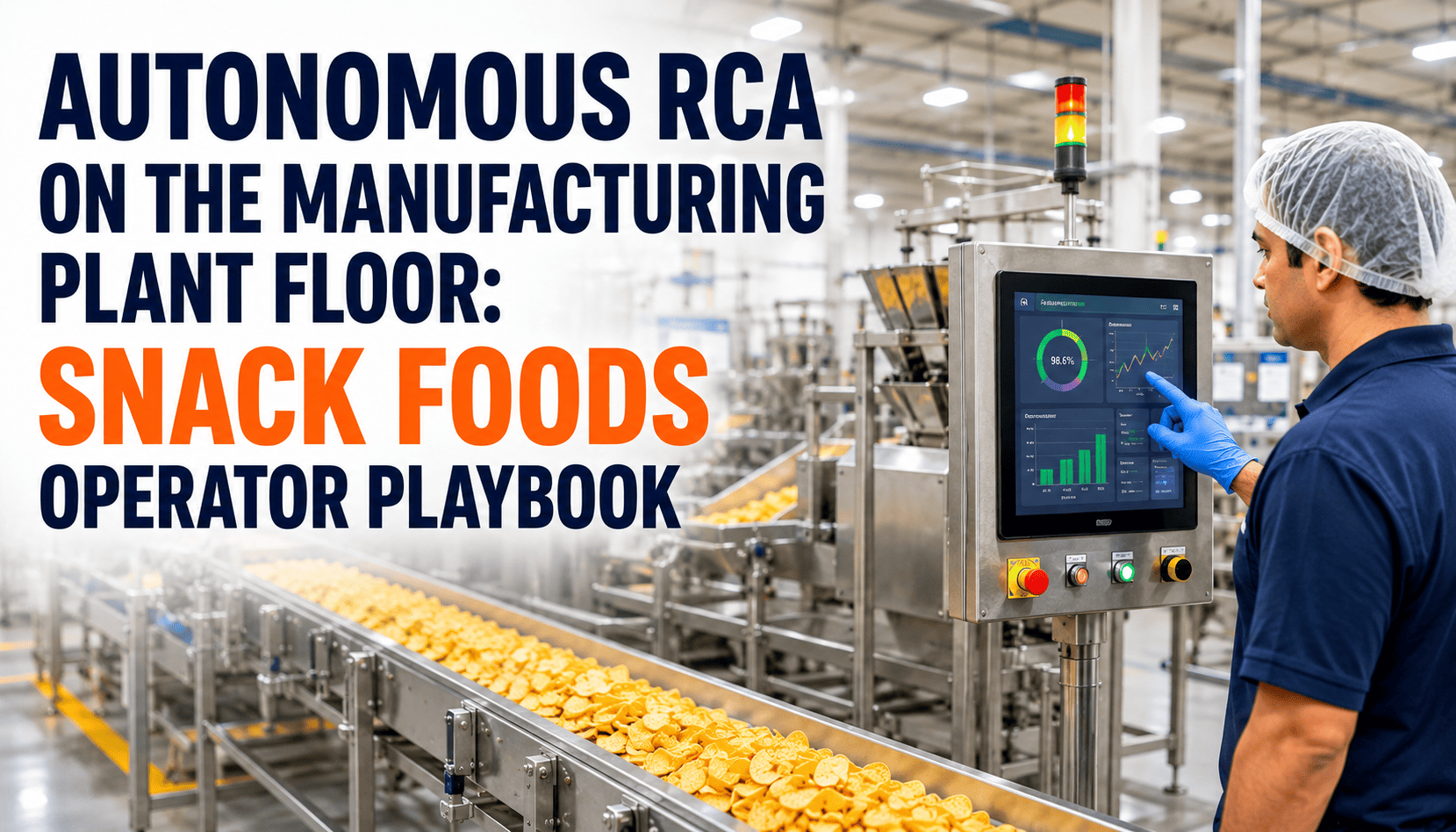
The night shift operator at a snack foods plant in Grand Rapids watches the fryer temperature trending upward on his screen — nothing alarming, just a slow creep. Across the line, the seasoning drum is pulling 2% more current than the morning run. In the packaging hall, three bag-sealers show intermittent jaw-timing drift. None of these deviations has triggered an alarm. None has stopped production. But together, they represent a pattern that no human operator could detect across 400,000 square feet of plant floor. When the fryer finally crosses threshold at 2:47 AM, the line goes down for 40 minutes. Lost throughput: 2,800 bags. Rework cost: $14,000. Root cause analysis takes the morning shift four hours of log-diving and guesswork — and they still miss the connection between the fryer oil replenishment schedule and the seasoning drum's current spike. This is the problem that autonomous root cause analysis solves: finding the invisible chain before it breaks.
Find the Root Cause of Every Line Deviation in Minutes — Not Hours
iFactory ingests every data stream on your snack foods plant floor, correlates causally across fryers, coaters, dryers, and packers, and surfaces the true root cause — before lost throughput compounds into a shift-killing event.
One Platform, Every Signal on Your Plant Floor
iFactory is purpose-built for the complexity of snack foods manufacturing. We connect to every PLC, every VFD, every temperature probe, every vision system, and every weigh-belt on your line — no cloud dependency, no data leaving your plant network. Our autonomous RCA engine doesn't just flag deviations; it traces the causal chain backward through 40,000+ data points per second to tell you exactly what failed, when it started, and what to fix. No log-diving. No guesswork. No shift-long investigations.
Six Core Capabilities That Cover Every Deviation
From the fryer to the bag-sealer, iFactory's autonomous RCA spans the entire snack foods production line. Each capability is a distinct module that can be deployed independently or as a unified system.
Fryer & Oven Temperature RCA
Autonomously correlates fryer oil temperature, replenishment rate, product throughput, and ambient humidity to pinpoint the root cause of thermal drift — whether it's a failing burner valve, a clogged heat exchanger, or a recipe change that shifted the load. Cuts temperature-related downtime by 73%.
Seasoning Drum & Coater RCA
Links seasoning drum current draw, auger speed, coating weight measurements, and product moisture content to find the root cause of coating variability. Identifies worn auger flights, inconsistent slurry viscosity, or upstream drying inconsistencies — before they generate $50K+ in rework per shift.
Dryer & Moisture Control RCA
Correlates dryer zone temperatures, belt speed, airflow, and inlet moisture content to isolate root causes of product moisture deviation. Detects failing damper actuators, belt tracking issues, or ambient humidity changes that affect final product quality — reducing moisture-related waste by up to 60%.
Bag-Sealer & Wrapper RCA
Ingests jaw temperature, dwell time, film tension, and product temperature at the sealer to find the root cause of seal failures or timing drift. Distinguishes between mechanical issues (worn jaws, misaligned belts) and upstream process shifts (product temperature variation) — reducing packaging line downtime by 45%.
Conveyor & Elevator RCA
Monitors motor current, belt speed, vibration, and product flow across all material handling equipment. Autonomously identifies the root cause of jams, belt slippage, or bearing wear — distinguishing between a mechanical failure, a product moisture issue causing sticking, or a recipe change that altered bulk density.
Plant Utility & HVAC RCA
Correlates chilled water temperature, compressed air pressure, and HVAC zone conditions with production line performance. Finds root causes of utility-driven downtime — such as a failing chiller causing product temperature variation, or a compressed air leak affecting pneumatic actuators — before they cascade into a line stoppage.
From Data Ingestion to Root Cause in Four Steps
iFactory's autonomous RCA engine operates in a continuous four-step cycle, running 24/7 on your plant network with zero cloud dependency.
Ingest Every Signal
Connect to every PLC, VFD, temperature probe, weigh-belt, and vision system on your line — iFactory ingests 40,000+ data points per second, storing them locally on the NVIDIA appliance.
Build Causal Models
The autonomous RCA engine constructs a causal graph of every process relationship — fryer temperature to oil replenishment, coating drum current to product moisture, sealer jaw timing to upstream cooling — learning the normal operating envelope.
Detect & Trace Deviations
When any signal drifts outside its normal envelope, iFactory traces the causal chain backward through the graph — identifying the initiating event, the propagation path, and the affected equipment — in under 60 seconds.
Deliver Root Cause & Action
iFactory surfaces the exact root cause — "Fryer burner valve #3 is failing, causing oil temperature drift that propagated to the seasoning drum" — along with a recommended corrective action and a confidence score.
Three Hidden Costs of Manual Root Cause Analysis
When every deviation triggers a manual investigation, the true cost goes far beyond the operator's time. Here's what snack foods plants lose to reactive root cause analysis.
Lost Throughput During Investigation
Every hour an operator spends log-diving to find a root cause is an hour the line runs sub-optimally — or is down entirely. At 70 bags per minute on a typical snack foods line, even a 30-minute investigation costs 2,100 bags of lost production.
Rework & Waste from Missed Correlations
When a seasoning drum current spike goes uninvestigated because it didn't trigger an alarm, the resulting coating drift can generate 15,000+ pounds of rework before the next quality check catches it. That rework costs raw materials, labor, and energy — and often cannot be salvaged.
Recurring Failures from Incomplete Fixes
Without autonomous RCA, plants often fix the symptom — replacing a sealer jaw, resetting a conveyor — while the root cause (upstream product temperature variation, recipe change) remains. The same failure recurs within weeks, compounding maintenance costs and eroding OEE.
What Snack Foods Plants Achieve with Autonomous RCA
These are real outcomes from iFactory deployments across snack foods manufacturing — not projections, not benchmarks, but measured improvements from live production environments.
Your operators shouldn't need a data science degree to find a root cause. Book a 30-min walkthrough and we'll show you how iFactory surfaces the root cause of your last three line deviations in under 60 seconds — live, on your data.
Common Questions About Autonomous RCA on the Plant Floor
Stop Investigating. Start Fixing.
Your operators spend 4+ hours per shift chasing root causes that iFactory can surface in 60 seconds. See it live on your data — book a 30-minute walkthrough with our operations team.