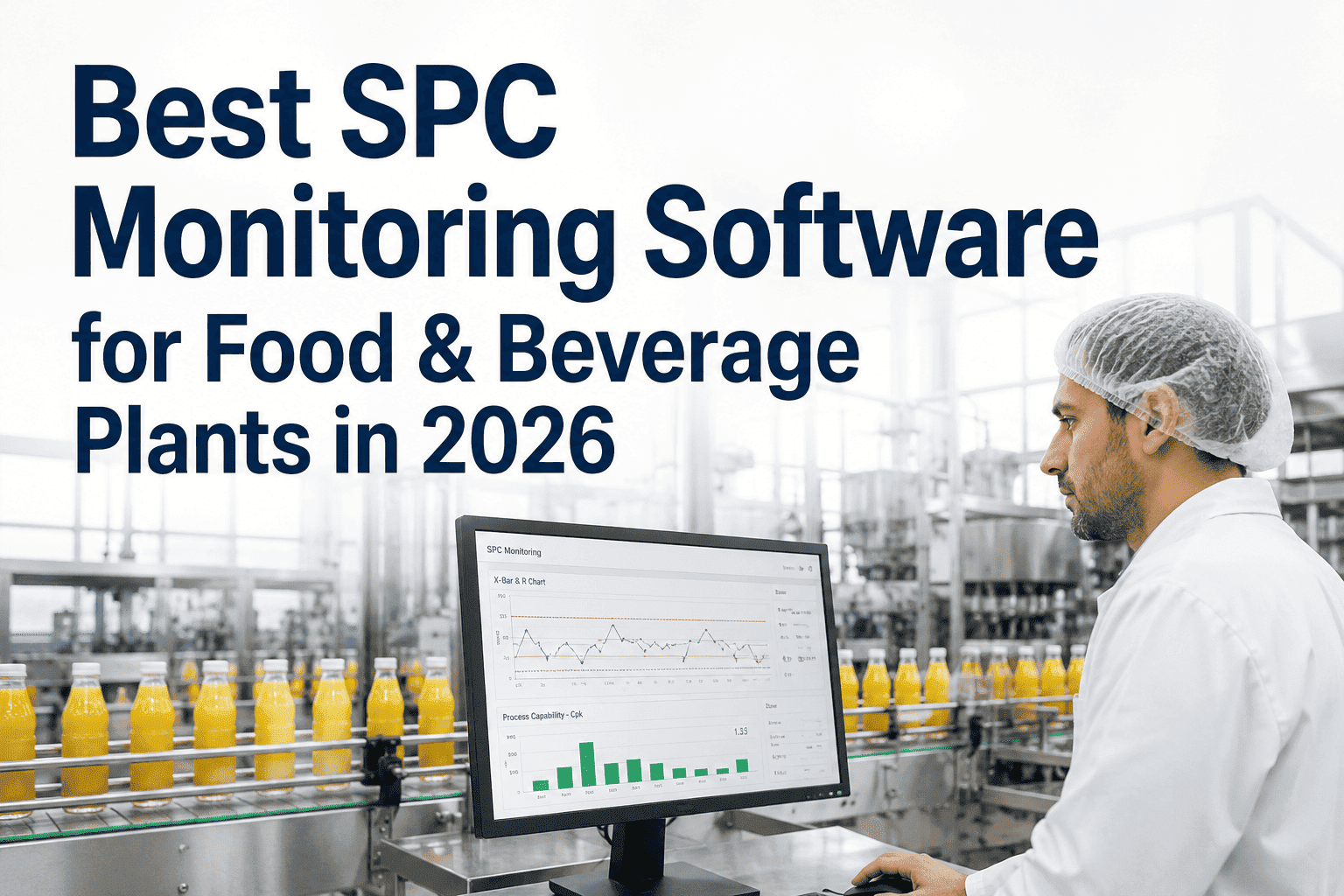
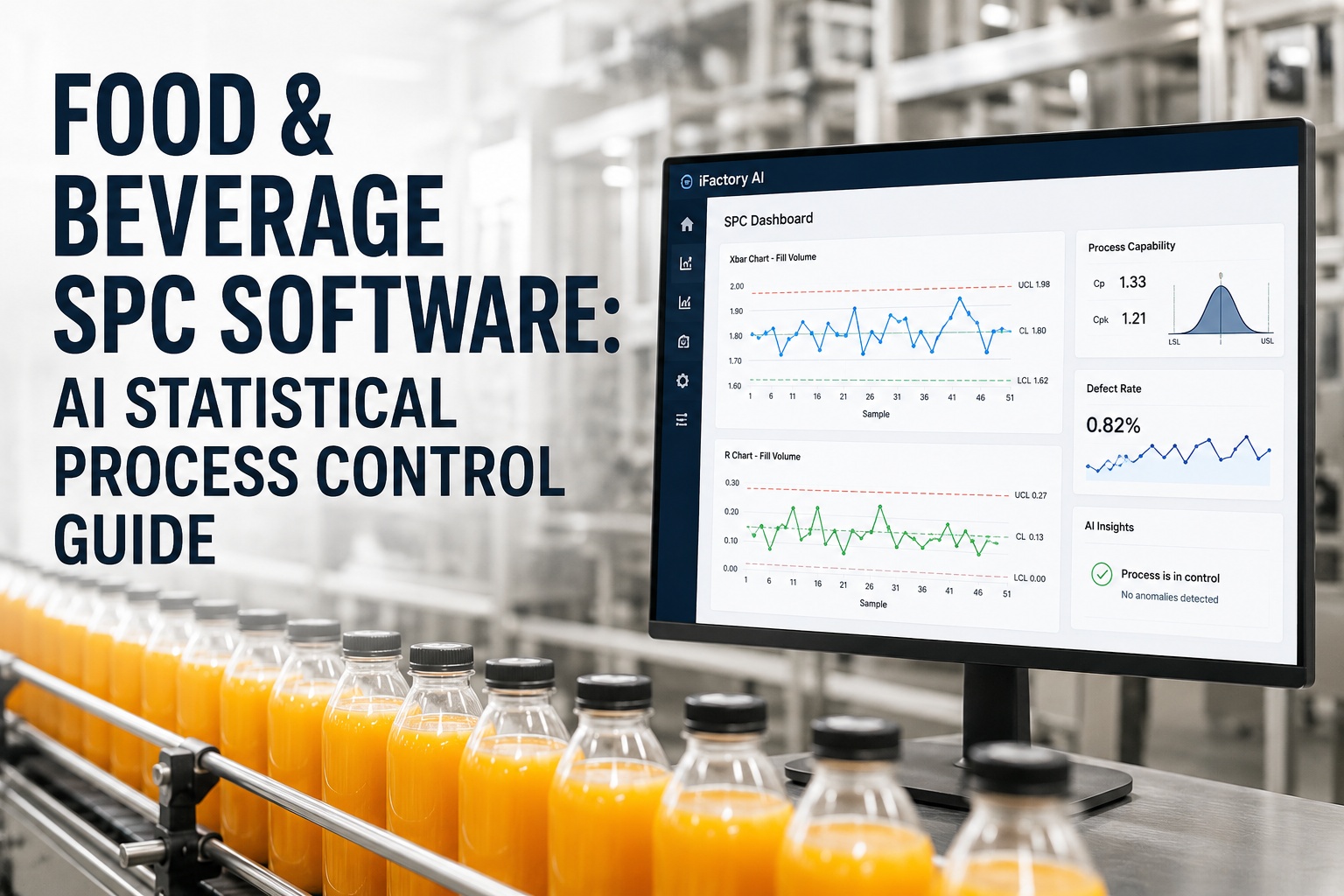
F&B Quality Managers shortlisting SPC monitoring software in 2026 face a different evaluation than five years ago. FSMA 204 took effect January 2026 with new traceability requirements. Static control limits are increasingly inadequate for multi-SKU lines with allergen changeovers and seasonal milk variability. SAP DMC retains the static SPC paradigm; InfinityQS and SafetyChain run on cloud architectures that conflict with F&B data sovereignty needs. iFactory AI is the on-prem NVIDIA-deployed AI-native SPC platform built for the 2026 F&B reality — adaptive limits, automated Western Electric and Nelson rule detection, CIP and allergen integration, and Cpk/Ppk tracking that Quality Managers can defend in any audit. Schedule an AI manufacturing transformation workshop to walk through your specific SPC selection criteria.
2026 Buyer’s Guide · F&B Quality Managers
From Static SPC to Adaptive AI SPC
The SPC paradigm that worked when xMII launched in 2005 can’t adapt to multi-SKU F&B lines, allergen changeovers, and CIP-frequent operations. iFactory AI’s adaptive AI-native SPC catches drift hours before static limits would alarm — with on-prem NVIDIA deployment, automated rule detection, and Cpk/Ppk tracking built for FSMA 204 audit posture.
Jan 2026FSMA 204 traceability effective
8 criteriato evaluate F&B SPC software
Cpk 1.33+capability tracking continuously
What to Look for in F&B SPC Software in 2026
The Quality Manager’s SPC software selection checklist has expanded significantly over the past 5 years. FSMA 204 took effect January 2026 with new traceability requirements that affect SPC documentation. Adaptive control limits have moved from research to production readiness. Cloud vs on-prem deployment now has audit implications that didn’t exist before. And AI capability has shifted from marketing layer to genuine differentiator. The 8-criteria framework below covers what F&B Quality Managers should evaluate when shortlisting SPC platforms.
01
Adaptive Control Limits
Does the platform recalculate limits continuously based on current product, shift, and incoming material variability — or are limits set quarterly and held static? Static limits force false alarms or missed drift in multi-SKU F&B operations.
Automated Pattern Detection
02
Western Electric Rules (1956) and Nelson Rules (1984) automated across all charts in real-time? Or operator vigilance required? Manual rule scanning misses 60–80% of patterns in practice.
03
Cpk/Ppk Capability Tracking
Live capability calculation per CCP, per shift, per product? Or monthly manual calculations? Quality Managers need Cpk >= 1.33 evidence continuously, not retrospectively.
Deployment Model
04
On-premise, cloud, or hybrid? F&B data sovereignty for allergen records, PMO compliance, and recipe IP increasingly requires on-prem options. Cloud-only platforms create audit complexity.
05
FSMA 204 & Audit Readiness
FSMA Rule 204 lot traceability effective January 2026. SQF, BRC, FSSC 22000, HACCP audit support. Does the SPC platform feed traceability records or operate in isolation from compliance documentation?
CIP & Allergen Integration
06
CIP cycle SPC integrated with batch process SPC? Allergen-aware adaptive limits adjusting per changeover? Or CIP data in a separate system that disconnects from quality intelligence?
07
CAPA Workflow Integration
SPC events generate preventive control records under FSMA 21 CFR 117 Subpart C? Integration with existing QMS (SAP QM, ETQ, MasterControl, Rockwell PharmaSuite)? Or SPC operates as a quality silo?
PLC/SCADA Integration
08
Standard OPC-UA, Modbus, MQTT connectivity? Or proprietary protocols requiring vendor-specific integration work? Layers on existing automation, or requires PLC/SCADA replacement?
Static SPC vs Adaptive AI SPC — The Capability Gap
The fundamental capability gap in 2026 SPC software is whether control limits adapt or stay static. Static limits are recalculated quarterly by quality engineers using historical data; they work for stable, single-product, low-variability lines. Adaptive limits are recalculated continuously by AI models that learn current process conditions; they work for the multi-SKU, allergen-changeover, CIP-frequent reality of modern F&B operations. The capability gap shows up most clearly during seasonal milk variability, product changeovers, and after CIP cycles — when static limits force Quality Managers to either accept false alarms or accept missed drift.
Static SPC Limitation
Limits Don’t Adapt to Current Reality
Seasonal milk variability (3.4–4.2% fat): Static limits set in winter alarm constantly in spring when fat content shifts. Quality Managers loosen limits, missing real drift.
Allergen changeovers: First batches after allergen changeover run with different baseline. Static limits trigger false alarms for 30–60 minutes after changeover.
CIP cycle drift: Each CIP cycle slightly modifies equipment baseline. Static limits don’t account, leading to gradual capability degradation.
Multi-SKU lines: Different products have different optimal control bands. Static limits force one-size-fits-all, sacrificing tightness on the most sensitive products.
Adaptive AI SPC Capability
Limits Learn Current Process Conditions
Seasonal awareness: Models recognize fat-content shifts and adjust pasteurization-related limits automatically. Alarms fire on real drift, not seasonal variation.
Changeover-aware limits: Adaptive limits adjust per product run. Allergen-aware AI flags cross-contact risk before next batch begins.
CIP-integrated baselining: CIP cycle data feeds adaptive baseline. Equipment drift between CIP cycles tracked continuously, not after audit.
Per-product optimization: Models calculate optimal control bands per SKU. Yogurt limits tighter than fluid milk; multi-SKU plants get optimal sensitivity per product.
Want to see adaptive limits running on your specific F&B products and lines? Schedule a transformation workshop — we’ll connect to a sample of your historian data and show the capability difference on your actual SKUs.
The 6 Capabilities F&B Quality Managers Actually Need
Beyond the foundational adaptive vs static SPC distinction, F&B Quality Managers in 2026 need six specific capabilities that map to their day-to-day responsibilities — capability tracking, audit defense, CAPA effectiveness, multi-line oversight, regulatory documentation, and management reporting. The capability descriptions below show what each Quality Manager workflow looks like with adaptive AI-native SPC versus with the static SPC paradigm.
01
Live Cpk/Ppk Capability Tracking
Process capability calculated continuously per CCP, per shift, per product. Cpk >= 1.33 evidence available at any moment without monthly manual recalculation. Trend reports show capability over time for management reviews.
Quality Manager impact: Audit defense ready instantly, not days before inspection.
02
Western Electric & Nelson Rules Automated
All 8 Western Electric Rules and all 8 Nelson Rules monitored continuously across every chart. Pattern detection runs 24×7 instead of depending on operator vigilance during chart reviews.
Quality Manager impact: 60–80% of patterns previously missed in retrospective reviews now caught in real time.
03
FSMA 204 Traceability Integration
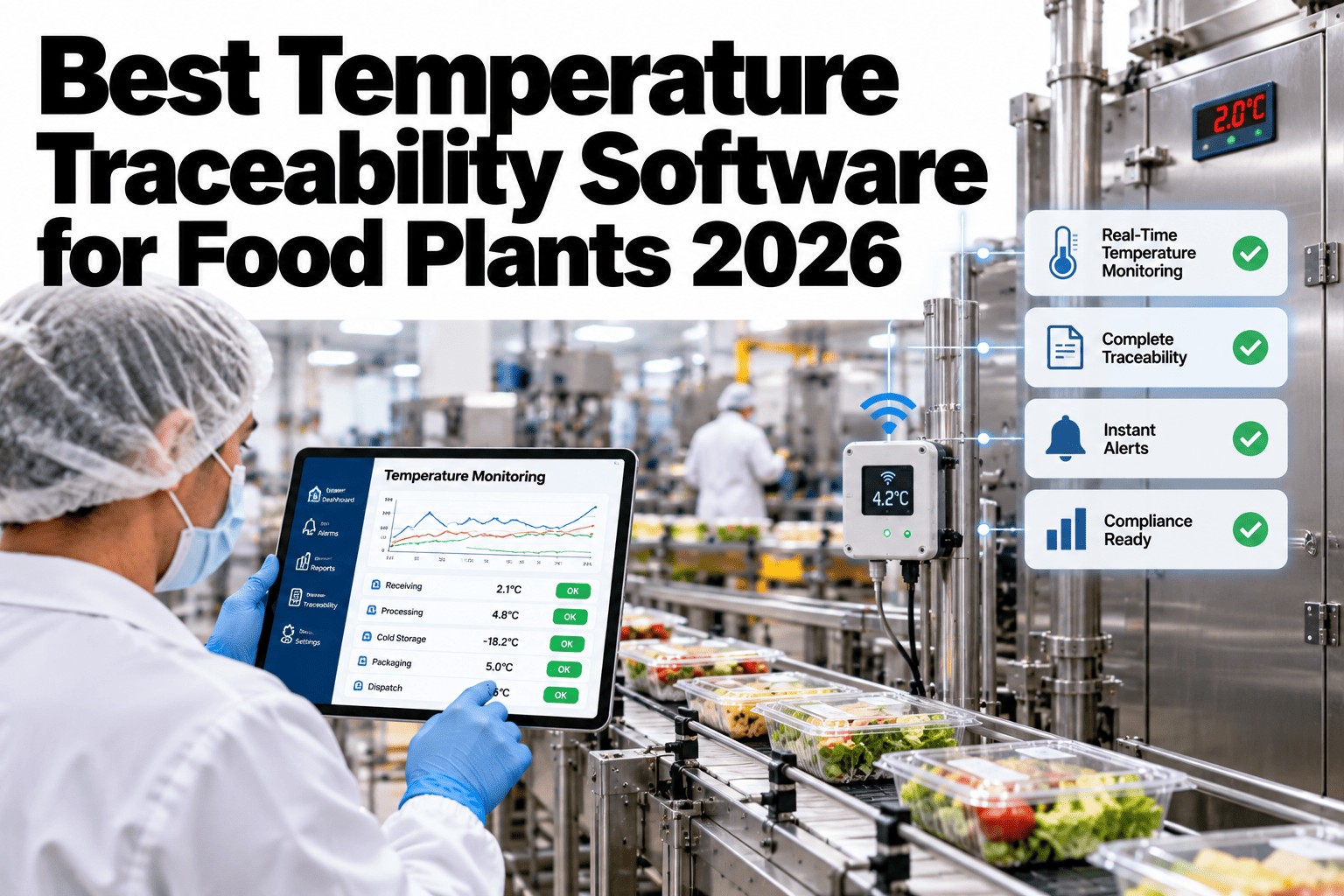
SPC events linked to batch genealogy and lot traceability records. KDE (Key Data Elements) for FSMA 204 Rule pulled from SPC platform. Recall-grade traceability for SPC-detected quality events.
Quality Manager impact: FSMA 204 compliance posture defensible, not aspirational.
04
CAPA Workflow with Root Cause Hypothesis
SPC pattern detection events feed CAPA records with AI-generated root cause hypothesis. CAPA effectiveness tracked continuously. Preventive control documentation under FSMA 21 CFR 117 Subpart C generated automatically.
Quality Manager impact: CAPA backlog shrinks because root cause investigation starts pre-populated.
05
Multi-Line Quality Oversight
Single quality dashboard across all production lines. Per-line, per-product capability trends. Cross-line pattern recognition (when the same drift appears across multiple lines, suggesting facility-wide issue).
Quality Manager impact: One screen for plant quality vs walking floor to check each line.
06
Audit-Ready Reporting
SQF, BRC, FSSC 22000, HACCP audit packages generated on demand. Cpk trend reports, CAPA effectiveness summaries, preventive control documentation, deviation reports. Auditor-ready format, not custom queries.
Quality Manager impact: Audit prep time reduced from weeks to hours.
Map Quality Manager Workflows to iFactory AI
A transformation workshop walks through your current Quality Manager workflows — Cpk tracking, CAPA management, audit preparation, multi-line oversight — and produces a documented transition plan to AI-native SPC. Includes audit package templates and CAPA workflow integration with your existing QMS.
iFactory AI vs Other SPC Platforms for F&B
The F&B SPC software market includes several established platforms — InfinityQS ProFicient, SafetyChain, Plex bundled SPC, SAP DMC’s SPC modules, and others. Each has strengths in different scenarios. The comparison below covers the dimensions Quality Managers evaluate when shortlisting, with iFactory AI’s positioning honestly mapped against alternatives. The key differentiator: AI-native adaptive limits combined with on-prem NVIDIA deployment.
← Swipe to see all columns →
FSMA 204 & Audit Readiness — Why 2026 Changed the SPC Bar
FSMA Rule 204 (Food Traceability Final Rule) took effect January 2026, requiring enhanced record-keeping for foods on the FDA’s Food Traceability List. The rule defines Key Data Elements (KDEs) that must be captured at Critical Tracking Events (CTEs) throughout the supply chain. For F&B manufacturers, this changed the SPC software bar specifically: SPC events that previously sat in isolation from traceability records now need to feed lot genealogy. Adaptive SPC platforms that detect drift earlier are inherently more valuable under FSMA 204 because preventive action records become defensible documentation, not retrospective explanations.
FSMA 204 Impact 01
SPC Events Must Link to Lot Genealogy
When a process drift event affects a batch, the SPC record must connect to the lot traceability chain — ingredients in, finished goods out, distribution destinations. Standalone SPC platforms that don’t integrate with traceability create gaps that auditors flag.
FSMA 204 Impact 02
Preventive Controls Documentation Required
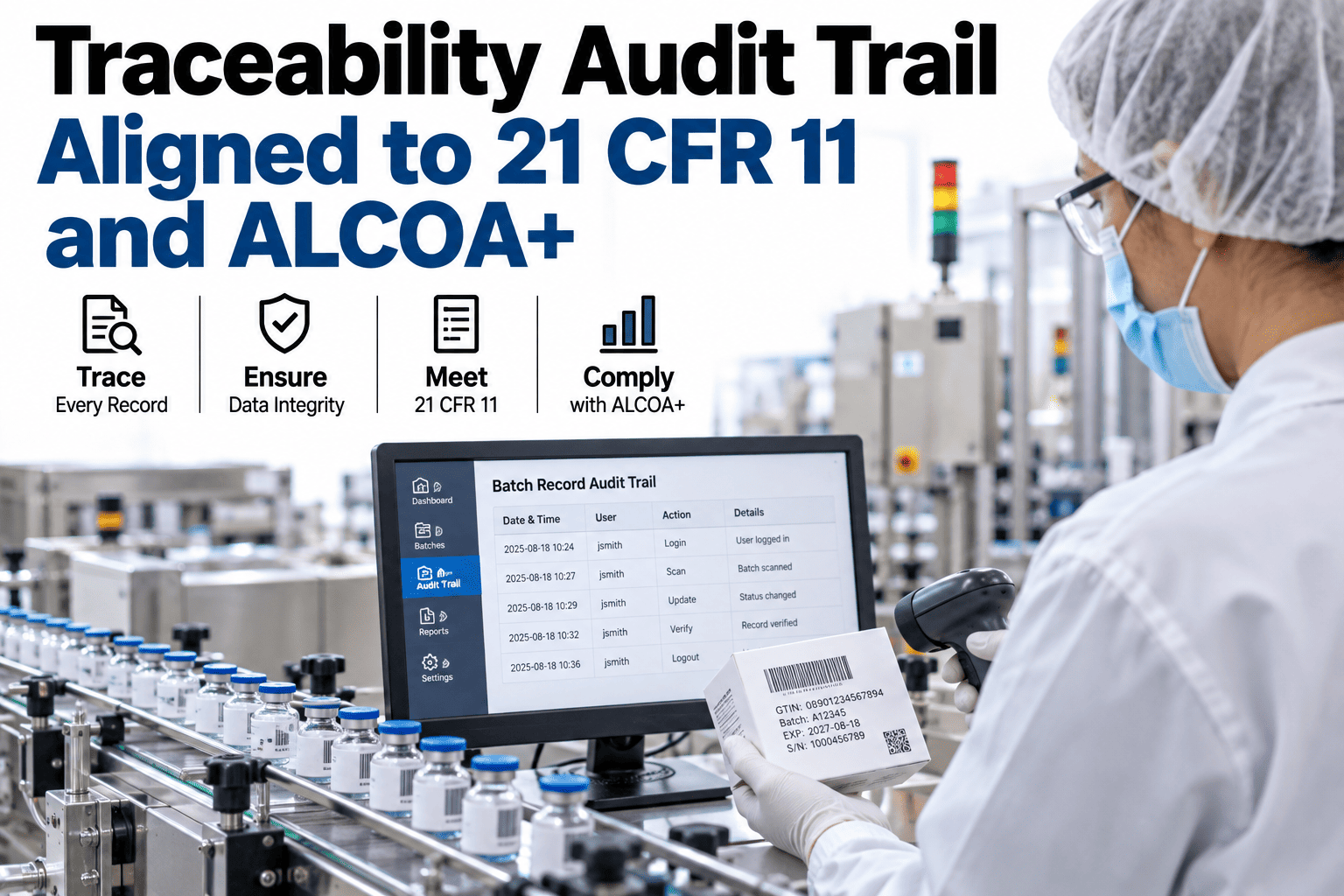
21 CFR 117 Subpart C preventive controls require documented evidence of monitoring and intervention. Adaptive SPC pattern detection events feed this documentation automatically; static SPC platforms require manual record creation.
FSMA 204 Impact 03
CTE Capture at Production Events
Critical Tracking Events at production (transformation steps, CIP cycles, allergen changeovers) need KDE capture. SPC platforms positioned at process level naturally collect these data points; SPC platforms running only at quality-lab level miss them.
FSMA 204 Impact 04
24-Hour Recall Response Capability
FSMA 204 requires 24-hour recall data submission. SPC platforms that maintain process and quality records integrated with batch genealogy enable rapid recall scope determination. Disconnected SPC data adds days to recall response.
Deployment & ROI — What F&B Plants See in 90 Days
iFactory AI deployment runs 6–12 weeks per line. Most F&B plants start with one critical line (typically dairy pasteurization, beverage filling, or bakery production) and expand once Quality Managers validate the AI-native SPC paradigm against historical defect data. The 90-day mark typically shows measurable ROI: 3–6% yield recovery from CIP optimization and filler giveaway reduction, 40–60% customer complaint reduction across two quarters, and Cpk capability improvements visible in quarterly management reviews.
Day 1–30
Connection & Shadow Mode
NVIDIA appliance installed in plant network
PLC/SCADA tag mapping — no automation code changes
Adaptive limits tune to your products and shift patterns
Quality Manager dashboard configured
Outcome: Baseline established. Pattern detection visible in shadow mode.
Day 31–60
Operator Transition
Operators transition to AI-native primary view
Western Electric & Nelson rules generating real-time alerts
CIP cycle optimization live, ATP-pass prediction running
Cpk/Ppk continuous calculation active
Outcome: First quantified yield recovery and complaint reduction.
Day 61–90
Measurable ROI
3–6% yield recovery documented (CIP, filler, drift correction)
CAPA workflow integrated with QMS, root cause hypothesis
Audit package generation tested for SQF/BRC/FSSC
Multi-line rollout plan finalized
Outcome: Quarterly Quality Manager review shows capability improvements.
Expert Perspective
"Quality Managers shortlisting SPC monitoring software in 2026 face a fundamentally different evaluation than in 2020. FSMA 204 changed the documentation bar. Adaptive control limits moved from research to production readiness. Cloud vs on-prem deployment now has audit implications. And AI capability has shifted from marketing layer to genuine differentiator that shows up in capability indices within the first quarter. The selection criteria that mattered most in 2020 (UI, chart variety, basic alerting) still matter but are table stakes. The differentiators in 2026 are adaptive limits, automated pattern detection, on-prem data sovereignty, FSMA 204 traceability integration, and continuous Cpk/Ppk tracking. For F&B specifically, the on-prem requirement is increasingly non-negotiable for plants with food safety data sovereignty policies. The plants picking the right SPC software in 2026 are the ones who recognize the paradigm shift is real and design their RFP around the new capability bar rather than the legacy feature checklist. iFactory AI fits the new bar; legacy SPC platforms designed before 2020 typically don’t."
— F&B Quality Practice, 2026 industry perspective
Jan 2026
FSMA 204 traceability rule effective
Cpk 1.33+
live capability tracking continuously
6–12 wk
per-line deployment timeline
Build Your 2026 SPC Software Shortlist with iFactory AI
90 minutes with your Quality Manager and supervisor team produces a documented evaluation: where iFactory AI ranks against your current shortlist (InfinityQS, SafetyChain, SAP DMC, Plex, others), which selection criteria matter most for your specific F&B environment, and a per-line deployment plan aligned to your FSMA 204 and audit deadlines. No engagement commitment required.
Frequently Asked Questions
How does iFactory AI compare to InfinityQS for F&B SPC?
InfinityQS ProFicient is the established F&B SPC platform with broad market presence and the Enlighten AI module for analytics. The key differences with iFactory AI: deployment model (InfinityQS is cloud-first; iFactory AI is on-prem NVIDIA), SPC paradigm (InfinityQS retains primarily static limits with some pattern detection; iFactory AI is adaptive AI-native from the ground up), and F&B vertical depth (InfinityQS is generic SPC with F&B customers; iFactory AI is pre-configured for dairy, beverage, bakery CCPs). For plants comfortable with cloud SPC and the static-limit paradigm, InfinityQS remains a solid choice. For plants needing on-prem deployment and adaptive limits, iFactory AI fits the 2026 F&B reality better.
What about SafetyChain — they claim real-time SPC across 2,500+ facilities?
SafetyChain is strong for large multi-facility F&B operations needing plant-floor data collection at scale. The platform integrates SQF/BRCGS audit modules and has wide deployment in food manufacturing. The differences with iFactory AI: SafetyChain’s SPC is primarily threshold-based deviation alerting (catches when values exceed limits); iFactory AI’s is adaptive AI-native (catches drift patterns before values exceed limits). SafetyChain is cloud-hosted; iFactory AI runs on-prem on NVIDIA. SafetyChain covers broader compliance workflows; iFactory AI focuses on AI-native SPC and adds compliance integration via API. For plants where data collection breadth matters most, SafetyChain fits. For plants where AI-native pattern detection and on-prem control matter most, iFactory AI fits.
If we already have SAP DMC or Plex MES, do we need a separate SPC platform?
Most F&B Quality Managers find SAP DMC and Plex MES bundled SPC modules adequate for basic charting but limited for AI-native adaptive limits and automated pattern detection. The MES SPC modules retain the static-limit paradigm of legacy MII. Plants getting the most value from their MES investment add an AI intelligence layer like iFactory AI on top — the MES handles production execution and ERP integration; iFactory AI handles adaptive SPC, CIP optimization, and Cpk/Ppk continuous tracking. The two integrate via standard APIs. This combination delivers MES + AI capability without forcing the MES vendor to be everything. For plants with simple stable single-product lines where static SPC is sufficient, MES bundled SPC may be all you need.
How does adaptive AI SPC handle FSMA 204 traceability requirements?
FSMA 204 requires Key Data Element (KDE) capture at Critical Tracking Events (CTEs) and 24-hour recall response capability. Adaptive AI SPC integrates with traceability in three ways. First, SPC events automatically link to batch lot genealogy — when a drift pattern is detected on a specific lot, the traceability chain (raw materials in, finished goods out) is queryable from the SPC record. Second, preventive control records under 21 CFR 117 Subpart C are generated automatically when pattern detection events fire, creating the audit-defensible documentation FSMA Subpart C requires. Third, recall scope determination accelerates because SPC quality history is integrated with lot data — a 24-hour recall response window is achievable, not aspirational. iFactory AI integrates with major QMS platforms (SAP QM, ETQ, MasterControl) so the FSMA 204 records flow through your existing quality system.
What does on-prem NVIDIA deployment actually mean operationally?
Operationally, on-prem NVIDIA deployment means iFactory AI’s AI server is a physical appliance installed in your plant network. The appliance contains NVIDIA GPU compute for AI model inference. It connects to your PLC, SCADA, and historian via standard OPC-UA, Modbus, MQTT protocols. All production data and AI inference stay within your plant network — no cloud round-trip. The appliance includes 24×7 monitoring and remote support access (read-only) through your existing network security. Updates are pushed remotely but data flow remains on-prem. For plants with strict food safety data sovereignty (allergen records, PMO compliance, recipe IP), this addresses the audit and IP concerns that cloud-only SPC platforms can’t. For plants without those constraints, cloud platforms remain viable.
How quickly does the Quality Manager see Cpk/Ppk improvements?
Most plants see measurable Cpk improvements within the first quarter of live operation (days 60–90 in the deployment timeline). The improvement mechanism is straightforward: adaptive limits + automated pattern detection catch drift earlier, drift correction happens earlier, process variance reduces, capability index increases. Typical improvements: Cpk on critical CCPs moves from 1.20–1.30 baseline to 1.40–1.60 within two quarters. The exact magnitude depends on starting baseline (plants with low baseline have more room to improve), product complexity (single-product lines stabilize faster than multi-SKU), and CIP frequency (high-CIP lines benefit most because CIP-driven variance is reduced by condition-based optimization). The workshop session includes a directional capability projection for your specific environment before any deployment commitment.