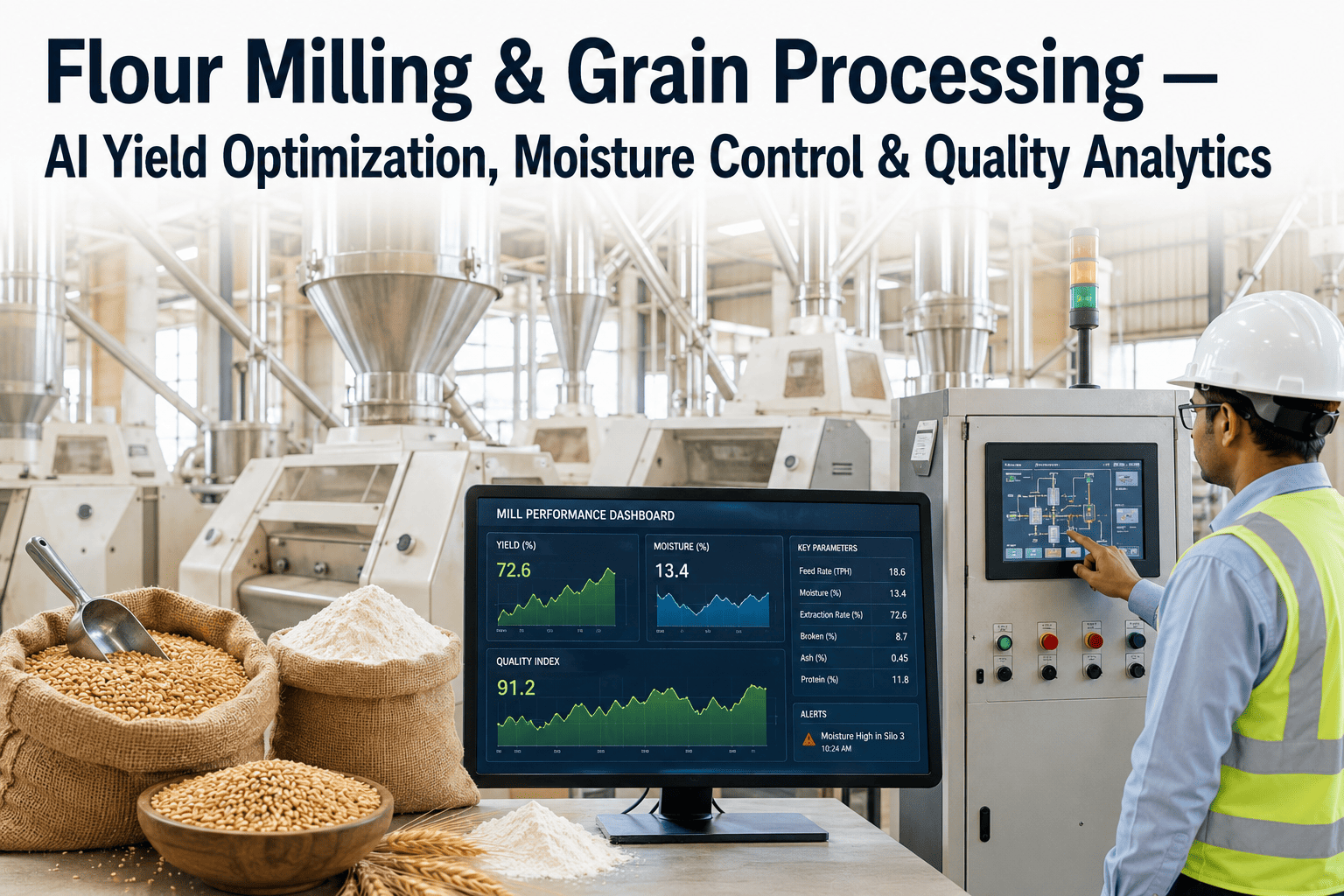
In the fiercely competitive flour milling industry, achieving maximum extraction yield while maintaining stringent quality standards is a constant battle against variables: grain moisture variability, roller mill wear, sifter blinding, and fluctuating ash content. Traditional manual adjustments and reactive maintenance leave significant profit on the table. Artificial intelligence (AI) and machine learning now offer a transformative path forward, enabling plant managers to optimize every stage—from grain intake to finished flour blending—with predictive precision. This comprehensive guide delves into the technical depths of AI-driven flour milling optimization, covering grain moisture conditioning, roller mill gap automation, extraction rate maximization, flour ash content monitoring, and real-time quality dashboards. Discover how leading mills are leveraging Industry 4.0 to reduce variability, increase yield by 2-5%, and cut energy costs by up to 15%. If you're ready to elevate your milling operations, book a demo to explore iFactory's predictive analytics platform.
Transform Your Mill with AI-Powered Yield Optimization
Achieve 2-5% higher extraction rates and consistent flour quality with real-time AI insights. Schedule a demo today.
Grain Moisture Conditioning
AI models analyze real-time grain moisture at intake and predict optimal tempering duration and water addition. This reduces variability by up to 30%, ensuring consistent milling performance and higher flour yield.
Roller Mill Gap Optimization
Using vibration and power draw sensors, AI adjusts gap settings dynamically to maintain particle size distribution, reducing over-grinding and energy waste by 12-18%.
Extraction Rate Maximization
Machine learning models correlate multiple process variables to identify optimal throughput, increasing extraction rates by 2-5% without compromising flour ash or protein content.
Flour Ash Content Monitoring
Near-infrared sensors combined with AI predict ash content in real-time, enabling immediate adjustments to sifter settings and blending ratios to stay within specification.
Technical Architecture of AI-Driven Milling
Modern AI systems for flour milling integrate edge computing, IoT sensors, and cloud-based analytics. The architecture typically includes: sensor layer (moisture, temperature, vibration, power), data ingestion via MQTT/OPC UA, feature engineering pipelines that extract rolling averages and spectral features, and a model inference engine running gradient-boosted trees or LSTM networks. These models predict key quality metrics up to 30 minutes ahead, allowing proactive control. The system outputs actionable recommendations via dashboards and can directly interface with PLCs for closed-loop control of tempering water valves, roller mill gaps, and sifter speed.
Implementation Roadmap for AI in Flour Mills
Sensor Deployment & Data Integration
Install moisture, NIR, vibration, and power sensors on key equipment. Integrate data streams into a centralized historian.
Baseline Model Training
Collect 3-6 months of historical data to train initial predictive models for moisture, ash, and extraction rate.
Closed-Loop Control Pilot
Deploy AI recommendations on a single mill line with manual override. Validate yield and quality improvements.
Full Scale Rollout
Expand to all mill lines, integrating with MES and ERP for end-to-end optimization.
Comparison: Traditional vs AI-Optimized Milling
| Parameter | Traditional | AI-Optimized |
|---|---|---|
| Moisture Variability | ±1.5% | ±0.3% |
| Extraction Rate | 74-76% | 78-80% |
| Ash Content Drift | ±0.08% | ±0.02% |
| Energy per Ton | 65 kWh | 55 kWh |
| Changeover Time | 45 min | 15 min |
Ready to Boost Your Mill's Yield?
Discover how iFactory's AI platform can increase your extraction rate by 2-5% while reducing energy costs. Book a personalized demo now.
Key AI Capabilities for Flour Mills
Predictive Tempering
AI models predict optimal water addition and tempering time based on grain hardness, protein content, and ambient humidity, reducing moisture variability by 30%.
Break Roller Gap Control
Real-time adjustment of break roll gaps using vibration and power draw feedback ensures consistent particle size and reduces energy consumption by 12%.
Reduction Roller Optimization
Machine learning algorithms optimize reduction roll differential speeds to maximize flour extraction while minimizing starch damage.
Sifter Performance Analytics
AI detects sifter blinding and inefficiencies, recommending cleaning cycles and mesh replacement schedules to maintain throughput.
Flour Blending Optimization
Predictive models recommend optimal blending ratios of different mill streams to meet target ash, protein, and color specifications with minimal giveaway.
Energy Management
AI identifies energy-intensive processes and suggests optimal scheduling to reduce peak demand charges and overall consumption by up to 15%.
Deep Dive: AI Model Training for Flour Quality Prediction
Developing robust AI models for flour milling requires careful feature engineering. Key input variables include: grain moisture at intake, tempering time, first break roll gap, roll speed differential, sifter flow rates, and NIR spectra. Target variables are typically ash content, protein content, and extraction rate. Gradient-boosted decision trees (XGBoost, LightGBM) often outperform deep learning for tabular data in this domain due to interpretability and lower data requirements. Models are trained on historical data spanning at least one harvest season to capture seasonal variability. Regular retraining (weekly or monthly) ensures the model adapts to grain source changes and equipment wear. Cross-validation strategies must account for temporal autocorrelation to avoid overfitting.
Measurable Impact of AI on Key KPIs
Frequently Asked Questions
How does AI improve flour extraction yield?
AI models analyze hundreds of process variables in real-time—such as grain moisture, roll gap, sifter speed, and aspiration air flow—to predict the optimal setpoints that maximize extraction without exceeding quality limits. By continuously adjusting to changing grain conditions, mills can achieve 2-5% higher yield without capital expenditure. For more details, visit our support page.
What sensors are required for AI-based moisture control?
Typically, near-infrared (NIR) sensors installed at grain intake and after tempering provide real-time moisture content readings. These are complemented by temperature and humidity sensors in the tempering bins. The AI system fuses this data to predict optimal tempering duration and water addition. Learn about sensor integration on our support page.
Can AI integrate with existing PLC and SCADA systems?
Yes, modern AI platforms use OPC UA, MQTT, and REST APIs to interface with legacy control systems. The AI model outputs are converted to setpoint changes that the PLC can execute via analog or digital signals. This enables closed-loop control without replacing existing infrastructure. For integration specifics, book a demo.
What is the typical ROI for AI in a flour mill?
Most mills see a payback period of 6-12 months, driven by a 2-5% increase in extraction yield, 10-15% reduction in energy costs, and 20-30% decrease in quality claims. Additional savings come from reduced downtime and optimized labor. For a customized ROI calculation, book a demo.
How long does it take to deploy an AI solution?
A pilot deployment typically takes 4-8 weeks, including sensor installation, data collection, model training, and validation. Full-scale rollout across multiple mill lines may take 3-6 months depending on complexity. Our team provides end-to-end support. Contact us via our support page.
Optimize Your Flour Mill with AI
Join industry leaders who have increased yield by 5% and reduced costs by 15%. Schedule your demo today to see iFactory in action.