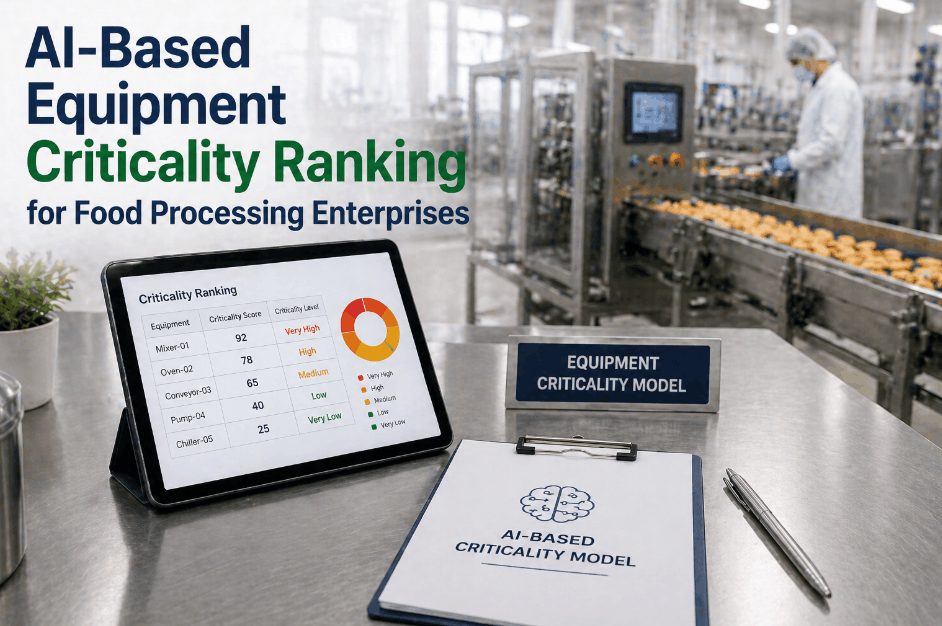
In the high-stakes environment of food manufacturing, "fixing it when it breaks" is a recipe for catastrophic batch loss and regulatory non-compliance. Reliability-Centered Maintenance (RCM) is no longer just an aerospace standard; it is a critical operational framework for modern F&B plants aiming for zero-downtime performance. iFactory's AI-Driven Predictive Analytics platform integrates RCM methodology directly into your production floor—systematically identifying failure modes, quantifying asset criticality, and optimizing maintenance tasks for every pasteurizer, filler, and secondary packager. By shifting from calendar-based PMs to data-driven RCM strategies, our platform ensures that your most critical assets are always available when production demands it most. Book a Demo to see how RCM-AI is transforming food plant reliability.
RELIABILITY ENGINEERING · ASSET CRITICALITY
Achieve Total Asset Reliability with AI-Powered RCM Analytics.
Discover how iFactory's RCM engine links failure mode analysis (FMEA) to real-time sensor data, ensuring your maintenance resources are focused on the assets that impact food safety and production most.
The Maintenance Paradox: Why 40% of Preventive Maintenance Tasks Are Counter-Productive
Traditional maintenance in food plants relies heavily on "time-based" interventions—replacing seals or bearings every 90 days regardless of their actual condition. This approach often introduces "infant mortality" failures by disturbing perfectly functioning equipment. Furthermore, calendar-based PMs often overlook "Hidden Failures" in sterile valves or safety interlocks that don't manifest until a crisis occurs. RCM-AI eliminates these structural vulnerabilities by asking seven fundamental questions about every asset's function and failure modes, then using real-time IoT data to determine the most effective maintenance task. It’s not about doing more maintenance; it’s about doing the *right* maintenance at the *right* time.
How AI-Driven RCM Operates at Production Speed
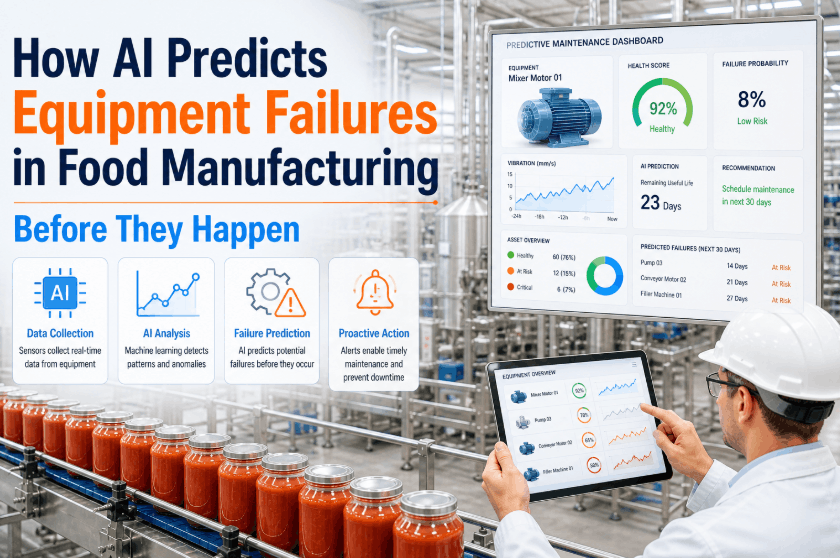
The iFactory platform uses a dual-layer logic: a "Criticality Layer" that ranks every asset based on its impact on food safety and OEE, and a "Predictive Layer" that monitors for specific failure signatures. As a homogenizer or spray dryer operates, AI models continuously compare its vibration and thermal profiles against its known FMEA (Failure Mode and Effects Analysis) library. When a signature matches a "Critical Failure Mode," the system triggers a targeted intervention—preventing the failure before it impacts the batch. Book a Demo to see our asset criticality mapping engine.
Dynamic Asset Criticality Ranking
AI automatically ranks assets based on real-time production schedules and food safety risks. A filler on an RTE line is automatically prioritized over a case sealer, ensuring maintenance resources follow the highest risk.
Automated FMEA Integration
iFactory links real-time sensor data to an exhaustive library of food equipment failure modes. The AI identifies if a vibration spike is a "Bearing Cage Failure" or a "Cavitation Event," providing instant root-cause diagnostics.
Hidden Failure Detection
Monitoring safety-critical and sterile-boundary components that "fail silently." AI-driven logic tests the readiness of bypass valves and redundant sensors during low-load periods, ensuring they work when needed.
Maintenance Task Optimization
Continuously evaluating the effectiveness of every PM task. If the AI detects that a 30-day grease cycle isn't reducing bearing wear, it automatically suggests an RCM-backed adjustment to the maintenance frequency.
Quantifying Reliability: Traditional Maintenance vs. AI-Driven RCM
The transition to Reliability-Centered Maintenance is a fundamental shift from "Equipment Care" to "Functional Preservation." Moving from reactive repairs to predictive RCM reduces maintenance costs by 25-30% while significantly improving OEE and food safety compliance. Understanding the comparative metrics is essential for building a strategic business case. Book a Demo to see our reliability ROI dashboards.
| Reliability Dimension | Traditional/Time-Based | iFactory AI-Driven RCM | Operational Advantage |
|---|---|---|---|
| Maintenance Strategy | One-Size-Fits-All (Calendar) | Failure-Mode Specific (PdM) | Optimized Resource Usage |
| Asset Criticality | Subjective (Guesswork) | Data-Driven (AI-Ranked) | Risk-Based Prioritization |
| Hidden Failure Detection | None (Found during crisis) | Predictive Readiness Checks | 100% Safety Availability |
| FMEA Management | Static Paper Documents | Live, Sensor-Linked Library | Real-Time Failure Prevention |
| Infant Mortality Risk | High (Due to over-maintenance) | Low (On-condition only) | Higher Equipment Lifespan |
| Spare Parts Inventory | Just-in-Case (High Cost) | Just-in-Time (RCM-Linked) | 15% Inventory Cost Reduction |
| Compliance Veracity | Manual PM Completion Logs | Digital Asset Integrity Ledger | Tamper-Proof Audit Defense |
Failure Mode Precision: Neutralizing Risks Before They Breach the Sterile Boundary
In food processing, the most dangerous failures are those that compromise the sterile boundary without stopping the machine—such as a hairline crack in a pasteurizer plate or a failing aseptic valve seal. AI-driven RCM enables "Boundary Precision" by identifying the subtle pressure or thermal signatures associated with these specific failure modes. Instead of waiting for a positive lab test, the RCM-AI identifies the "Functional Failure" at the micron level, allowing for containment before any contaminated product leaves the line. Book a Demo to see our failure-mode simulators.
RCM Compliance: Meeting ISO 55000 and GFSI Asset Management Standards
Global food safety standards (SQF, BRCGS) and asset management standards (ISO 55001) now demand evidence that manufacturers are managing equipment risks based on their impact on product safety. iFactory's platform is purpose-built to automate the documentation of your RCM decision logic. By linking every work order to a specific failure mode on the blockchain-backed ledger, we ensure your facility is "Audit-Ready" with technically authoritative proof of asset integrity. Book a Demo to see our RCM compliance dashboard.
Digital Failure Mode Library
iFactory maintains a dynamic Digital Twin of your asset's FMEA. Every maintenance action is automatically mapped to a known failure mode, satisfying ISO 55000 requirements for evidence-based asset management.
GFSI Asset Criticality Matrix
Our platform generates an automated criticality matrix that ranks assets based on GFSI (Global Food Safety Initiative) risk categories. This provides auditors with clear proof that safety-critical assets are receiving priority care.
Predictive Readiness Verification
AI-driven "Proof Testing" for hidden failures. The system records the successful operation of standby pumps and emergency stops on the blockchain, creating an unalterable safety veracity log.
Root Cause Analysis (RCA) Automation
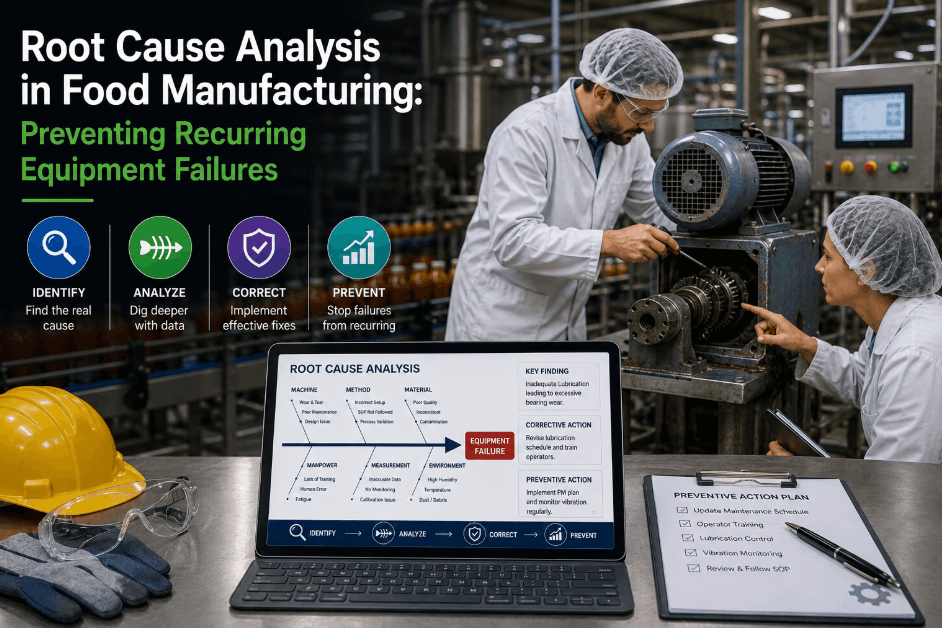
When a failure occurs, iFactory automatically correlates the sensor history to provide a "Digital Post-Mortem," accelerating the RCA process and preventing recurring functional failures.
Predictive Reliability: Forecasting the Future of Your Asset Health
Reliability isn't just about what happened; it's about forecasting what *will* happen. iFactory uses machine learning to project the "Remaining Useful Life" (RUL) of every critical component. By analyzing the interaction between production throughput and equipment degradation, AI predicts exactly when a filler nozzle or a conveyor gearbox will cross the threshold from "Reliable" to "At-Risk." This allows for long-range maintenance planning that aligns perfectly with scheduled plant shutdowns, eliminating the need for emergency call-outs.
AI-Driven Reliability Forecasting: Identifying Functional Drift
The ultimate value of RCM-AI is the ability to forecast functional drift before it reaches a failure state. By analyzing patterns across thousands of asset entries, iFactory identifies "Reliability Signatures"—such as a specific motor's recurring current surges that indicate a pending winding failure. Book a Demo to see our predictive reliability dashboards.
MTBF Projection AI
AI models analyze historical failure data to project the "Next Failure Window" for critical assets. This allows maintenance teams to transition from reactive 911 calls to planned reliability interventions.
Sterile Boundary Integrity Prediction
By correlating thermal cycle counts with gasket age and vibration, AI predicts the "Fatigue Point" of aseptic seals, preventing the microscopic breaches that cause batch spoilage.
Energy-to-Failure Correlation
The platform identifies assets that are consuming 5-10% more energy than their baseline—a "Silent Alarm" that indicates internal friction, misalignment, or pending mechanical failure.
Maintenance Task Effectiveness Score
AI constantly reconciles "Work Performed" against "Asset Improvement." If a specific PM task isn't improving reliability, the AI suggests an RCM-backed strategy shift to optimize labor spend.
The Financial Case: ROI of AI-Driven Reliability-Centered Maintenance
The business case for RCM in food manufacturing is built on OEE improvement and maintenance efficiency. While a single avoided batch loss can save $1M+, the daily savings from 25% lower maintenance labor and 15% lower parts inventory provide a compelling 12-18 month payback period. For large-scale multi-site manufacturers, the data-driven reliability provided by iFactory is the key to unlocking consistent global quality standards.
Implementation Roadmap: Deploying RCM-AI Across Your Facility
Deploying Reliability-Centered Maintenance is a strategic journey from digital data capture to full autonomous reliability orchestration. iFactory's phased model ensures immediate ROI by focusing on your "Critical 10%" assets first.
Asset Criticality & Functional Mapping
Deployment of the RCM-AI engine on your most critical production line. Establishing the asset functional requirements and ranking every component based on its impact on safety and OEE.
- Asset Criticality Ranking (ACR) established
- Functional requirement mapping
- Initial FMEA library synchronization
IoT-Linked Failure Mode Detection
Connecting production sensors to the FMEA library. AI starts learning specific failure signatures and identifying "On-Condition" maintenance opportunities, replacing calendar PMs.
- Sensor-to-Failure-Mode mapping
- "On-Condition" maintenance logic activated
- Hidden failure detection loops established
Maintenance Task Strategy Optimization
Evaluating the effectiveness of the entire PM program. AI suggests task removals or modifications based on actual equipment performance data, optimizing maintenance labor spend.
- PM-to-RCM strategy shift
- Maintenance labor reallocation dashboard
- Spare parts optimization engine activation
Autonomous Reliability Orchestration
The final phase enables the "Self-Healing" reliability layer. The platform automatically adjusts maintenance schedules based on predictive MTBF data and upcoming production demands.
- Predictive MTBF-based scheduling
- Autonomous Root Cause Analysis (RCA)
- Plant-wide Reliability Digital Twin
ASSET INTEGRITY · PREDICTIVE OEE · TOTAL RELIABILITY
Stop Fix-and-Fail. Start Reliability-Centered AI.
Don't let your maintenance strategy be a bottleneck. Join global food leaders who are using iFactory RCM-AI to achieve absolute asset availability and massive operational savings.
Frequently Asked Questions
What is Reliability-Centered Maintenance (RCM) in food manufacturing?
RCM is a systematic process used to determine the most effective maintenance strategy for every asset, focusing on preserving functions rather than just equipment. It prioritizes tasks based on the impact of failure on food safety, environment, and OEE.
How does AI improve the RCM process?
AI automates the complex FMEA (Failure Mode and Effects Analysis) by linking real-time sensor data to failure modes, predicting "Functional Failures" before they occur, and dynamically adjusting maintenance schedules based on actual asset health.
What is a "Hidden Failure" in a food plant?
A hidden failure is a failure in a component—like a backup sterile valve or a high-pressure safety switch—that does not manifest during normal operation but leaves the facility vulnerable if a primary system fails. RCM-AI continuously monitors these readiness nodes.
Can RCM help reduce food safety risks?
Yes. By identifying "Failure Modes" that could lead to sterile boundary breaches or allergen cross-contamination, RCM ensures that the components protecting food safety receive the highest priority care.
Does RCM require us to replace our current CMMS?
No. iFactory sits on top of your existing CMMS (like SAP PM or Maximo), providing the "Intelligence Layer" that optimizes work orders and maintenance tasks based on RCM logic and real-time sensor data.
How do you rank "Asset Criticality"?
We use a multi-variable matrix that considers food safety risk, impact on production throughput (OEE), maintenance cost, and environmental impact. Assets with the highest scores are prioritized for predictive RCM tasks.
What is FMEA?
Failure Mode and Effects Analysis (FMEA) is a step-by-step approach for identifying all possible failures in a design, a manufacturing or assembly process, or a product or service. iFactory digitizes this and links it to real-time IoT signatures.
How much can we save by switching to RCM-AI?
Most manufacturers achieve a 25% reduction in maintenance labor and parts spend, combined with a 3-5% increase in total line availability, leading to a full ROI in under 18 months.
RELIABILITY LEADERSHIP · PREDICTIVE ASSET INTEGRITY
Secure Your Production Future with iFactory RCM-AI.
Join global food leaders who are transforming their maintenance from a cost center into a reliability advantage. See your entire facility's reliability on a single, data-driven map today.