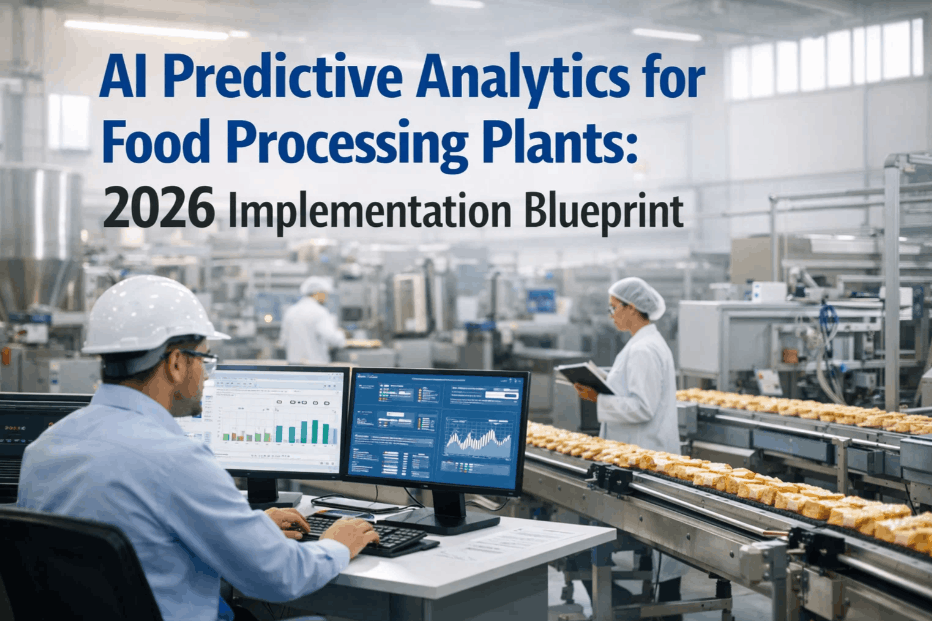
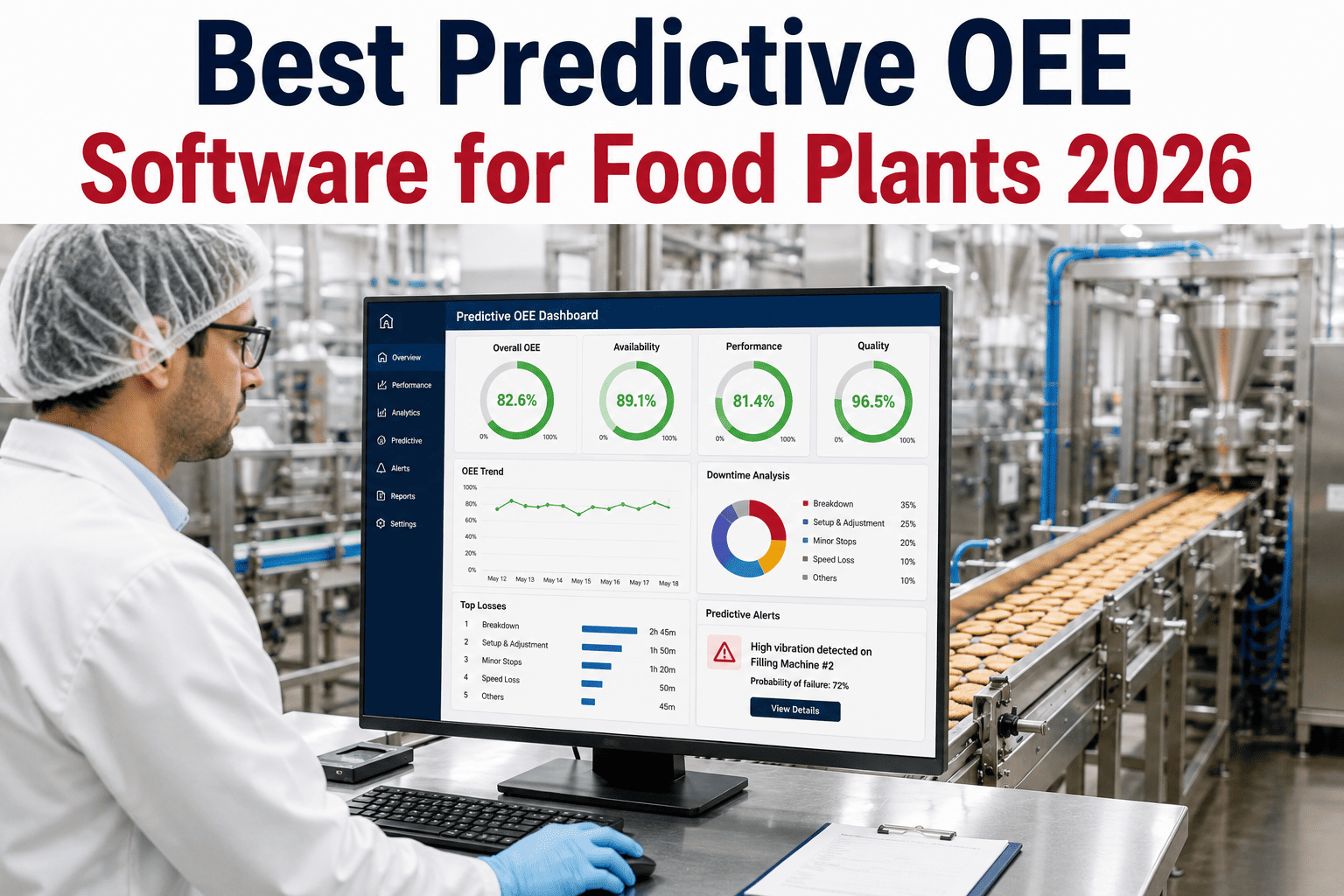
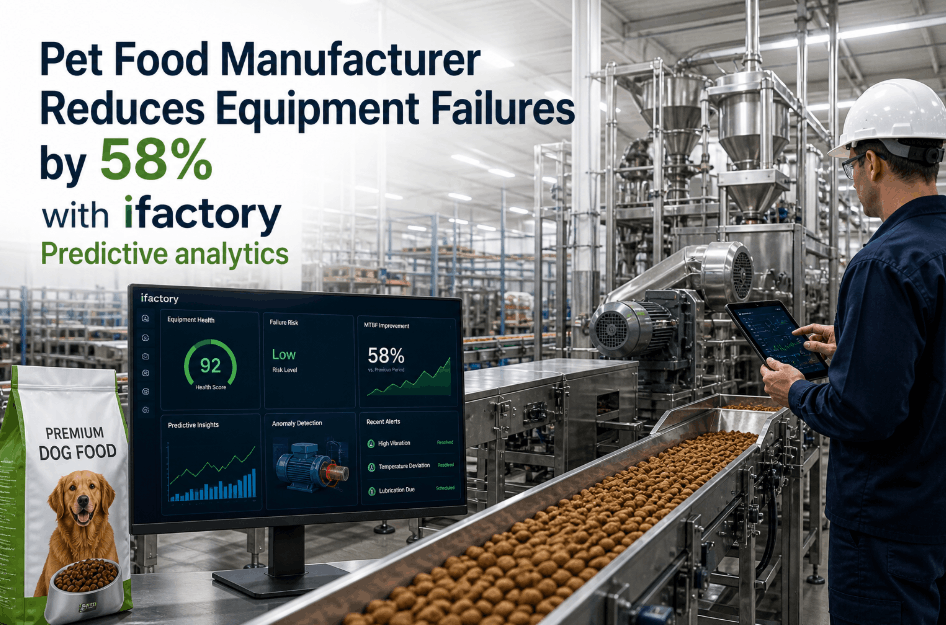
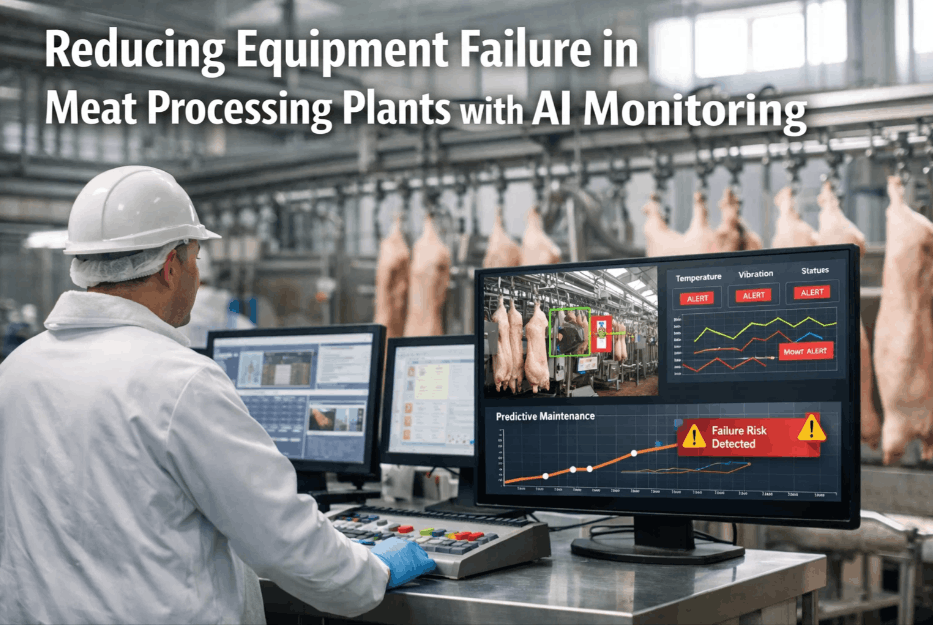
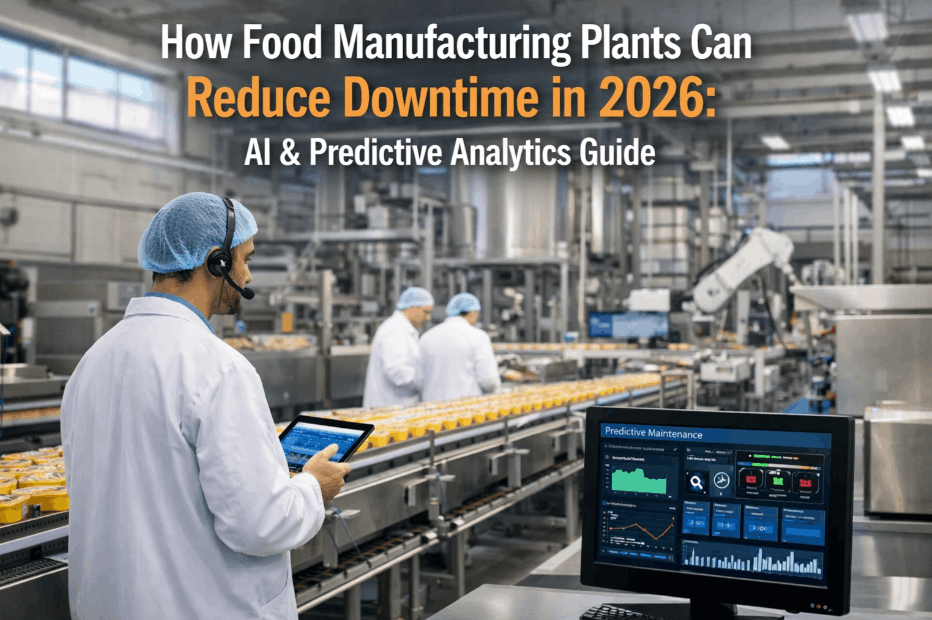
AI predictive analytics for food processing plants has moved from experimental technology to operational necessity in 2026. As machine failure prediction capabilities become more accessible and industrial AI analytics platforms more affordable, food manufacturers that delay adoption are paying a measurable price — in unplanned downtime, contamination risk events, compliance violations, and lost production capacity. This blueprint provides a step-by-step implementation guide for deploying AI predictive analytics in food processing environments, covering platform selection, sensor integration, model training, and ROI measurement — and you can Book a Demo to see exactly how an AI analytics platform maps to your plant's specific risk profile.
AI-DRIVEN PLATFORM
·
PREDICTIVE ANALYTICS
·
FOOD PLANT READY
Stop Equipment Failures Before They Happen — AI Predictive Analytics Built for Food Processing
iFactory's industrial AI analytics platform monitors every critical asset in your food processing plant — delivering machine failure predictions 7 to 21 days in advance, automated CCP compliance records, and real-time production health dashboards that keep your facility audit-ready year-round.
Why AI Predictive Analytics Is Now Critical for Food Processing Plants in 2026
The food processing industry entered 2026 facing a convergence of operational pressures that have made reactive maintenance strategies financially untenable. Equipment failure rates have climbed steadily as aging assets operate beyond their original design lifespans, skilled maintenance technicians become harder to retain, and production schedules intensify to meet post-pandemic demand recovery. The result is a sector where unplanned downtime now costs mid-size food facilities an average of $2.4 million annually — a figure that grows when regulatory penalties, product waste, and customer fulfillment failures are factored in.
AI predictive analytics for food processing plants addresses this challenge at its root. Rather than responding to failures after they occur, machine failure prediction software uses real-time sensor data, historical equipment performance patterns, and machine learning algorithms to identify developing failure signatures days or weeks before breakdown. Food plant operators gain the ability to schedule maintenance interventions at the optimal moment — eliminating emergency repairs while preserving every hour of available production capacity.
The technology has matured significantly. Industrial AI analytics platforms purpose-built for food manufacturing now integrate seamlessly with existing production infrastructure, require no dedicated data science teams to operate, and deliver measurable ROI within the first six to nine months of deployment. For food manufacturers still evaluating whether predictive analytics is right for their operation, the more pressing question in 2026 is how much longer they can afford to operate without it.
85%
Reduction in unplanned equipment failures reported within 12 months of AI deployment
7–21
Days of advance failure warning delivered by AI predictive models on critical assets
40%
Average reduction in maintenance costs when shifting from reactive to predictive programs
6–9 mo
Typical ROI payback period for food plants deploying industrial AI analytics platforms
Core Technology
How AI Predictive Analytics Works in Food Processing Environments
Understanding the mechanics of predictive analytics manufacturing software is essential before any food plant deployment. The technology operates across three interconnected layers: data acquisition, analytical processing, and actionable output. Each layer builds on the previous one — and the quality of outcomes is directly proportional to the quality of data flowing through the system.
01
Industrial IoT Sensor Data Acquisition
Industrial IoT sensors attached to critical production assets — filling machines, pasteurizers, conveyor systems, metal detectors, packaging lines, refrigeration compressors — capture continuous streams of vibration, temperature, pressure, current draw, and cycle rate data. This real-time equipment health monitoring provides the raw signal depth that machine learning models need to identify degradation patterns. Modern IoT sensors retrofit onto existing equipment without modification, making deployment practical even in older food processing facilities where capital expenditure on new machinery is constrained.
02
Machine Learning Model Training and Pattern Recognition
AI machine learning models are trained on the specific operational signatures of your production assets — learning what normal equipment behavior looks like across different production runs, seasonal temperature variations, and product changeovers. Once baseline patterns are established, the model continuously analyzes incoming sensor data for deviations that precede known failure modes. As operational history accumulates, predictive accuracy improves: models trained on six months of plant data consistently outperform those trained on sixty days, making early deployment a compounding advantage for food manufacturers.
03
Actionable Alerts and Maintenance Scheduling Integration
When AI analysis detects an equipment health indicator crossing into elevated risk territory, automated alerts are dispatched to maintenance teams, plant managers, and production schedulers with specific failure probability scores, recommended intervention windows, and suggested maintenance actions. These alerts integrate directly with existing CMMS and ERP systems — converting predictive insights into scheduled work orders without requiring manual transcription. The result is a maintenance program driven by actual asset condition rather than fixed calendar intervals, eliminating both unnecessary preventive replacements and catastrophic unplanned failures simultaneously.
Implementation Blueprint
Step-by-Step Guide to Deploying AI Predictive Analytics in Your Food Processing Plant
Successful deployment of a food factory AI analytics system follows a structured sequence that maximizes early value delivery while building the operational foundation for long-term predictive accuracy. Food manufacturers that skip phases or attempt full-plant simultaneous deployment consistently report slower time-to-value and more complex change management challenges than those following a phased, asset-priority approach. You can Book a Demo to walk through this deployment sequence against your specific plant configuration before committing to any implementation investment.
1
Asset Criticality Assessment and Failure Mode Mapping
Begin by ranking every production asset by its criticality to continuous plant operation. Which equipment failures cause the longest production stoppages? Which assets have the worst historical breakdown frequency? Which CCPs would lose monitoring continuity if a specific piece of equipment failed? This structured criticality assessment determines your IoT sensor deployment sequence and ensures that predictive analytics resources are applied to the assets with the highest failure impact first — generating maximum ROI from the initial deployment phase.
Outcome: Risk-ranked asset deployment roadmap
2
IoT Sensor Retrofit and Real-Time Data Pipeline Setup
Industrial IoT sensors are installed on priority assets according to the criticality ranking. For food processing environments, sensor placement protocols must account for washdown cycles, temperature extremes, vibration interference, and food safety zoning requirements. The iFactory platform accepts data from a wide range of industrial sensor protocols — minimizing integration complexity. Within hours of sensor activation, live equipment health dashboards begin populating with real-time production data, providing immediate visibility even before predictive models reach full accuracy.
Outcome: Live equipment health monitoring from day one
3
Baseline Establishment and Predictive Model Calibration
During the first 30 to 60 days of sensor operation, the AI analytics platform builds equipment-specific performance baselines — capturing normal operating ranges across different production conditions, shift patterns, and product SKUs. This calibration period is critical for predictive accuracy: models that cannot distinguish between normal operational variation and genuine failure signals generate excessive false alerts that undermine maintenance team confidence. Quality baseline data is the foundation of a high-precision machine failure prediction system.
Outcome: Plant-specific AI models with high signal accuracy
4
Alert Threshold Configuration and CMMS Integration
With baseline models established, alert thresholds are configured to match your maintenance team's capacity to respond. Thresholds set too sensitively generate alert fatigue; thresholds set too conservatively miss early-stage failures. The iFactory platform uses historical maintenance data and equipment failure libraries to recommend starting threshold configurations — which are then refined based on actual alert response outcomes over the first 60 to 90 days of operation. Direct CMMS integration converts high-confidence failure predictions into scheduled work orders automatically.
Outcome: Automated maintenance scheduling tied to real asset health
5
Compliance Documentation Automation and CCP Integration
The final phase of the core deployment connects equipment health monitoring to CCP compliance documentation workflows. Food processing facilities must maintain continuous monitoring records for critical control points — and equipment failures that interrupt CCP monitoring represent both a safety risk and a certification audit vulnerability. AI-driven compliance automation captures temperature records, metal detector challenge results, pressure verifications, and corrective action documentation in real time — maintaining complete audit-ready records regardless of whether the plant is operating normally or in disruption-response mode.
Outcome: Continuous GFSI-compliant documentation under any operating condition
Asset Coverage
Critical Food Processing Equipment Where AI Predictive Analytics Delivers the Highest ROI
Not all food processing assets carry equal failure risk or disruption impact. The food plant breakdown prevention software deployments that generate the fastest and most substantial ROI are those that prioritize monitoring resources on the equipment categories where failures cause the greatest production and safety consequences. Understanding which assets to instrument first is one of the most important decisions in any predictive analytics implementation. If you want guidance specific to your plant configuration, Book a Demo and our engineers will map the optimal sensor deployment sequence against your actual asset inventory.
01
Pasteurizers and Thermal Processing Units
Thermal processing equipment failures in food plants represent simultaneous production, safety, and compliance risks. AI monitoring of heating element degradation, pump performance, flow rate consistency, and temperature profile deviations provides early warning of failures that would otherwise trigger both production stoppages and mandatory product holds. Predictive intervention windows of 7 to 14 days are routinely achieved on pasteurizer systems with mature sensor data histories.
02
High-Speed Filling and Packaging Lines
Filling and packaging line downtime carries compounding impact — idle line time, upstream product accumulation, ingredient quality degradation, and fulfilled order delays all cascade from a single mechanical failure. AI vibration and cycle time monitoring on servo motors, pneumatic components, and sealing systems identifies developing wear patterns weeks before they escalate to line stoppage, enabling planned maintenance scheduling that fits around production commitments rather than forcing emergency shutdowns.
03
Metal Detection and X-Ray Inspection Systems
Detection system performance degradation is particularly dangerous in food processing because it creates a compliance gap risk that may not be visible until a regulatory audit or customer complaint surfaces. AI monitoring of rejection rate trends, sensitivity calibration drift, and mechanical conveyor performance on metal detectors and X-ray inspection systems ensures that food safety critical equipment maintains certified performance levels — and flags sensitivity degradation before it reaches the point of regulatory non-compliance.
04
Refrigeration and Cold Chain Compressors
Compressor failures in food manufacturing are among the highest-cost equipment events — not only because of repair costs but because of the product loss and food safety exposure that accompanies cold chain interruption. AI predictive monitoring of compressor vibration, refrigerant pressure profiles, oil temperature, and motor current draw delivers failure warnings on a timeline that prevents product loss entirely, converting what would be a catastrophic cold chain failure into a planned maintenance event.
05
Conveyor Systems and Material Handling
Conveyor belt and drive system failures in food processing plants create production bottlenecks that ripple across multiple production lines simultaneously. AI monitoring of belt tension, roller bearing vibration, motor current signatures, and drive chain wear patterns identifies developing failures across entire conveyor networks — allowing maintenance teams to prioritize intervention on the conveyor segments closest to failure before line stoppages impact downstream packaging operations.
06
CIP and Sanitation System Components
Clean-in-place system failures are uniquely dangerous in food processing because they compromise both sanitation effectiveness and production scheduling simultaneously. AI monitoring of CIP pump performance, flow rates, chemical dosing accuracy, and cycle time consistency ensures that sanitation systems maintain certified performance levels — and that any performance degradation is detected and corrected before it creates a food safety non-conformance or triggers a production hold.
Predictive vs. Reactive Maintenance in Food Processing: Performance Comparison
Food plants that have deployed AI predictive analytics platforms report measurable improvements across every maintenance and production performance dimension compared to facilities still operating on reactive or time-based maintenance schedules.
AI Predictive Analytics vs. Reactive Maintenance: Food Processing Plant Performance
Contamination Risk
AI Predictive Analytics and Food Contamination Risk Prevention
Beyond operational efficiency, AI predictive analytics for food processing plants delivers a food safety benefit that is increasingly recognized by GFSI certification bodies and food safety regulators: the ability to identify equipment conditions that elevate contamination risk before a product safety event occurs. Equipment that degrades in ways that create metal-on-metal contact, seal deterioration, or lubricant migration into product contact zones can generate foreign body contamination that bypasses detection systems if the contamination originates from a compromised detection asset itself.
Smart factory predictive systems monitor equipment health in the specific dimensions most relevant to contamination risk — seal integrity pressure signatures, bearing failure vibration modes that precede metallic particle generation, and conveyor belt surface degradation patterns that can introduce rubber contamination into open product lines. For food manufacturers operating under FSSC 22000, SQF, or BRC certification, this contamination risk prediction capability represents a meaningful advance in hazard analysis methodology — and one that resonates strongly with certification auditors evaluating a facility's proactive food safety management culture. Food safety teams interested in this capability can Book a Demo to see how AI contamination risk monitoring maps to their specific HACCP plan.
Metal Contamination Risk Monitoring
AI monitoring of bearing vibration signatures and metal-on-metal contact indicators in food processing equipment identifies the preconditions for metallic particle generation before particles enter the product stream — providing a preventive contamination control that supplements detection-based approaches with upstream prevention.
Seal and Gasket Integrity Prediction
Seal failure in food processing equipment creates both contamination risk and allergen cross-contact exposure. AI analysis of pump pressure profiles, flow rate signatures, and CIP cycle completion data identifies developing seal degradation weeks before physical failure — enabling planned replacement during scheduled downtime rather than emergency response during production.
Detection System Performance Assurance
The integrity of a food safety program depends entirely on the performance of its detection systems. AI predictive monitoring of metal detector and X-ray system performance trends ensures that sensitivity calibration remains within certified tolerances — and flags drift before it reaches levels that would compromise detection effectiveness and create audit non-conformances.
Thermal Process Validation Continuity
Pasteurizer and retort equipment operating below validated thermal process parameters creates microbiological safety risk that may not be immediately apparent. AI monitoring of thermal processing equipment health and temperature profile consistency maintains validated process delivery — alerting food safety teams to deviations before they compromise product safety rather than after batch release.
ROI Analysis
Measuring the ROI of AI Predictive Analytics in Food Manufacturing
Justifying the capital investment in a predictive analytics manufacturing software deployment requires a structured ROI framework that captures the full value delivered across maintenance cost reduction, production uptime improvement, compliance efficiency gains, and food safety risk mitigation. Food plant financial teams evaluating AI predictive analytics platforms should build ROI models that account for all four value dimensions — not just maintenance savings — to accurately represent the business case. Facilities that have completed deployments with iFactory consistently achieve positive ROI within six to nine months when all value dimensions are properly captured. You can Book a Demo to walk through an ROI model built specifically for your facility size, asset count, and production volume.
Maintenance Cost Reduction
25–40%
Reduction in total maintenance spend driven by elimination of emergency repair premiums, unnecessary preventive replacements, and overtime maintenance labor costs. Calculated against pre-deployment maintenance budget as baseline.
Unplanned Downtime Elimination
60–85%
Reduction in unplanned production stoppages in the first 12 months. Calculated using pre-deployment downtime frequency and average cost per hour of line stoppage — typically the largest single value driver in the ROI model.
Audit Preparation Efficiency
95%
Reduction in staff hours required to prepare documentation for GFSI certification audits. Automated record generation converts 40 to 80 hours of manual audit preparation into 2 to 4 hours of report review per audit cycle.
OEE Improvement
+20 pts
Overall Equipment Effectiveness improvement from the 55 to 65% range typical of reactive environments to the 75 to 88% range achievable with real-time AI monitoring — representing a 15 to 35% increase in effective production capacity from the same asset base.
Frequently Asked Questions: AI Predictive Analytics for Food Processing Plants
How long does it take to deploy an AI predictive analytics platform in a food plant?
Initial sensor deployment on priority assets and live dashboard activation typically completes within 2 to 4 weeks. Predictive models begin generating meaningful failure warnings within 30 to 60 days as equipment baselines are established. Full-plant coverage in phased deployments generally completes within 3 to 6 months.
Does AI predictive analytics work with older food processing equipment?
Yes. Industrial IoT sensors retrofit onto existing equipment without modification in most cases. The iFactory platform is designed for food manufacturing environments where capital replacement cycles are long — providing AI monitoring capability regardless of equipment age or original digital capability.
Can predictive analytics help with GFSI certification audits?
Directly. AI-driven compliance automation captures all CCP monitoring records, corrective action documentation, and equipment calibration histories in audit-ready format — reducing BRC, SQF, and FSSC 22000 audit preparation from 40 to 80 hours to 2 to 4 hours per certification cycle.
How accurate are the machine failure predictions?
Prediction accuracy improves with operational history. Models trained on 90-plus days of plant data typically achieve 80 to 90% failure prediction accuracy with 7 to 21 days of advance warning on well-instrumented assets. False alert rates decrease significantly after the first 60 to 90 days of operation.
What is the minimum facility size that benefits from AI predictive analytics?
Single-site food processing facilities with as few as 15 to 20 monitored assets generate strong ROI from AI predictive analytics deployment. Smaller manufacturers often benefit most due to limited in-house maintenance engineering resources — the AI platform effectively extends their analytical capability without adding headcount.
Does the platform integrate with our existing ERP and CMMS systems?
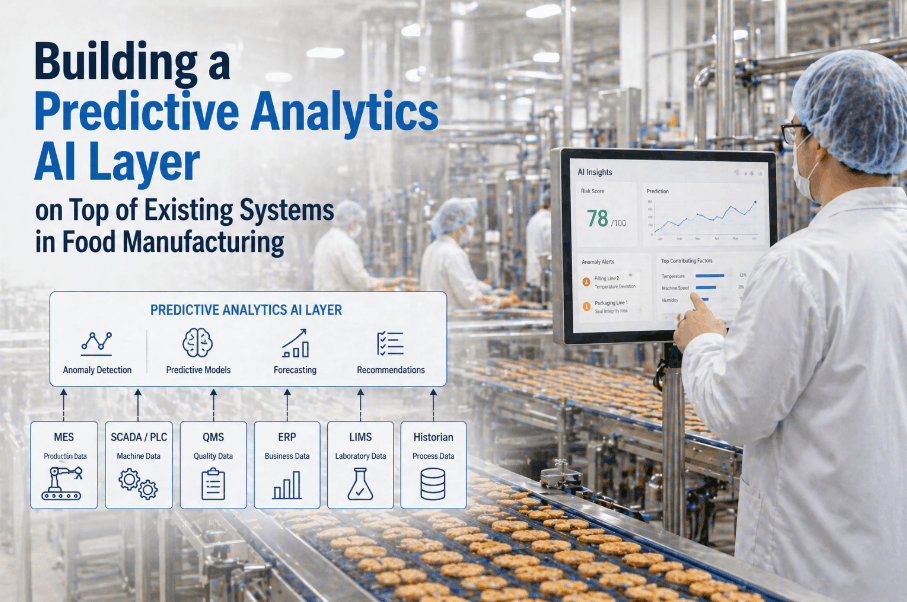
iFactory integrates with existing ERP, CMMS, and MES systems through standard API connectivity — layering real-time predictive intelligence on top of current technology investments without replacing them. Integration typically completes within the first two weeks of deployment.
2026 Implementation Blueprint
iFactory — AI Predictive Analytics Built for Food Processing Plant Resilience
Machine failure prediction in food processing is no longer a future capability — it is a present operational requirement for any food manufacturer competing on reliability, safety, and cost efficiency. The food plants deploying AI analytics platforms in 2026 are achieving measurable advantages in equipment uptime, maintenance cost structure, contamination risk management, and GFSI compliance readiness that their reactive-maintenance competitors cannot match. iFactory delivers all of this in a single integrated platform purpose-built for food manufacturing environments.
Real-time equipment health monitoring across all critical food processing assets
AI machine failure prediction with 7 to 21 days advance warning
Contamination risk monitoring for metal detection and thermal processing systems
Automated CCP compliance documentation for BRC, SQF, and FSSC 22000
CMMS and ERP integration for automated maintenance work order generation
Audit-ready reporting with 95% preparation time reduction