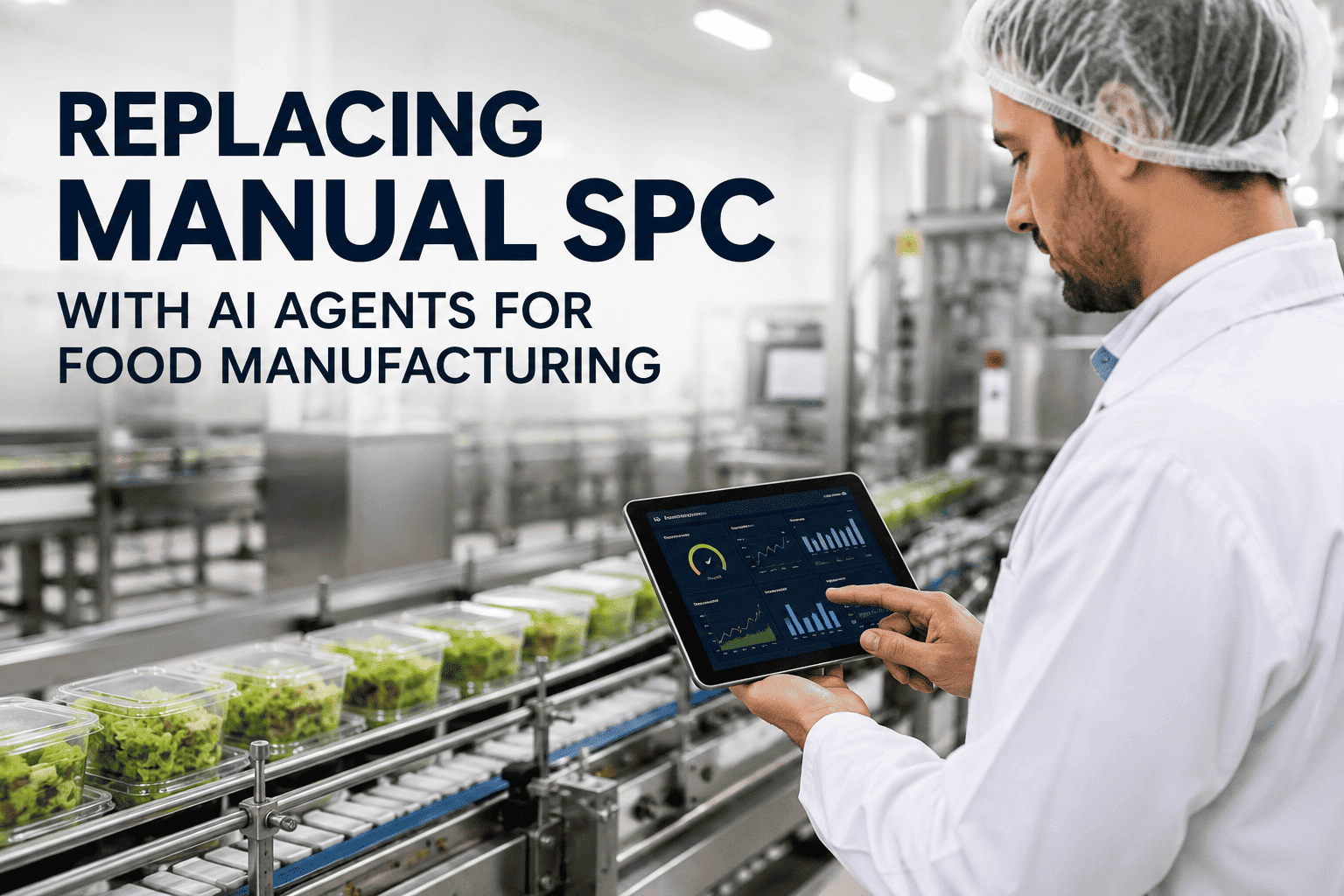
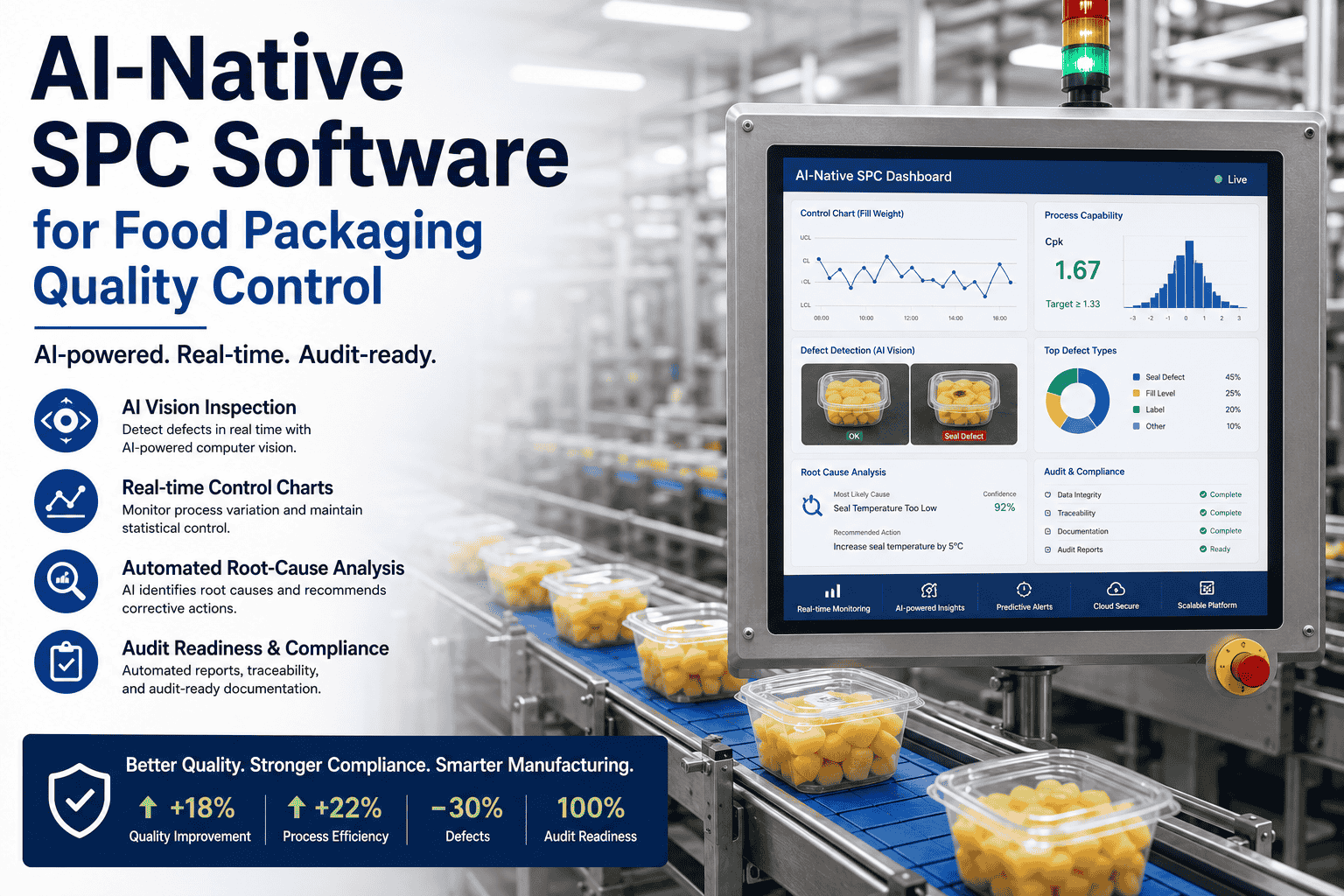
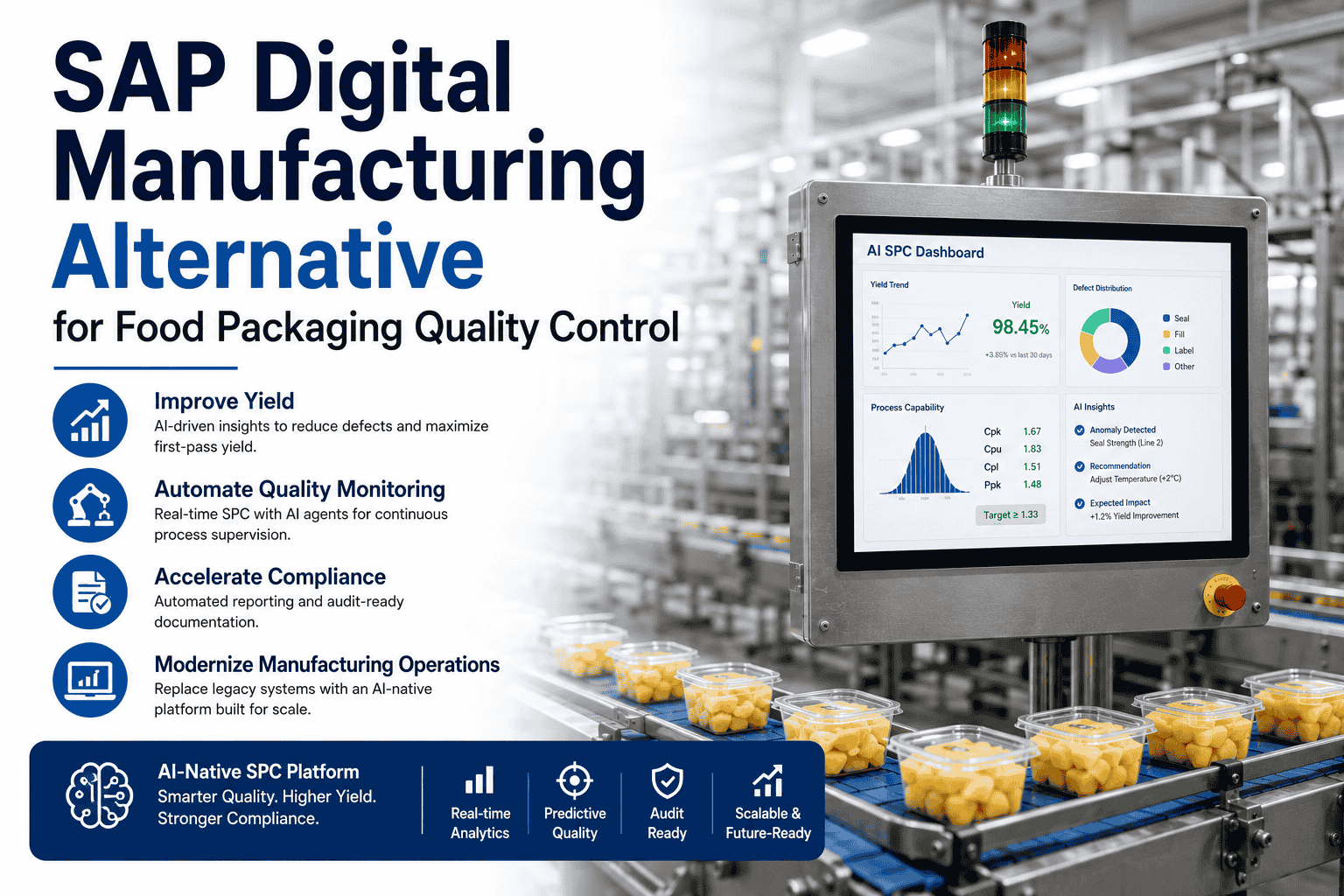
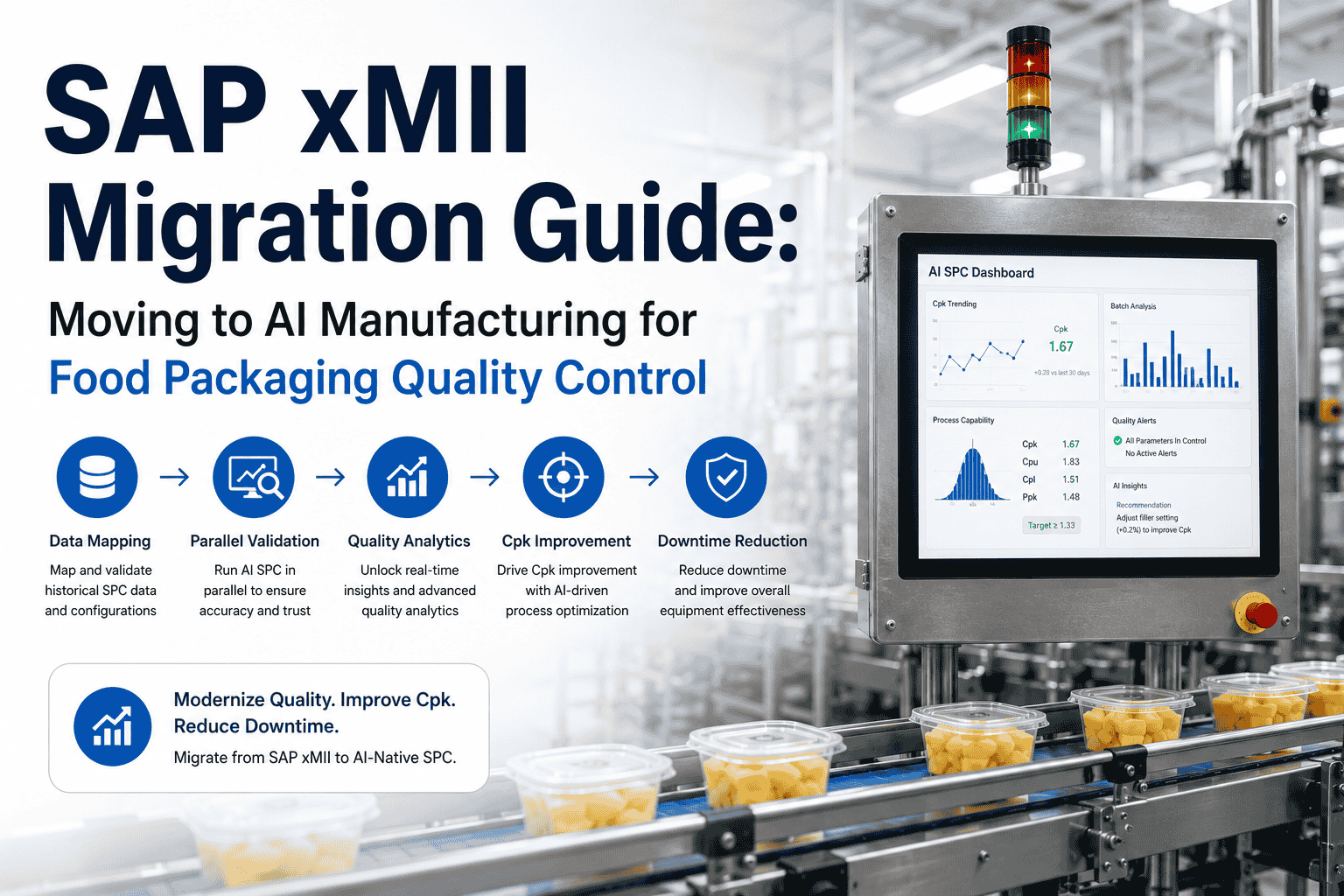
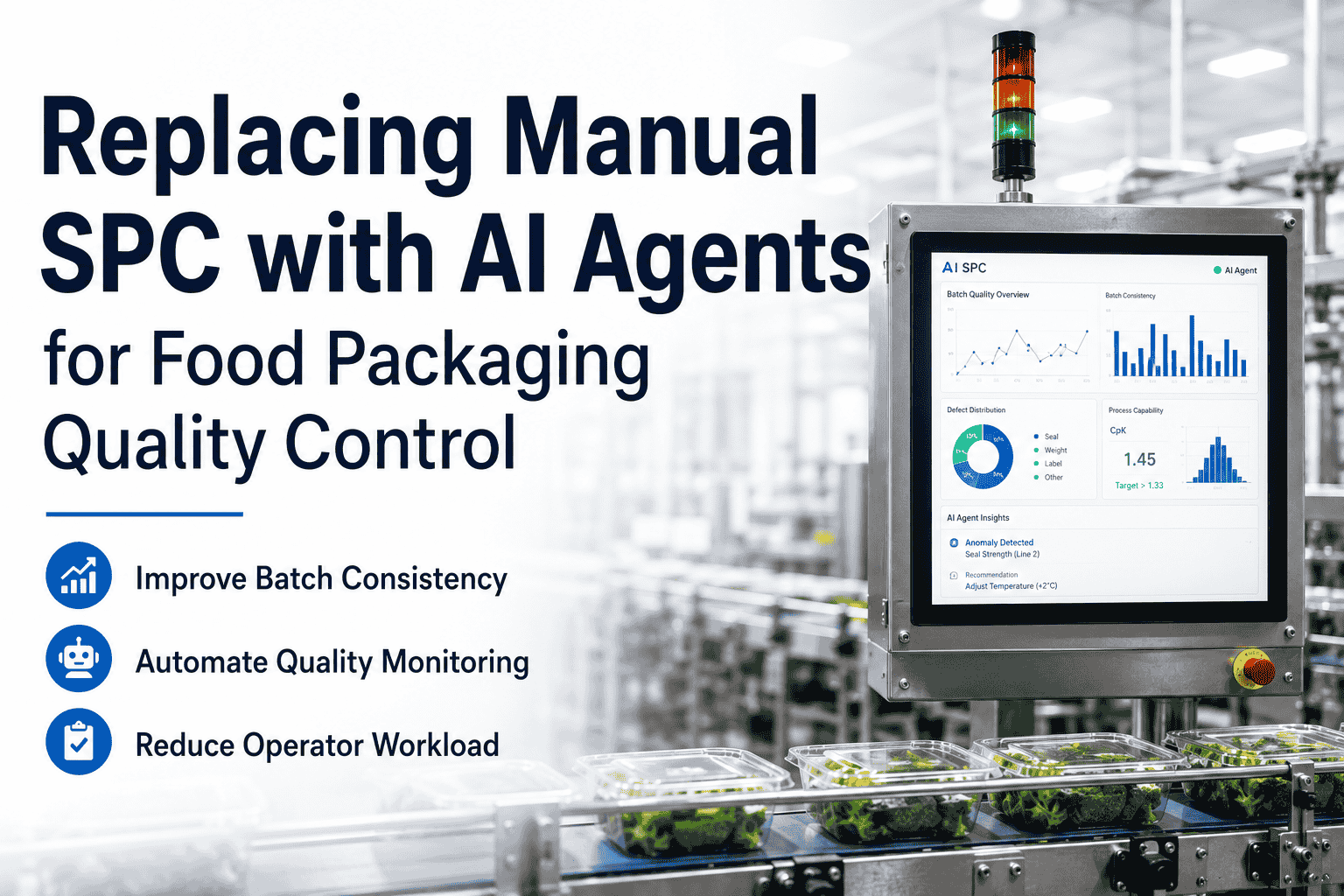
Your quality engineers are spending 60% of their day on tasks a machine should handle—collecting data from clipboards, entering readings into spreadsheets, manually plotting control charts, calculating Cpk values, and investigating out-of-spec events after the defective product is already on the pallet. That's not quality engineering. That's data entry with a lab coat. In 2026, food manufacturers are replacing manual SPC workflows with AI quality agents that collect data automatically, update control charts in real time, predict drift before it causes scrap, and surface root causes in seconds instead of hours. The result: 30–60% scrap reduction and quality engineers freed to do actual engineering. Book a demo to see AI SPC agents replace your manual quality workflow in 12 weeks.
Manual SPC Replacement
Replace Manual SPC with AI Quality Agents
From clipboards and spreadsheets to predictive intelligence that runs itself
Manual SPC Today
Operator records readings on paper
QE enters data into spreadsheet
QE manually plots control charts
QE investigates out-of-spec events
Supervisor reviews next morning
Hours to days of lag
AI SPC Agents
Sensors stream data automatically
AI updates charts in real time
Drift predicted before breach
Root cause identified in seconds
Operator alerted with corrective action
Seconds — fully automated
What Manual SPC Actually Costs Your Plant
Manual SPC doesn't look expensive in the budget because the costs hide inside labor hours, scrap rates, and investigation cycles that nobody tracks as a single line item. When you add them up, the true cost of manual quality processes is staggering—and most of it is completely avoidable.
60%
of QE time on data tasks
Quality Engineer Labor Waste
Quality engineers with advanced degrees spend the majority of their shift collecting data, entering it into systems, plotting charts, and writing reports. That's $80K–$120K/year salaries doing $15/hour data entry work. AI agents automate the entire data pipeline—freeing engineers for root-cause analysis, process improvement, and CAPA management.
4–8 hr
detection-to-action lag
Detection Lag Creates Scrap
Manual SPC checks happen at intervals—hourly, per-batch, or per-shift. Between checks, process drift goes undetected. At 600 units per minute, a 4-hour detection lag produces 144,000 potentially defective units before anyone knows there's a problem. AI agents detect drift in real time—the lag drops from hours to seconds.
50+
measurements = unreliable
Manual Data Collection Breaks at Scale
Above 50 measurements per shift, manual SQC becomes unreliable—data is delayed, transcription errors increase, charts age before anyone reviews them, and operators stop trusting the system. Modern food lines generate thousands of data points per minute. Manual processes physically cannot keep up.
Want to quantify what manual SPC costs your plant? Book a scrap reduction demo — we'll calculate your avoidable quality costs in 30 minutes.
How AI Quality Agents Work on the Factory Floor
An AI quality agent isn't a dashboard you check—it's an autonomous system that monitors, analyzes, predicts, and acts on quality data continuously. Think of it as a quality engineer that never sleeps, never misses a reading, analyzes every variable simultaneously, and gets smarter every shift.
1
Sense — Automatic Data Collection
The agent connects directly to PLCs, sensors, SCADA, and vision systems—ingesting every process variable in real time. No operator data entry, no clipboards, no spreadsheet transcription. Data flows continuously from the source of truth: the equipment itself.
2
Monitor — Real-Time Adaptive SPC
Control charts update automatically with every data point. Limits adapt to current conditions—material lot, post-CIP baseline, ambient environment, equipment state. The agent monitors hundreds of variables simultaneously, detecting multivariate interactions that single-chart SPC misses.
3
Predict — Pre-Breach Drift Detection
When trending patterns signal a control limit will be breached in the next 15–30 minutes, the agent generates a predictive alert—before a single defective unit is produced. This flips quality from reactive (finding defects after they exist) to predictive (preventing defects before they occur).
4
Diagnose — Automated Root-Cause Correlation
The agent correlates every upstream variable—temperature, pressure, speed, material properties, equipment wear, environmental conditions—and identifies the most probable root cause within seconds. Quality engineers receive a diagnosis, not just an alarm.
5
Act — Operator-Ready Corrective Guidance
The agent doesn't just flag the problem—it recommends the specific corrective action: adjust seal-bar temperature by 3°C, reduce line speed by 5%, check film tension on lane 2. Operators get actionable instructions, not abstract alerts they have to interpret.
See AI Quality Agents on Your Process Data
In a 30-minute workshop, we'll show AI agents detecting drift, diagnosing root causes, and recommending corrections on your specific food manufacturing parameters.
The Scrap Reduction Impact
When you replace manual SPC with AI agents, scrap reduction isn't a hope—it's a mathematical certainty. You're eliminating detection lag, removing transcription errors, catching multivariate drift that manual processes can't see, and enabling corrective action minutes before defects occur instead of hours after.
Detection lag
4–8 hours between manual checks
Real-time — every data point monitored
Variables tracked
5–10 manually, one at a time
Hundreds simultaneously with AI
Root-cause speed
Hours to days of manual analysis
Seconds — automated correlation
Control limits
Fixed — same for every condition
Adaptive — adjust to real-time context
Scrap reduction
Baseline
30–60% within first 90 days
Want to see the scrap reduction numbers for your specific lines? Schedule a scrap reduction demo and get a projected savings estimate in one session.
Expert Perspective
"In 2026, the best manufacturers are not replacing workers—they're augmenting them. AI agents assist in troubleshooting, quality checks, machine calibration, and safety validation. The strongest manufacturing copilot implementations aren't standalone chat tools—they're embedded inside the systems engineers and operators already use, providing contextual answers from plant-specific data."
— Manufacturing AI Copilot Best Practice, 2026
45%
reduction in unplanned downtime with AI quality copilots
30–60%
scrap reduction in first 90 days of AI SPC deployment
12 wk
from manual SPC to fully automated AI quality agents
Ready to free your quality engineers from data entry? Request a demo and see AI agents running quality intelligence on your process data.
Conclusion: Stop Paying Engineers to Enter Data
Every hour your quality engineers spend collecting readings, entering data, and manually plotting control charts is an hour they're not spending on process improvement, CAPA management, and the engineering work that actually prevents defects. Manual SPC was the best available method in 1990. In 2026, it's an operational liability—a system that guarantees detection lag, limits your visibility to a handful of variables, and scales by hiring more people instead of deploying more intelligence. AI quality agents automate the entire SPC pipeline from sensor to corrective action, detect multivariate drift patterns that manual processes structurally cannot see, and reduce scrap by 30–60% within the first 90 days. The migration takes 12 weeks. The ROI arrives on the first shift.
Replace Manual SPC With AI Quality Agents
In a 30-minute workshop, we'll map your manual SPC workflow, show AI agents handling it automatically, and project the scrap reduction for your specific lines and products.
Frequently Asked Questions
What does an AI quality agent actually do?
An AI quality agent is an autonomous system that performs the complete SPC cycle without manual intervention: it collects data directly from sensors and PLCs, updates control charts in real time, detects multivariate drift patterns across hundreds of variables, predicts quality exceedances 15–30 minutes before they occur, identifies root causes in seconds, and delivers specific corrective actions to operators. It does everything a quality engineer does during manual SPC—but continuously, at machine speed, and across far more variables simultaneously.
Book a demo to see it running on food manufacturing data.
Does replacing manual SPC mean replacing quality engineers?
No—it means upgrading their role. AI agents handle the data collection, charting, monitoring, and alerting that currently consume 60% of a quality engineer's shift. Engineers are freed to focus on high-value work: root-cause investigation, process improvement projects, CAPA management, supplier quality programs, and regulatory strategy. The best-performing food plants in 2026 are augmenting their quality teams with AI, not replacing them.
How much scrap can AI SPC agents reduce?
Food manufacturers typically see 30–60% scrap reduction within the first 90 days. The reduction comes from eliminating the detection lag (real-time monitoring vs. periodic manual checks), catching multivariate drift patterns that manual single-variable charts miss, adaptive control limits that prevent false rejects, and automated root-cause identification that resolves issues in seconds instead of hours. The specific reduction depends on your current scrap rates, line speed, and the number of quality parameters being monitored.
How long does it take to replace manual SPC with AI agents?
A typical implementation takes 12 weeks: connect data sources and sensors (weeks 1–2), train AI models on your products and defect patterns (weeks 3–5), parallel validation alongside existing manual processes (weeks 6–9), and full go-live with automated alerts and adaptive control (weeks 10–12). Your existing quality management system (SAP QM, MES, etc.) continues handling compliance documentation while AI agents handle real-time quality intelligence.
What data sources do AI quality agents need?
AI agents connect to the same data sources your manual SPC process currently relies on—PLCs, SCADA systems, temperature sensors, pressure transmitters, flow meters, vision systems, and weighing equipment—plus additional sources that manual processes can't practically monitor: ambient environmental sensors, equipment vibration data, material lot properties, and upstream process parameters. The AI platform ingests data via standard industrial protocols (OPC-UA, MQTT, Modbus) with no changes to your existing equipment or control systems.