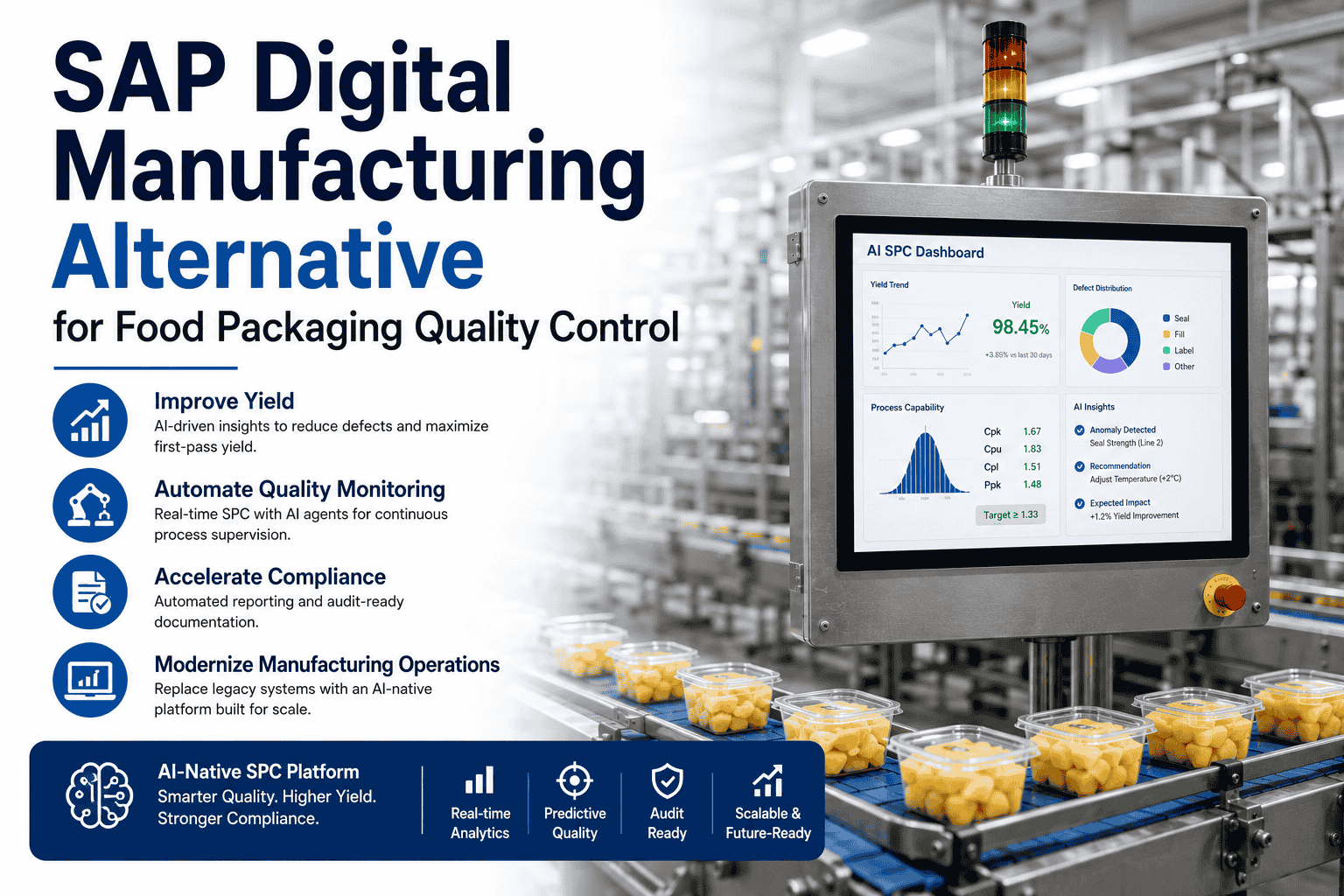
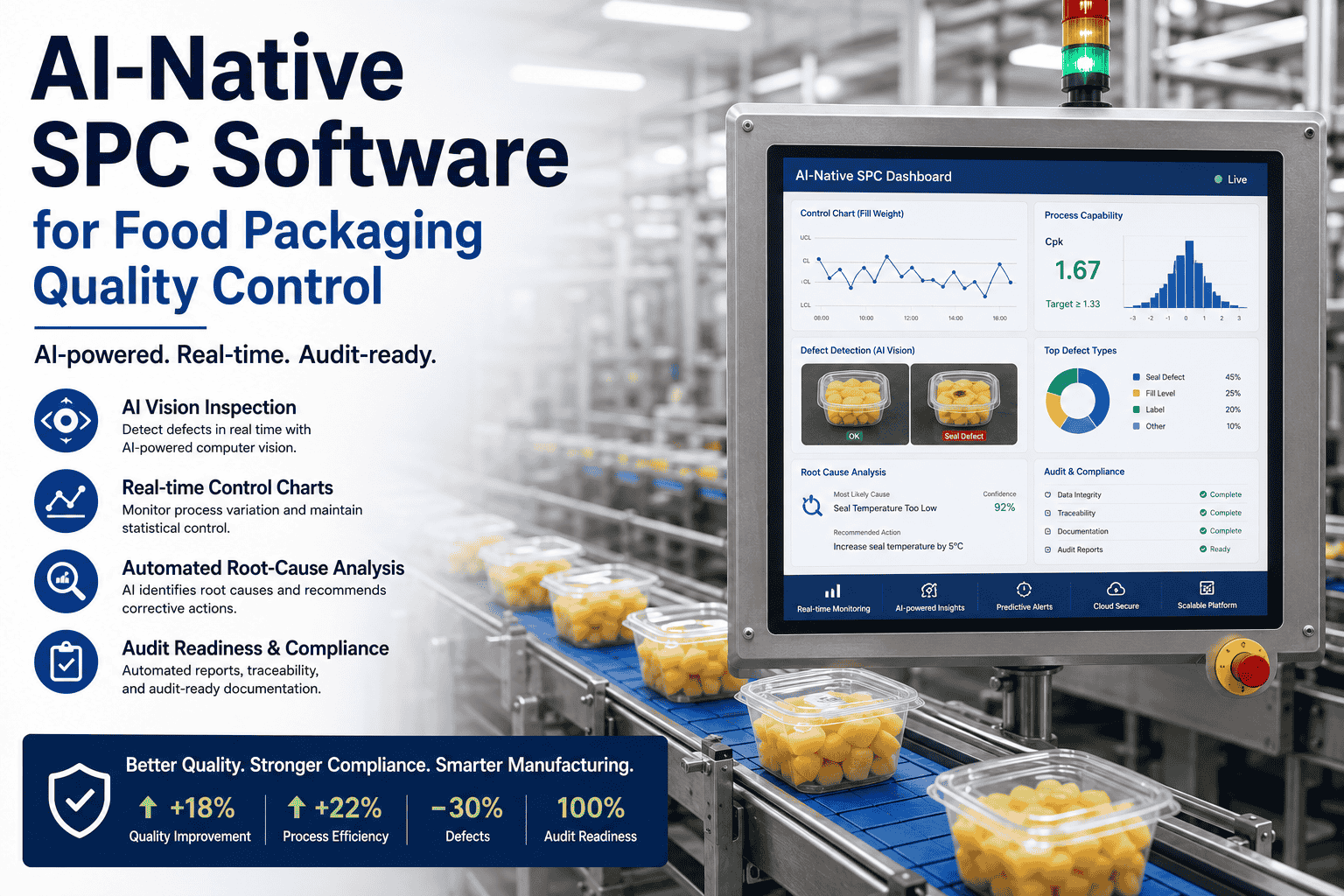
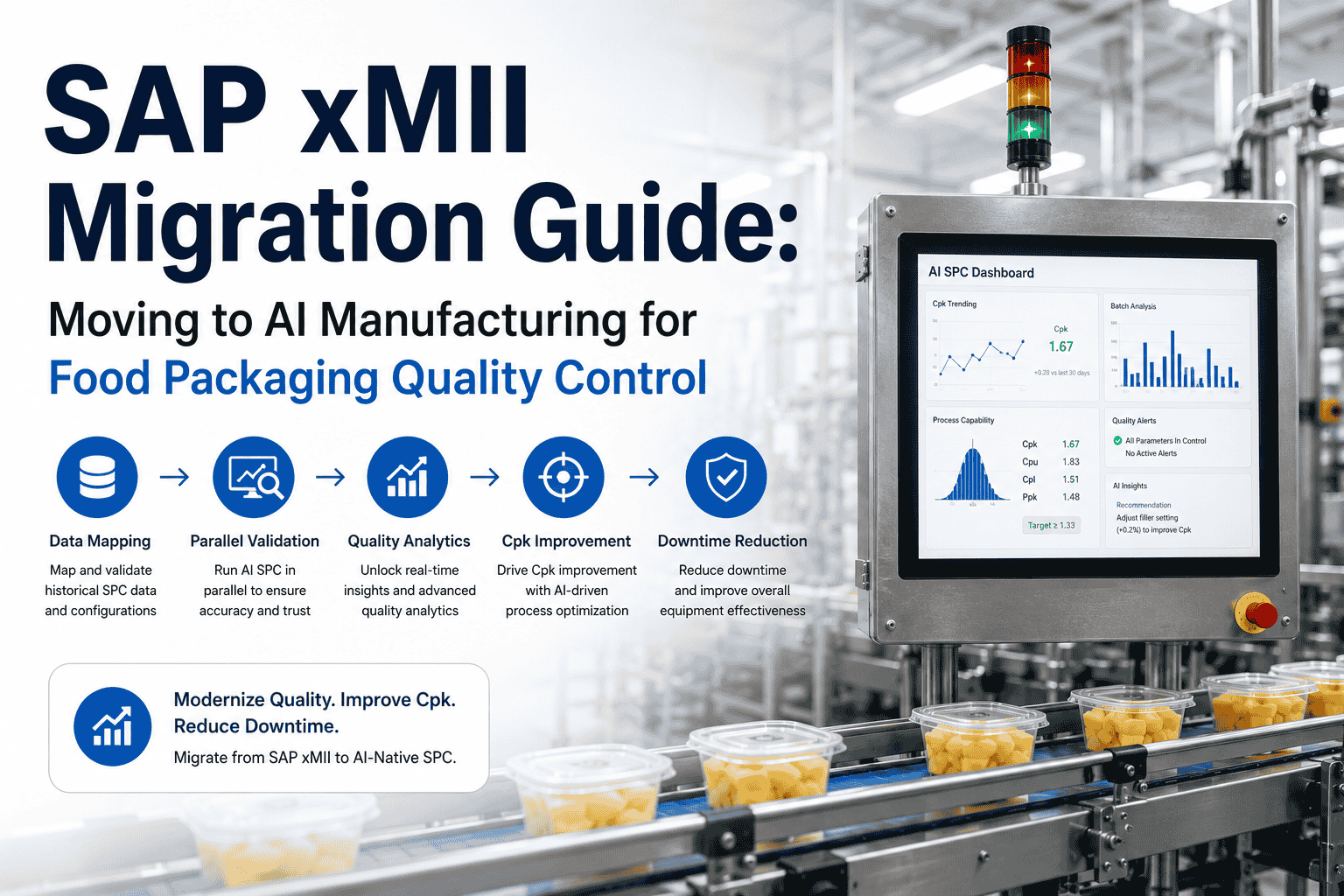
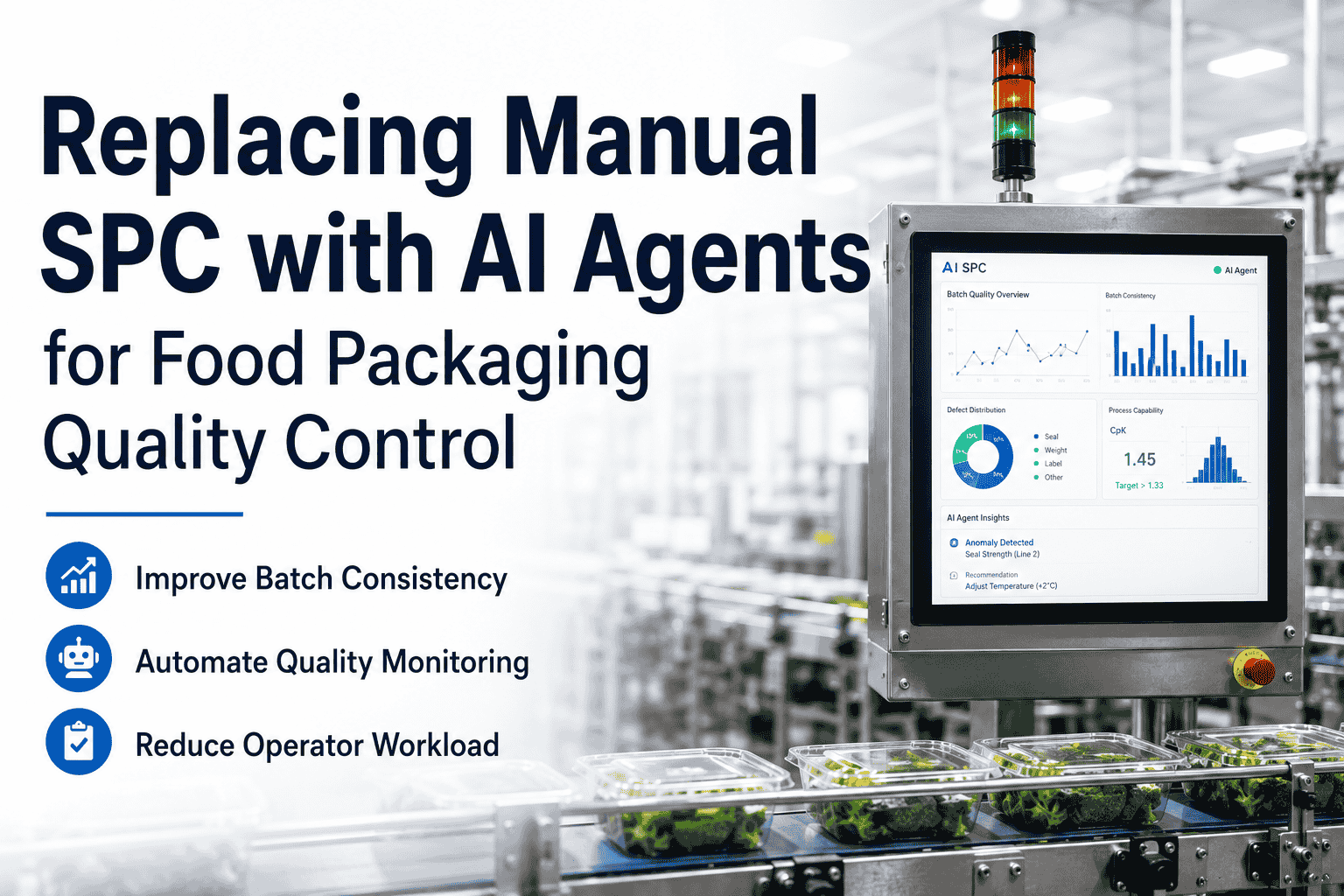
SAP Digital Manufacturing (SAP DM, formerly SAP DMC) is SAP’s recommended successor to SAP MII for production execution — electronic work instructions, in-process quality checks, and resource orchestration. It does that work well. What it does not ship deeply is the AI-native quality intelligence that food packaging operations need for yield improvement: continuous predictive monitoring, autonomous root cause analysis, real-time AI inspection, and operator-level GenAI coaching. For F&B plants choosing between pure SAP DM and an AI-native SPC alternative (or coexistence of both), the yield difference is material — typically 5–10 percentage points within 6–9 months. This guide explains where SAP DM falls short for quality, where it excels for execution, and how the coexistence pattern works. Book an AI SPC migration workshop to evaluate the right balance for your operation.
STACK 01
Manual SPC + Spreadsheets
Reactive chart review. Drift caught after defects fire. Operator-to-operator variation uncontrolled. Audit prep manual.
Structured electronic work instructions, in-process quality checks. Better than manual but rule-based SPC, no prediction, no autonomous RCA.
STACK 03
SAP DM + AI-Native SPC
Continuous AI monitoring, 4–24 hr predictive intervention, autonomous RCA in 3–5 min, AI coaching at line. Yield ceiling lifted.
The SAP DM Quality Gap for Food Packaging
SAP DM was designed primarily as an execution layer, not a quality intelligence platform. The capabilities it ships well are oriented toward production execution: electronic work instructions, in-process quality checks against predefined criteria, resource orchestration, and integration with SAP ERP. What it does not ship deeply — and this is the honest gap food packaging operations need to evaluate — is the AI-native quality intelligence that drives yield improvement above the 85–88% ceiling that rule-based SPC achieves. The gaps below are the specific capabilities SAP DM doesn’t deliver that AI-native SPC does.
01
No Predictive Scrap Prevention
SAP DM in-process quality checks fire when parameters exceed pre-set limits. Rule-based. Detection-after-the-fact. No ML models anticipating drift 4–24 hours before defects fire. The single highest-leverage AI capability for yield improvement is not part of SAP DM’s native scope.
02
Manual Root Cause Analysis
When SAP DM flags a quality deviation, supervisors still run RCA manually: pulling data from DM, SAP ERP, historian, line PLCs to build correlations. 30–60 minutes per investigation. SAP DM doesn’t pre-compute root cause hypotheses or maintain continuous causal analysis.
03
No Line-Rate AI Inspection
High-speed packaging lines (200–1000+ units/min) require sub-50ms vision and inspection latency that SAP DM’s cloud architecture cannot deliver. SAP DM relies on integration with separate inspection systems — the inspection AI itself is not native to SAP DM.
04
No GenAI Operator Coaching
SAP DM provides work instructions and POD (Production Operator Dashboard) interfaces. It does not provide natural language GenAI Copilots that answer operator questions in seconds or coach operators through quality decisions in real-time. Coaching remains a supervisor task.
05
Limited Cross-Site Yield Intelligence
SAP DM excels at plant-level execution but lags on portfolio-wide yield analytics, cross-plant benchmarking, and pattern detection across sites. Identifying that paste viscosity variation drives yield loss at multiple sites simultaneously is not a native SAP DM capability.
06
Continuous Compliance Documentation
SAP DM produces structured batch records aligned with its data model. Continuous auto-generation of FSMA Rule 204 audit packages, customer scorecard reports, and SQF/BRCGS evidence with explanatory narratives is not native — it requires layering analytics on top.
Where SAP DM Excels (The Honest View)
Positioning AI-native SPC as a categorical replacement for SAP DM would be inaccurate. SAP DM does several things genuinely well and continues to fit specific operational contexts. The credible alternative positioning is more nuanced: for the execution layer, SAP DM is often the right choice (especially for SAP-centric organizations migrating off MII). For the quality intelligence layer specifically — and the yield improvement that flows from it — AI-native SPC is the alternative that fills the gap. The strengths below are where SAP DM’s investment shows.
Strength 01
Electronic Work Instructions
SAP DM PODs deliver structured electronic work instructions tied to operator certification and revision control. Replaces paper work instructions effectively. Strong for plants where work instruction execution is a primary operational concern.
Strength 02
SAP ERP Integration
Native integration with SAP S/4HANA and the broader SAP suite. Batch records, materials, customer specifications flow without custom integration work. Strong fit for SAP-centric IT strategies and organizations already committed to the SAP ecosystem.
Strength 03
Production Execution Workflow
Resource orchestration, labor and equipment scheduling, production order execution, in-process quality check workflows. SAP DM handles execution layer responsibilities that AI-native quality platforms typically do not address.
Strength 04
SAP-Aligned Roadmap
As SAP’s strategic successor to MII, SAP DM gets continuous SAP investment and roadmap evolution. Plants committed to SAP’s long-term direction benefit from staying within the SAP ecosystem for execution.
Need help deciding what to keep on SAP DM vs what needs AI-native SPC? Book an AI SPC migration workshop — we’ll map your specific quality use cases against both stacks honestly and recommend the right balance.
AI-Native SPC: The Quality Intelligence Alternative
AI-native SPC platforms address the specific quality intelligence gap that SAP DM doesn’t cover. These platforms are purpose-built for AI-driven quality monitoring, predictive analytics, autonomous root cause analysis, and yield optimization in food packaging operations. They’re not trying to replace SAP DM’s execution layer — they’re filling the quality intelligence layer that SAP DM doesn’t deeply address. The four capability categories below represent what AI-native SPC delivers that SAP DM does not.
Capability 01
Continuous AI Monitoring & Prediction
ML models trained on plant-specific historical data anticipate quality drift 4–24 hours before defects fire. Continuous monitoring of every parameter, every second. Ranked alerts with confidence scores and intervention recommendations. The yield improvement engine that rule-based SPC architecturally cannot deliver.
Yield contribution: +3–5 pts from prevented breaches
Capability 02
Autonomous Root Cause Analysis
AI agents maintain continuous causal hypothesis across equipment state, recipe parameters, ingredient lot history, environmental conditions, operator actions. When deviations fire, root cause is pre-computed: evidence-backed explanation in 3–5 minutes vs 30–60 minutes manual RCA in SAP DM.
Yield contribution: +1–2 pts from faster intervention
Capability 03
Line-Rate AI Inspection
Sub-50ms inspection latency for line-rate vision systems, seal integrity, weight verification, label accuracy on high-speed packaging lines (200–1000+ units/min). On-prem AI inference closes the loop in tens of milliseconds — physics that cloud-based SAP DM architecture cannot match.
Yield contribution: +2–3 pts from inspection coverage
Capability 04
GenAI Operator Coaching
Natural language interface for operators and supervisors. Real-time AI guidance at line-side. Operator-to-operator variation eliminated because every operator receives consistent coaching from the AI. New operators reach proficiency in weeks instead of months.
Yield contribution: +1–2 pts from consistency
Want to see these capabilities running against your specific operation? Book an AI SPC migration workshop — the half-day session demonstrates AI quality intelligence capabilities on representative F&B packaging scenarios with your line configurations.
The Yield Improvement Mechanism
Yield improvement from AI-native SPC compounds through four mechanisms that work together. None individually moves yield by more than a few points; together they shift the yield ceiling from 85–88% (SAP DM alone) to 92–97% (SAP DM + AI-native). The mechanisms below explain how each component of the yield improvement actually happens in food packaging operations — not as marketing claims but as the operational changes that produce measurable yield gain.
01
Preventing Quality Drift Before Breach
Predictive Scrap Prevention anticipates quality drift 4–24 hours before defects fire. Each prevented breach is one fewer batch of scrap. For typical F&B operations losing 3–5% to drift-driven scrap, preventing 60–80% of those events translates to 2–4 yield points recovered. The mechanism is structural — rule-based SPC fundamentally cannot prevent what it can only detect after the fact.
+3–5 yield points
02
Compressing Root Cause Response
When deviations do fire, Autonomous RCA Agent delivers root cause in 3–5 minutes vs 30–60 minutes manual investigation. During the difference, production continues with the root cause active. Faster intervention reduces the batch count affected by each deviation by 80%, translating to 1–2 yield points across typical deviation frequency.
+1–2 yield points
03
100% Inspection Coverage
Line-rate AI inspection catches defects that sampling-based inspection statistically misses. Sub-50ms inference checks every unit on the line for vision-detectable defects: seal integrity, label accuracy, fill weight, allergen contamination. Catches the 0.5–2% of defects that escape sampling, translating to 2–3 yield points across typical line throughput.
+2–3 yield points
04
Eliminating Operator-to-Operator Variation
Different operators on different shifts produce different yield levels even with identical recipes. Operator Coaching Agent provides consistent AI guidance, eliminating shift-to-shift variation. New operators reach proficiency in weeks instead of months. Yield variation between best and worst shifts compresses from typical 4–6 points to 1–2 points — net average yield gain of 1–2 points.
+1–2 yield points
Model Yield Improvement for Your Operation
A migration workshop maps these four mechanisms against your specific lines, current yield baseline, and quality variance drivers. Output: a documented yield improvement model with realistic 6-9 month and 12-month targets for your operation.
The Coexistence Pattern: SAP DM + AI-Native SPC
The dominant 2026 pattern for F&B operations migrating from SAP MII is not to choose between SAP DM and AI-native SPC — it’s to deploy both, with each handling the workloads it’s best designed for. SAP DM owns the execution layer: electronic work instructions, in-process quality checks against structured criteria, resource orchestration, ERP integration. AI-native SPC owns the quality intelligence layer: continuous monitoring, predictive prevention, autonomous RCA, line-rate AI inspection, operator coaching. The coexistence architecture is well-defined and integrates via standard protocols.
Layer 01
SAP DM — Execution Layer
Electronic work instructions, PODs, in-process quality checks, resource orchestration, SAP ERP integration, batch records, production order execution, labor/equipment scheduling
Best for: Execution workflows, SAP-aligned operations, structured batch records
Layer 02
AI-Native SPC — Quality Intelligence Layer
Continuous AI monitoring, Predictive Scrap Prevention, Autonomous RCA, line-rate AI inspection, GenAI Copilots, FSMA traceability automation, portfolio yield analytics
Best for: Quality intelligence, yield improvement, predictive analytics, AI-driven RCA
Layer 03
Integration Spine
OPC-UA streaming from line PLCs to AI appliance, MQTT for cloud aggregation, REST API between SAP DM and AI-native SPC, native connectors to OEM packaging equipment
Best for: Bidirectional data flow without custom integration burden
Layer 04
Unified Operator & Supervisor Experience
SAP DM POD shows work instructions and execution status. AI-native SPC overlays predictive alerts, AI Copilot, autonomous RCA results in operator workflow without context-switching
Best for: Reducing operator screen-switching, unified quality intelligence at line
Want to see the coexistence pattern in operation? Book a workshop — we’ll walk through how SAP DM and AI-native SPC integrate via standard protocols and what the unified operator experience looks like.
Expert Perspective
"The SAP DM vs AI-native SPC question is often framed as either/or — but that framing produces the worst outcomes for F&B operations. The reality in 2026 is that SAP DM does execution well and AI-native SPC does quality intelligence well, and the plants getting yield improvement right deploy both. The execution layer benefits from SAP’s structured approach: electronic work instructions, integrated ERP, SAP-aligned roadmap. The quality intelligence layer benefits from AI-native architecture: continuous prediction, autonomous RCA, line-rate inspection, GenAI coaching — capabilities SAP DM doesn’t ship deeply and likely never will. The yield improvement from coexistence consistently lands at 5–10 percentage points within 6–9 months because the two stacks address fundamentally different workloads that compound when deployed together. Plants choosing pure SAP DM leave the AI yield improvement on the table. Plants choosing AI-native without SAP DM lose the execution layer benefits. The coexistence pattern is winning because it captures both."
— F&B AI Manufacturing Practice, 2026 perspective
5–10 pts
yield gain from coexistence vs SAP DM alone
92–97%
yield ceiling with full stack
6 wks
AI-native deployment per plant
Find the Right Balance of SAP DM and AI-Native SPC
The half-day AI SPC Migration Workshop evaluates your current SAP DM strategy, identifies the specific quality intelligence gaps for F&B packaging yield, demonstrates AI-native capabilities on representative scenarios, and produces a phased deployment plan for the coexistence architecture.
Frequently Asked Questions
Is AI-native SPC a complete replacement for SAP DM?
For some operations, yes — specifically plants that don’t need execution layer capabilities (electronic work instructions, structured production order execution, SAP ERP-native integration) and want a focused quality intelligence platform. For most F&B operations with established SAP estates, however, AI-native SPC is the alternative for quality intelligence specifically while SAP DM remains the execution layer. The coexistence pattern is dominant for F&B operations in 2026 because it captures the strengths of both: SAP DM’s execution depth and AI-native SPC’s quality intelligence depth. Pure AI-native deployments work best when the plant doesn’t have heavy SAP execution layer commitments to honor.
What yield improvement is realistic for our operation?
F&B packaging operations migrating from manual SPC + SAP DM to SAP DM + AI-native SPC typically see 5–10 percentage points of yield improvement within 6–9 months. The improvement compounds from four mechanisms: predictive prevention (+3–5 pts), faster RCA response (+1–2 pts), 100% inspection coverage (+2–3 pts), and operator consistency (+1–2 pts). Plants starting at 80–85% yield with manual SPC typically reach 90–95%. Plants starting at 85–88% with SAP DM alone typically reach 93–97%. The remaining gap to 100% reflects irreducible variation that no quality system can eliminate.
Schedule a workshop to model the realistic yield improvement for your specific operation.
How do SAP DM and AI-native SPC integrate technically?
Integration uses standard manufacturing protocols. AI-native SPC reads line data directly from PLCs via OPC-UA (or MQTT where deployed) — the same data SAP DM receives. AI-native SPC pushes enriched quality intelligence back to SAP DM via REST API for batch record integration. SAP DM remains the system of record for execution; AI-native SPC remains the source of intelligence for quality. Operator dashboards can be unified so operators see SAP DM work instructions and AI-native predictive alerts in a single interface without context-switching. The integration doesn’t require custom development beyond standard protocol configuration.
If we’re already on SAP DM, do we need to migrate to deploy AI-native SPC?
No. AI-native SPC deploys alongside SAP DM, not in place of it. The deployment timeline is 6 weeks per plant for AI-native SPC, running in parallel with whatever SAP DM activity is already underway. The integration via OPC-UA and REST API does not disrupt SAP DM operations. Plants currently mid-migration from SAP MII to SAP DM can layer AI-native SPC in parallel, capturing AI yield improvement during the SAP DM migration rather than waiting until afterward. Plants already on SAP DM for years can deploy AI-native SPC as an incremental capability addition.
What about SAP DM’s quality features — aren’t they enough?
SAP DM’s native quality features are structured in-process checks: parameter monitored against pre-set limits, flag when exceeded, route to deviation workflow. This is meaningful capability and represents real improvement over manual quality recording. It is not, however, predictive intelligence. Rule-based checks cannot anticipate drift before defects fire, cannot pre-compute root cause, cannot perform line-rate AI inspection, and cannot provide GenAI coaching. For operations where yield improvement is a strategic priority and the gap from rule-based SPC to AI-driven quality intelligence is the difference between 85–88% yield and 92–97% yield, SAP DM’s native quality capabilities are not enough on their own.