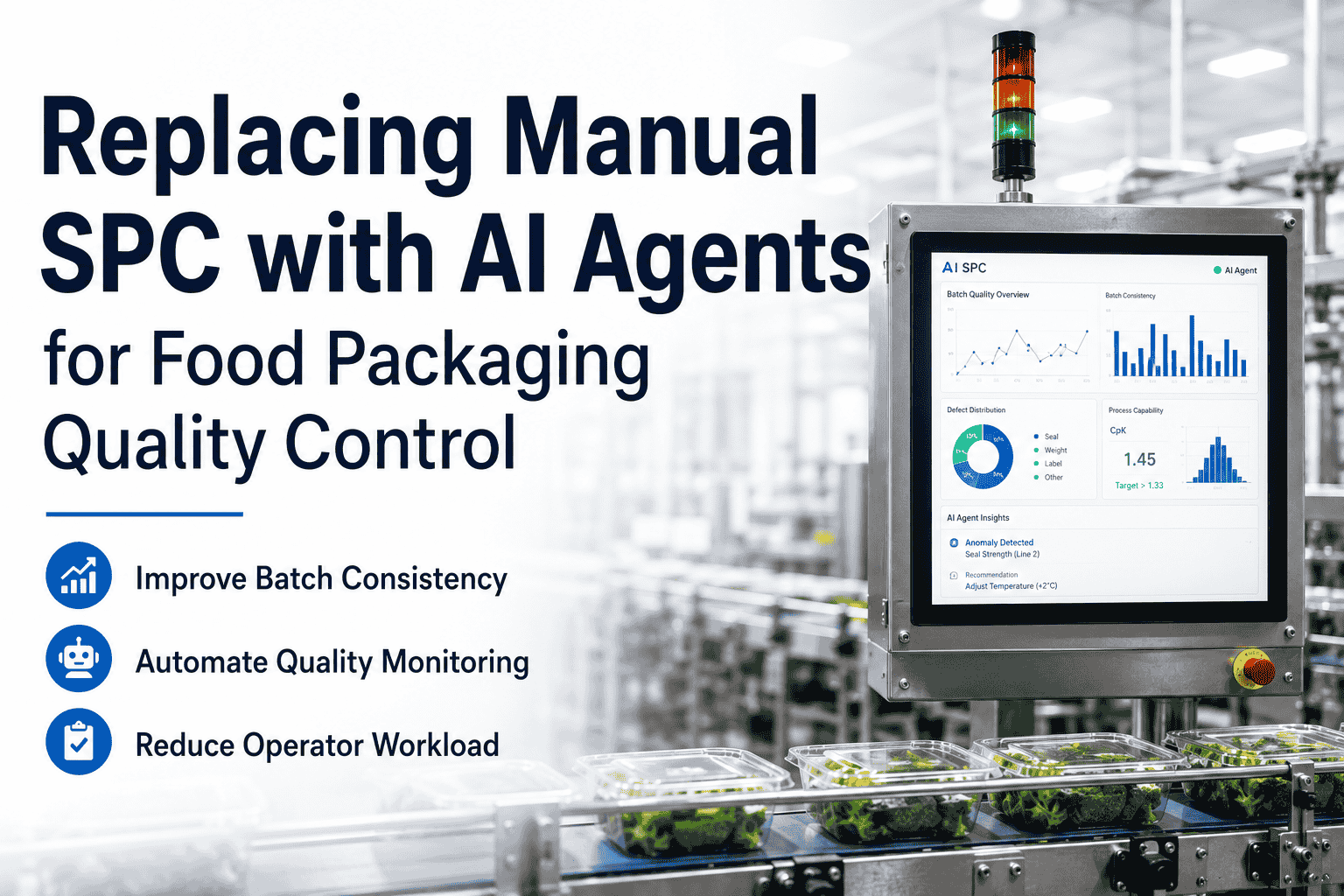
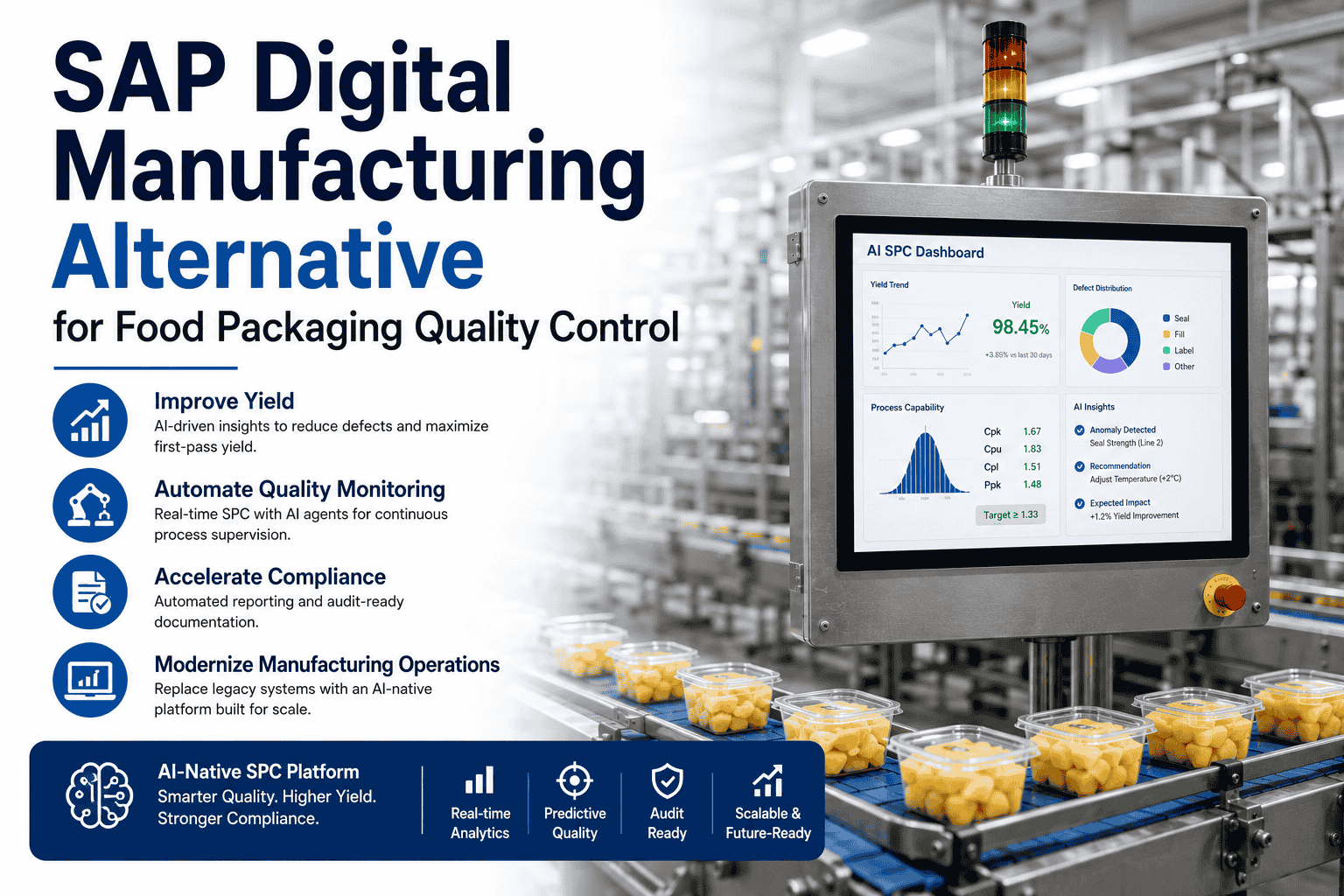
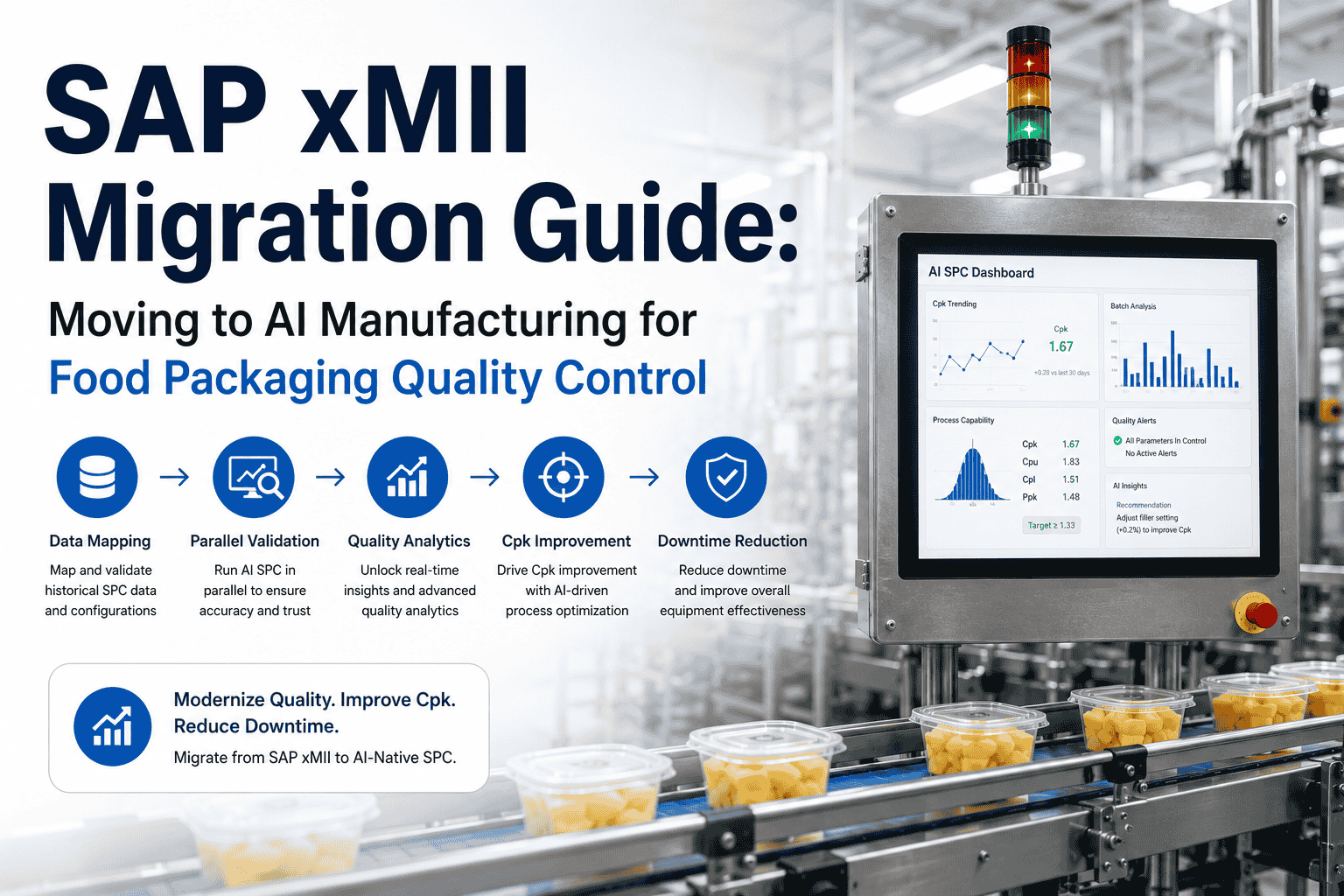
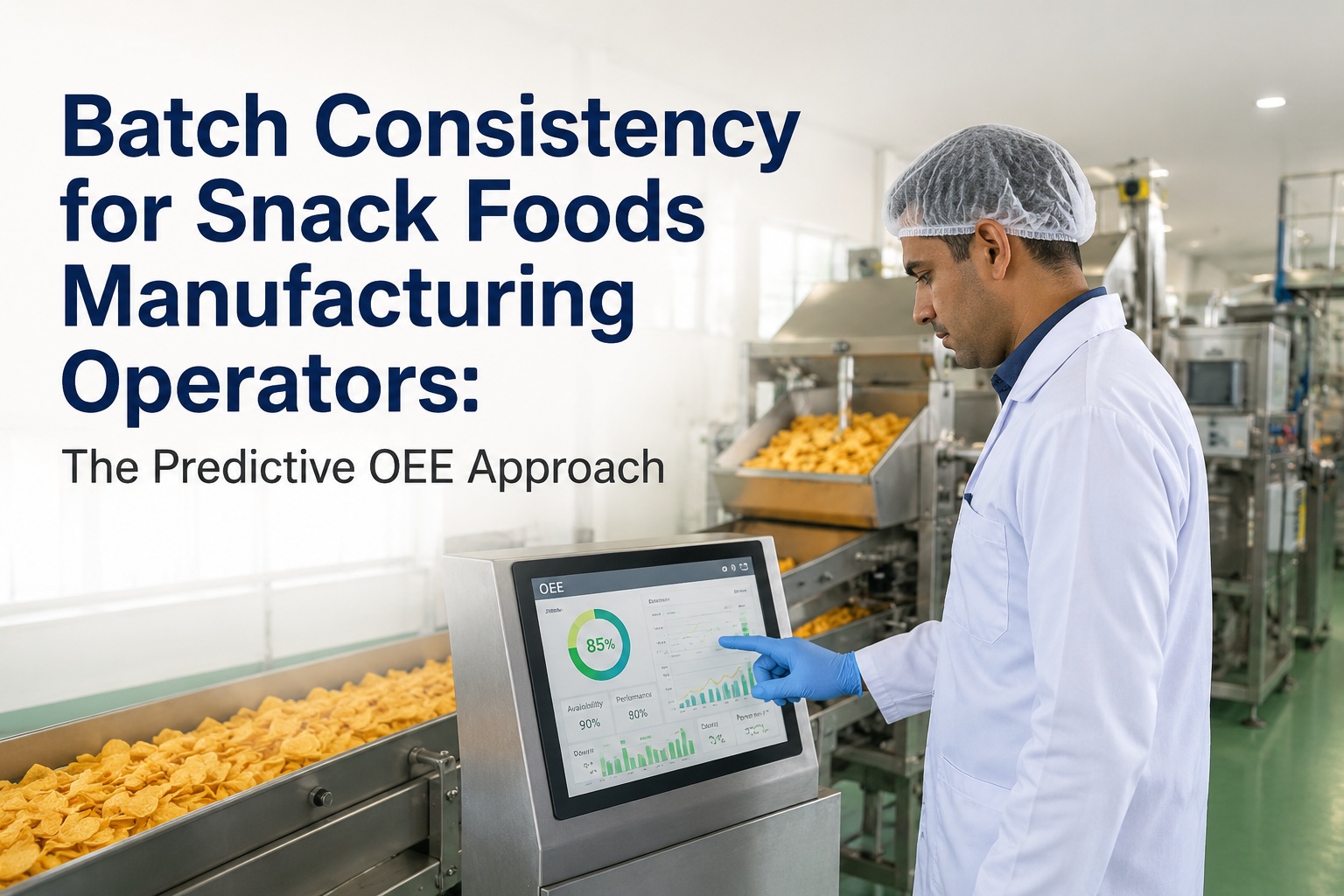
Food packaging quality control still runs on a mix of spreadsheets, manual SPC chart reviews, paper-based batch records, and brittle SAP xMII workflows in most plants. Operators spend 2–4 hours per shift on data entry and chart review. Supervisors spend another 2–3 hours hunting for root cause. Quality teams spend days building audit packages. AI agents change this fundamentally — not by adding features to existing tools, but by taking over the manual work itself. This guide walks through what AI agents actually do for food packaging quality control, how they move batch consistency as a KPI, and the migration path from spreadsheets to autonomous quality intelligence. Book an AI SPC migration workshop to map which agents fit your specific operation.
AGENT 01
Batch Consistency Agent
Monitors batch-to-batch variation continuously. Flags Cpk/Ppk drift before spec breach.
Replaces: Manual SPC chart review
Saves: 2–3 hrs/shift
AGENT 02
Predictive Scrap Agent
Anticipates quality drift 4–24 hours before defects fire. Ranked alerts with intervention recommendations.
Replaces: Reactive problem-solving
Saves: 30–55% scrap
AGENT 03
Autonomous RCA Agent
Pre-computes root cause when anomalies fire. Evidence-backed explanation in 3–5 minutes.
Replaces: 30–60 min manual RCA
Saves: 85% RCA time
AGENT 04
Compliance Documentation Agent
Auto-generates FSMA, 21 CFR, SQF, BRCGS audit reports. Continuous batch genealogy.
Replaces: Manual audit prep
Saves: Days per audit cycle
AGENT 05
Operator Coaching Agent
Real-time AI guidance at line-side. Suggests interventions inline. Answers operator questions via Copilot.
Replaces: Supervisor floor coaching
Saves: 2 hrs/shift supervisor
The Hidden Cost of Manual SPC in Food Packaging
Manual SPC processes are deeply embedded in food packaging operations — usually invisible because they’ve always been there. Operators record batch parameters on paper or spreadsheets, transcribe them into SAP xMII or quality systems hours later, review SPC charts during downtime windows, and escalate exceptions through email chains. The hidden cost shows up in three categories: operator hours not spent on production, missed quality signals that produce scrap, and batch-to-batch variation that slowly erodes Cpk. The numbers below come from food packaging operations we evaluated in 2025–2026 before AI agent migration.
01
Operator Hours Lost to Data Entry
F&B packaging operators typically spend 2–4 hours per shift on manual SPC tasks: parameter recording, spreadsheet updates, chart printouts, transcription into ERP. Across a 4-line plant running three shifts, this represents 25,000+ operator hours per year that produce no direct value.
~25K operator hours/yr
02
Missed Predictive Signals
Manual SPC catches violations after they happen. Subtle parameter drift that AI detects 4–24 hours ahead is invisible to human chart reviewers. The signals are present in the data — operators just can’t process them fast enough to intervene before scrap.
30–55% preventable scrap
03
Batch-to-Batch Variation
Manual recipe execution and parameter monitoring introduces variation between batches that wouldn’t exist with automated agents. Cpk degradation of 0.2–0.4 between manual and automated control is typical. Customer specs that should be hit every batch get hit 95% of batches.
Cpk 1.0 vs 1.4+
04
Audit & Compliance Burden
Manual recordkeeping means audit prep consumes quality and supervisor time for days before each audit cycle. FSMA Rule 204 traceability assembled retroactively. Recall scope determination takes days when minutes matter. Quality team can’t scale beyond audit cycle pace.
Days per audit cycle
05
Supervisor Time Lost to RCA
When anomalies fire, supervisors spend 30–60 minutes investigating root cause manually — pulling data from xMII, MES, historian, ERP, building correlations. During this time, production continues with the root cause active. Multiple events per shift compound the cost.
2–3 hrs/shift/supervisor
06
Lost Tribal Knowledge
Experienced operators carry quality intuition that’s never written down. When they retire or change shifts, the knowledge leaves. Manual SPC depends on this institutional knowledge — AI agents capture and operationalize it, making expertise portable across shifts and sites.
Knowledge loss with attrition
From Spreadsheets to AI Agents: The Operational Shift
The shift from manual SPC to AI agents isn’t a software upgrade — it’s a fundamental restructuring of who does what. Manual SPC has humans doing the monitoring, calculation, anomaly detection, root cause investigation, and documentation work. AI agents do all of that autonomously, with humans taking the higher-value role of decision-making, intervention, and continuous improvement. The four shifts below illustrate how this restructuring actually changes operations day-to-day.
MANUAL SPC
Operator records parameters in spreadsheet every 15 minutes. Updates SPC charts during downtime windows. Often misses subtle drift between sampling intervals.
→
AI AGENTS
Batch Consistency Agent continuously monitors every batch parameter, every second. Detects drift before spec breach. Operator sees AI-suggested intervention inline.
MANUAL SPC
Anomaly fires. Supervisor pulls data from xMII, MES, historian, ERP. Builds correlation manually. Takes 30–60 minutes. Production continues during investigation.
→
AI AGENTS
Autonomous RCA Agent has pre-computed root cause continuously. When anomaly fires, evidence-backed explanation displays in 3–5 minutes. Supervisor takes corrective action with full context.
MANUAL SPC
Quality team builds audit package manually before each cycle. Batch genealogy assembled from xMII queries, spreadsheets, paper records. Takes days, prone to gaps.
→
AI AGENTS
Compliance Documentation Agent generates audit-ready reports continuously. FSMA Rule 204 24-hour traceability automatic. Audit becomes review, not assembly. Recall scope identified in minutes.
MANUAL SPC
Supervisor walks the floor coaching operators. Coverage limited to one line at a time. New operators learn quality intuition over months of shadowing experienced staff.
→
AI AGENTS
Operator Coaching Agent provides real-time AI guidance at line-side. Every operator on every line receives consistent coaching. New operators reach proficiency in weeks, not months.
Curious which manual workflows AI agents can take over in your operation? Book an AI SPC migration workshop — we’ll map each agent against your specific manual workflows and quantify the operator/supervisor hours recovered.
The Five AI Agents for Food Packaging Quality
The five agents below represent the core of the AI-native quality intelligence stack for food packaging operations. Each agent runs autonomously and handles a specific category of work that operators, supervisors, and quality teams currently do manually. Together they shift quality intelligence from periodic human review to continuous autonomous monitoring — the difference between catching problems after they happen and preventing them from happening.
Continuously monitors every batch parameter across recipe execution: ingredient lot data, mixing time, temperature, pressure, equipment state, environmental conditions. Tracks Cpk/Ppk in real-time per parameter per batch. Flags batch-to-batch drift before spec breach. Recommends recipe adjustments to maintain consistency across shifts and ingredient lots. Replaces manual SPC chart review — the most time-consuming routine task in food packaging quality.
MonitorsEvery parameter, every batch
Cpk target maintenanceContinuous
Replaces2–3 hrs operator time/shift
ML models anticipate quality drift 4–24 hours before defects fire. Trained on plant-specific historical data including ingredient lot variations, equipment wear patterns, environmental drift, and operator action sequences. Ranked alerts surface in supervisor dashboards with confidence scores and recommended interventions. Predictive Scrap transforms operations from reactive to proactive — the highest-leverage AI agent for batch consistency.
Foresight window4–24 hours
Scrap prevented30–55% reduction
ReplacesAfter-the-fact reactive response
Maintains continuous causal hypothesis about plant operations. Runs multivariate correlations across equipment state, recipe parameters, ingredient lot history, environmental conditions, and operator actions. When anomaly fires, root cause is pre-computed: operator sees evidence-backed explanation in 3–5 minutes vs 30–60 minutes of manual investigation. RCA closes during the event, not after. Replaces the most time-consuming supervisor task.
RCA delivery3–5 min
Time saved85% reduction
Replaces2–3 hrs supervisor/shift
Auto-generates audit-ready documentation continuously. Continuous batch genealogy across ingredients, packaging runs, equipment state, operator actions. FSMA Rule 204 (Food Traceability Final Rule) 24-hour source-to-shelf traceability automatically satisfied. Audit reports auto-generated against 21 CFR Part 11, SQF, BRCGS, customer scorecard requirements. Recall scope identified in minutes when speed matters most.
Traceability24-hr source-to-shelf
Recall scopeMinutes vs days
ReplacesDays per audit cycle
Real-time AI guidance at line-side via tablet or HMI. Suggests interventions inline when parameters drift. Answers operator questions through GenAI Copilot interface in natural language. Captures experienced operator quality intuition and operationalizes it across every shift and site. New operators reach proficiency in weeks instead of months. Knowledge no longer leaves with experienced staff.
CoverageEvery operator, every line
New operator rampWeeks vs months
ReplacesSupervisor floor coaching time
Want to see these agents running against your specific packaging operation? Book an AI SPC migration workshop — the half-day session demonstrates each agent on representative F&B scenarios using your line configurations and recipe profiles.
Batch Consistency: How AI Agents Move the Primary KPI
Batch consistency is the primary quality KPI in food packaging because every batch must meet customer spec, regulatory tolerance, and internal quality targets. Variation between batches drives scrap, customer complaints, audit findings, and recipe rework. The Cpk and Ppk values track how reliably the process holds within spec — values below 1.33 indicate variation that produces scrap, values above 1.67 indicate robust capability. AI agents move these numbers by addressing the four sources of batch-to-batch variation that manual SPC cannot effectively manage.
Source 01
Ingredient Lot Variation
Same recipe, different ingredient lot — different result. Sugar moisture, flour protein content, oil viscosity vary lot to lot. Manual SPC catches the variation in finished product; can’t adjust upstream.
Batch Consistency Agent learns ingredient lot signatures and adjusts recipe parameters proactively to maintain finished product spec across lot variation.
Source 02
Equipment Wear & Drift
Mixer impeller wear changes shear profile gradually. Heat exchanger fouling reduces heat transfer over weeks. Manual SPC sees the end result; can’t isolate equipment cause from recipe cause.
Predictive Scrap Agent correlates equipment state across maintenance histories and detects wear-driven drift weeks before it produces spec breach.
Source 03
Environmental Conditions
Plant temperature, humidity, atmospheric pressure all affect food packaging quality — seal integrity, fill weight, viscosity. Manual SPC doesn’t connect environmental variation to quality outcomes.
Batch Consistency and Autonomous RCA agents continuously correlate environmental sensor data with batch outcomes and recommend setpoint adjustments.
Source 04
Operator-to-Operator Variation
Different operators on different shifts execute recipes slightly differently — timing, sequence, intervention judgment. Shift-to-shift quality variation is often invisible until audit time.
Operator Coaching Agent provides consistent AI guidance across all operators, eliminating shift-to-shift variation in recipe execution and intervention decisions.
Move Batch Consistency with AI Agents
A migration workshop maps the four sources of batch variation in your operation against the AI agents that address each. Output: a documented plan with expected Cpk improvement, scrap reduction, and operator hours recovered for your specific lines.
The Migration Path: From Spreadsheets to AI Agents
Migration from manual SPC to AI agents follows a structured phased path. Plants that try to migrate everything at once typically encounter operator resistance and adoption stalls. Plants that follow the phased approach below capture incremental value at each phase and build organizational confidence in the agents before expanding scope. Full plant migration for a typical 4–8 line F&B operation completes in 3–5 months end-to-end.
01
Document Manual Workflows (Weeks 1–2)
Inventory the manual SPC work currently happening: which operators do what, how long each task takes, which spreadsheets and SAP xMII workflows are involved, which audit and compliance documents are built manually. This inventory becomes the baseline against which AI agent value is measured.
02
Deploy Batch Consistency Agent First (Weeks 3–8)
Start with Batch Consistency Agent on a single pilot line. NVIDIA AI appliance deployed, line PLC integration completed, recipe parameters connected, historical batch data loaded for training. Within 4–6 weeks the agent is detecting drift patterns and presenting recommendations to operators. Adoption builds confidence in subsequent agents.
03
Add Predictive Scrap and Autonomous RCA (Weeks 9–12)
Layer Predictive Scrap Agent and Autonomous RCA Agent on the foundation Batch Consistency provides. These agents build on the data pipeline established in phase 2. Supervisor workflow transformation begins — reactive RCA cycles compress, predictive alerts arrive, batch consistency Cpk improves measurably.
04
Expand to Compliance & Coaching (Weeks 13–20)
Add Compliance Documentation Agent and Operator Coaching Agent. Audit preparation transforms from days to minutes. New operators ramp in weeks instead of months. Manual SPC workflows decommissioned. SAP xMII custom logic migrated to AI-native equivalents. Full plant operating on agent-driven quality intelligence.
Ready to scope this migration for your operation? Book an AI SPC migration workshop — output is a documented agent deployment plan with line-by-line schedule and expected batch consistency improvement.
Expert Perspective
"The shift from manual SPC to AI agents is fundamentally about who does the work, not what tools the work is done with. Manual SPC has humans doing the monitoring, calculation, anomaly detection, root cause investigation, and documentation — while production runs around them. AI agents do that work autonomously and continuously, with humans taking the higher-value role of decision-making and intervention. For batch consistency specifically, the impact is direct and measurable: ingredient lot variation that manual SPC can’t track gets handled by agents that learn lot signatures. Equipment wear that’s invisible to chart review becomes a predictable pattern. Operator-to-operator variation eliminates because every operator receives the same AI coaching. Plants we’ve worked with see Cpk move from 1.0–1.2 territory (where manual SPC typically lands) up to 1.5–1.7 with agents deployed across all four sources of variation. That’s not a marginal improvement — that’s the difference between hitting customer spec 95% of batches and hitting it on essentially every batch."
— F&B AI Manufacturing Practice, 2026 perspective
Cpk 1.5+
typical with agents vs 1.0–1.2 manual
25K+ hrs
operator hours/yr recovered per plant
3–5 mo
full plant agent deployment
Replace Manual SPC with AI Agents
The half-day AI SPC Migration Workshop covers current-state manual workflow inventory, demonstration of each agent against representative F&B scenarios using your recipes and line configurations, batch consistency improvement modeling, and a phased deployment plan sized to your line count and timeline.
Frequently Asked Questions
What does the Batch Consistency Agent actually do continuously?
The Batch Consistency Agent monitors every batch parameter in real-time across recipe execution: ingredient lot data (moisture, viscosity, protein content where measured), mixing time and shear profile, temperature and pressure across each process step, equipment state (impeller wear, heat exchanger efficiency), and environmental conditions (plant temperature, humidity). It tracks Cpk/Ppk continuously per parameter per batch, learns ingredient lot signatures over time, and recommends recipe adjustments to maintain finished product spec across input variation. When the agent detects drift, it surfaces alerts to operators with recommended setpoint adjustments before the drift produces a spec breach.
How is this different from rule-based SPC alerts?
Rule-based SPC alerts fire when a parameter crosses a pre-set limit — useful but limited. AI agents detect patterns and drift before any single parameter crosses a limit, by correlating multiple parameters simultaneously across recipe execution, ingredient lots, and equipment state. A rule-based system might say "temperature exceeded 75°C." An AI agent says "the combination of slightly elevated mixer temperature, ingredient lot with above-average moisture, and impeller wear pattern produces 78% probability of seal integrity issue in next 6 batches — recommend reducing mix time by 12 seconds." The depth of analysis is incomparable.
Do operators trust AI agent recommendations?
Operator adoption depends on three factors that successful migrations get right: (1) AI agents explain their recommendations with evidence — the operator sees why the agent recommends an action, not just what to do. (2) Operators retain decision authority — the agent suggests, the operator decides. (3) The agent learns from operator feedback over time, becoming more aligned with plant-specific expertise. Plants that deploy agents as recommendation engines (not autonomous controllers) and respect operator decision authority see strong adoption. Plants that try to override operator judgment see resistance.
Book a workshop to discuss change management strategies that work in F&B environments.
What happens to operators when AI agents take over manual SPC?
Operators shift from data entry and chart review to higher-value work: responding to predictive alerts, executing recommended interventions, monitoring multiple lines, training newer staff with AI coaching support, and contributing to continuous improvement projects. The hours freed up by AI agents don’t reduce headcount — they get redirected to work that humans do better than agents. The supervisor role transforms most significantly: from reactive firefighting and manual RCA to proactive intervention and team coaching. Plants we’ve worked with report higher operator and supervisor job satisfaction post-migration because the work is more meaningful.
How does this integrate with our existing SAP xMII while we migrate?
AI agents integrate with SAP xMII via OPC-UA from line PLCs, MQTT to cloud (if deployed), and REST API to SAP ERP for batch context. During migration, AI agents and SAP xMII coexist — agents handle real-time quality intelligence, xMII handles legacy workflows being progressively decommissioned. As confidence builds and agents prove value, xMII custom logic is migrated to AI-native equivalents. By the end of the 3–5 month migration timeline, SAP xMII can be fully decommissioned or kept for residual functionality with SAP DM if that’s the execution layer strategy. The migration does not require a big-bang cutover.