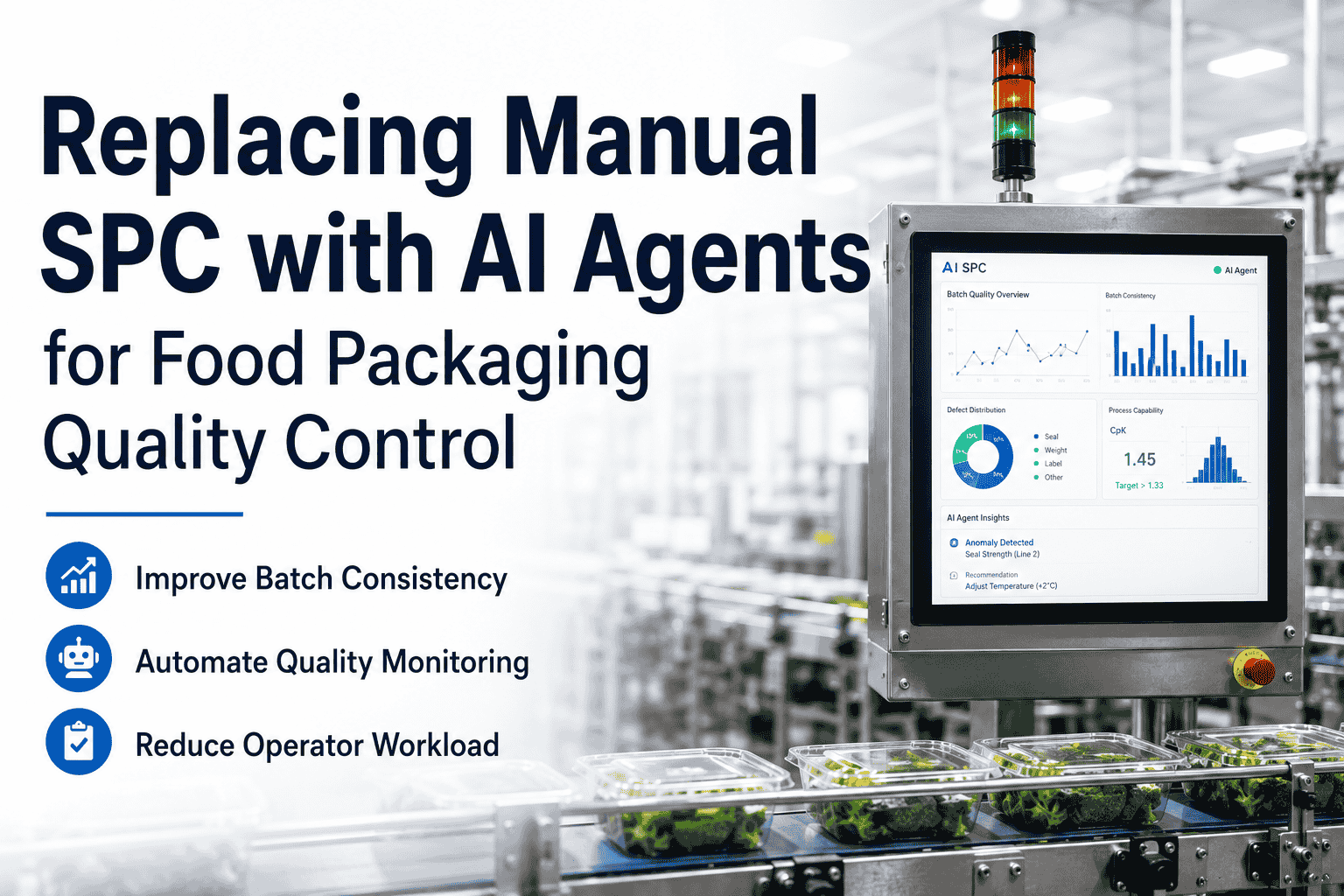
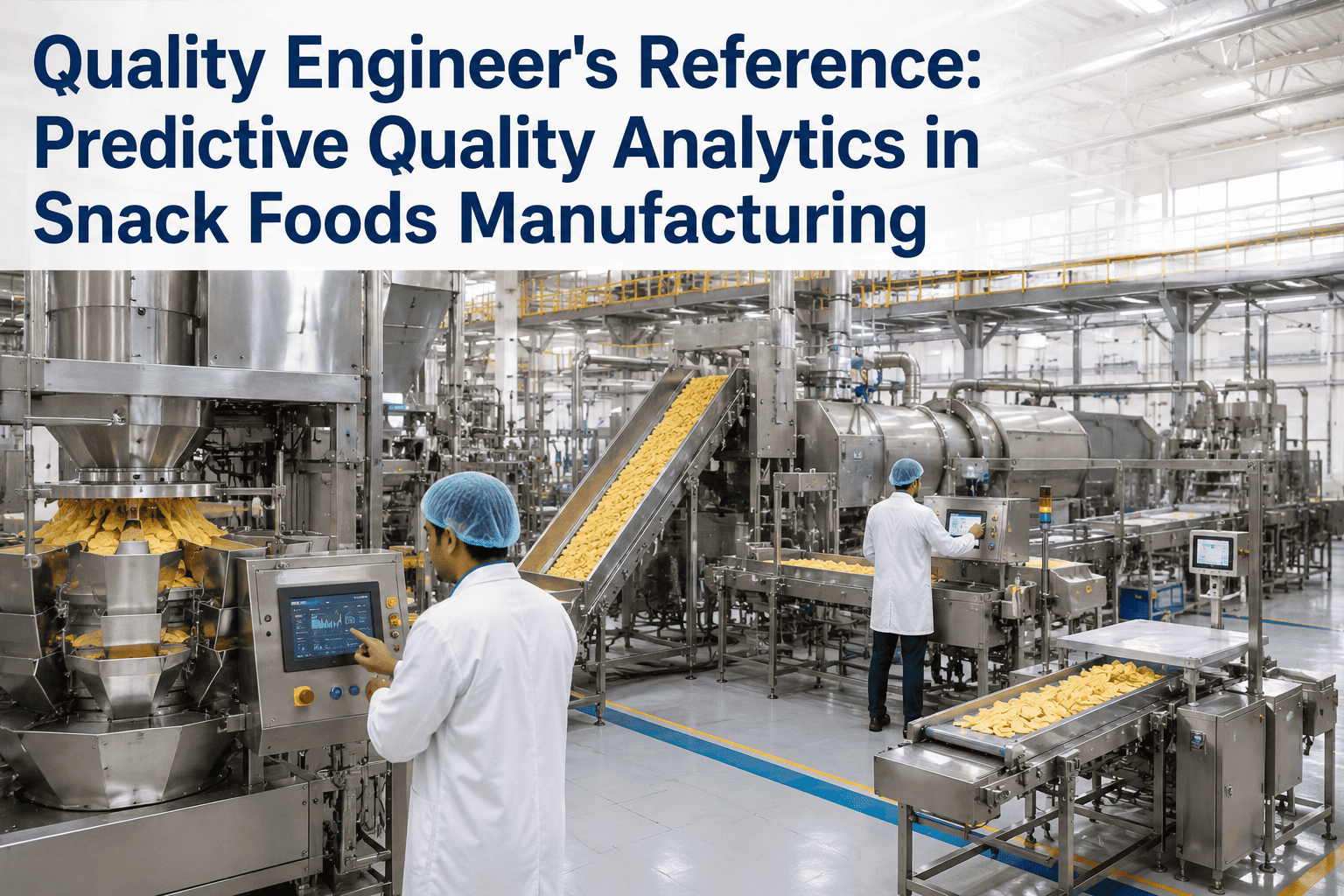
Replacing Manual SPC with AI Agents in Food & Beverage Manufacturing
By Riley Quinn on June 1, 2026
Manual SPC depends on a chain of operator actions — reading charts, interpreting Nelson Rules, opening quality notifications, investigating root causes, drafting CAPA records, assembling audit packs. AI agents replace that chain with autonomous quality intelligence that reasons, plans, and acts within guardrails — while keeping humans in the loop for governance and exception handling. Gartner projects 50% of supply chain solutions will include agentic AI capabilities by 2030; F&B batch quality is moving faster because the manual SPC burden is heaviest where batch consistency matters most. Book an AI SPC migration workshop to map agent workflows against your specific manual SPC processes.
Autonomous Quality Intelligence Team
Five AI Agents Replace Five Manual SPC Workflows
Each agent runs autonomously within governance guardrails. Humans set policy, review escalations, handle exceptions. The agent team operates 24/7 on every batch.
Agent 01
Drift Detection
Watches 80+ tags continuously
Agent 02
RCA Investigator
Ranks hypotheses with confidence
Agent 03
CAPA Verifier
Tracks effectiveness over time
Agent 04
Audit Pack Composer
Assembles evidence per batch
Agent 05
Sanitation Coordinator
Validates CIP & allergen control
Human
In-the-Loop
Policy · exceptions · governance
Agent vs Copilot — The Distinction That Matters
The terms get used interchangeably in vendor marketing, but the architectural difference matters for F&B operations. A copilot suggests; an agent acts. A copilot answers questions; an agent executes multi-step workflows. A copilot waits for the next prompt; an agent runs continuously toward a defined goal within guardrails. F&B batch quality benefits from both — but agents are what replace manual SPC workflows.
The Five Manual SPC Workflows — Now Run by AI Agents
Each agent has a defined scope, autonomy boundary, and human escalation policy. Plants moving from manual SPC to autonomous quality intelligence don’t deploy "AI" as a single thing — they deploy five specialized agents, each replacing a specific manual workflow with measurable time and accuracy improvements.
01
Drift Detection Agent
Replaces: operator chart reading + Nelson Rule interpretation
Manual today
Operator monitors univariate control charts on xMII templates. Spots Nelson Rule signals on individual tags. Interprets rule cascades manually. Misses multivariate drift signatures across 80+ correlated variables.
Agent autonomy
Watches 80+ tags continuously. Runs LSTM + Nelson + Autoencoder confidence fusion. Detects drift 30–60 min before specification failure. Auto-generates prescriptive alert with ranked hypothesis. Escalates to operator only when confidence below threshold.
Outcome:
Multivariate drift caught 4–6× earlier than manual univariate monitoring
02
RCA Investigator Agent
Replaces: manual cross-system data correlation + hypothesis generation
Manual today
Quality engineer pulls data from PLC, historian, SAP QM, CMMS. Manually correlates across systems. Drafts root cause hypothesis. Investigation runs 4–8 hours per deviation. Same drift recurs because the cause isn’t codified.
Agent autonomy
Federates query across all systems automatically. Generates ranked root cause hypotheses with confidence scores. 78–88% top-1 accuracy for mature deployments. Operator verifies the ranked hypothesis rather than constructing it from scratch.
Outcome:
RCA time drops from 4–8 hours to 15–45 minutes verification
CAPAs closed on paper without effectiveness verification. Same drift signature recurs within 30–90 days but no one checks. The most common F&B audit finding: CAPA closure without recurrence verification.
Agent autonomy
Tracks each closed CAPA against the failure pattern library. Monitors for signature recurrence in subsequent batches. Auto-confirms effectiveness or escalates to quality engineer if recurrence detected. Closes the audit-finding gap.
Outcome:
Drift recurrence rate drops from 60–75% to 15–25%
04
Audit Pack Composer Agent
Replaces: retrospective evidence assembly from siloed systems
Manual today
QA team assembles audit packs over 40–80 hours per audit cycle. Documentation gaps discovered during audit prep. Unannounced audits expose unprepared evidence. BRCGS Issue 9 averages 5 non-conformance findings per audit.
Agent autonomy
Per-batch audit pack auto-generated at release. Includes inspection results, SPC charts, deviation log, CAPA evidence, calibration records, CIP verification, supplier lot trace, Part 11 audit trail, FSMA 204 KDE/CTE. Available on demand in 5–10 min.
Outcome:
Audit pack generation drops from 2–4 hours per batch to 5–10 minutes
Operator manually validates CIP cycle completion. ATP swab results entered by hand. Allergen carryover risk evaluated by interpretation. Equipment release sign-off depends on operator availability. Bottleneck between batches.
Agent autonomy
Monitors CIP cycle data in real-time. Validates 6-phase completion (pre-rinse, alkaline, intermediate, acid, final, sanitization). Ingests ATP swab results automatically. Computes allergen carryover risk scores. Releases equipment when policy thresholds met.
Outcome:
Sanitation window time reduced 20–30%; allergen carryover risk continuously scored
Need these agent workflows mapped against your specific manual SPC processes? Book an AI SPC migration workshop — the agent-by-agent deployment plan reflects your actual operational pain points.
Governance — The Guardrails That Make Agents Trustworthy
Autonomous agents need access to operational data and control networks — which demands zero-trust architectures, encrypted communication, and strict role-based access. Security and governance discussions for agent deployment can’t start late; they belong in the design phase. Four governance principles separate production-grade agentic AI from experimental deployments.
Zero-Trust Architecture
Every agent request verified, every connection encrypted, every action logged. Role-based access controls scope what each agent can read and write. Service accounts isolated by least-privilege principle.
Decision Audit Trail
Every agent decision logged with input data, confidence score, action taken, and outcome. Auditors trace agent reasoning the same way they trace operator decisions today. 21 CFR Part 11 compatible.
Escalation Policies
Confidence thresholds define when agents act autonomously vs escalate to humans. Low-stakes routine actions: full autonomy. High-stakes irreversible actions: always escalate. Tunable per workflow.
From Manual SPC to Autonomous Quality Intelligence
iFactory ships pre-configured AI agents for F&B batch quality control: drift detection, RCA investigation, CAPA verification, audit pack composition, sanitation coordination. Zero-trust security, decision audit trails, configurable autonomy boundaries, and human oversight gates built in. Deployment runs 8–12 weeks with first agent live within 30 days. SAP QM preserved as system of record.
Each agent reclaims specific hours per shift, per audit, per CAPA cycle. The compound effect across the quality team is the CFO-defensible business case. The math holds across F&B deployments — not vendor sales-deck percentages, but documented time savings from manual workflows replaced by autonomous agents.
Swipe horizontally to compare time reclaimed by agent
AI Agent
Manual workflow time
Agent-handled time
Reclaimed per cycle
Drift Detection Agent
2–4 hr/shift chart monitoring
Continuous + escalations only
~90% time freed
RCA Investigator Agent
4–8 hr per deviation
15–45 min verification
8–16× faster
CAPA Verifier Agent
Manual recurrence checks (rarely done)
Auto-verified per signature
Audit gap closed
Audit Pack Composer Agent
2–4 hr per pack · 40–80 hr annual
5–10 min auto-generated
~95% time freed
Sanitation Coordinator Agent
30–60 min per batch transition
Auto-validated + alerts
20–30% window reduction
Cumulative quality team impact
~40–60% manual SPC effort
Strategic work & oversight
Workforce capacity unlocked
Vendor Evaluation — The Agent Architecture Lens
Vendors claiming "AI agents for SPC" range from genuine autonomous quality intelligence to chatbots rebranded with agentic marketing. Eight criteria separate production-grade agent architectures from copilot-only platforms or generic chatbots.
01
Autonomous action, not just suggestions
Ask:
"Does the agent execute multi-step workflows autonomously, or does it only suggest actions for operators to take?"
Genuine agents reason, plan, and act within guardrails. Platforms that only suggest are copilots — valuable but different. For replacing manual SPC workflows, you need agents that take action. Demand a live demo where the agent creates a quality notification in SAP QM without operator click.
02
Configurable autonomy boundaries
Ask:
"Can the autonomy level be configured per workflow, with confidence thresholds determining when agents act vs escalate?"
Production-grade agent platforms expose autonomy policies as configurable rules. Low-stakes routine actions: full autonomy. High-stakes irreversible actions: always escalate. Vendors with hardcoded autonomy levels can’t adapt to F&B governance requirements.
03
Decision audit trail
Ask:
"Does every agent decision log input data, confidence score, action taken, and outcome with 21 CFR Part 11 compliance?"
Auditors need to trace agent reasoning the same way they trace operator decisions. Production-grade platforms maintain tamper-evident, time-stamped audit trails of every agent action. Vendors with opaque decision logs fail audit defensibility.
04
Zero-trust security architecture
Ask:
"How is each agent’s access scoped, encrypted, and verified across the OT/IT boundary?"
Agents accessing operational data and control networks need zero-trust architecture, encrypted communication, role-based access. Service accounts isolated by least-privilege principle. Security can’t be bolted on — it must be designed in from the start.
05
SAP QM coexistence
Ask:
"Do agents write back to SAP QM via OData/REST APIs, or maintain a parallel record system?"
Production-grade agents write to SAP QM directly. Quality notifications, defect codes, CAPA evidence, audit packs all persist in SAP QM as system of record. Agents acting through SAP-native APIs preserve audit trail integrity and downstream SAP integration.
A single agent isn’t enough. F&B batch quality requires coordinated handoffs across workflows. Production-grade platforms ship multi-agent orchestration where each specialist agent feeds the next. Generic chatbot platforms can’t coordinate complex multi-step workflows.
07
Learning from operator feedback
Ask:
"How do operator confirmations and rejections refine agent decisions over time?"
Agents that don’t improve from operator feedback deliver static accuracy that degrades. Production-grade platforms expose monthly accuracy improvement, false-positive rate reduction, and pattern library growth as observable metrics. Vendors who can’t demonstrate learning deliver hand-crafted rules dressed up as AI.
08
Deployment timeline per agent
Ask:
"When does the first agent go live in production, and how long to deploy all five?"
First agent live within 30 days is the production-grade benchmark. All five agents deployed within 8–12 weeks. Vendors quoting 6+ months for first agent indicate custom development or rip-and-replace migrations. Pre-configured agents with F&B-specific tuning should deploy fast.
Expert Perspective
"The most common mistake F&B plants make in evaluating AI for SPC is conflating copilots with agents. Both have a role, but they replace different things. Copilots augment operators — valuable for training, troubleshooting, recommendations. Agents replace manual workflows entirely — drift detection, RCA, CAPA verification, audit pack composition, sanitation coordination. The plants getting this right deploy five specialized agents that coordinate handoffs across workflows, each with configurable autonomy, decision audit trails, and human oversight gates. Quality team capacity unlocked is the structural benefit: 40–60% of manual SPC effort moves to autonomous handling, freeing engineers for strategic work, exception handling, and continuous improvement. Gartner’s projection that 50% of supply chain solutions will include agentic AI by 2030 is conservative for F&B because the manual SPC burden is heaviest exactly where batch consistency matters most. The technology is ready. The governance frameworks are mature. The deployment timelines are 8–12 weeks. The question is whether the plant’s quality leadership defines agents as workforce multipliers or as workforce threats — the framing determines adoption velocity more than the underlying technology."
— F&B Agentic AI Practice, 2026 industry insight
5 agents
specialized AI agents replacing five manual SPC workflows
40–60%
manual SPC effort moved to autonomous handling
8–12 wk
full agent team deployment timeline with SAP QM preserved
Conclusion: Agents Replace Workflows, Not People
F&B plants evaluating agentic AI for SPC in 2026 face a clearer choice than the vendor pitches suggest. Manual SPC workflows are concrete — chart reading, Nelson Rule interpretation, cross-system RCA, CAPA effectiveness tracking, audit pack assembly, CIP validation, allergen control sign-off. Each workflow has documented time consumption and accuracy ceilings the legacy manual approach can’t exceed. AI agents replace these workflows with configurable autonomy: drift detection runs continuously, RCA hypotheses arrive ranked, CAPA effectiveness gets verified against the failure pattern library, audit packs assemble per batch, sanitation coordinates handoffs. Each agent operates within guardrails — zero-trust security, decision audit trails, escalation policies, human oversight gates. Quality engineers shift from manual workflow execution to policy setting, exception handling, and continuous improvement. The compound effect: 40–60% of manual SPC effort moves to autonomous handling, freeing strategic capacity at the moment when F&B operations face workforce shortages, audit pressure intensification, and batch consistency expectations rising. SAP QM stays as system of record. xMII or DMC can be retired or layered above. Agents act; humans govern. The architecture works. Book an AI SPC migration workshop to map autonomous agent workflows against your specific manual SPC processes.
Deploy Your First AI Agent in 30 Days
iFactory’s F&B agentic AI practice runs a 90-minute workshop applying the five-agent architecture, governance frameworks, and SAP QM coexistence patterns to your specific manual SPC processes. You leave with an agent-by-agent deployment plan, configurable autonomy policies aligned to your governance, and a CFO-defensible business case grounded in reclaimed quality team capacity.
What’s the difference between AI agents and AI copilots for manufacturing?
A copilot suggests; an agent acts. A copilot answers questions in conversation; an agent runs continuously toward a defined goal. A copilot needs a prompt each time; an agent watches data continuously and acts when policy conditions are met. Both have valid roles in F&B operations. Copilots help operators during training, troubleshooting, and ad-hoc decisions — "What does this Nelson Rule signal mean?" or "How should I interpret this Cpk trend?" Agents replace manual workflows entirely — drift detection running on 80+ tags continuously, RCA investigation auto-generating ranked hypotheses, CAPA verifier checking each closed CAPA for recurrence in subsequent batches, audit pack composer assembling evidence per batch at release, sanitation coordinator validating CIP cycles and releasing equipment. Production-grade F&B platforms deploy both: copilots for collaborative work where operator judgment matters; agents for autonomous workflows where consistency and continuity matter. The architectural test: ask the vendor to show their agent creating a quality notification in SAP QM without operator click. If it can’t, it’s a copilot, not an agent.
How autonomous are AI agents really — can they make decisions without human review?
Production-grade agentic AI uses configurable autonomy boundaries rather than binary "fully autonomous" vs "human in the loop." Each agent workflow has confidence thresholds and policy guardrails. Low-stakes routine actions with high model confidence: full autonomy (drift detection, CAPA recurrence check, audit pack assembly all run autonomously). High-stakes irreversible actions: always escalate (equipment shutdown, batch reject, allergen quarantine require human approval). Medium-stakes actions with moderate confidence: agent recommends, human approves with one click (RCA hypothesis confirmation, deviation classification). The autonomy levels are configurable per workflow and tunable as plants gain confidence with agent accuracy. Most F&B deployments start conservatively (more escalations) and increase autonomy as the pattern library matures and operator trust builds. After 6 months, typical deployments operate 70–85% of agent actions autonomously with 15–30% escalation rate. The framework: agents act within their scope; humans govern the policy and handle exceptions.
How do AI agents work with SAP QM — do they replace it or work alongside?
Agents work alongside SAP QM, never replace it. SAP QM remains the system of record for quality notifications, batch certificates, CAPA workflows, batch genealogy, and audit management. Agents write back to SAP QM via OData/REST APIs — quality notifications auto-created by the Drift Detection Agent, defect codes auto-populated with confidence by the RCA Investigator Agent, CAPA effectiveness verification recorded by the CAPA Verifier Agent, audit packs assembled from SAP QM data plus historian/PLC/CMMS by the Audit Pack Composer Agent. The downstream SAP workflows (procurement integration, finance integration, compliance reporting) continue working exactly as today — they just receive higher-quality, earlier, more accurate input from autonomous agents. The integration approach works identically on ECC and S/4HANA — the OData/REST patterns survive the S/4HANA migration boundary unchanged. Agents acting through SAP-native APIs preserve audit trail integrity. Vendors who require replacing SAP QM aren’t delivering agents — they’re delivering replacement MES platforms with agentic marketing.
What governance frameworks are needed before deploying AI agents in production?
Four governance principles separate production-grade agentic AI from experimental deployments. First, zero-trust architecture: every agent request verified, every connection encrypted, every action logged. Role-based access controls scope what each agent can read and write. Service accounts isolated by least-privilege principle. Second, decision audit trail: every agent decision logs input data, confidence score, action taken, and outcome with 21 CFR Part 11 compatibility. Auditors trace agent reasoning the same way they trace operator decisions. Third, escalation policies: confidence thresholds and policy guardrails define when agents act vs escalate. Configurable per workflow with conservative defaults at deployment. Fourth, human oversight gates: quality engineers review agent decisions on configurable cadences (daily exception reviews, weekly accuracy verification, monthly policy adjustments). These four principles should be designed into the platform architecture, not bolted on. Security and governance discussions for agent deployment can’t start late — they belong in the design phase from week one.
How long does it take to deploy AI agents and see measurable impact?
First agent live within 30 days is the production-grade benchmark. All five agents (Drift Detection, RCA Investigator, CAPA Verifier, Audit Pack Composer, Sanitation Coordinator) deployed within 8–12 weeks. The deployment sequence: Weeks 1–2: SAP QM integration, historical data ingestion (6–12 months), governance policy configuration. Weeks 3–5: Drift Detection Agent live first — operators see prescriptive alerts immediately, RCA times drop within days. Weeks 5–8: RCA Investigator and CAPA Verifier Agents deployed, failure pattern library begins compounding. Weeks 8–12: Audit Pack Composer and Sanitation Coordinator Agents deployed, full agent team operational. Days 30–90 post first-agent: pattern library matures with plant-specific incidents, autonomy levels increase as confidence builds. Days 90–180: full maturity, manual SPC effort visibly reduced 40–60%, quality team capacity reallocated to strategic work. Payback period averages 7–9 months across F&B agent deployments. The technology readiness isn’t the constraint — it’s the plant’s governance framework and change management readiness.