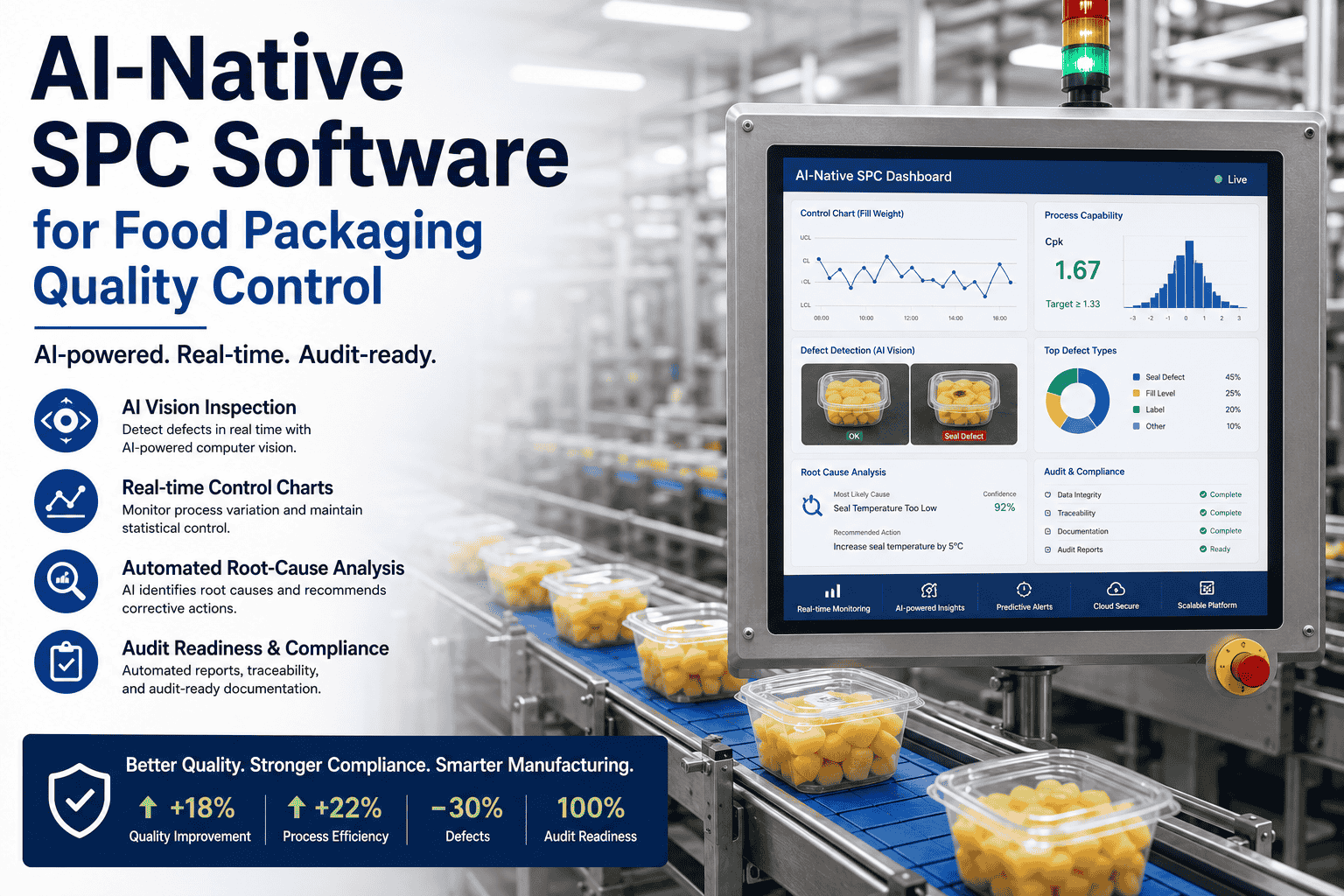
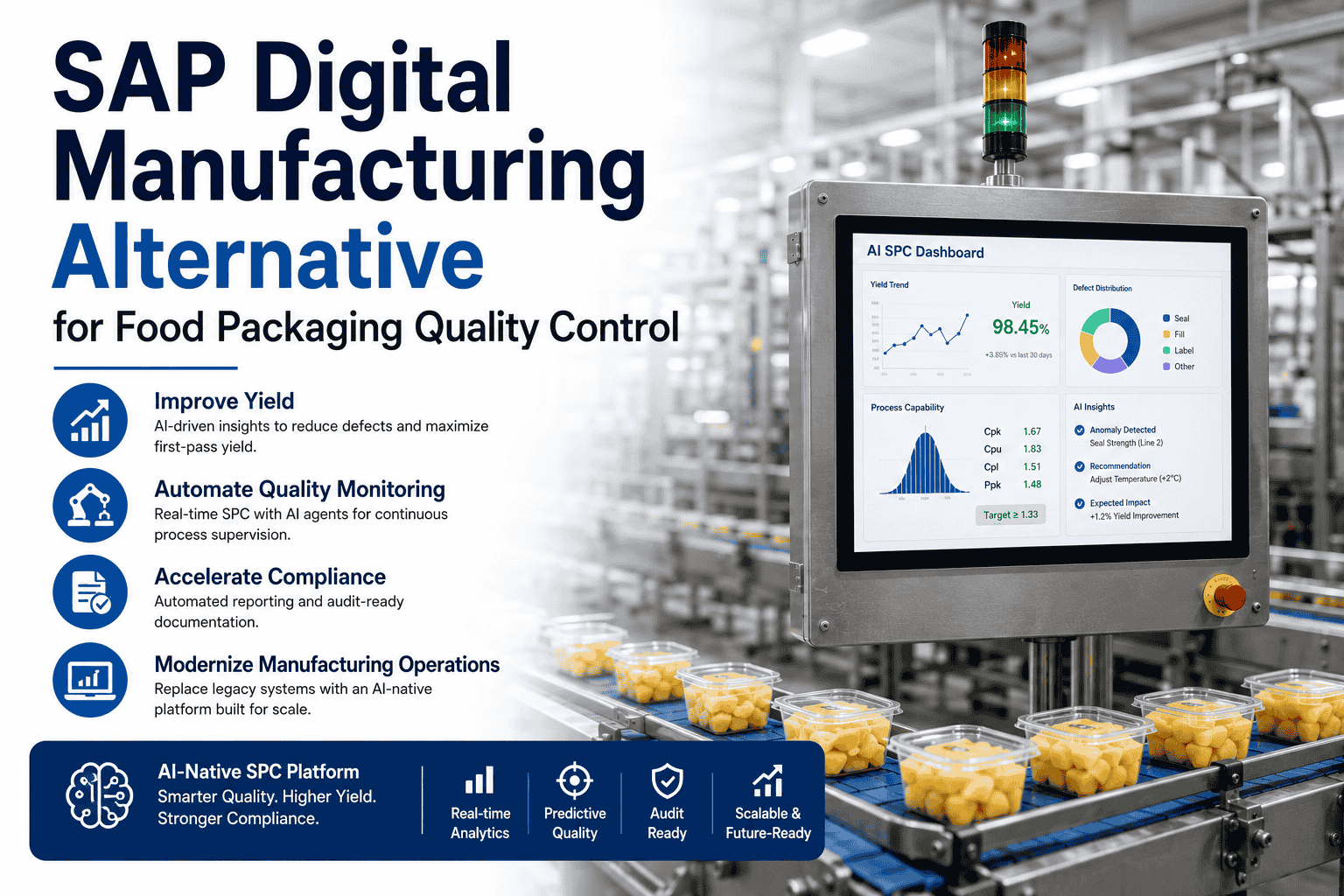
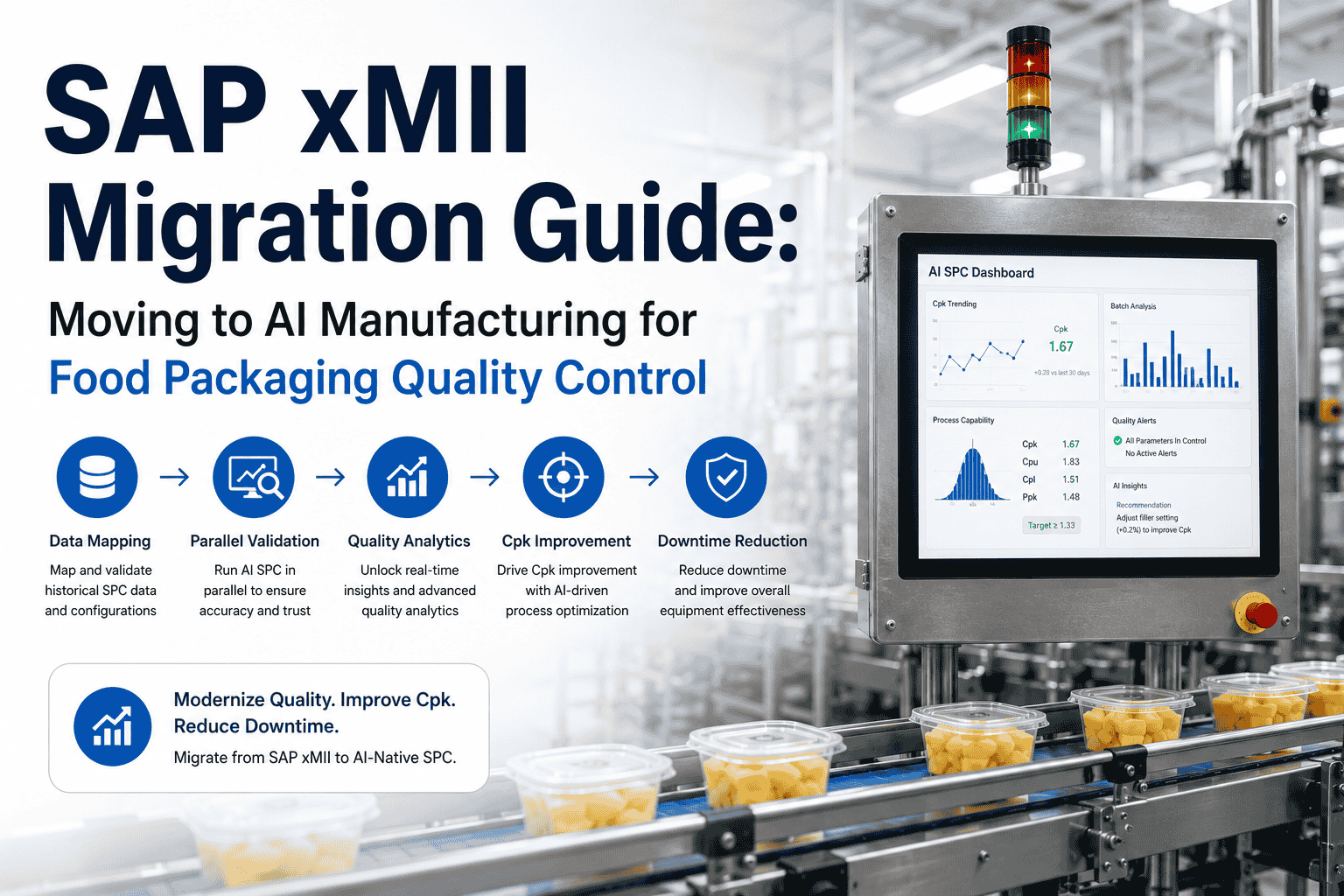
SAP xMII mainstream support ends December 2027 — food packaging operations have 18 months to land on a replacement architecture or face escalating migration risk. The strategic question isn’t whether to move, it’s where to land: cloud SPC offers fast deployment and predictable subscription economics, while on-prem AI SPC delivers the sub-50ms latency that high-speed packaging line inspection actually requires. Most food & beverage plants end up running both. This guide compares the two architectures across deployment, latency, downtime prevention, compliance, and total cost of ownership. Book an AI SPC migration workshop to map the right architecture for your specific lines and quality use cases.
CLOUD SPC
SaaS Deployment
Packaging
Line
→
Edge
Gateway
→
Cloud
SPC
→
Dashboard
Latency200–800ms
Deployment2–4 weeks
EconomicsSubscription OpEx
Best for: Cross-site analytics, portfolio dashboards, executive views
ON-PREM AI SPC
Edge Deployment
Packaging
Line
→
NVIDIA
Appliance
→
Local
Dashboard
Latency<50ms
Deployment6 weeks per plant
EconomicsAppliance + minimal OpEx
Best for: Line-rate inspection, real-time scrap prevention, downtime avoidance
The SAP xMII Replacement Clock — Why Now
The SAP xMII end-of-life timeline is the most concrete forcing function in manufacturing IT today. SAP confirmed mainstream maintenance and support for SAP MII (and SAP ME) ends December 2027, with extended support available at premium pricing until 2030. No new MII roadmap is coming. The underlying J2EE architecture on NetWeaver AS Java 7.5 was designed for early-2000s data volumes and processing patterns — modern food packaging operations have outgrown it. Plants that wait until 2027 to start migration face 12–36 month timelines compressed against a deadline. Plants starting in 2026 have the runway to migrate deliberately and capture AI capabilities along the way.
01
2027 Mainstream Support Ends
SAP MII mainstream maintenance ends December 2027. Extended support available until 2030 at premium pricing. Every SAP ERP upgrade after 2027 becomes a potential break point for custom MII integrations with no SAP patch coming. Maintenance overhead grows continuously.
02
Migration Timelines: 12–36 Months
Migration duration is driven primarily by custom logic volume — BLS transactions, xMII queries, integration points. Plants with minimal customization complete migration in 12 months; heavily customized operations require 36. Honest inventory of custom logic is the single most important migration input.
03
Food Packaging Stakes Are Higher
High-speed packaging lines (200–1000+ units/min) require sub-50ms inspection latency that cloud architectures cannot deliver. FSMA compliance, allergen control, and customer scorecard pressure mean quality system reliability is operationally critical — not a back-office concern.
04
AI Capabilities Now Differentiate
Modern AI-native SPC platforms deliver capabilities SAP MII never had: Predictive Scrap (4–24 hour foresight), Autonomous Root Cause Analysis (3–5 min vs 30–60), GenAI Copilots for operators. Migration is the opportunity to capture these capabilities, not just to land on a supported platform.
The Cloud SPC Path — What It Offers
Cloud SPC deployment is the dominant pattern for analytics, dashboards, and cross-site portfolio visibility. Modern cloud SPC platforms ingest line data from edge gateways and run statistical analysis, trending, and reporting in the cloud. The architecture is well-suited to applications where round-trip latency of 200–800ms is acceptable — which covers most analytics use cases but excludes line-rate inspection. The economics are predictable: subscription pricing, no upfront capital, and continuous platform improvements via vendor updates.
Strength 01
Fast Deployment
Cloud SPC deployments typically complete in 2–4 weeks. No on-site hardware procurement, no rack installation, no local IT engagement beyond network configuration. For plants with limited engineering bandwidth or aggressive migration deadlines, this matters.
Strength 02
Cross-Site Portfolio Intelligence
Cloud architecture excels at aggregating data across multiple plants. Executive dashboards show fleet-wide first-pass yield, quality cost concentration, and customer scorecard risk. Sites learn from each other — defect patterns identified at one plant inform inspection logic at others.
Strength 03
Predictable OpEx Economics
Subscription pricing converts quality system from capital project to operational expense. No upfront hardware investment, no depreciation, no refresh cycles. Per-line or per-site pricing scales linearly with operations. Predictable budget makes finance approval faster.
Strength 04
Continuous Platform Evolution
Cloud platforms evolve with vendor research and customer feedback. Customers benefit from new SPC algorithms, GenAI capabilities, and integrations without re-investment. No on-site upgrade projects, no version-lock risk — the platform you deploy today improves automatically.
Evaluating cloud SPC for portfolio analytics? Book an AI SPC migration workshop — we’ll walk through cloud SPC capabilities mapped to your specific F&B analytics use cases and reporting requirements.
The On-Prem AI SPC Path — Line-Rate Latency
On-prem AI SPC deployment addresses use cases that cloud architecturally cannot serve. High-speed food packaging lines running 200–1000+ units per minute require inspection decisions in under 50 milliseconds — well below the 200–800ms cloud round-trip latency floor. The fundamental constraint is physics: data must travel from line PLCs through the WAN to a cloud data center, be processed by AI inference, and return a decision in time for the line controller to act. Cloud architectures cannot close that loop fast enough for line-rate inspection regardless of vendor optimization. On-prem AI inference closes the loop in tens of milliseconds.
Strength 01
Sub-50ms Inspection Latency
On-prem AI inference closes the inspection loop in 10–50ms — the latency required for line-rate vision inspection, weight verification, seal integrity, and allergen control at high-speed packaging line rates. Cloud architecturally cannot match this regardless of optimization.
Strength 02
Predictive Scrap Prevention
AI models anticipate quality drift 4–24 hours before defects fire. Detects subtle parameter shifts that human operators and rule-based SPC miss. Predictive intervention prevents scrap events from happening — cloud SPC catches them after the fact.
Strength 03
Autonomous Root Cause Analysis
AI agents maintain continuous causal hypothesis about plant operations. When anomaly fires, root cause is pre-computed: operator sees evidence-backed explanation in 3–5 minutes vs 30–60 minutes of manual investigation. Resolves scrap events before next batch starts.
Strength 04
Data Sovereignty & Resilience
All production data stays on plant network. Continues running during WAN outages — cloud SPC fails when internet drops. Meets data residency requirements for sensitive recipes and proprietary process data. Compliance simpler when data never leaves the plant.
High-speed packaging lines need on-prem latency? Book an AI SPC migration workshop — we’ll evaluate which lines require on-prem inference vs which can run cloud SPC against your specific throughput and inspection requirements.
Side-by-Side Comparison Matrix
The comparison below maps both architectures across the dimensions that drive successful food packaging SPC deployments. The fundamental insight: these architectures are complementary, not competitive. The right answer for most F&B operations is both — cloud for analytics and portfolio, on-prem for line-rate inspection.
← Swipe to see all columns →
Map the Right Architecture to Your Packaging Operation
A migration workshop evaluates your specific lines, throughput requirements, current SAP xMII inventory, and quality use cases against both architectures. Output: a documented migration plan with line-by-line architecture decisions and realistic timeline.
The Hybrid Reality for Food Packaging
The dominant pattern for food & beverage operations replacing SAP xMII in 2026 is not cloud OR on-prem — it’s both, deployed in coordination. On-prem AI inference runs the latency-critical inspection workload on every packaging line. Cloud SPC aggregates plant-level data for portfolio analytics, executive dashboards, and cross-site benchmarking. The two architectures work together, with the on-prem appliance acting as an intelligent edge that handles real-time inspection locally and streams enriched data to the cloud for analytics. This hybrid model captures the latency advantage of on-prem with the portfolio intelligence advantage of cloud.
Layer 01
On-Prem Edge (Per Line)
NVIDIA AI appliance handles line-rate inspection: vision systems, seal integrity, weight verification, allergen control. Sub-50ms decisions. Autonomous RCA pre-computes root cause when anomalies fire. Continues running during WAN outages.
Runs: Inspection, Predictive Scrap, RCA, Local SPC
Layer 02
Cloud Aggregation (Per Plant)
Plant-level cloud tenant aggregates enriched data from all on-prem appliances. Plant-wide SPC trends, shift comparisons, quality cost concentration. GenAI Copilots answer plant-level questions in seconds. Integration with SAP ERP for batch genealogy and traceability.
Runs: Plant SPC, Copilots, ERP Integration
Layer 03
Cloud Portfolio (Cross-Site)
Single tenant for fleet-wide analytics across multiple plants. Cross-site benchmarking identifies best-performing plants and propagates improvements. Customer scorecard risk visible at executive level. Pattern detection across plants reveals systemic issues.
Runs: Portfolio Intelligence, Benchmarking, Executive Views
Layer 04
Integration Spine (SAP & Beyond)
OPC-UA from line PLCs, MQTT to cloud, REST API to SAP ERP/QM, integration with packaging line OEMs (Multivac, Tetra Pak, Krones, Sidel). Coexists with SAP DM where deployed. Single integration layer replaces patchwork of xMII custom transactions.
Runs: OPC-UA, MQTT, REST, OEM Connectors
Designing a hybrid architecture for your F&B operation? Book an AI SPC migration workshop — we’ll map which workloads run on-prem and which in cloud against your specific lines, plants, and reporting needs.
Migration Decision Framework
The migration decision in 2026 isn’t a single architecture choice — it’s a structured set of decisions per line, per plant, and across the portfolio. The four-step framework below produces a documented migration plan with concrete architecture decisions, realistic timelines, and budget allocation. Best practice: complete this framework within the first 6 weeks of migration planning, before locking detailed engineering decisions.
01
Inventory Custom Logic in Current SAP xMII
Honest inventory of BLS transactions, xMII queries, custom dashboards, integration points. This single input determines whether migration timeline is 12 months or 36. Plants with minimal customization migrate fast; heavily customized plants need significant rework.
02
Classify Lines by Latency Requirement
High-speed packaging lines (200+ units/min) requiring vision/seal/weight inspection need on-prem AI architecture. Lower-speed lines, lab quality, batch reporting can run on cloud SPC. Document line-by-line latency requirements before architecture commitment.
03
Pilot on Highest-Value Line
Start with the line where scrap cost is highest or RCA investigations are most frequent. Validate Predictive Scrap accuracy and Autonomous RCA performance on a single line. Pilot duration: 6 weeks for on-prem appliance, 2–4 weeks for cloud SPC.
04
Expand in 2–4 Week Waves
After pilot validates approach, expand line-by-line in 2–4 week waves. Full plant deployment for typical 4–8 line F&B operation completes in 3–5 months end-to-end. Cloud portfolio layer activated after first plant goes live.
Expert Perspective
"The SAP xMII replacement decision for food packaging operations is fundamentally an architecture decision, not a vendor decision. The 2027 mainstream end-of-life creates the deadline, but the harder question is matching workloads to architecture. High-speed packaging lines — the ones running 200–1000+ units per minute with vision inspection, seal integrity, weight verification, and allergen control — architecturally require sub-50ms inference latency that cloud cannot deliver. That’s not a vendor optimization problem; it’s physics. Data has to travel from line PLCs to cloud and back. Round-trip latency of 200–800ms is real, persistent, and incompatible with line-rate inspection. Meanwhile, cloud architectures excel at the workloads they’re actually designed for: portfolio analytics, cross-site benchmarking, executive dashboards. The plants that get this migration right deploy on-prem AI on every packaging line and cloud analytics on top — not because vendors push it, but because that’s where the workloads naturally fit. Plants forcing one architecture to serve both use cases either accept inadequate latency for inspection or excessive complexity for analytics."
— F&B AI Manufacturing Practice, 2026 perspective
<50ms
latency required for line-rate inspection
8–15%
first-pass yield improvement (typical)
40–65%
cost of quality reduction
Plan Your SAP xMII Replacement Migration
The half-day workshop covers current-state SAP MII/xMII/DMC assessment, six cloud failure modes analysis for your operation, Autonomous RCA + Predictive Scrap demonstration on representative F&B scenarios, and a three-path migration comparison sized to your custom logic inventory.
Frequently Asked Questions
When does SAP xMII actually go end-of-life?
SAP MII mainstream maintenance and support ends December 2027. Extended support is available at premium pricing until around 2030 for plants willing to pay. No new MII roadmap, no version 15.6, no new features. The underlying J2EE architecture on NetWeaver AS Java 7.5 will not be modernized. Every SAP ERP upgrade after 2027 becomes a potential break point for custom MII integrations with no SAP patch coming. Plants starting migration in 2026 have runway to migrate deliberately; plants starting in 2027 face compressed timelines against the deadline.
Can cloud SPC really not handle high-speed food packaging line inspection?
Correct — cloud SPC cannot handle line-rate inspection at high-speed packaging line throughput. The constraint is round-trip latency: data travels from line PLCs through WAN to cloud, gets processed by AI inference, and returns a decision. Cloud round-trip latency runs 200–800ms in real-world deployments. A packaging line running 600 units/min processes one unit every 100ms — the inspection decision must complete in less time than that. Cloud architectures cannot close that loop fast enough regardless of vendor optimization. On-prem AI inference closes the loop in 10–50ms because data never leaves the plant network.
What does a typical hybrid deployment look like?
For a typical F&B operation with 4–8 packaging lines per plant: NVIDIA AI appliance on-prem at each plant handles line-rate inspection across all lines (sub-50ms latency, Predictive Scrap, Autonomous RCA, local SPC). Cloud tenant aggregates plant-level data for portfolio analytics, cross-site benchmarking, and executive dashboards. Plant-level GenAI Copilots run on the on-prem appliance for sub-second response to operator and supervisor questions. Cross-site portfolio Copilots run in cloud. Total deployment timeline: 6 weeks per plant for on-prem, cloud portfolio activates after first plant goes live.
Book an AI SPC migration workshop to map this to your specific operation.
How does this work with our SAP DM migration?
SAP DM (Digital Manufacturing) is SAP’s recommended successor to SAP MII and handles core MES use cases — production execution, electronic work instructions, in-process quality checks. iFactory’s AI-native platform layers on top of SAP DM (or in place of SAP DM where SAP DM doesn’t fit), providing the AI capabilities SAP DM doesn’t ship deeply: line-rate vision inspection, Predictive Scrap, Autonomous RCA, GenAI Copilots, portfolio analytics. Many F&B operations migrate execution layer to SAP DM Cloud while deploying iFactory for AI on top. Timeline: 14 months for SAP DM, 6 weeks per plant for iFactory in parallel.
What’s in the AI SPC Migration Workshop?
The half-day workshop covers current-state SAP MII/xMII/DMC assessment (custom logic inventory), six cloud failure modes analysis specific to your operation, Autonomous RCA and Predictive Scrap demonstration on representative F&B scenarios (your line configurations, your packaging types, your defect categories), and a three-path migration comparison sized to your custom logic inventory and timeline. Output: a documented migration plan with line-by-line architecture decisions (cloud vs on-prem), realistic timeline, and budget allocation. Most teams come out with concrete next steps and a defensible recommendation for executive approval.