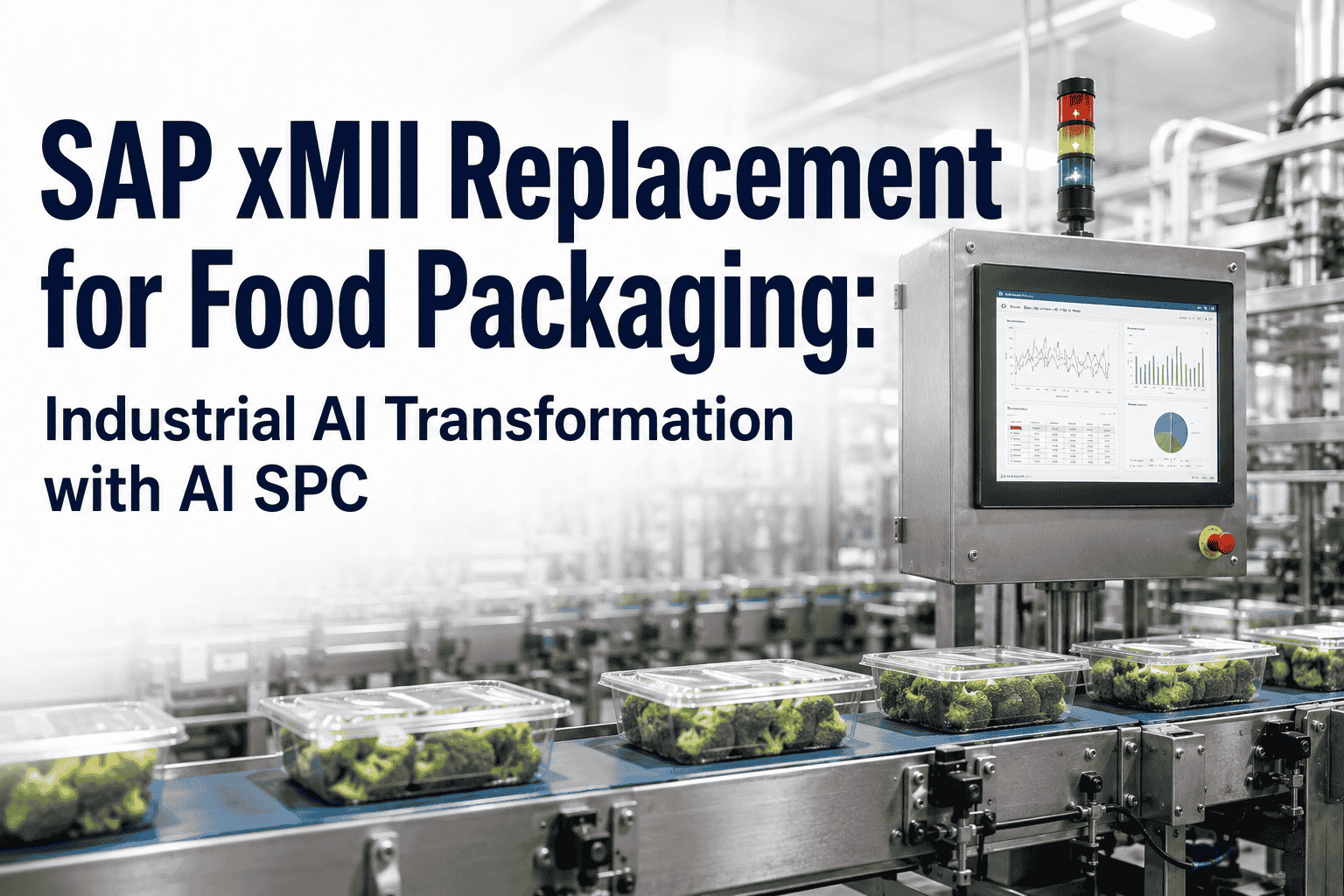
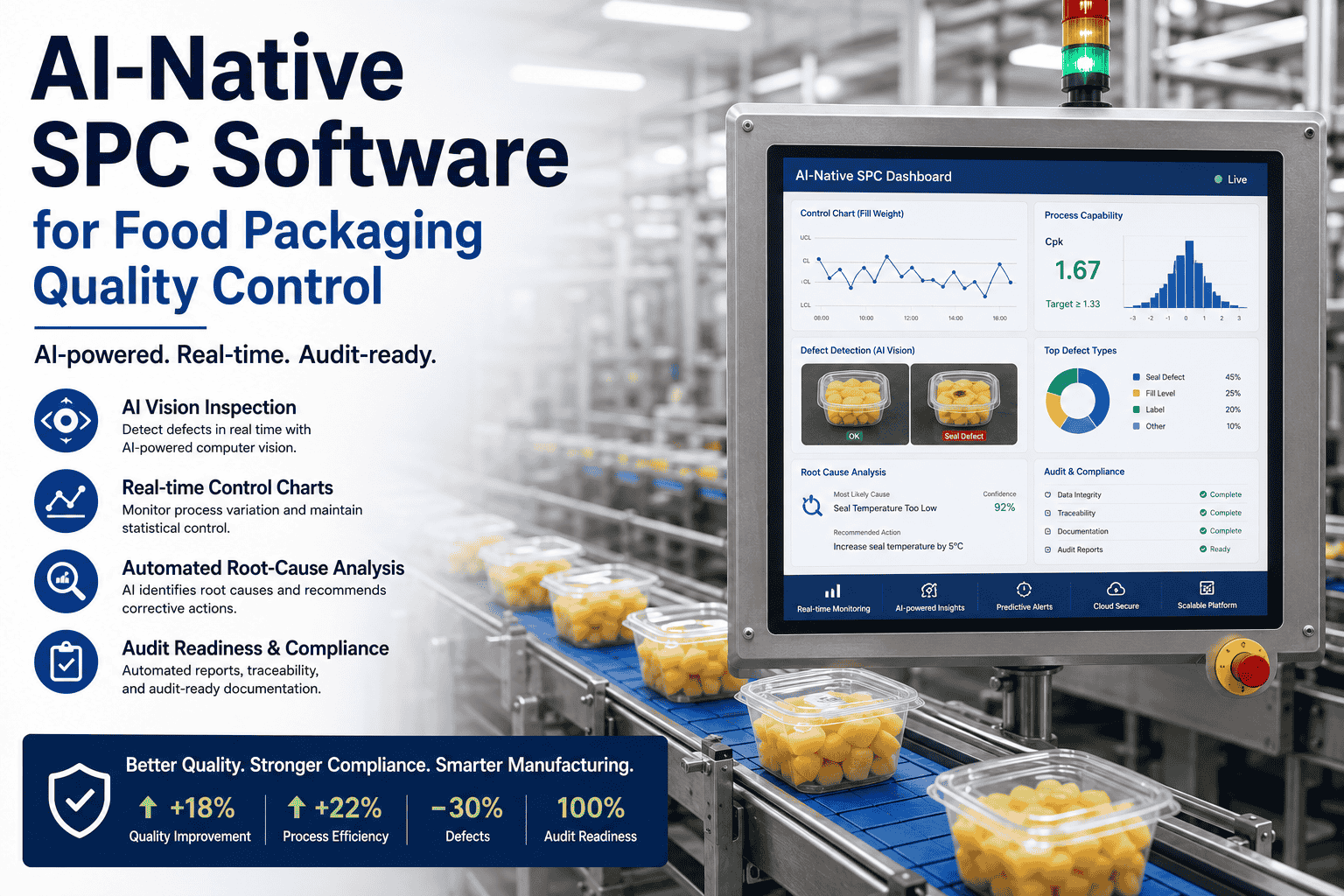
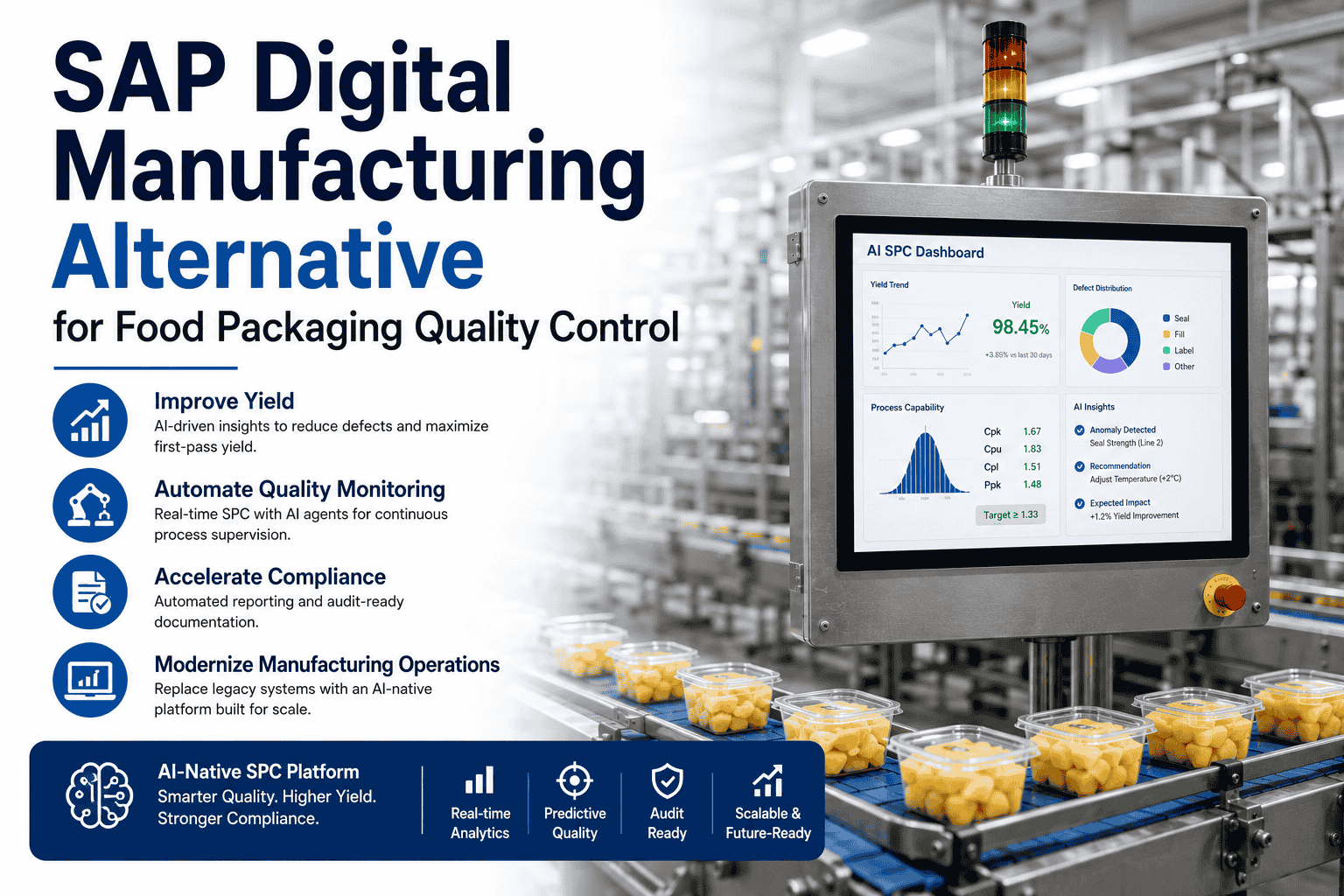
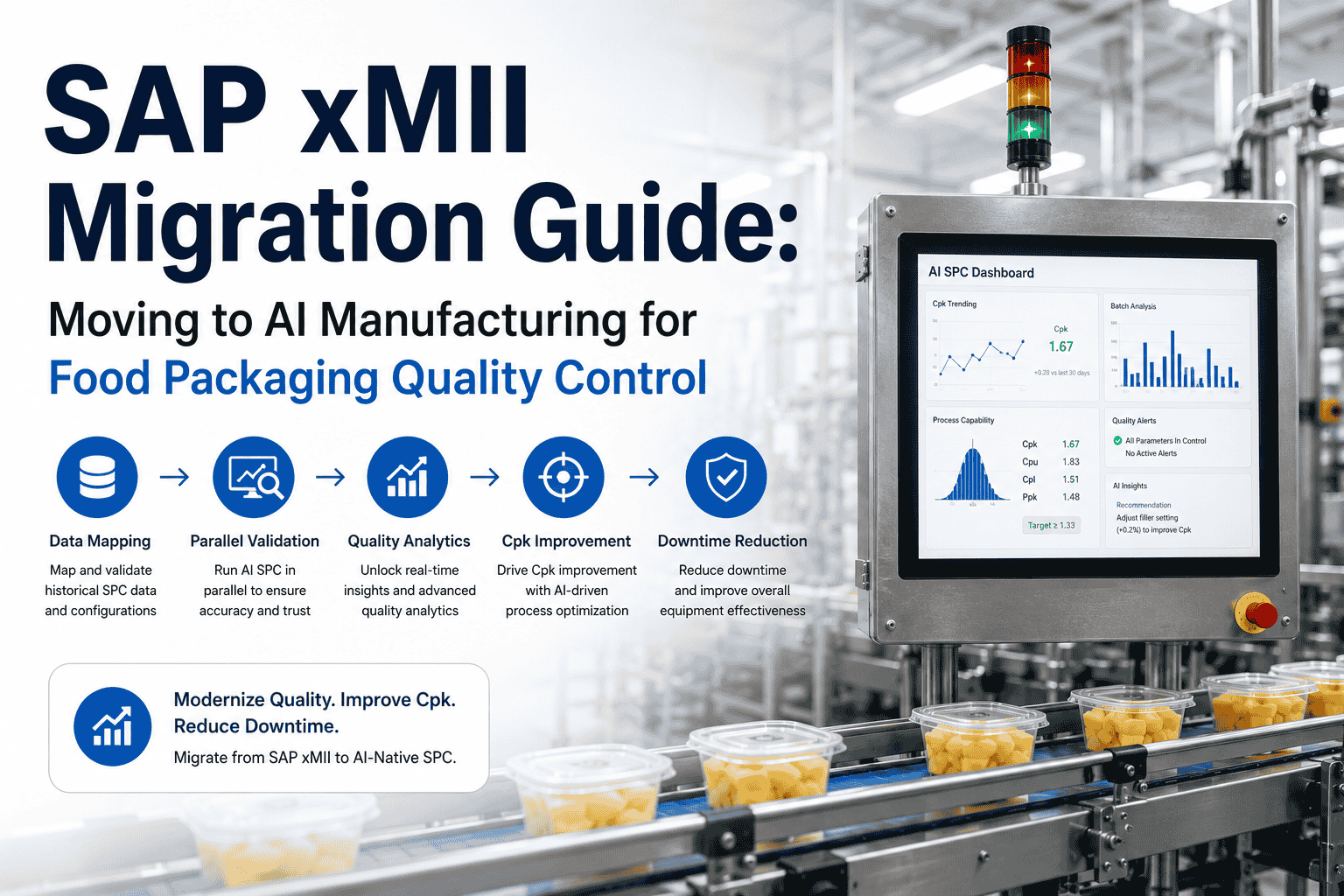
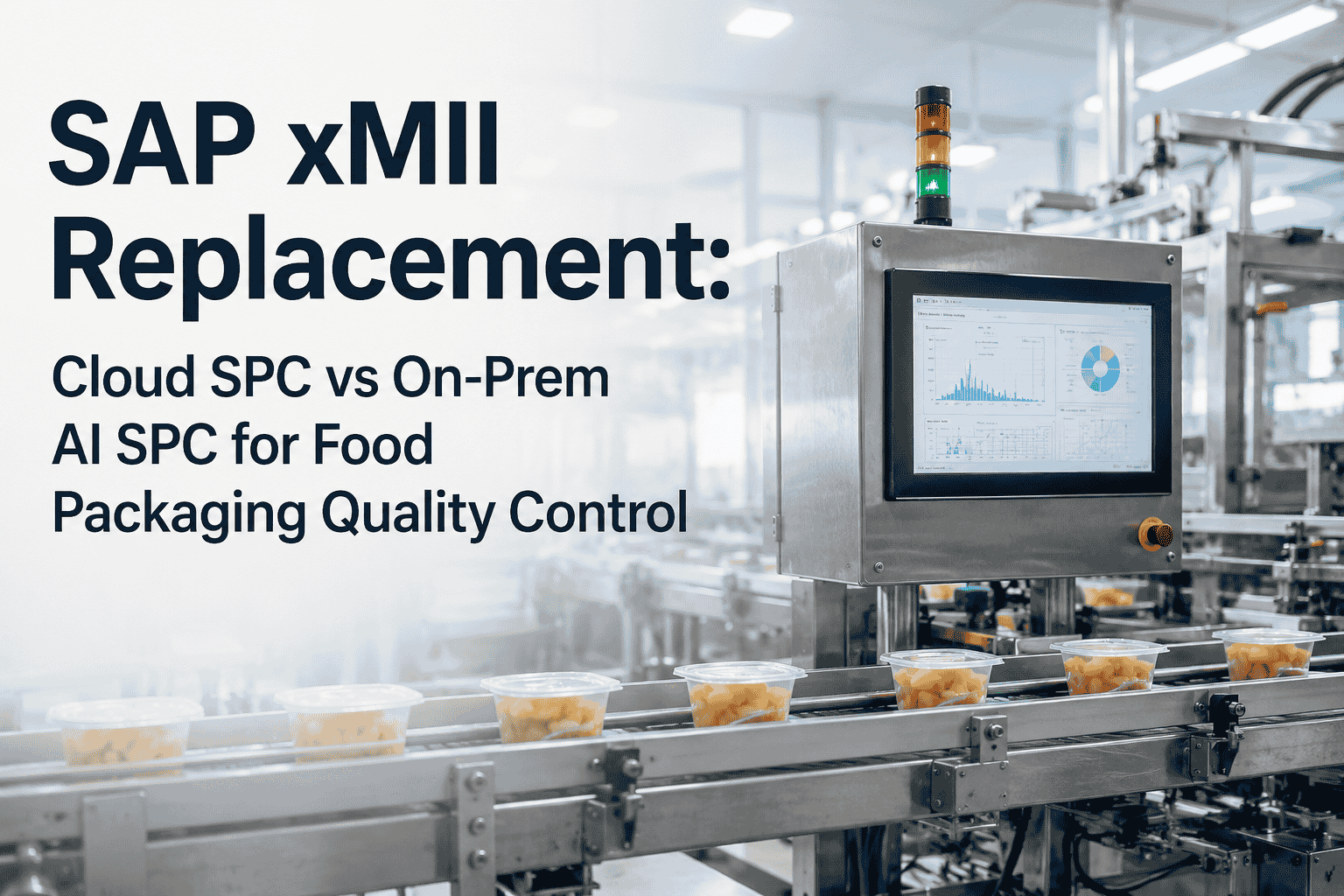
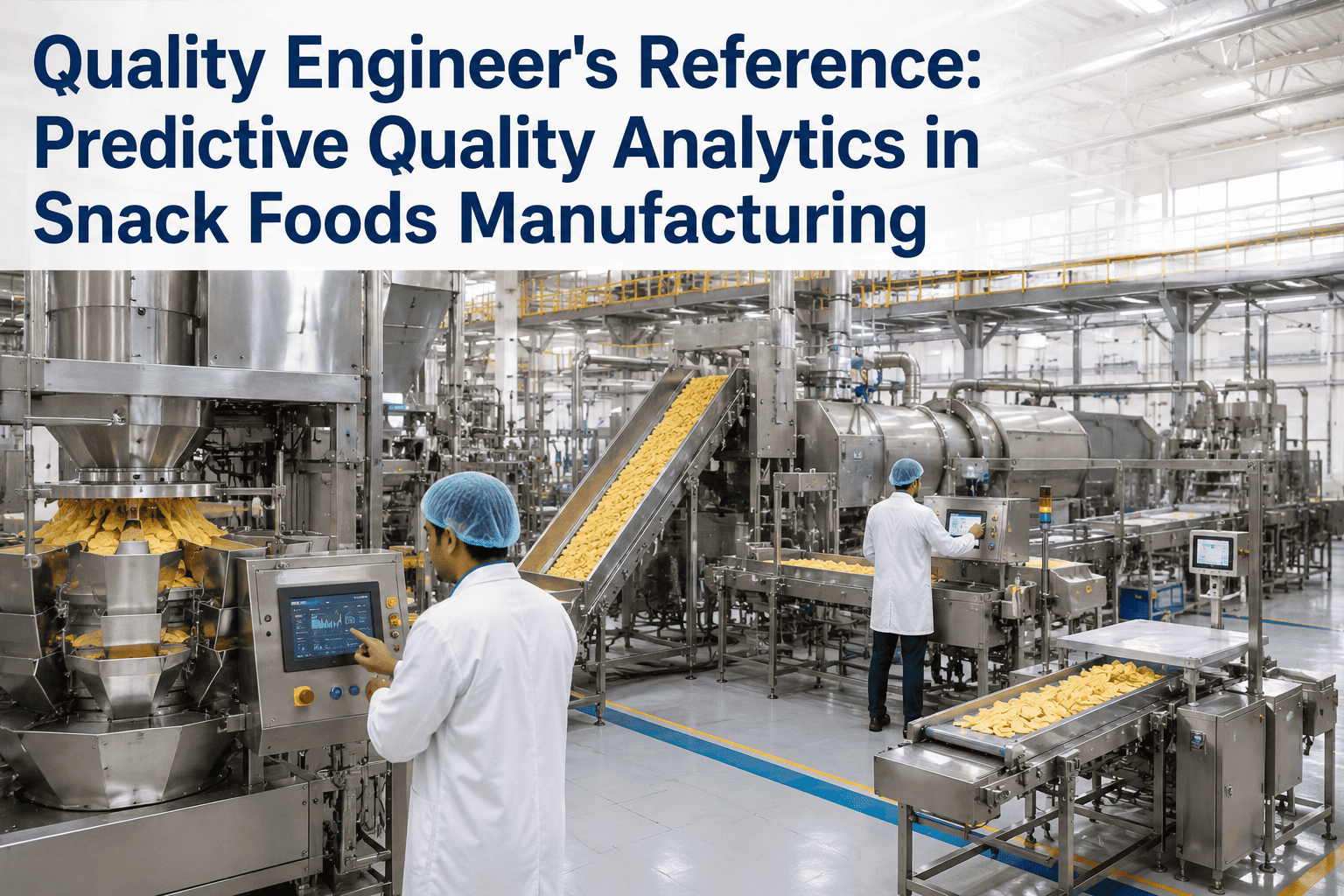
SAP xMII was a strong manufacturing intelligence layer for its era — but its era ended. For food & beverage packaging operations facing the December 2027 mainstream end-of-life, the migration question isn’t just about a supported successor — it’s about capturing AI capabilities that fundamentally transform how supervisors prevent downtime, how quality teams investigate root cause, and how plants stay audit-ready under FSMA traceability rules. This guide walks through what industrial AI transformation looks like for food packaging quality control, the six capabilities that replace what SAP xMII never had, and the migration path that gets you there. Book an AI SPC migration workshop to scope the transformation for your specific lines and packaging operations.
01
Predictive Scrap Prevention
Anticipates quality drift 4–24 hours before defects fire. Detects subtle parameter shifts that rule-based SPC misses.
4–24 hr foresight
02
Autonomous Root Cause Analysis
Pre-computed root cause when anomaly fires. Evidence-backed explanation in minutes instead of hours of manual investigation.
3–5 min vs 30–60 min
03
Real-Time AI SPC
Sub-50ms inspection latency for line-rate vision, seal, weight, and label verification on high-speed packaging.
<50ms inference
04
GenAI Copilots
Natural language interface for supervisors and operators. Ask plant questions, get evidence-backed answers in seconds.
Sub-second response
05
Edge AI Inference
Pre-configured NVIDIA appliance on-prem. Data sovereignty, WAN-outage resilience, line-rate response without cloud dependency.
On-prem deployment
06
FSMA Audit Readiness
Continuous traceability across batches, lots, and packaging runs. Auto-generated audit reports against 21 CFR and FSMA Rule 204.
24-hr traceability
Why SAP xMII Falls Short for Modern Food Packaging
SAP xMII was designed two decades ago for a different manufacturing world. It served well for batch-oriented data collection, dashboard generation, and SAP ERP integration. What it cannot serve well in 2026 is the real-time, AI-driven, multivariate quality intelligence that modern food packaging operations actually need. The platform was built on J2EE architecture running on NetWeaver AS Java 7.5 — an early-2000s technology stack that will not be modernized. The functional gaps below explain why even plants with substantial xMII investment are migrating to AI-native platforms before the 2027 mainstream end-of-life.
01
No Predictive Capability
SAP xMII reports what happened. It cannot predict what will happen. Modern AI-native SPC anticipates quality drift 4–24 hours before defects fire — transforming supervisors from reactive to proactive. xMII rule-based SPC catches violations after the fact, when scrap has already occurred.
02
Manual Root Cause Analysis
When anomalies fire in xMII, operators spend 30–60 minutes investigating root cause manually — pulling data from multiple systems, building correlations, testing hypotheses. AI-native platforms pre-compute root cause continuously, presenting evidence-backed explanations in 3–5 minutes.
03
Architectural Latency Limit
xMII batch query patterns and J2EE web tier cannot deliver the sub-50ms response required for line-rate inspection on high-speed packaging lines (200–1000+ units/min). Modern operations need edge AI inference architecturally co-located with line PLCs.
04
No Natural Language Interface
Supervisors and operators interact with xMII through pre-built dashboards and rigid reports. Modern GenAI Copilots answer ad-hoc plant questions in seconds: "What’s driving yield loss on line 3 this shift?" gets a complete evidence-backed answer.
05
Integration Burden Compounds
Custom BLS transactions, xMII queries, and PCo connections that worked in 2015 require ongoing maintenance as adjacent systems evolve. Maintenance overhead grows continuously with no SAP investment to stabilize the platform. Every ERP upgrade post-2027 is a potential break point.
06
No Path to AI Capability
SAP MII end-of-life confirms the platform will not gain AI capabilities. No 15.6 release. No new roadmap. Plants that wait risk falling further behind competitors who have already captured Predictive Scrap, Autonomous RCA, and GenAI Copilot capabilities.
What Industrial AI Transformation Looks Like
Industrial AI transformation for food & beverage packaging isn’t about adding AI features to a traditional SPC tool. It’s about restructuring how quality intelligence flows through the plant — from sensors to operators to supervisors to executives — with AI agents continuously running correlations, predictions, and root cause hypotheses in the background. The transformation reaches every role: operators see AI-suggested interventions at the line, supervisors receive predictive alerts hours before scrap events, quality teams resolve RCA in minutes, and executives see portfolio-wide pattern detection.
Curious what industrial AI transformation looks like in your specific operation? Book an AI SPC migration workshop — we’ll demonstrate Predictive Scrap and Autonomous RCA on representative F&B packaging scenarios using your line configurations.
The Six AI Capabilities That Replace SAP xMII
The capabilities below represent the core of the AI-native transformation. Each addresses a specific gap in legacy SAP xMII and delivers measurable business impact in food packaging operations. They’re not features that bolt onto a traditional SPC platform — they require an AI-native architecture from the ground up, with edge inference, ML pipelines, and natural language interfaces designed for industrial environments.
ML models trained on historical line data anticipate quality drift 4–24 hours before defects fire. Detects subtle parameter shifts — recipe ingredient lot variation, environmental drift, equipment wear patterns — that rule-based SPC and human operators miss. Ranked alerts surface in supervisor dashboards with confidence scores and recommended interventions.
Foresight window4–24 hours
Scrap reduction30–55%
ReplacesReactive xMII rule-based SPC
AI agents maintain continuous causal hypothesis about plant operations — running multivariate correlations across equipment state, recipe parameters, ingredient lot history, environmental conditions, and operator actions. When anomaly fires, root cause is pre-computed: operator sees evidence-backed explanation in 3–5 minutes vs 30–60 minutes of manual investigation.
RCA time3–5 min
Time saved85% reduction
ReplacesManual investigation cycles
Sub-50ms inspection latency for line-rate vision systems, weight verification, seal integrity, and label accuracy on high-speed packaging lines (200–1000+ units/min). On-prem AI inference closes the inspection loop in tens of milliseconds — physics that cloud architectures cannot match regardless of optimization.
Inference latency<50ms
Line speed support1000+ units/min
ReplacesSampling-based inspection
Natural language interface replaces rigid dashboards. Supervisors ask "what’s driving yield loss on line 3 this shift" and get evidence-backed answers in seconds. Operators ask "why did the seal fail" and receive root cause with corrective steps. Copilots run on the on-prem appliance for sub-second response without cloud dependency.
Response timeSub-second
InterfaceNatural language
ReplacesPre-built dashboards, rigid reports
Pre-configured NVIDIA appliance ships fully loaded: AI server, software pre-installed, network gear, cabling, edge devices for line-side inference, and industrial cameras where needed. Plant provides rack space, line power, Ethernet, and PLC integration points. Data sovereignty: production data stays on plant network. Continues operating during WAN outages.
DeploymentPre-configured turnkey
Data locationPlant network
ReplacesCloud-dependent architectures
Continuous batch genealogy across ingredients, packaging runs, equipment state, operator actions. FSMA Rule 204 (Food Traceability Final Rule) 24-hour source-to-shelf traceability automatically satisfied. Audit reports auto-generated against 21 CFR Part 11, SQF, BRCGS. Recall scope identified in minutes, not days.
Traceability24-hr source-to-shelf
Recall scopeMinutes vs days
ReplacesManual recordkeeping, audit prep
Want to see these capabilities running against your specific packaging scenarios? Book an AI SPC migration workshop — the half-day session demonstrates Predictive Scrap, Autonomous RCA, and GenAI Copilots on representative F&B operations.
The Supervisor’s Workflow Transformation
Downtime prevention is where industrial AI transformation produces the most visible business impact. For food packaging operations, supervisor downtime decisions during a shift account for 60–80% of operational scrap, rework, and customer scorecard incidents. The transformation reshapes how supervisors spend their shift — from reactive firefighting to proactive intervention. The four workflow shifts below represent how AI-native SPC changes the supervisor role in practice, not in theory.
BEFORE (SAP xMII)
Supervisor reviews shift-end SPC charts. By the time the trend is visible, scrap has already occurred. Investigation begins after the fact.
→
AFTER (AI-Native SPC)
Supervisor receives ranked predictive alerts 4–24 hours before quality drift produces defects. Intervention recommendation included. Scrap prevented.
BEFORE (SAP xMII)
Anomaly fires on line. Supervisor pulls data from xMII, MES, historian, ERP. Builds correlation manually. RCA takes 30–60 minutes. Production resumes during investigation.
→
AFTER (AI-Native SPC)
Anomaly fires. Pre-computed root cause displays in 3–5 minutes with evidence chain. Supervisor takes corrective action with full context. RCA closes during the event, not after.
BEFORE (SAP xMII)
Supervisor question: "what’s driving yield loss on line 3?" Answer requires opening multiple xMII reports, exporting to Excel, building pivot tables. 15–30 minutes per question.
→
AFTER (AI-Native SPC)
Supervisor types the question into GenAI Copilot. Evidence-backed answer with chart in seconds. Follow-up questions answered in context. Hours back per shift.
BEFORE (SAP xMII)
Audit prep consumes quality and supervisor time for days. Manual report generation, batch genealogy assembly, FSMA traceability documentation built from scratch each audit cycle.
→
AFTER (AI-Native SPC)
Audit reports auto-generated continuously. FSMA Rule 204 24-hour traceability automatically satisfied. Recall scope identified in minutes. Audit becomes review, not assembly.
Transform Supervisor Workflows for Downtime Prevention
A migration workshop maps your specific supervisor workflows against AI-native capabilities. Output: a documented transformation plan with supervisor role evolution, line-by-line capability deployment, and realistic timeline to capture the productivity shift.
The Migration Path — From SAP xMII to AI-Native
The migration from SAP xMII to AI-native SPC follows a structured phased path. Plants that try to migrate everything at once typically encounter timeline overruns and operational disruption. Plants that follow the phased approach below complete migration in 3–5 months end-to-end for typical 4–8 line F&B operations and capture AI capabilities along the way rather than only at the end. Each phase has clear deliverables, validation criteria, and go/no-go decision points.
01
Inventory & Workshop (Weeks 1–2)
Document current SAP xMII custom logic: BLS transactions, queries, dashboards, integration points. Half-day AI SPC migration workshop demonstrates capabilities against representative F&B scenarios. Output: documented migration plan with line-by-line capability roadmap.
02
Pilot Line Deployment (Weeks 3–8)
Start with the line where scrap cost is highest or RCA investigations most frequent. NVIDIA AI appliance deployed and configured. Vision systems, sensors, PLC integration completed. Operators trained on Copilot interface. Validate Predictive Scrap accuracy and Autonomous RCA performance.
03
Line-by-Line Expansion (Weeks 9–16)
After pilot validates approach, expand to remaining lines in 2–4 week waves. Each line goes through inspection model training (defect taxonomy refinement), supervisor workflow integration, and operator certification. Each wave reinforces capabilities and reveals incremental optimizations.
04
SAP xMII Sunset & Portfolio Activation (Weeks 17–20)
Migrate residual xMII workloads (reports, dashboards) to AI-native equivalents. Activate cloud portfolio tenant for cross-plant analytics if multi-site. Decommission xMII custom transactions. Document the new operational state for governance and future audits.
Ready to scope the migration timeline for your specific operation? Book an AI SPC migration workshop — output is a documented migration plan with line-by-line schedule, capability roadmap, and budget allocation.
Expert Perspective
"Industrial AI transformation for food & beverage packaging quality isn’t a feature upgrade — it’s a workflow restructuring that reaches every role from operator to executive. The supervisor who used to spend two hours of every shift on manual RCA investigations now spends those hours on the proactive interventions that prevent the next scrap event. The quality team that used to assemble audit packages from scratch now reviews auto-generated reports. The operator who used to wait for a defect to fire before knowing something was wrong now sees AI-suggested interventions inline. The transformation captures real productivity that compounds over months, and it changes how plants compete. The SAP xMII end-of-life deadline creates the migration window. The plants that approach it as an opportunity to capture AI capabilities — not just to land on a supported platform — come out of the migration with material competitive advantage. The plants that approach it as a forced platform swap leave most of the value on the table."
— F&B AI Manufacturing Practice, 2026 perspective
30–55%
scrap reduction with Predictive Scrap
85%
RCA time reduction with autonomous AI
3–5 mo
full plant deployment timeline
Capture AI Capabilities in Your SAP xMII Migration
The half-day AI SPC Migration Workshop covers current-state SAP MII/xMII assessment, demonstration of Predictive Scrap and Autonomous RCA on your representative scenarios, supervisor workflow transformation walkthrough, and a phased migration plan sized to your custom logic inventory and line count.
Frequently Asked Questions
What does AI-native SPC do that SAP xMII cannot?
Six core capabilities. (1) Predictive Scrap Prevention anticipates quality drift 4–24 hours before defects fire — xMII rule-based SPC only catches violations after the fact. (2) Autonomous Root Cause Analysis pre-computes RCA when anomalies fire, delivering evidence-backed explanations in 3–5 minutes vs 30–60 minutes of manual investigation. (3) Real-time AI inference at sub-50ms latency enables line-rate vision and inspection on high-speed packaging that xMII architecturally cannot serve. (4) GenAI Copilots answer plant questions in natural language. (5) Edge AI appliance provides data sovereignty and WAN-outage resilience. (6) FSMA traceability and audit reports auto-generated continuously. None of these capabilities can be retrofitted onto SAP xMII — they require an AI-native architecture from the ground up.
How does this work for supervisors specifically?
Supervisors experience the largest workflow transformation. Before: supervisors spent 2–3 hours per shift on manual RCA investigations, building correlations across xMII, MES, historian, and ERP data. After: pre-computed RCA presents evidence-backed root cause in minutes; GenAI Copilots answer ad-hoc plant questions in seconds; predictive alerts arrive 4–24 hours before scrap events with intervention recommendations. The supervisor role shifts from reactive firefighting to proactive intervention. The freed time goes to coaching operators, optimizing scheduling, and addressing systemic issues that previously went unnoticed.
What’s realistic for downtime prevention impact?
F&B packaging operations typically see 30–55% scrap reduction within the first 12 months of AI-native SPC deployment, driven primarily by Predictive Scrap Prevention catching quality drift before defects fire. Unplanned downtime reductions of 20–35% are typical as AI-suggested interventions prevent equipment-driven quality events. Cost of quality reductions of 40–65% appear over 18–24 months as predictive capability matures with line-specific historical data.
Book a migration workshop to model the realistic impact for your specific lines and scrap cost baseline.
How does the migration coexist with our SAP DM strategy?
SAP DM (Digital Manufacturing) is SAP’s recommended successor for production execution — electronic work instructions, in-process quality checks, resource orchestration. AI-native SPC layers on top of SAP DM (or in place where SAP DM doesn’t fit), providing the AI capabilities SAP DM doesn’t ship deeply: line-rate vision, Predictive Scrap, Autonomous RCA, GenAI Copilots, portfolio analytics. Many F&B operations migrate execution layer to SAP DM Cloud while deploying AI-native SPC for quality intelligence in parallel. Timeline: 14 months for SAP DM, 6 weeks per plant for AI-native SPC running in parallel. The two systems integrate via standard protocols (OPC-UA, MQTT, REST API).
What does deployment actually look like for a 4–8 line F&B plant?
Full plant deployment for a typical 4–8 line F&B operation completes in 3–5 months end-to-end. Week 1–2: AI SPC migration workshop and custom logic inventory. Week 3–8: pilot line deployment with NVIDIA appliance install, vision system integration, PLC connectivity, operator training, capability validation. Week 9–16: line-by-line expansion in 2–4 week waves with progressive capability activation. Week 17–20: SAP xMII sunset, residual workload migration, portfolio analytics activation. Plant provides rack space, line power, Ethernet, PLC integration points. Deployment team handles installation, configuration, training, and validation.