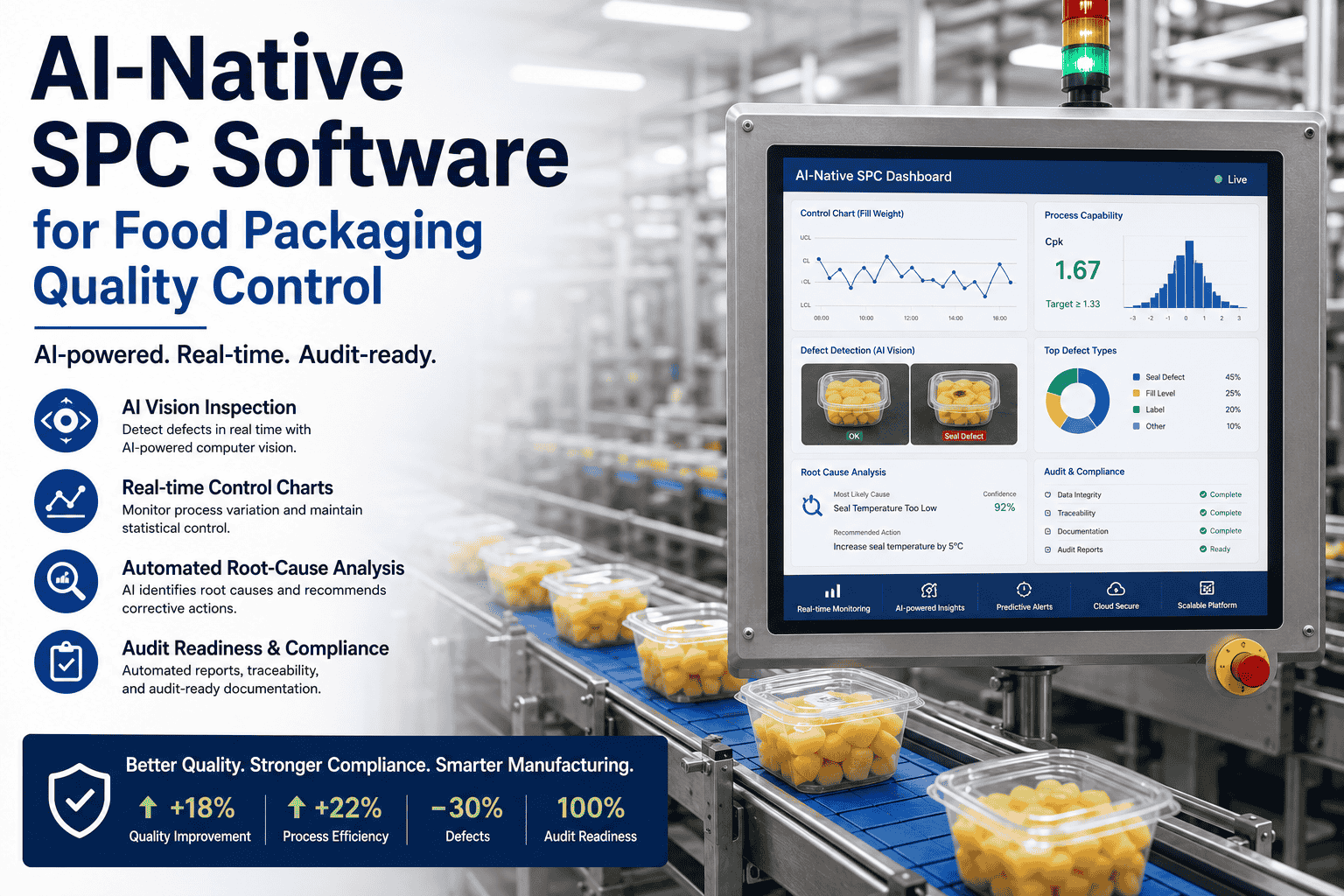
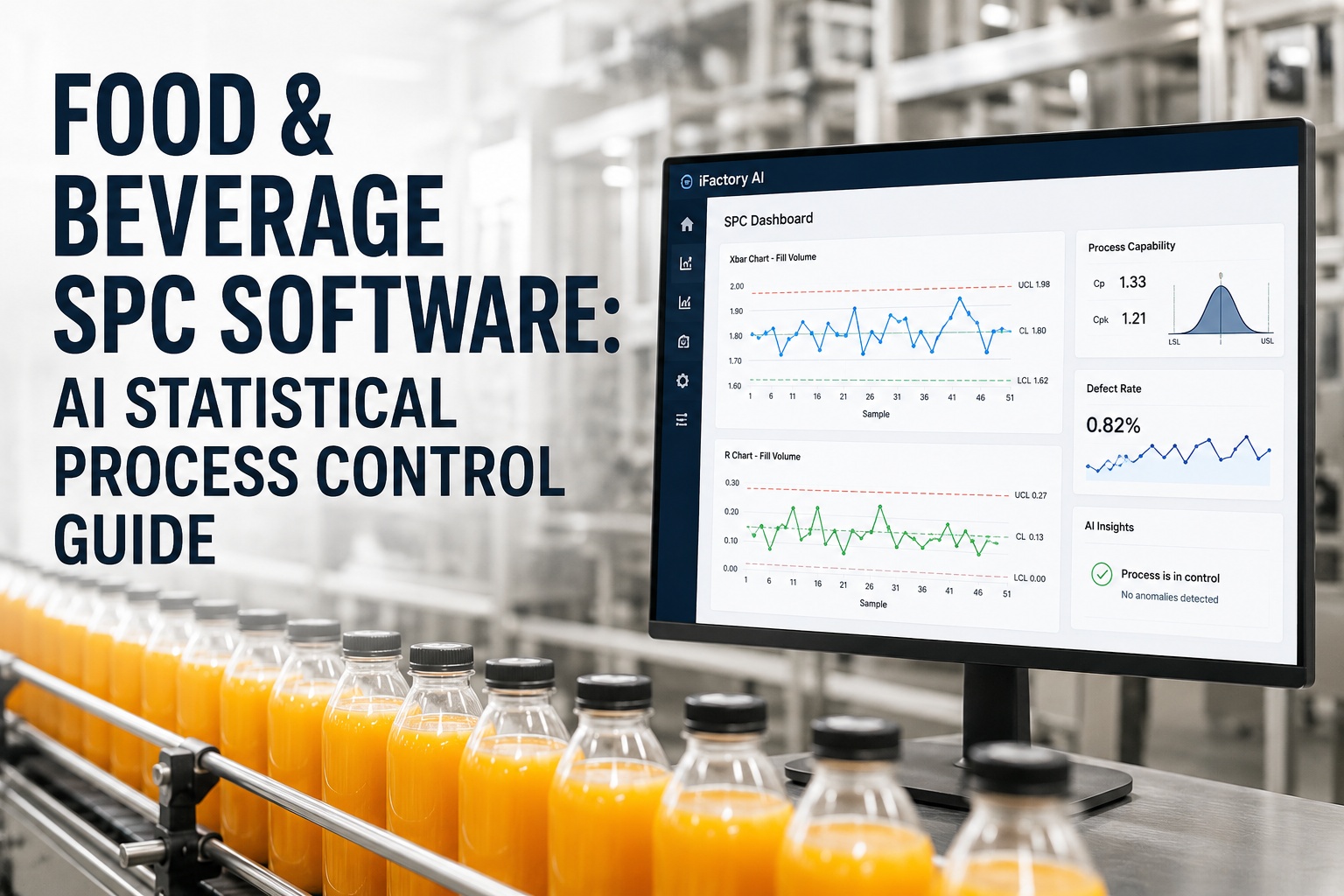
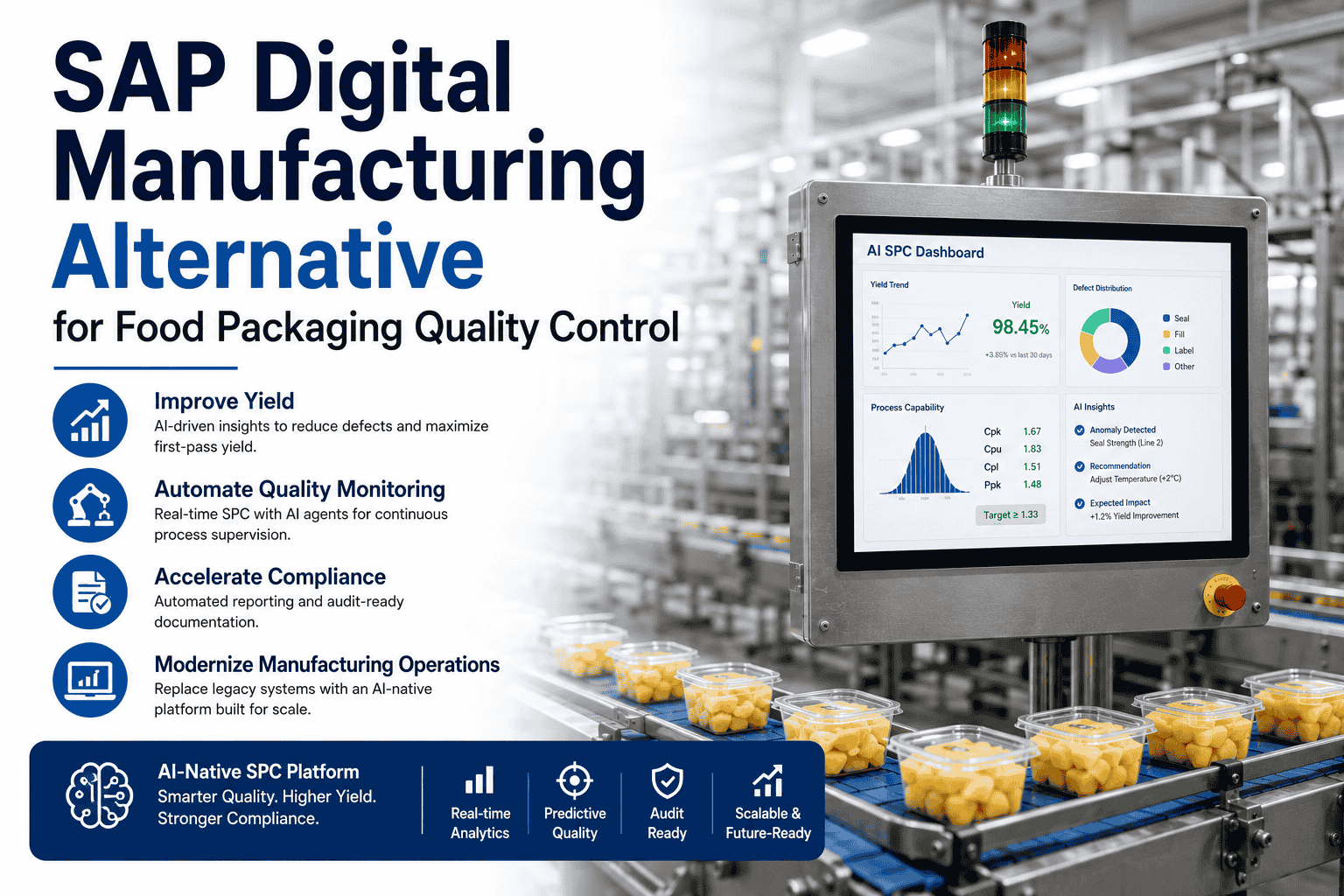
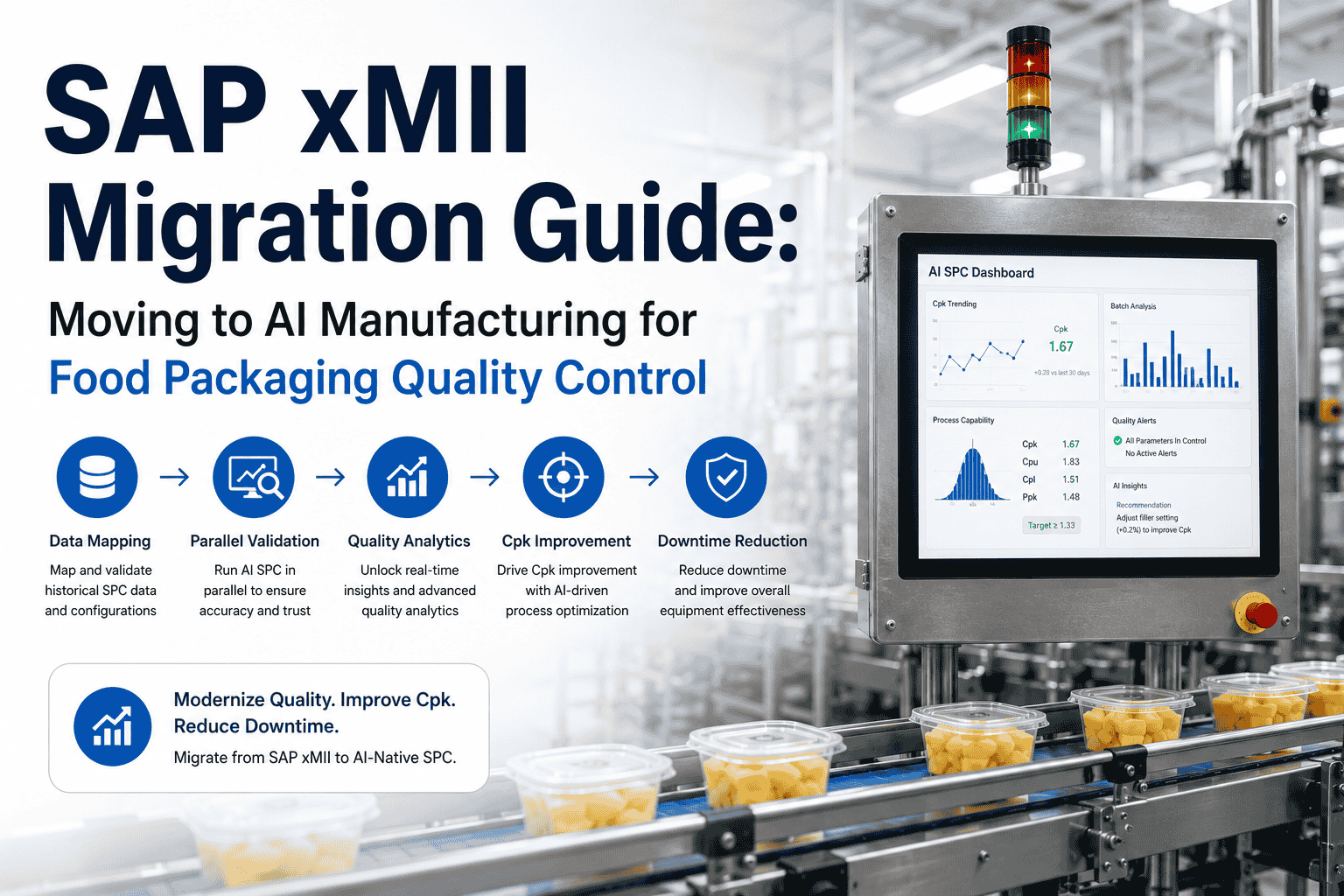
AI-native SPC software is fundamentally different from the rule-based statistical process control tools manufacturers used for the last two decades. It combines AI vision inspection at line rate, continuous predictive monitoring, automated root cause analysis, and auto-generated compliance documentation into a single platform purpose-built for modern food packaging operations. For food & beverage manufacturers evaluating AI SPC software in 2026, the audit readiness benefits alone justify the platform — FSMA Rule 204 traceability, 21 CFR Part 11 electronic records, SQF and BRCGS certifications, and customer scorecards all auto-generated from continuous monitoring rather than assembled manually before each audit cycle. This guide breaks down what AI-native SPC software actually contains and what to look for when evaluating platforms. Book an AI SPC migration workshop to evaluate platform capabilities against your specific compliance and quality requirements.
REGULATION
FSMA Rule 204
Food Traceability Final Rule. 24-hour source-to-shelf traceability for high-risk foods.
Auto-maintained: Continuous batch genealogy
REGULATION
21 CFR Part 11
Electronic records and electronic signatures. Audit trails, system validation, access controls.
Auto-maintained: Built-in compliant infrastructure
CERTIFICATION
SQF Code
Safe Quality Food certification. HACCP-based food safety and quality management.
Auto-maintained: Continuous evidence trail
CERTIFICATION
BRCGS Global Standard
Brand Reputation Compliance Global Standard. Food safety, quality, and legality.
Auto-maintained: Audit-ready documentation
CUSTOMER
Customer Scorecards
Customer-specific quality requirements. First-pass yield, defect rates, on-time delivery.
Auto-maintained: Real-time scorecard tracking
FDA
Recall Readiness
FDA recall response capability. Identification of affected batches, distribution scope.
Auto-maintained: Recall scope in minutes
What Is AI-Native SPC Software?
AI-native SPC software is a category that emerged distinctly from traditional rule-based statistical process control over the past five years. Traditional SPC tools (including SAP xMII, SAP DM’s in-process checks, and standalone platforms like InfinityQS) operate on pre-set parameter limits with alerts when thresholds are exceeded. AI-native SPC operates fundamentally differently: continuous monitoring of every parameter, ML-driven prediction of quality drift before defects fire, multivariate correlation analysis for autonomous root cause, and natural language interfaces for operators. The four distinguishing characteristics below separate AI-native SPC from traditional SPC software with AI features bolted on.
01
Built on AI Architecture from Inception
AI-native platforms are designed around ML inference, model training pipelines, and AI agent orchestration as core architecture. Not legacy rule engines with AI plugins. The architecture decisions cascade through every feature — continuous prediction is the default operating mode, not an add-on capability.
02
Multivariate Continuous Analysis
Traditional SPC checks one parameter at a time against control limits. AI-native SPC correlates dozens of parameters simultaneously, including ingredient lot data, equipment state, environmental conditions, and operator actions. Detects patterns invisible to single-parameter analysis.
03
Predictive Rather Than Reactive
Traditional SPC flags violations after they happen. AI-native SPC predicts drift 4–24 hours before defects fire. The predictive horizon shifts operations from reactive firefighting to proactive intervention — the structural change that produces yield improvement and audit readiness simultaneously.
04
Autonomous Documentation Generation
Traditional SPC produces data; humans assemble compliance documentation from it. AI-native SPC generates audit-ready reports, batch genealogy, and recall scope documentation continuously as a byproduct of operation. Compliance becomes a default state, not a project undertaken before each audit cycle.
The Six Core Components of AI-Native SPC
AI-native SPC software is not a single tool — it’s an integrated platform of six components working together. When evaluating platforms, buyers should verify that each component is present and that the components are genuinely integrated (not assembled from third-party tools). The six components below represent the consensus architecture for AI-native SPC in food packaging operations as of 2026, validated across multiple successful deployments in F&B.
Component 01
AI Vision Inspection Engine
Line-rate computer vision inspection at sub-50ms latency. Vision models trained on plant-specific defect taxonomies. Seal integrity, label accuracy, fill level verification, allergen segregation, package damage detection. Edge AI inference on-prem (cloud architectures cannot deliver line-rate latency).
Evaluate: Inference latency, defect taxonomy training process, integration with existing cameras
Component 02
Predictive SPC Engine
ML models trained on historical batch data anticipate quality drift 4–24 hours ahead. Continuous multivariate analysis across recipe parameters, equipment state, ingredient lots, environmental conditions. Ranked alerts with confidence scores and intervention recommendations.
Evaluate: Model training pipeline, F&B-specific algorithms, prediction accuracy validation methodology
Component 03
Autonomous RCA Engine
AI agents maintain continuous causal hypothesis about plant operations. Pre-computes root cause when anomalies fire. Evidence-backed explanation in 3–5 minutes vs 30–60 minutes manual investigation. Replaces the most time-consuming supervisor task with autonomous analysis.
Evaluate: Causal modeling approach, evidence presentation, supervisor adoption methodology
Component 04
Compliance Documentation Engine
Auto-generates audit-ready documentation continuously. FSMA Rule 204 traceability, 21 CFR Part 11 electronic records, SQF and BRCGS evidence trails, customer scorecards. Recall scope identified in minutes when speed matters most. Compliance is a default state, not a project.
Evaluate: Specific framework support, evidence completeness, recall response methodology
Component 05
GenAI Copilot Interface
Natural language interface for operators, supervisors, and quality teams. Ad-hoc questions get evidence-backed answers in seconds: "what’s driving yield loss on line 3?" or "why did the seal fail in batch 1247?" Replaces rigid dashboards with conversational quality intelligence.
Evaluate: Plant-specific grounding, sub-second response, hallucination prevention
Component 06
Edge AI Appliance
Pre-configured NVIDIA appliance ships fully loaded: AI server, software pre-installed, network gear, cabling, edge devices for line-side inference. Data sovereignty: production data stays on plant network. Continues operating during WAN outages. Sub-50ms inference for line-rate decisions.
Evaluate: Hardware specification, software pre-load completeness, deployment turnkey vs DIY
Need help evaluating these components against specific platforms? Book an AI SPC migration workshop — we’ll walk through each component, demonstrate against your specific F&B packaging scenarios, and provide an honest evaluation framework you can use across vendors.
AI Vision Inspection for Food Packaging
AI vision inspection deserves dedicated evaluation because it’s the highest-impact component for food packaging operations and the area where AI-native platforms differ most from traditional rule-based vision systems. Traditional vision uses fixed parameter thresholds (a label is correctly positioned if it falls within X mm of expected location). AI vision learns from plant-specific defect examples and detects patterns no rule-based system can describe. The six inspection categories below represent the production-grade AI vision applications buyers should expect from an AI-native SPC platform.
Inspection 01
Seal Integrity
AI vision detects incomplete seals, wrinkles, contamination, foreign objects in seal area. Catches issues that pressure/leak tests catch downstream — before product is loaded. Critical for shelf-life and food safety.
Inspection 02
Label Accuracy
Correct label for correct product (allergen-critical), correct positioning, legibility of date codes and lot numbers, barcode scannability. AI catches label swap errors that customer scorecard penalties depend on detecting.
Inspection 03
Fill Level Verification
Visual fill level inspection alongside weight verification. Catches under-fills and over-fills missed by sampling. Reduces giveaway (over-fill) and customer complaints (under-fill) simultaneously.
Inspection 04
Allergen Segregation
AI vision verifies allergen-free runs by detecting cross-contamination indicators on line. Critical for FSMA compliance and customer protection. Catches cross-contamination scenarios that downstream testing identifies too late.
Inspection 05
Package Damage
Dents, tears, deformation, structural integrity. AI detects damage patterns that survive existing rejection systems but cause customer returns. Reduces customer-side rejection and retailer chargebacks.
Inspection 06
Foreign Object Detection
Detection of non-product material in or on packaging. Complements metal detection and X-ray systems with visual inspection of items those systems miss. Critical for food safety and brand protection.
Want to see AI vision inspection running against your specific packaging defect taxonomy? Book an AI SPC migration workshop — we’ll demonstrate vision inspection on representative packaging samples from your product portfolio.
Audit Readiness: Auto-Generated Compliance Documentation
Audit readiness is the primary KPI for food packaging operations choosing AI-native SPC software. The shift from manual audit prep to continuous auto-generation transforms what audits actually feel like — from days of pre-audit assembly and team mobilization to a review of documentation that’s been built continuously throughout the period. Recall response shifts from days of investigation to minutes of scope identification. Customer scorecards become real-time visibility rather than month-end surprise. The four documentation domains below show how AI-native SPC delivers audit readiness across the compliance frameworks F&B operations face.
Domain 01
Continuous Batch Genealogy
Every batch traced continuously: ingredient lots used, equipment state during run, environmental conditions, operator actions, quality measurements, deviation events, corrective actions. Genealogy assembled in real-time, queryable in seconds for any batch from any line on any date. FSMA Rule 204 traceability automatic.
Replaces: Manual batch record assembly
Domain 02
21 CFR Part 11 Compliant Infrastructure
Electronic records with audit trails, electronic signatures with non-repudiation, access controls with role-based permissions, system validation documentation. Built into the platform architecture — not added as a configuration layer. Audit-ready for FDA inspection of electronic records.
Replaces: Custom electronic records workflows
Domain 03
Auto-Generated Audit Packages
SQF audit packages, BRCGS evidence, customer-specific scorecards, internal quality reviews — all auto-generated from continuous data. Auditor walks in to find documentation already assembled and current, not built specifically for the audit. Audit becomes review, not assembly.
Replaces: Days of pre-audit assembly
Domain 04
Recall Scope Identification
When a recall event occurs, affected batches identified in minutes rather than days. Query the platform: which batches used ingredient lot X, what distribution did they enter, which customers received which batches. Scope precision reduces recall cost and customer impact.
Replaces: Days of recall investigation
Make Audit Readiness a Default State
A migration workshop walks through how AI-native SPC delivers audit readiness across the specific compliance frameworks your operation faces. Output: a documented audit readiness plan with specific evidence trails mapped to your auditors and customers.
Evaluation Criteria: What to Look For
Evaluating AI-native SPC platforms requires moving beyond feature lists. Most vendors claim similar capability sets — the differentiation shows up in architectural decisions and deployment practicalities that determine whether the platform actually delivers in production. The six evaluation criteria below come from talking to F&B operations leaders who have evaluated multiple platforms over the past 24 months. They’re the questions that separate platforms that demo well from platforms that perform well in production.
01
On-Prem Edge Capability
Cloud-only platforms cannot deliver sub-50ms latency for line-rate inspection. If your packaging lines run 200+ units/min, you need on-prem AI inference. Verify the vendor ships a working appliance, not a cloud platform with edge connectivity bolted on.
02
F&B-Specific Model Training
Generic ML models trained on cross-industry data perform worse than F&B-specific models trained on food packaging scenarios. Ask vendors how they train models for your specific applications: vision inspection for your packaging types, predictive SPC for your recipes, RCA for your equipment.
03
Compliance Framework Coverage
Verify which specific compliance frameworks are natively supported: FSMA Rule 204, 21 CFR Part 11, SQF, BRCGS, customer scorecards relevant to your business. Auto-generation should be native — not promised as customization. Ask to see actual audit packages from existing customers.
04
SAP Coexistence Architecture
If you’re migrating from SAP MII or running SAP DM, the platform should coexist via standard protocols (OPC-UA, MQTT, REST API) without custom integration burden. Verify reference customers running the platform alongside SAP MII/DM successfully.
05
Deployment Timeline Realism
Realistic deployment for a 4–8 line F&B plant: 6 weeks per plant for on-prem AI appliance, 3–5 months end-to-end for full plant transformation. Vendors promising "2 weeks deployment" are usually selling cloud platforms that won’t deliver line-rate latency.
06
Reference Customer Validation
Ask for reference customers in F&B specifically, with similar line speeds, similar product portfolios, similar compliance requirements. Verify Cpk improvement, yield gain, scrap reduction numbers vendors quote against reference customer data, not against marketing material.
Want a structured evaluation framework to use across multiple AI SPC vendors? Book a workshop — we’ll share the evaluation criteria spreadsheet F&B operations leaders use and walk through how we score against each criterion.
Expert Perspective
"AI-native SPC software evaluation is dominated by vendors claiming similar capability sets — predictive SPC, autonomous RCA, AI vision, GenAI Copilots. The differentiation that matters shows up at deployment time, not in the demo. The first question buyers should ask is whether the platform genuinely runs on-prem with sub-50ms inference latency, because cloud architectures cannot deliver line-rate inspection regardless of how the vendor explains it. The second question is whether the F&B-specific model training is real or marketing — ask for the model training pipeline, not just the capability list. The third question is whether audit-ready documentation is genuinely auto-generated or whether the vendor expects customers to configure custom reports. These three questions separate platforms that work in production from platforms that demo well. For audit readiness specifically — the most concrete F&B benefit — the difference is days of pre-audit assembly vs continuous evidence trails that auditors review. The best F&B operations we work with treat AI-native SPC as the audit readiness infrastructure investment, with yield improvement and scrap reduction as additional dividends."
— F&B AI Manufacturing Practice, 2026 perspective
6
core components for AI-native SPC software
Minutes
recall scope identification vs days manual
<50ms
on-prem inference latency for line-rate
Evaluate AI SPC Software with Structure
The half-day AI SPC Migration Workshop walks through the six core components, demonstrates each against your specific F&B scenarios, evaluates compliance framework coverage for your operation, and provides a structured evaluation framework usable across vendors. Output: a documented evaluation matrix and recommendation.
Frequently Asked Questions
What separates AI-native SPC from traditional SPC software with AI features?
Four architectural distinctions. (1) AI-native platforms are built around ML inference, model training pipelines, and AI agent orchestration as core architecture — not legacy rule engines with AI plugins. (2) Continuous multivariate analysis correlates dozens of parameters simultaneously, not single-parameter checks against thresholds. (3) Predictive operating mode anticipates drift 4–24 hours ahead, not reactive flagging of violations after they occur. (4) Documentation is auto-generated continuously, not assembled by humans from raw data. Traditional SPC tools with AI features bolted on can mimic some of these capabilities but architecturally cannot deliver the latency, accuracy, or scale that AI-native platforms achieve.
How does AI-native SPC software auto-generate audit documentation?
Continuous data capture combined with structured documentation templates. As the platform operates, every batch parameter, equipment state, ingredient lot, operator action, and quality measurement is captured and indexed. Auto-generation engines compile this data into framework-specific document formats: FSMA Rule 204 traceability reports, 21 CFR Part 11 electronic record audit trails, SQF evidence packages, BRCGS documentation, customer scorecards. The documentation is current at all times — there’s no "pre-audit prep" because the evidence is continuously assembled. Audits become reviews of documentation that already exists.
Schedule a workshop to see actual audit packages from F&B reference customers.
What should we ask vendors during AI SPC software evaluation?
Six questions that separate platforms that work in production from platforms that demo well: (1) Do you ship a working on-prem appliance, and what’s the actual inference latency on it? (2) How do you train F&B-specific ML models for our specific applications? (3) Which compliance frameworks are natively supported and can we see actual audit packages from reference customers? (4) How does your platform coexist with SAP MII/DM via standard protocols? (5) What’s the realistic deployment timeline for a 4–8 line F&B plant? (6) Can we talk to F&B reference customers with similar line speeds and compliance requirements? Vendors uncomfortable with any of these questions are usually selling cloud platforms that won’t deliver line-rate latency or capability sets without F&B-specific implementation depth.
Does AI-native SPC replace our existing vision inspection systems?
It depends on the existing systems. AI-native SPC platforms can integrate with existing cameras and vision hardware (the inspection AI replaces rule-based vision algorithms while keeping camera infrastructure) or deploy new cameras where existing coverage is inadequate. Most F&B operations keep existing metal detection and X-ray systems and add AI vision for the inspection categories those systems don’t address: seal integrity, label accuracy, package damage, allergen verification. The platform integrates with existing inspection systems via standard protocols, providing unified inspection intelligence across all sources.
How does AI-native SPC software change the audit experience?
Audits transform from days-long assembly projects to documentation reviews. Before AI-native SPC: 3–5 days of pre-audit prep, quality team and supervisors pulled from regular work to assemble batch records, build traceability evidence, prepare scorecards. After: documentation is continuously current; auditor walks in to find evidence packages already assembled and queryable. Auditor questions get evidence-backed answers in seconds via GenAI Copilot. Audit duration compresses 30–50% because the documentation review is faster. Audit findings are typically reduced because evidence quality is higher and gaps are visible continuously rather than discovered at audit time.