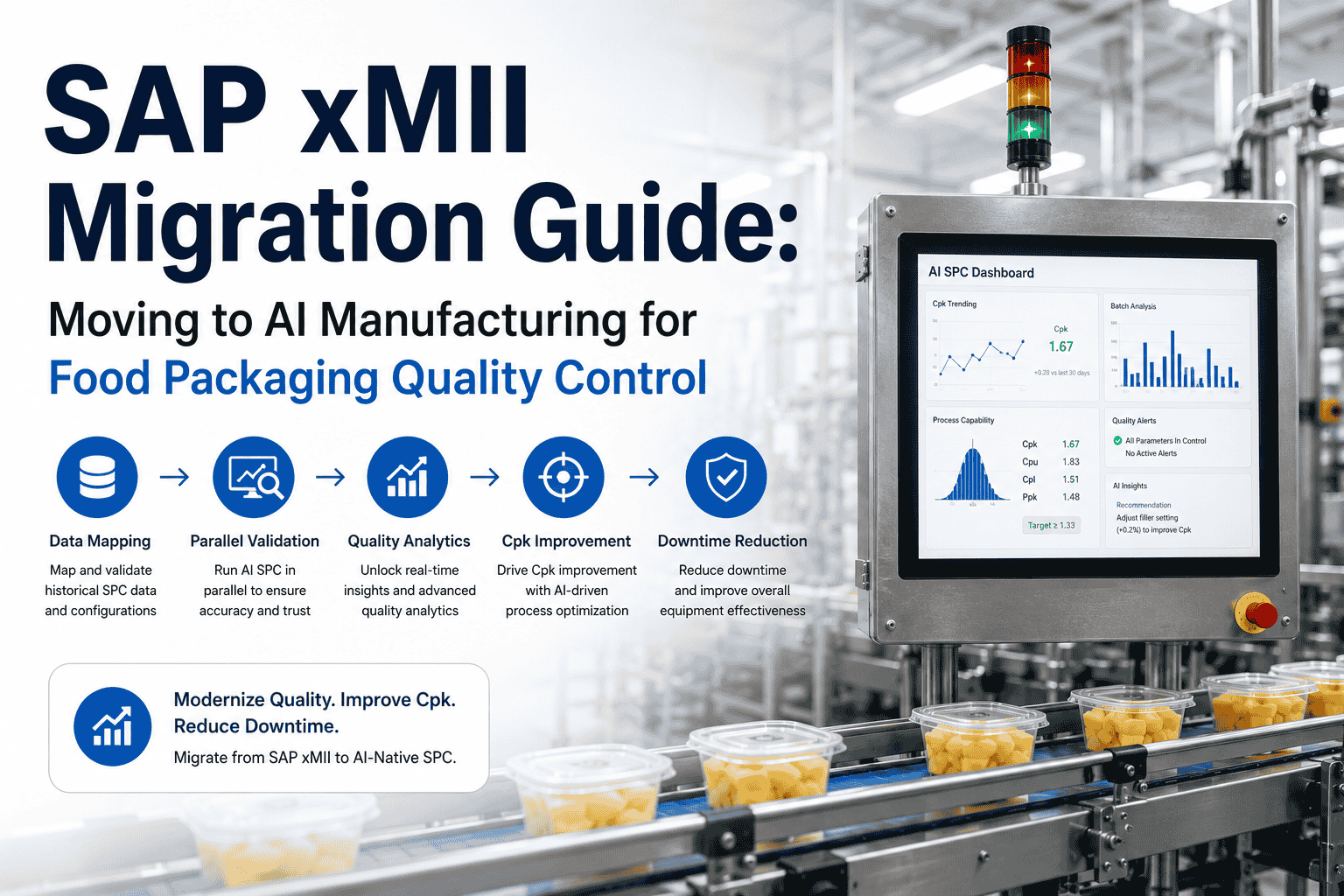
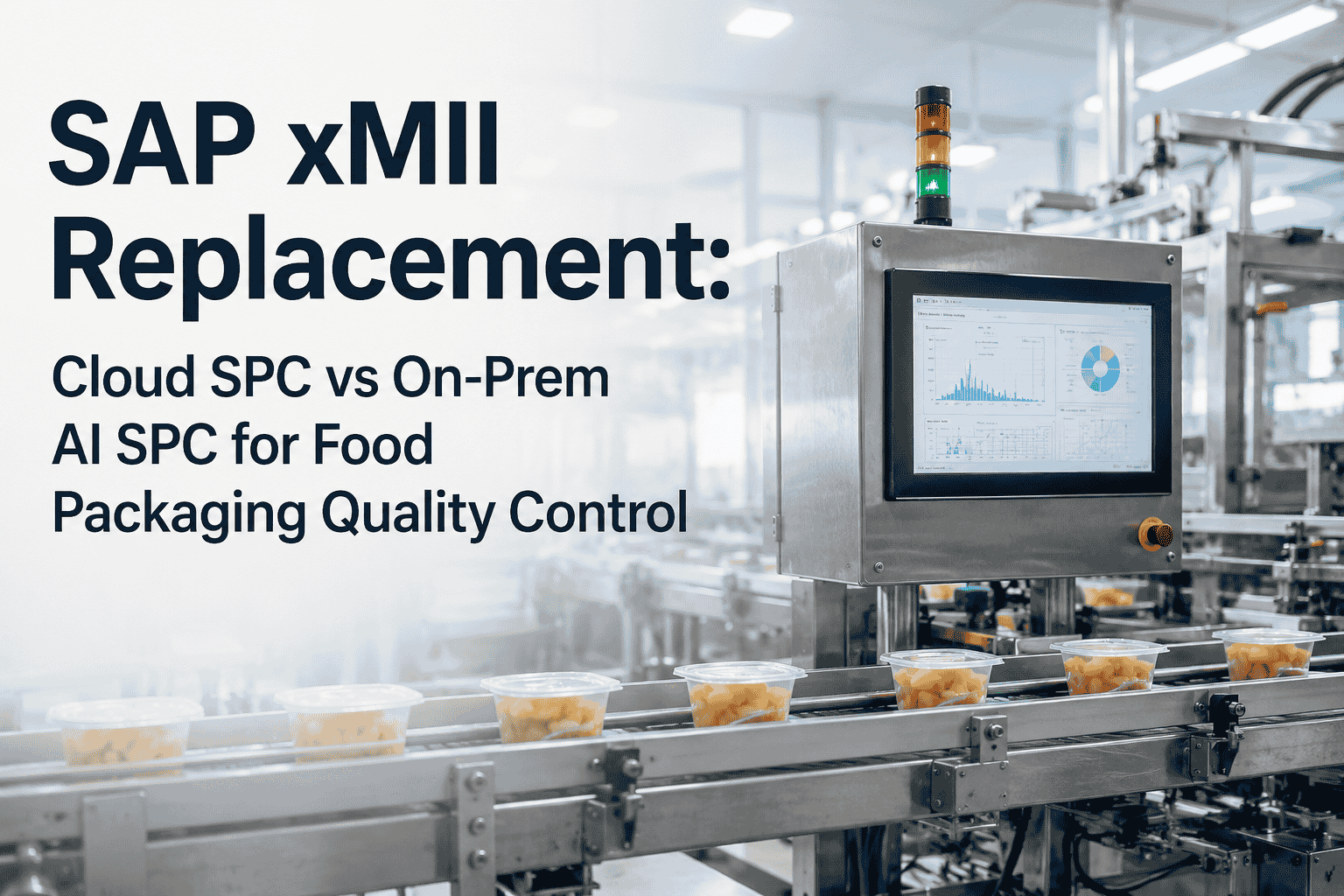
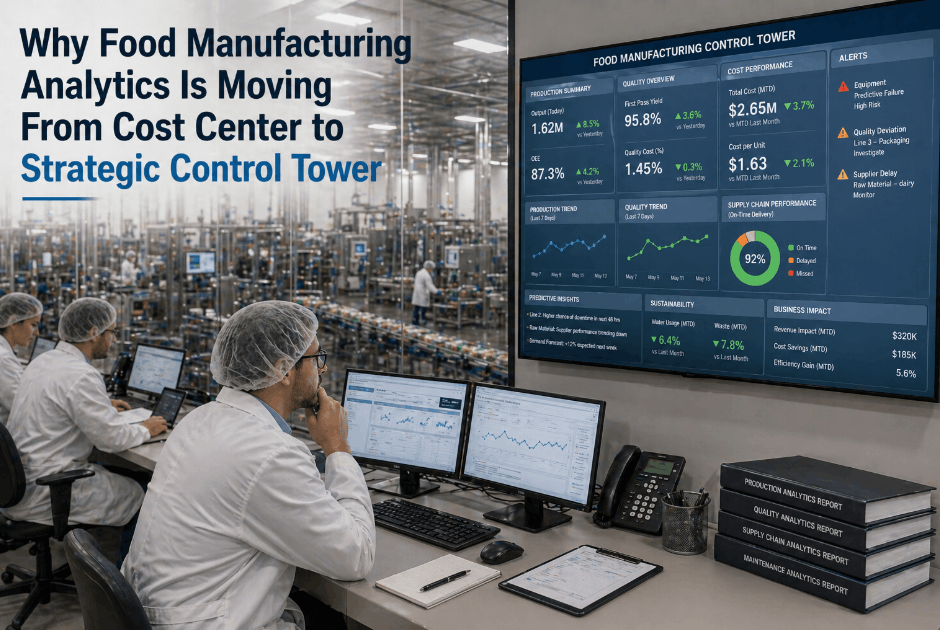
SAP xMII migration is no longer a question of if — the December 2027 mainstream end-of-life forces the timeline. The question is how to migrate without disrupting production, without losing custom logic that took years to build, and while capturing AI capabilities that move Cpk meaningfully. This guide covers the practical mechanics: the five phases of migration, how to map SAP xMII custom logic to AI-native SPC, how parallel validation de-risks cutover and how migration moves Cpk improvement as a primary KPI. Each phase has concrete deliverables and decision gates designed for food packaging operations specifically. Book an AI SPC migration workshop to scope these phases against your custom logic inventory and line count.
01
Assessment & Inventory
Weeks 1–3
Custom logic inventory, line-by-line capability roadmap
→
02
Data Mapping
Weeks 4–7
BLS transactions, xMII queries mapped to AI-native equivalents
→
03
Pilot Deployment
Weeks 8–14
NVIDIA appliance + first line running AI-native SPC
→
04
Parallel Validation
Weeks 15–18
Both systems running side-by-side, outputs reconciled
→
05
Cutover & Sunset
Weeks 19–22
xMII decommissioned, AI-native SPC sole production system
22 wkstypical 4–8 line F&B operation
Cpk 1.5+post-migration vs 1.0–1.2 typical xMII
Zeroproduction disruption with parallel validation
Why F&B Manufacturers Are Migrating Now
Three converging forces make 2026 the practical window for SAP xMII migration in food & beverage operations. The 2027 mainstream end-of-life sets the deadline. AI-native capabilities deliver Cpk improvement and downtime reduction that legacy xMII cannot match. And migration timelines of 12–36 months mean plants starting in 2026 have runway to migrate deliberately, while plants starting in 2027 face compressed timelines against the deadline. The plants getting migration right today are the ones who recognize this as a strategic capability capture, not a forced platform swap.
01
2027 EOL Forces the Decision
SAP MII mainstream maintenance ends December 2027. Extended support to 2030 at premium pricing. No new MII roadmap. Every SAP ERP upgrade after 2027 becomes a potential break point for custom xMII integrations. The deadline is real and not moving.
02
Migration Timelines Stretch
12–36 month migration durations driven by custom logic volume. Plants with minimal customization migrate in 12 months; heavily customized operations need 36. Starting in 2026 leaves runway; starting in 2027 compresses everything against the deadline.
03
Cpk Improvement Is Captured Now
AI-native SPC moves Cpk from typical 1.0–1.2 manual/xMII territory to 1.5+ within 6–9 months of deployment. Customer scorecard improvements, scrap reduction, and audit performance compound monthly. Plants delaying migration leave this value uncaptured.
04
FSMA Traceability Compliance
FSMA Rule 204 24-hour source-to-shelf traceability requirement is fully effective for food packaging in 2026. Manual recordkeeping cannot meet the response time requirement. AI-native platforms automate the traceability chain — SAP xMII does not.
The Five Migration Phases in Detail
The 22-week migration roadmap above is the typical timeline for a 4–8 line F&B operation with moderate SAP xMII custom logic. Plants with simpler footprints complete in 16–18 weeks; plants with heavily customized xMII deployments extend to 30+ weeks. Each phase has concrete deliverables, validation criteria, and go/no-go decision gates that prevent moving forward with unresolved issues. Phase sequencing matters — skipping or compressing earlier phases produces the migration failures that show up at cutover.
Document the current SAP xMII footprint in detail: BLS transactions in production use, xMII queries, custom dashboards, PCo connections, integration points to SAP ERP/QM, custom Java extensions, and any UI customization. Inventory drives migration timeline more than any other input. Half-day AI SPC migration workshop demonstrates AI-native capabilities against representative F&B scenarios using your line data.
Deliverables: Custom logic inventory document, line-by-line capability roadmap, signed migration plan
Map every BLS transaction, xMII query, and custom dashboard to its AI-native equivalent. Some xMII patterns translate directly; many do not and require redesign. Document which logic moves to AI-native SPC, which moves to SAP DM (if running in parallel), and which is retired. Define data flows between line PLCs, AI inference appliance, SAP ERP, and reporting layer.
Deliverables: Data mapping document, target data model, integration spec for OPC-UA / MQTT / REST
Deploy NVIDIA AI appliance on-prem at pilot site. Integrate first packaging line: PLC connections via OPC-UA, vision systems if applicable, sensor data ingestion, recipe configuration. Load historical batch data for AI model training. Operators trained on Copilot interface. Validate AI agent capabilities against current xMII performance on the pilot line.
Deliverables: Pilot line running AI-native SPC, AI models trained, operators certified, capability validation report
Run SAP xMII and AI-native SPC side-by-side on pilot line. Both systems receive identical inputs; outputs reconciled daily. Discrepancies investigated and resolved. Cpk, scrap rate, RCA time tracked under both systems. Parallel validation is the critical de-risking phase — cutover only after both systems produce equivalent or better outputs from AI-native with no unresolved discrepancies.
Deliverables: Parallel validation report, Cpk comparison, discrepancy log resolved, cutover go/no-go decision
After parallel validation passes, cut over pilot line to AI-native SPC as sole production system. SAP xMII workflows for the pilot line decommissioned. Roll out to remaining lines in 2–4 week waves using validated playbook. Cloud portfolio analytics layer activated for cross-line and cross-site visibility. Full sunset of SAP xMII custom logic, residual workloads migrated or retired.
Deliverables: All lines on AI-native SPC, SAP xMII decommissioned, governance docs, post-migration audit
Want to map these phases against your specific operation? Book an AI SPC migration workshop — we’ll inventory your SAP xMII custom logic and produce a phased migration plan sized to your timeline and line count.
Data Mapping: Translating SAP xMII to AI-Native SPC
Data mapping is the technical heart of migration. It’s where decisions are made about which custom logic moves directly, which is redesigned for AI-native architecture, and which is retired. Plants that skip rigorous data mapping discover gaps and surprises at parallel validation, which extends timeline by weeks or months. The mapping below covers the most common SAP xMII components and their AI-native equivalents for food packaging operations — the patterns we see consistently across migration projects.
FROM (SAP xMII)
BLS transactions calling xMII queries to retrieve PLC data, transform it, and write to xMII data tables for dashboard consumption
→
TO (AI-Native SPC)
OPC-UA streaming from PLCs to AI appliance, continuous parameter ingestion, AI agents process and surface insights in real-time without intermediate query layer
FROM (SAP xMII)
Custom dashboards built in xMII UI — SPC charts, Pareto, run charts, OEE displays — with role-based access
→
TO (AI-Native SPC)
Web-based dashboards with role-aware GenAI Copilot interface. Pre-built F&B packaging templates plus ad-hoc question answering replaces rigid dashboard customization
FROM (SAP xMII)
PCo connections from xMII to industrial systems — SCADA, MES, OEM packaging equipment, historian
→
TO (AI-Native SPC)
Native protocol support: OPC-UA, MQTT, Modbus TCP, EtherNet/IP. Direct connectors to OEM packaging systems (Multivac, Tetra Pak, Krones, Sidel). No PCo intermediate layer required
FROM (SAP xMII)
Custom Java extensions and business logic for quality calculations, recipe management, batch genealogy
→
TO (AI-Native SPC)
Configuration-driven logic with AI agent extension points. Batch Consistency Agent and Autonomous RCA Agent replace most quality calculations with continuous monitoring
FROM (SAP xMII)
Integration to SAP ERP for batch context, materials, customer specifications — via xMII Java connectors
→
TO (AI-Native SPC)
REST API integration to SAP S/4HANA or SAP DM. Standard endpoints for materials, batches, specs, deviations. Coexists with SAP DM where deployed
FROM (SAP xMII)
Manual reports built from xMII queries for FSMA compliance, customer audits, SQF/BRCGS reviews
→
TO (AI-Native SPC)
Compliance Documentation Agent auto-generates audit-ready reports continuously. FSMA Rule 204 24-hour traceability automatic. Recall scope identified in minutes
Need help inventorying your custom xMII logic for data mapping? Book a migration workshop — we’ll walk through your BLS transactions, xMII queries, and integration points and identify the right AI-native target for each.
Parallel Validation: The Critical De-Risking Phase
Parallel validation is what distinguishes successful F&B migrations from the failed ones. Running SAP xMII and AI-native SPC side-by-side for 3–4 weeks before cutover catches discrepancies, builds operator trust, and produces the audit trail that regulatory bodies expect for system changes affecting quality records. Plants that skip parallel validation or compress it to days inevitably discover issues at cutover that should have surfaced during validation — producing rework, schedule slip, and operational disruption.
01
Identical Inputs to Both Systems
PLC data, sensor streams, operator inputs, and recipe parameters feed both SAP xMII and AI-native SPC simultaneously. Neither system is the "real" one during this phase — both produce parallel outputs that are reconciled daily. No production decisions depend on which system is consulted; that’s the point.
02
Daily Output Reconciliation
Quality metrics produced by both systems compared daily: Cpk values, SPC alerts, scrap categorization, batch dispositions, RCA outcomes. Discrepancies logged with severity classification. Critical discrepancies investigated immediately; minor variances tracked for trend analysis.
03
Discrepancy Root Cause Analysis
Discrepancies fall into three categories: AI-native producing better signal (most common, validates migration), AI-native missing something xMII catches (requires AI model tuning), or genuine bug. Each requires different remediation. Discrepancy log becomes part of the migration audit trail.
04
Cpk & Performance Comparison
Track Cpk on each parameter under both systems during validation period. Document the AI-native improvement explicitly: typical pilot shows Cpk improvement of 0.2–0.4 on key parameters within validation window. This evidence justifies the cutover decision and the broader migration investment.
05
Operator & Supervisor Validation
Operators and supervisors use AI-native SPC interface during validation period while xMII remains source-of-truth. Builds familiarity, surfaces UI issues, captures workflow questions. By cutover, the team has 3–4 weeks of practical experience with the new system.
06
Cutover Go/No-Go Decision
Validation closes with go/no-go decision based on documented criteria: zero unresolved critical discrepancies, demonstrated Cpk improvement or parity, operator readiness, audit trail complete. Cutover only proceeds when criteria met. Conservative approach prevents the costly mistakes that show up post-cutover.
De-Risk Your Migration with Parallel Validation
A migration workshop walks through parallel validation methodology adapted to your specific operation, line count, regulatory profile, and custom logic complexity. Output: a documented validation plan with concrete go/no-go criteria for cutover.
Cpk Improvement: How Migration Moves the Primary KPI
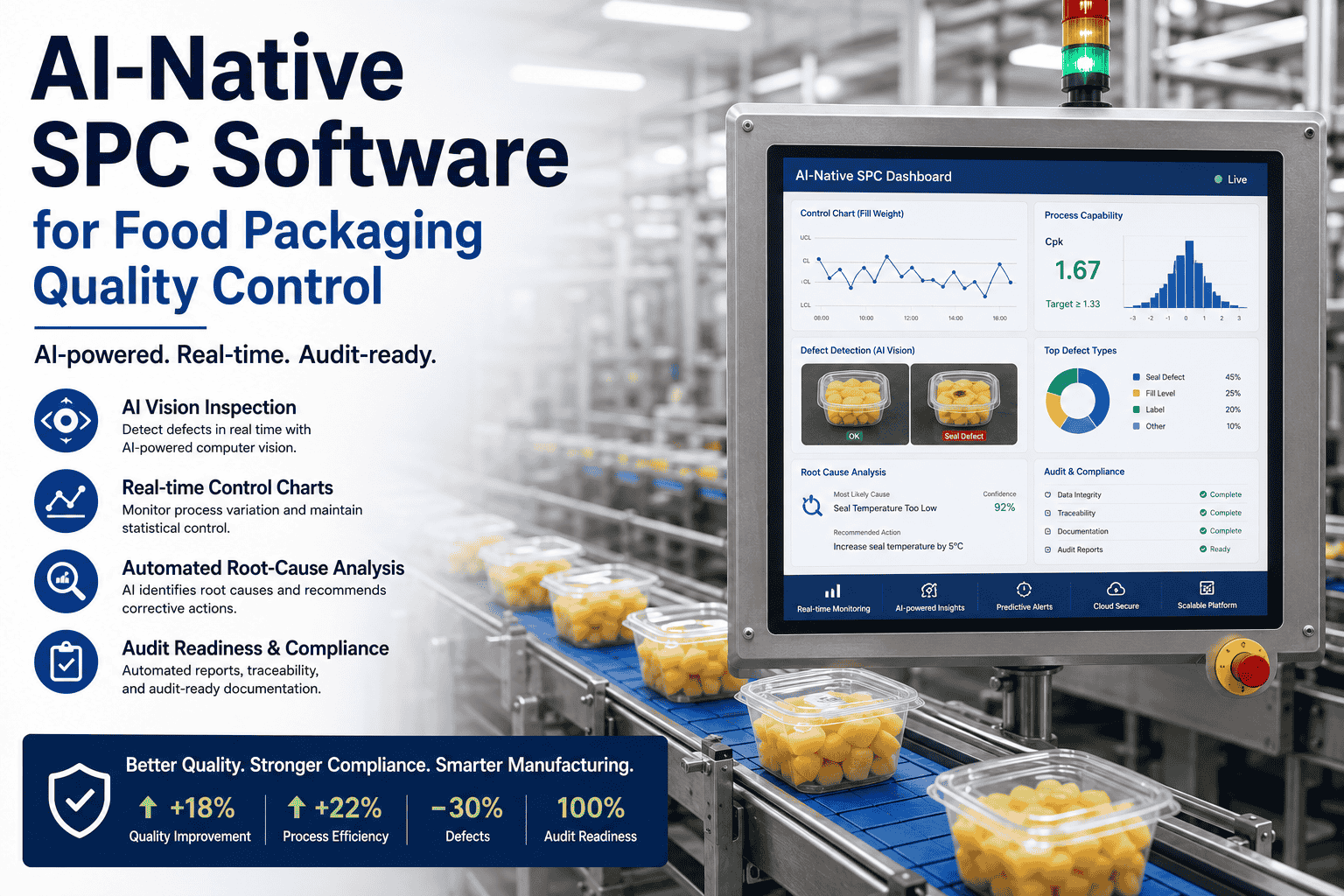
Cpk improvement is the most concrete measurable outcome of SAP xMII migration to AI-native SPC for food packaging operations. The improvement comes from three mechanisms working together: continuous monitoring replaces sampled chart review, predictive intervention prevents drift before spec breach, and operator-to-operator variation gets eliminated through consistent AI coaching. Plants migrating from SAP xMII typically see Cpk move from 1.0–1.2 territory (where manual and rule-based SPC land) up to 1.5–1.7+ within 6–9 months of full deployment.
Mechanism 01
Continuous vs Sampled Monitoring
SAP xMII rule-based SPC checks parameters at sample intervals (typically every 15–30 minutes). Drift between samples invisible. AI-native SPC monitors every parameter every second, catching drift that sampled SPC misses entirely.
Cpk impact: +0.15 to +0.25 from drift capture alone
Mechanism 02
Predictive Intervention
Predictive Scrap Agent anticipates quality drift 4–24 hours before defects fire. Recommended interventions executed before drift produces spec breach. Each prevented breach is one fewer point outside control limits — direct Cpk improvement.
Cpk impact: +0.15 to +0.30 from prevented breaches
Mechanism 03
Recipe & Setpoint Optimization
Batch Consistency Agent learns ingredient lot signatures and equipment state correlations. Adjusts recipe parameters to maintain finished product spec across input variation. Reduces process variation that manual recipe execution introduces.
Cpk impact: +0.10 to +0.20 from variation reduction
Mechanism 04
Operator-to-Operator Consistency
Operator Coaching Agent provides consistent AI guidance across all operators on all shifts. Eliminates shift-to-shift variation in recipe execution and intervention decisions. Every operator receives the same coaching regardless of experience level.
Cpk impact: +0.10 to +0.20 from consistency
Want to model Cpk improvement potential for your specific operation? Book an AI SPC migration workshop — output includes a Cpk improvement model against your current parameter performance and customer spec ranges.
Expert Perspective
"SAP xMII migration in food & beverage is fundamentally a project management discipline applied to a technology decision — not a technology project with project management overhead. The migrations that go well are the ones where teams treat data mapping rigorously, run parallel validation conservatively, and decide cutover on documented criteria. The migrations that go badly are the ones where teams compress phases to hit aggressive timelines, skip parallel validation because they’re confident, or commit to cutover dates before validation criteria are met. The Cpk improvement is real and measurable — we consistently see 0.3–0.6 Cpk lift on key parameters within 6–9 months of full deployment — but it’s a downstream consequence of the discipline applied to the migration itself. Plants treating the 2027 SAP MII end-of-life as a strategic capability capture, with 2026 as the runway to migrate deliberately, are the ones positioned to extract full value. Plants treating it as a forced platform swap to be minimized are the ones leaving most of the Cpk improvement uncaptured."
— F&B AI Manufacturing Practice, 2026 perspective
0.3–0.6
typical Cpk lift within 6–9 months
3–4 wks
parallel validation duration before cutover
22 wks
typical migration timeline 4–8 lines
Plan Your SAP xMII Migration with Discipline
The half-day AI SPC Migration Workshop covers current-state SAP xMII assessment, custom logic inventory, data mapping methodology, parallel validation plan adapted to your operation, Cpk improvement modeling, and a phased migration schedule with concrete go/no-go gates.
Frequently Asked Questions
How long does SAP xMII migration actually take for F&B?
Migration duration is driven primarily by SAP xMII custom logic complexity, not by line count or plant size. Plants with minimal customization (standard xMII queries, basic dashboards, no Java extensions) complete migration in 14–18 weeks. Plants with moderate customization (some Java extensions, multiple PCo connections, custom integrations) need 20–26 weeks — this is the typical 22-week timeline. Plants with heavily customized xMII deployments (extensive Java, complex BLS transactions, deep ERP integration) extend to 30–36 weeks. The single most important migration input is honest inventory of custom logic during assessment phase — it determines the actual timeline.
What does parallel validation actually involve?
Parallel validation runs SAP xMII and AI-native SPC simultaneously for 3–4 weeks on the pilot line. Both systems receive identical PLC data, sensor inputs, and operator entries. Both produce quality metrics, SPC alerts, batch dispositions. Outputs reconciled daily by quality and IT teams. Discrepancies logged and categorized: AI-native producing better signal (validates migration), AI-native missing something xMII catches (model tuning required), or genuine bug requiring fix. Cpk values tracked under both systems. Operators use AI-native interface during validation while xMII remains source-of-truth. Cutover decision based on documented go/no-go criteria. This 3–4 week investment prevents the post-cutover problems that occur when validation is compressed or skipped.
How much Cpk improvement is realistic?
Plants migrating from SAP xMII (or manual SPC with xMII reporting) to AI-native SPC typically see Cpk improvement of 0.3–0.6 on key parameters within 6–9 months of full deployment. The improvement compounds from four mechanisms: continuous monitoring (+0.15 to +0.25), predictive intervention (+0.15 to +0.30), recipe optimization (+0.10 to +0.20), and operator consistency (+0.10 to +0.20). Plants starting at Cpk 1.0–1.2 with xMII typically end at 1.5–1.7+. Plants starting higher see smaller absolute improvement but capture remaining variation drivers.
Schedule a workshop to model the improvement against your specific parameters.
Do we need to migrate all SAP xMII custom logic, or can we retire some?
Most SAP xMII deployments accumulate custom logic over years that no longer serves production needs. Migration is the opportunity to retire it. The data mapping phase explicitly categorizes each component: (1) migrate to AI-native SPC (functionality still needed), (2) migrate to SAP DM (production execution, if running SAP DM in parallel), (3) retire (functionality no longer needed). Plants typically find 20–40% of xMII custom logic falls into the retire category — reports nobody reads, dashboards built for retired processes, BLS transactions superseded by newer integrations. Honest inventory during assessment phase surfaces these candidates for retirement, shrinking the actual migration scope meaningfully.
How does this coexist with SAP DM during migration?
SAP DM (Digital Manufacturing) is SAP’s recommended successor for production execution — electronic work instructions, in-process quality checks, resource orchestration. Many F&B operations migrating from SAP xMII run SAP DM and AI-native SPC in parallel: SAP DM handles execution layer, AI-native SPC handles real-time quality intelligence and AI capabilities SAP DM doesn’t ship deeply. During migration, three systems coexist temporarily (xMII, SAP DM, AI-native SPC). By cutover completion, xMII is decommissioned and SAP DM + AI-native SPC are the operational stack. Integration via OPC-UA, MQTT, REST API. SAP DM migration timeline is 12–14 months in parallel with AI-native SPC at 6 weeks per plant.