Most food manufacturers calculate Cpk for customer PPAPs, file it, and never look at it again until the next audit. That's not a capability program—that's documentation theater. SAP xMII computes Cpk retrospectively from sampled data, displays it in a static report, and sends it to a binder. It cannot monitor capability in real time, cannot detect the subtle drift that degrades Cpk between audits, and cannot automatically recenter a process when variation starts climbing. AI-native SPC makes Cpk a live operating metric—calculated continuously from every data point, with adaptive limits that maintain capability through material lot changes, CIP resets, and seasonal variation. Book a demo to see how iFactory replaces xMII's retrospective Cpk reports with live process capability that improves every shift.
xMII Replacement Strategy
Replace SAP xMII with Live Process Capability
From quarterly Cpk reports to real-time capability intelligence that improves every shift
< 1.0
Not Capable
Actively producing defects — immediate action needed
1.0 – 1.33
Marginal
Small shifts push you out of spec — reactive mode
1.33+
Capable
Meeting specs consistently — industry standard target
1.67+
Six Sigma
World-class — wins long-term contracts
Why SAP xMII Calculates Cpk but Can't Improve It
SAP xMII computes Cpk from batch-level data after production completes—then presents it in a report that arrives hours or days after the process ran. By the time you see a Cpk drop, the defective product is already produced, packaged, and potentially shipped. This retrospective model has three structural problems that prevent continuous capability improvement.
Retro
calculated after the batch
Cpk Arrives Too Late to Act On
xMII calculates Cpk at batch completion using sampled data points. A process that drifts from Cpk 1.5 to Cpk 0.9 mid-batch is invisible until the report generates—hours after the defective product was made. In food manufacturing, where line speeds exceed 600 units per minute, that delay turns a correctable drift into thousands of defective packages.
Static
limits ignore context
Fixed Limits Can't Maintain Capability
xMII uses specification limits defined once during quality planning. When ingredient moisture changes between supplier lots, when ambient temperature shifts seasonally, or when equipment wears between maintenance cycles, the Cpk calculation doesn't account for these context changes—producing either false capability confidence or false alarms depending on which direction the context shifted.
Single-Variable Cpk Misses Interaction Effects
xMII calculates Cpk for each quality parameter independently. But in food manufacturing, capability loss often comes from the combined effect of multiple variables—temperature and humidity both within spec but their interaction pushing product outside tolerance. Single-variable Cpk looks fine while the process is actually producing defects.
Seeing Cpk numbers that don't match your actual scrap rates? Book a capability assessment demo — we'll show you where your real Cpk stands versus what your reports say.
How AI-Native SPC Drives Continuous Cpk Improvement
AI-native SPC doesn't just calculate Cpk faster—it transforms capability from a retrospective audit metric into a live operating system that detects, diagnoses, and corrects capability degradation in real time.
Live Cpk
Continuous Real-Time Calculation
Cpk recalculates with every new data point from sensors, gauges, and vision systems—not at batch boundaries. Quality engineers and operators see a live capability index that updates in real time. When Cpk starts trending downward, the system alerts before it crosses the 1.33 threshold—giving time to correct while the process is still capable.
Real-time Cpk from every data point, not batch-end samples
Adaptive
Context-Aware Process Centering
AI learns how your process capability changes with material lots, post-CIP restarts, environmental conditions, and equipment state—then automatically adjusts center-line targets and control limits to maintain capability through these transitions. The system maintains Cpk 1.33+ across conditions that would cause fixed-limit SPC to oscillate between false alarms and missed drift.
Cpk 1.33+ maintained through lot changes, CIP resets, and seasonal shifts
Multivariate
Interaction-Aware Capability
AI monitors hundreds of variables simultaneously and calculates multivariate capability indices that account for parameter interactions. When two individually-capable parameters interact to degrade combined capability, the system detects the interaction and identifies which variable to adjust for maximum Cpk recovery.
Hundreds of variables analyzed simultaneously for interaction effects
Predictive
Capability Degradation Forecasting
AI correlates equipment wear patterns, maintenance schedules, and material aging with historical Cpk trends—predicting when capability will degrade weeks before it happens. This triggers preventive maintenance from Cpk trends instead of calendar dates, addressing the root cause before it produces a single out-of-spec unit.
Weeks of early warning before capability degradation
See Live Cpk Intelligence on Your Process Data
In a 30-minute workshop, we'll show real-time Cpk calculation, adaptive process centering, and capability forecasting running on your specific food manufacturing parameters.
The Replacement Strategy: xMII to Live Capability in 12 Weeks
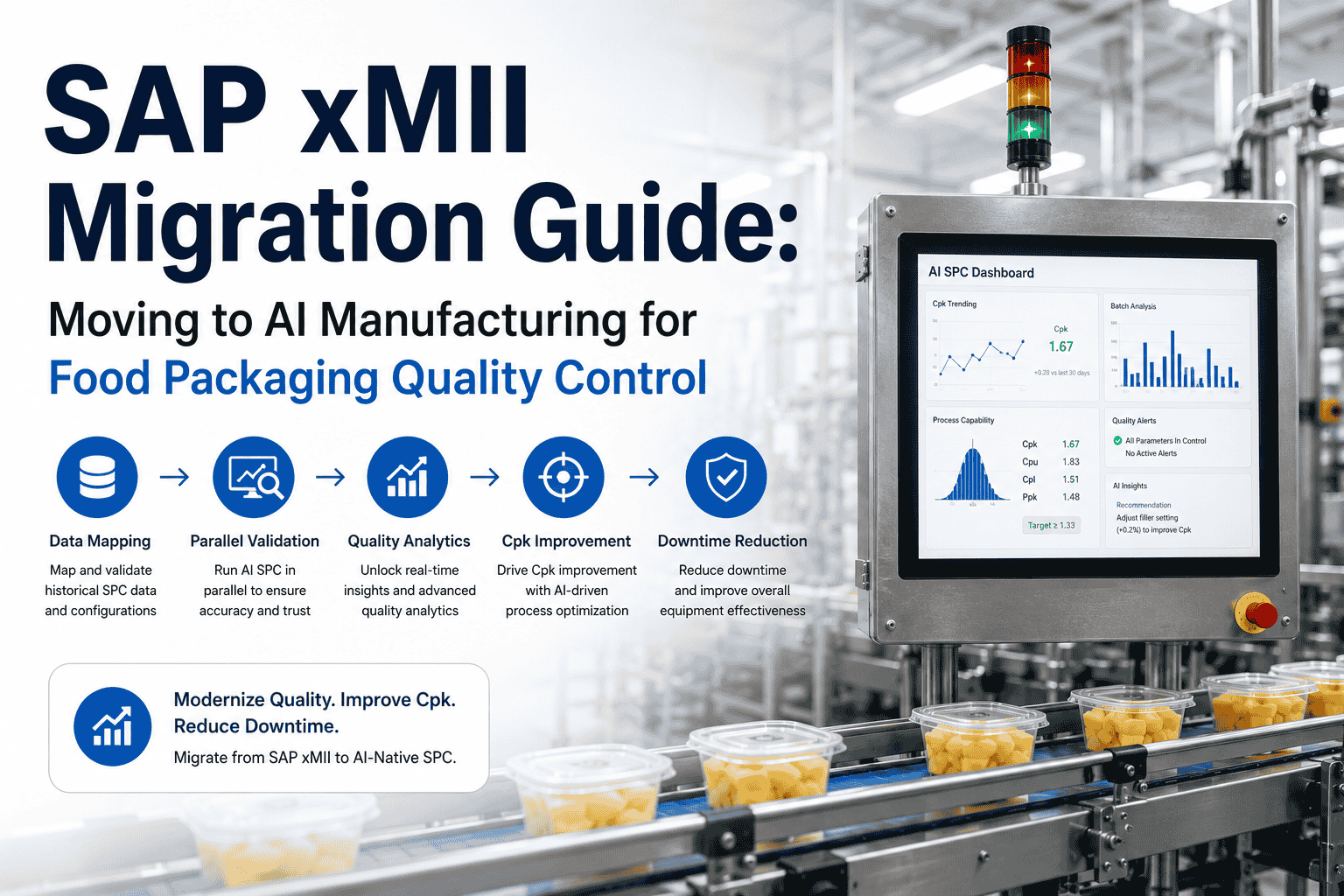
Replacing xMII's Cpk reporting with live AI-native capability follows a proven four-phase approach. Your SAP ERP integration stays intact, compliance documentation continues uninterrupted, and the switch to live Cpk happens through parallel validation—not a risky big-bang cutover.
Inventory and Baseline
Audit xMII Cpk calculation logic, data sources, and reporting workflows. Connect AI platform to PLCs, sensors, and gauges. Establish real-time Cpk baselines for every critical quality parameter—comparing live calculations against xMII's batch-level values.
Train and Calibrate
Train AI models on your specific products, equipment profiles, material lot variations, and known capability degradation patterns. Calibrate adaptive limits and process centering targets. Set up multivariate capability monitoring across parameter groups.
Parallel Validation
Run live Cpk alongside xMII's batch Cpk. Validate that real-time calculations match within tolerance, confirm predictive alerts correspond to actual capability drops, and verify SAP ERP integration maintains compliance documentation continuity.
Go Live and Scale
Activate live Cpk as primary capability system. Automated capability alerts, adaptive centering, and degradation forecasting go live. SAP ERP receives Cpk data for compliance records. Roll out to additional lines using the validated playbook.
Ready to make Cpk a live operating metric? Schedule a replacement strategy demo and see the 12-week roadmap for your xMII environment.
Expert Perspective
"The most common failure pattern in manufacturing quality programs is what I call Cpk theater—the number gets calculated for the customer PPAP, filed, and never looked at again until the next audit. That is not a capability program. That is documentation. A real capability program measures continuously from live data, detects degradation before it produces defects, and wins contracts because the numbers are always current."
— Process Capability Best Practice, 2026
Cpk 1.33+
maintained continuously with adaptive AI limits
18%
yield improvement within 3 months of AI SPC deployment
2027
SAP xMII support ends — plan your replacement now
Still calculating Cpk from batch samples in xMII? Request a demo to see live capability intelligence on your actual process data.
Conclusion: Stop Filing Cpk — Start Living It
The plants winning long-term food manufacturing contracts in 2026 are the ones whose capability indices are live, visible, and acted on every shift—not calculated quarterly and filed in a binder. SAP xMII's batch-level Cpk reports were adequate when the only audience was an annual audit. But when retailer scorecards, GFSI compliance, and competitive margins all depend on consistent process capability, a retrospective number that arrives hours after the process ran is a liability, not an asset. AI-native SPC makes Cpk a real-time operating metric: calculated from every data point, adaptive to changing conditions, predictive of degradation, and actionable by operators on the shift floor. The replacement takes 12 weeks. The capability improvement starts on day one.
Replace xMII with Live Process Capability
In a 30-minute workshop, we'll assess your xMII Cpk workflow, show live capability intelligence on your parameters, and map the 12-week replacement strategy.
Frequently Asked Questions
What Cpk value should food manufacturers target?
Industry standard requires Cpk above 1.33 as a minimum for capable processes—meaning the process consistently produces within specification with margin for normal variation. Six Sigma targets require Cpk above 1.67. A Cpk below 1.0 means the process is actively producing defects. The critical distinction is whether Cpk is measured continuously from live data or calculated retrospectively from batch samples.
Book a demo to see real-time Cpk monitoring that maintains 1.33+ through changing conditions.
Why does my Cpk report look good but scrap rates stay high?
This is the most common disconnect in food manufacturing quality. SAP xMII calculates Cpk from sampled data at batch boundaries—missing the mid-batch drift that produces most defects. Additionally, single-variable Cpk can look acceptable while multivariate interactions push combined quality outside tolerance. AI-native SPC calculates multivariate capability from every data point in real time, closing the gap between what Cpk reports say and what your scrap bins show.
How does AI maintain Cpk through material lot changes?
AI-native SPC learns how each material lot's properties (moisture, protein content, viscosity, particle size) affect process behavior and output quality. When a new lot is loaded, the system automatically adjusts process center-line targets and control limits to maintain the same Cpk despite changed input properties. This eliminates the capability degradation that occurs in fixed-limit systems every time a supplier lot changes—which in food manufacturing can happen multiple times per shift.
Does replacing xMII affect our GFSI or FSMA compliance?
No—it strengthens compliance. AI-native SPC feeds Cpk data and quality results back into SAP ERP for all compliance documentation, audit trails, and regulatory reporting. The replacement actually improves your compliance posture because real-time continuous monitoring with adaptive controls demonstrates stronger preventive control than batch-sampled retrospective Cpk—exactly what GFSI frameworks (BRCGS, SQF, FSSC 22000) and FSMA preventive controls require.
How long does the xMII replacement take for Cpk improvement?
The replacement follows a 12-week implementation: inventory and baseline (weeks 1–3), AI model training and calibration (weeks 4–6), parallel validation alongside xMII (weeks 7–10), and go-live with full SAP ERP integration (weeks 11–12). Live Cpk monitoring starts producing data in week 3, adaptive capabilities activate in week 6, and measurable Cpk improvement is typically visible within the first 90 days of full operation.