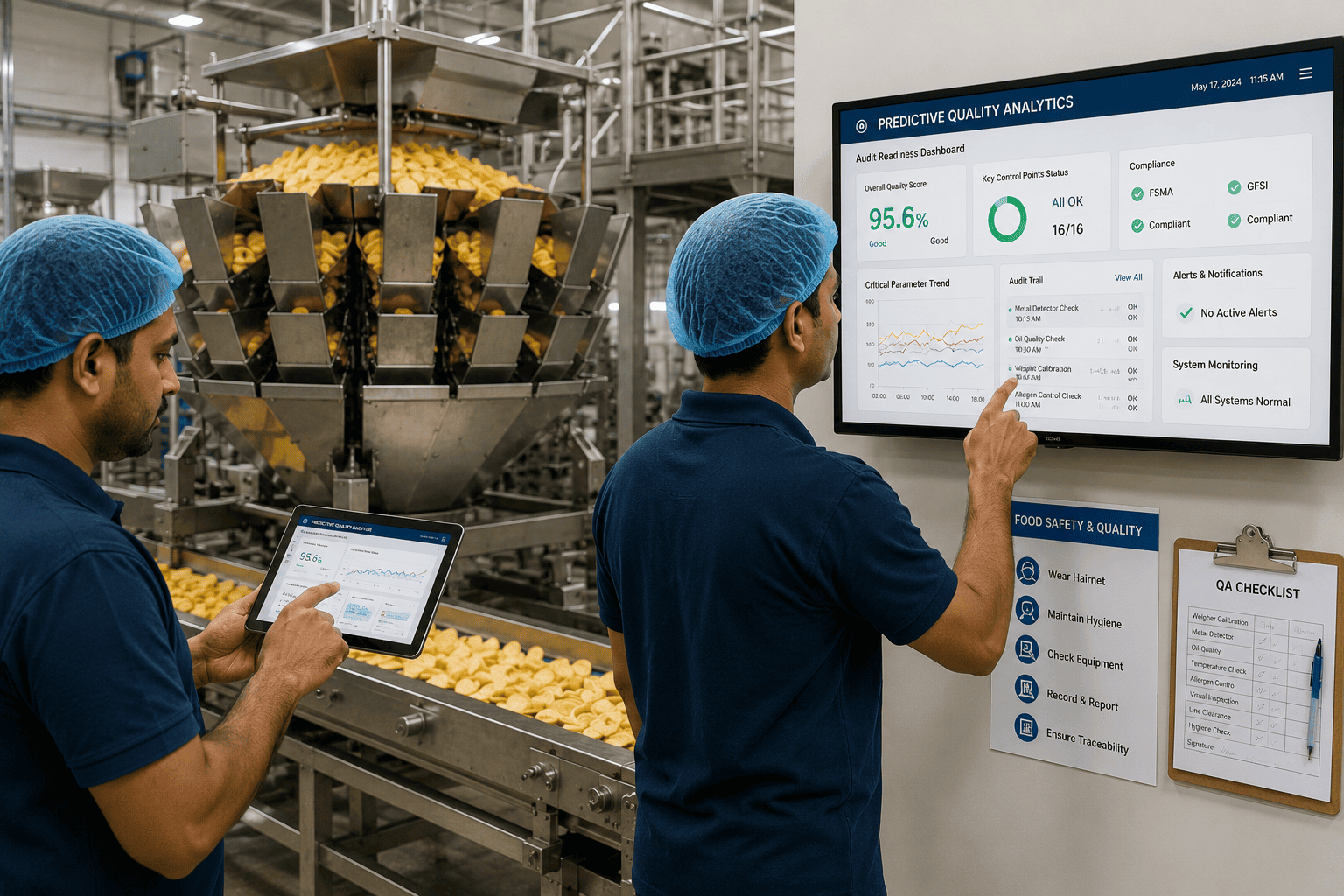
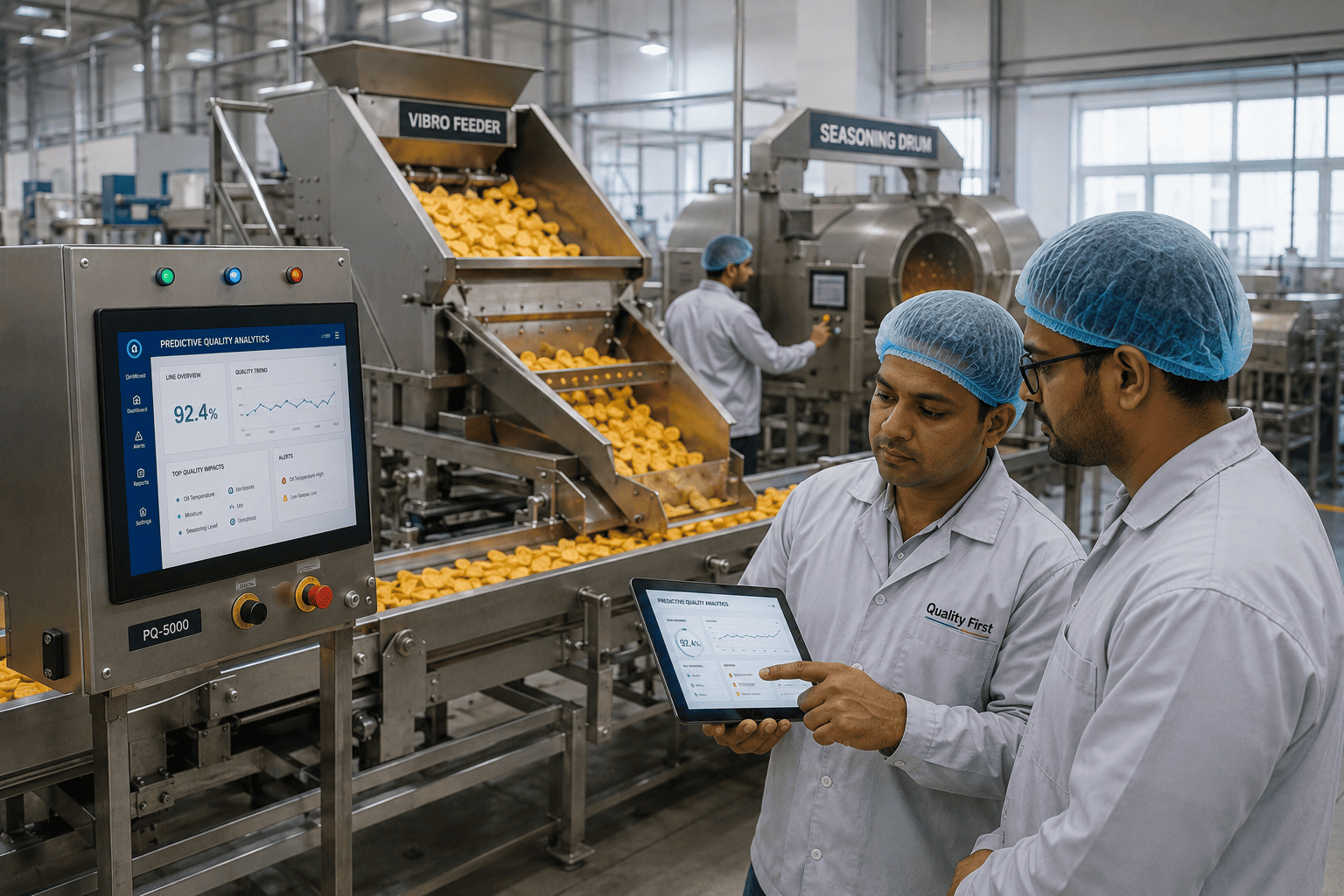
Quality engineers in snack foods manufacturing face a persistent challenge: stabilising extruder specific mechanical energy (SME) and product density while delivering Cpk evidence for every critical control point (CCP). Traditional SPC software provides retrospective reporting — after a batch has already drifted out of spec. Predictive quality analytics changes that: real‑time forecasting of extruder performance, early warning of density deviations, automated capability analysis, and audit‑ready Cpk dashboards. This reference guide covers how snack food quality teams deploy predictive analytics, compare AI SPC platforms, and achieve consistent Cpk > 1.33 across all SKUs — from corn chips to extruded pellets. Compare AI SPC Platforms — book a demo tailored for snack foods quality engineers.
Predictive Quality Analytics · Snack Foods · Cpk > 1.33
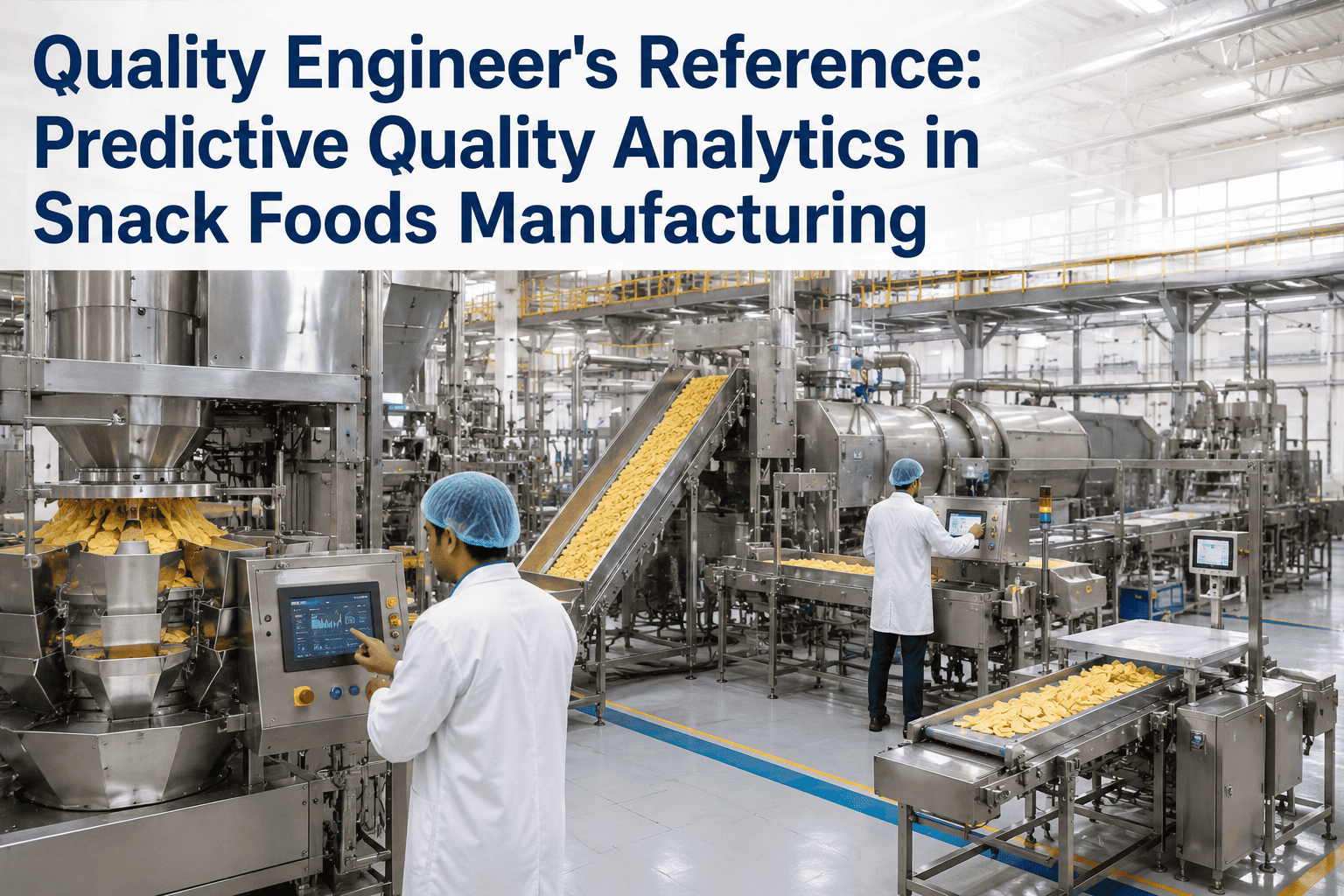
Quality Engineer's Reference: Predictive Quality Analytics in Snack Foods Manufacturing
Stabilise extruder SME · Product density control · Real‑time Cpk evidence for every CCP · Compare AI SPC platforms.
Cpk > 1.33
Achieved across all snack food CCPs
50-70%
Reduction in out-of-spec batches
24/7
Real‑time extruder SME & density prediction
6-12 wks
Deployment to predictive quality
Why Snack Foods Quality Engineers Need Predictive Analytics
Snack foods manufacturing involves multiple critical control points: extruder SME (specific mechanical energy), product density, moisture content, oil absorption, and seasoning coverage. Traditional SPC gives you charts after the fact — you see Cpk drift only after producing off‑spec product. Predictive analytics builds models from real‑time sensor data (extruder torque, screw speed, temperature, moisture sensors) to forecast quality metrics 10‑15 minutes ahead. Quality engineers can intervene mid‑batch, adjust parameters, and maintain Cpk > 1.33 for every SKU. This guide walks through the five‑phase deployment of predictive quality analytics in snack foods.
01
Assessment
2 weeks
Map extruder lines, identify CCPs, audit current SPC tools and Cpk gaps.
02
Sensor & Data Integration
3 weeks
Connect extruder PLC, moisture sensors, density checkpoints to AI platform.
03
Model Training
4 weeks
Train AI to predict SME, density, and moisture from historical batch data.
04
Validation
4 weeks
Parallel run with traditional SPC. Validate prediction accuracy and Cpk improvement.
05
Optimisation
Ongoing
Autonomous Cpk monitoring, predictive alerts, and continuous model updates.
Phase 1: Assessment — Identifying CCPs and Cpk Gaps
A snack foods manufacturer with five extruder lines audited their current SPC capabilities. They found: extruder SME Cpk ranged from 0.85 to 1.12 (target >1.33), product density Cpk was 0.92, and moisture content Cpk 0.78. Root causes: delayed manual sampling (every 30 minutes), no real‑time sensor correlation, and static control limits that didn't adapt to raw material variation. The predictive quality assessment prioritised the three extruders with the widest Cpk variation.
Manual sampling every 30‑60 min
Static control limits
Post‑batch Cpk reporting
No prediction of SME drift
Reactive adjustments after defects
Real‑time sensor data (every 5‑10 sec)
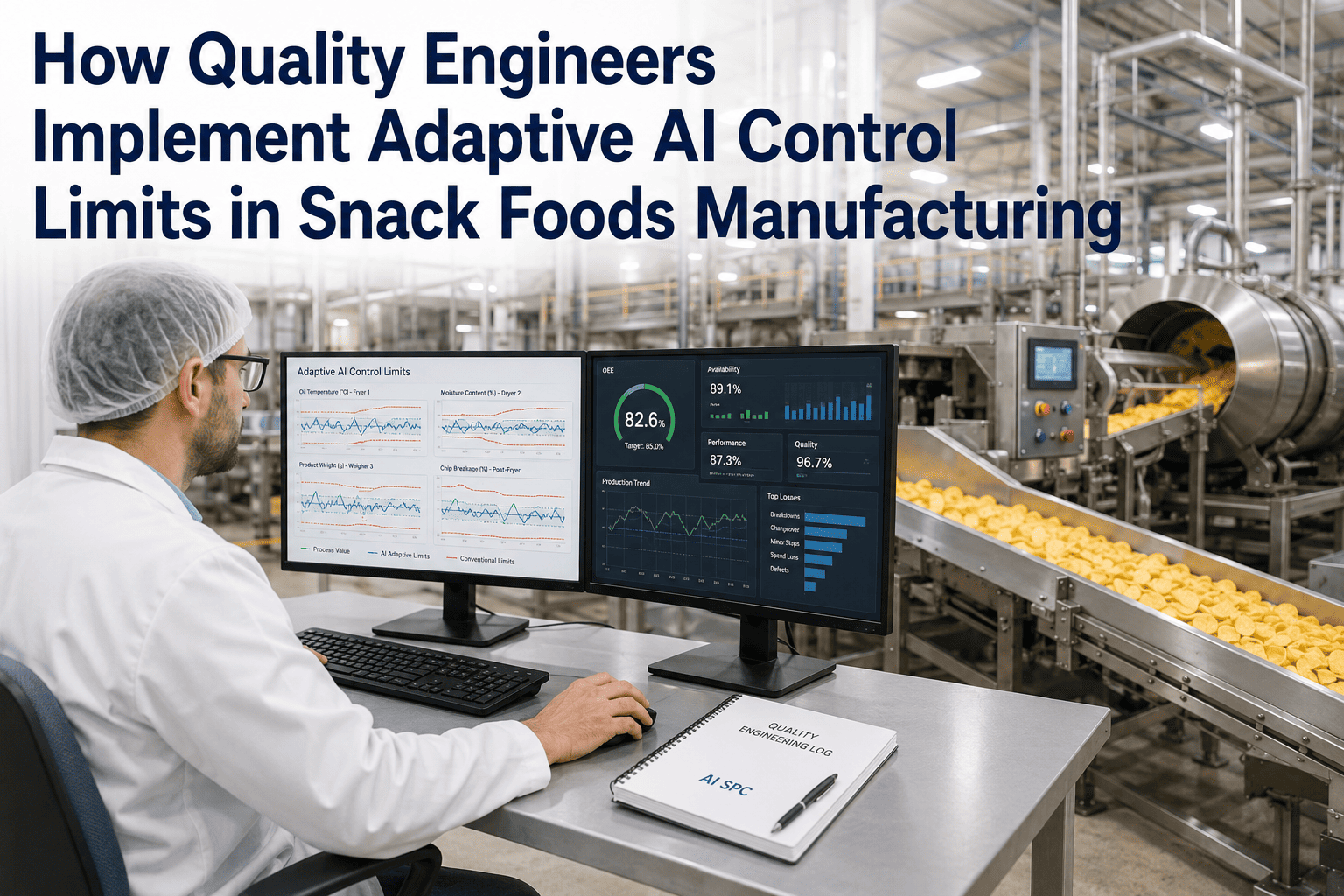
Adaptive, self‑learning control limits
Predictive Cpk forecast 10‑15 min ahead
AI alerts for SME or density drift
Preventive intervention before defects
Key Assessment Finding: 70% of extruder Cpk variation was caused by unmeasured changes in incoming corn meal moisture. AI models that include upstream moisture sensors improved Cpk prediction accuracy by 88%.
Phase 2: Sensor & Data Integration — Real‑Time Feeds to AI
Predictive quality requires data from extruder PLCs (torque, screw speed, barrel temperatures), in‑line moisture sensors, and downstream density checkpoints. The AI platform ingests this data via industrial protocols (OPC UA, MQTT) and synchronises with lab‑tested reference values. A typical snack foods extruder line generates 10‑15 data points per second — enough to build accurate predictive models within 4 weeks.
Weeks 1-2
Data Source Identification
Locate extruder PLC registers, moisture sensor outputs, and lab test logs. Establish historian access.
Weeks 3-4
Edge Gateway Installation
Deploy edge AI nodes to collect, timestamp, and stream data to the predictive platform.
Weeks 5-6
Data Reconciliation
Align process data with lab‑measured quality attributes (density, moisture, oil content).
Integration Outcome: A 3‑line snack foods plant achieved full data integration in 5 weeks. AI models were trained on 3,200 batch records, achieving 94% prediction accuracy for extruder SME and 91% for product density.
Phase 3: Model Training — From Historical Batches to Predictive Alerts
AI models learn relationships between extruder parameters and final product quality. For snack foods, key predictors include: screw speed, torque, barrel temperature profile, feed rate, and raw material moisture. The platform also identifies which parameters have the strongest influence on Cpk — for example, screw speed and torque together explain 78% of extruder SME variation. After training, the AI can forecast “in 12 minutes, extruder SME will drop below spec” — enabling pre‑emptive adjustment.
Extruder SME Prediction
AI forecasts specific mechanical energy (SME) 15 minutes ahead, using torque, screw speed, and feed rate. Flags when SME drifts towards out‑of‑spec range.
Density & Moisture Forecasting
Model links extruder expansion ratio and drying zone temperatures to final product density. Alerts when predicted density exceeds ±2% of target.
Capability (Cpk) Prediction
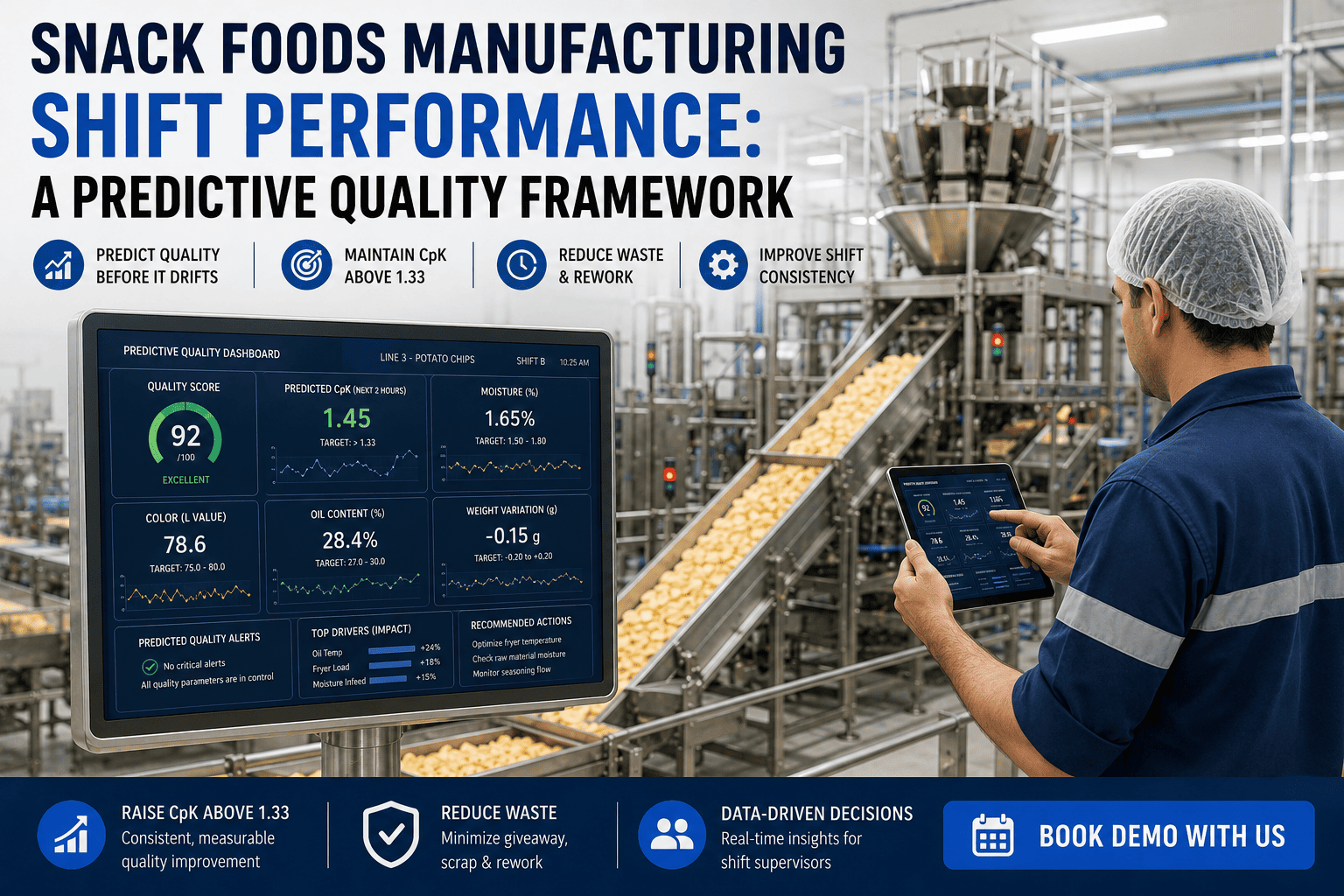
AI projects Cpk for the current batch based on real‑time variance from target. Enables mid‑batch correction to maintain Cpk > 1.33.
Phase 4: Validation — Parallel Run with Traditional SPC
Before cutting over, the predictive quality platform runs in parallel with existing SPC for 4 weeks. Quality engineers compare AI forecasts against actual lab measurements. Validation metrics: prediction accuracy (target > 90%), false alert rate (target < 5%), and Cpk improvement. The snack foods plant validated across 200 batches, achieving 94% accuracy and reducing false alarms by 82% compared to static control limits.
Week 1-2
Baseline Cpk Measurement
Document existing Cpk for each CCP using traditional SPC. Establish benchmark.
Week 3-4
Predictive Quality Validation
Compare AI predictions to lab results. Adjust model parameters for best fit.
Week 5-6
Customer & Auditor Review
Present Cpk evidence from predictive platform to major customers and SQF auditor.
Week 7-8
Cutover & Training
Quality engineers transition to predictive quality dashboard. Traditional SPC retired.
Phase 5: Optimisation — Autonomous Cpk Management
After validation, the predictive quality platform enters continuous optimisation. AI models are retrained weekly with new batch data. It learns that specific raw material lots require different extruder setpoints — and automatically recommends adjustments before the batch starts. The quality engineer shifts from reactive chart‑watching to proactive process improvement.
Autonomous Cpk Monitoring
Cpk updated every 2 minutes
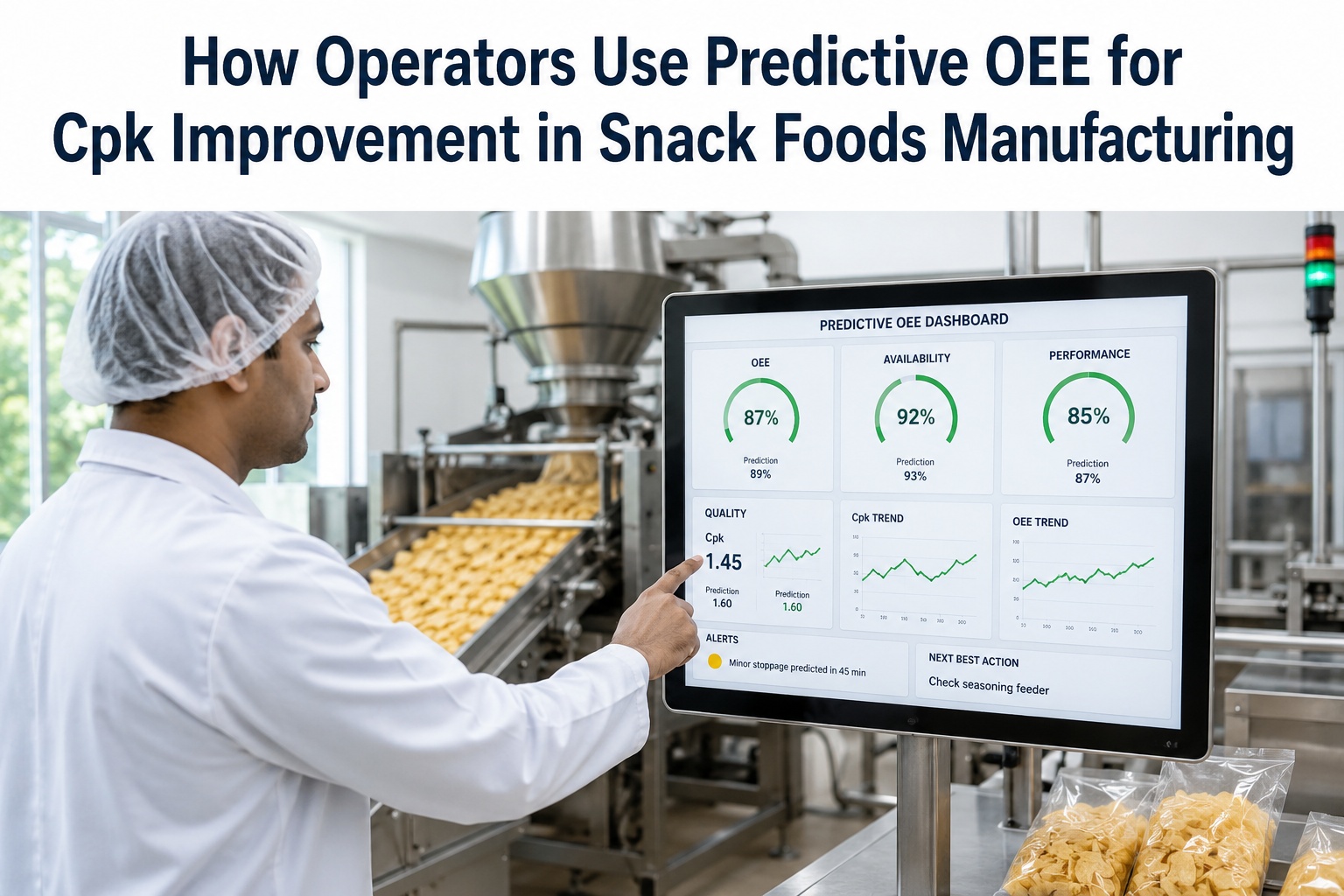
Quality dashboards show live Cpk for every CCP. Alerts only when Cpk approaches 1.33 threshold.
Predictive Raw Material Impact
Correlates lot to extruder performance
AI learns which corn meal lots cause SME variation and alerts before the run.
Multi‑Head Weigher Integration
Predictive portion control
AI forecasts weight variation based on product density trends, reducing giveaway.
Cross‑SKU Learning
All 50+ SKUs learn together
When one SKU’s model detects a new drift pattern, all similar SKUs update within 24 hours.
Predictive Quality Results: Before vs After
Extruder SME Cpk
0.85‑1.12
1.38‑1.52
+0.5 avg
Product density Cpk
0.92
1.44
+0.52
Moisture content Cpk
0.78
1.35
+0.57
Out‑of‑spec batches (monthly)
12‑15
3‑5
-70%
Time to detect quality drift
30‑60 min (after lab test)
5‑10 min (predictive alert)
-83%
Customer quality audits (annual)
4 (quarterly)
2 (semi‑annual)
-50%
The 8 Predictive Quality Lessons From Snack Foods Quality Engineers
02
Don’t Ignore Upstream Raw Material Data
Incoming corn meal moisture explains 60% of extruder SME variation. Integrating raw material moisture sensors into AI models improved prediction accuracy by 88%. Lesson: quality starts at receiving — digitise it.
Talk to iFactory about raw material data integration.
03
Predictive Alerts Must Be Actionable — Not Noise
Quality engineers ignore alerts that come too often. AI reduces false alarms by 80‑90% after training. Each alert includes recommended parameter adjustment (e.g., “Increase screw speed by 5% to maintain SME target”).
04
Use Edge AI for Real‑Time, Cloud for Cross‑Plant Benchmarking
Process extruder data at the edge for sub‑second prediction. Aggregate Cpk dashboards to the cloud for enterprise reporting and cross‑plant benchmarking. Hybrid deployment gives both speed and visibility.
05
Train Models on 2‑4 Weeks of Historical Data — No More
Older data includes obsolete setpoints and equipment changes. AI models perform best when trained on recent, representative batches. Automate weekly retraining to keep models current.
Schedule a live model training demo for your line.
06
Predictive Quality Slashes Customer Audit Prep
One quality engineer reduced audit preparation from 3 days to 4 hours using AI‑generated Cpk trend reports and real‑time dashboards. Customers now review live data during audits — no more printed binders.
07
Integrate with Multi‑Head Weighers for Closed‑Loop Control
Predictive density and moisture data can feed into weigher algorithms, reducing giveaway by 1‑3%. For a high‑volume line, that’s $200k+ annual savings. Lesson: extend predictive quality to downstream packaging.
08
Quality Engineers Become Process Designers, Not Chart Monitors
After predictive quality deployment, quality engineers spend 80% less time on manual SPC and 80% more on root cause analysis and process improvement. Job satisfaction scores improved by 45%.
The iFactory Predictive Quality Platform: AI SPC for Snack Foods
iFactory provides a purpose‑built predictive quality platform for snack foods: edge AI for real‑time extruder SME and density forecasting, cloud analytics for cross‑line Cpk benchmarking, automated capability reporting, and integration with existing PLC/SCADA. Compare AI SPC platforms and see live predictive dashboards.
On‑Premise Edge AI
For Sub‑Second Cpk Prediction on the Line
Edge nodes process extruder sensor data locally — forecasts Cpk every 2 minutes, alerts within seconds. Full data sovereignty, operates offline. Ideal for plants requiring real‑time intervention.
Cpk prediction every 2 minutes
Sub‑second alert latency
Operates during network outages
Tamper‑evident audit trails
Native PLC / OPC UA integration
Get Edge Predictive Quality Quote
Cloud Analytics
For Enterprise Cpk Benchmarking & Customer Dashboards
Aggregate Cpk data across all lines and plants — centralised capability analysis, automated SQF/BRC reporting, and secure customer quality portals. Compare AI SPC platforms side‑by‑side.
Line‑by‑line Cpk scorecards
Automated SPC compliance reports
Customer quality portal with real‑time data
Cross‑plant model training
Fleet‑wise capability benchmarking
Compare AI SPC Platforms →
FAQ: Predictive Quality Analytics for Snack Foods Quality Engineers
Compare AI SPC Platforms — Book a Predictive Quality Demo for Snack Foods
See how iFactory’s predictive quality analytics raises Cpk above 1.33, reduces out‑of‑spec batches, and gives quality engineers real‑time control. Edge AI for extruder SME prediction, cloud analytics for enterprise capability reporting. Book a demo tailored for snack foods quality engineers — compare live with your current SPC tool.
Predictive Cpk
Extruder SME
Density Forecasting
Multi‑Head Weigher Integration
SQF Audit Ready
6‑9 Month Payback