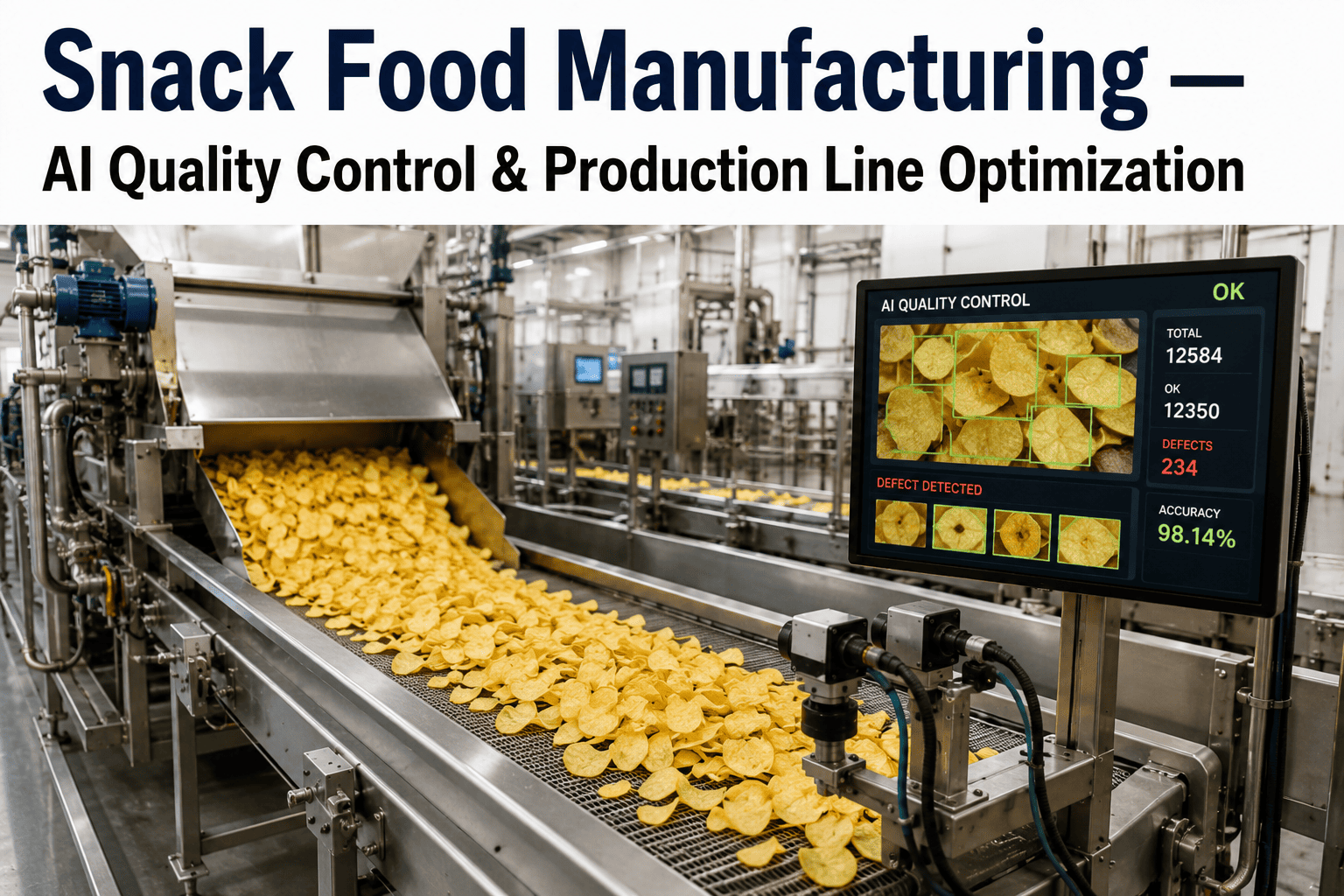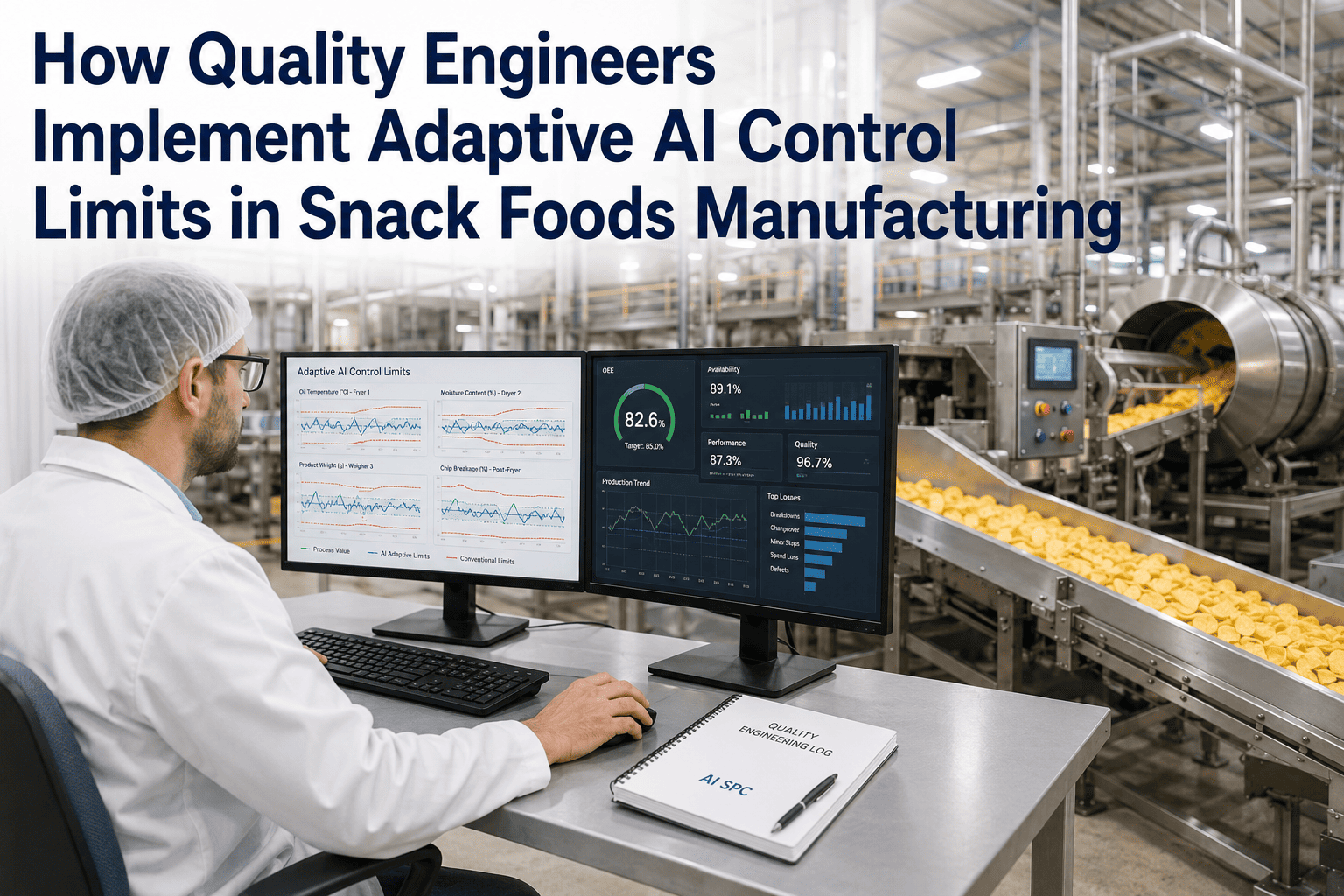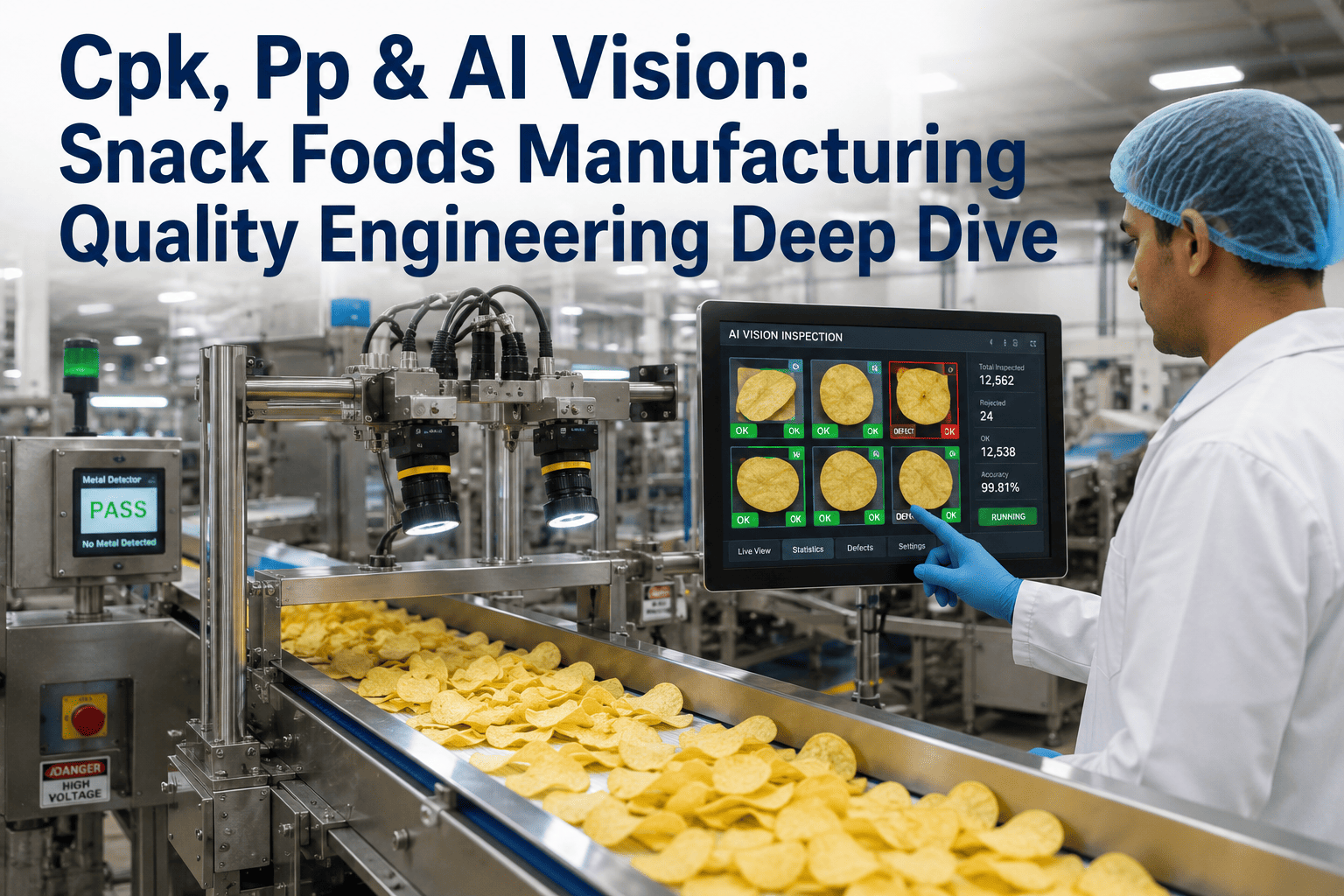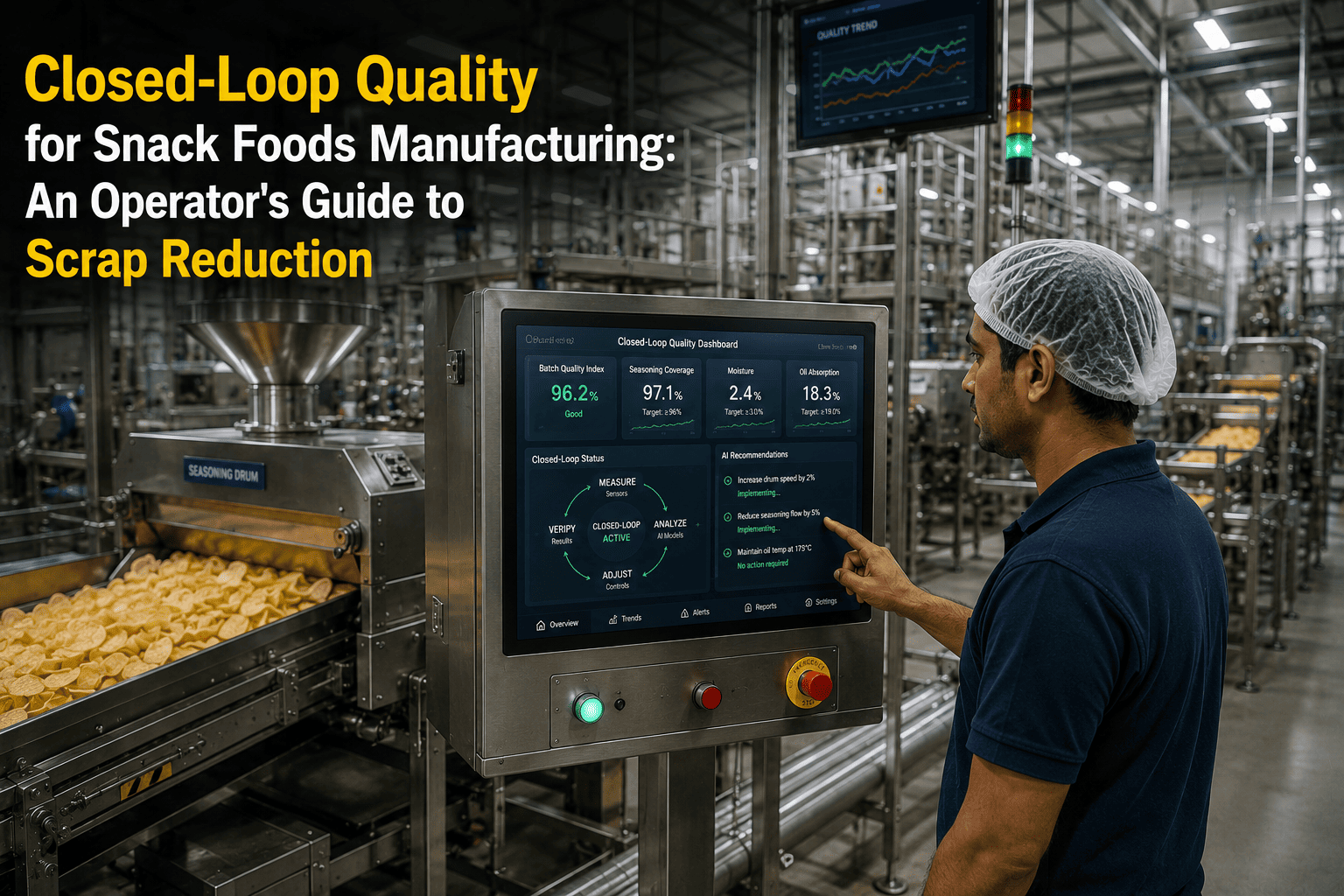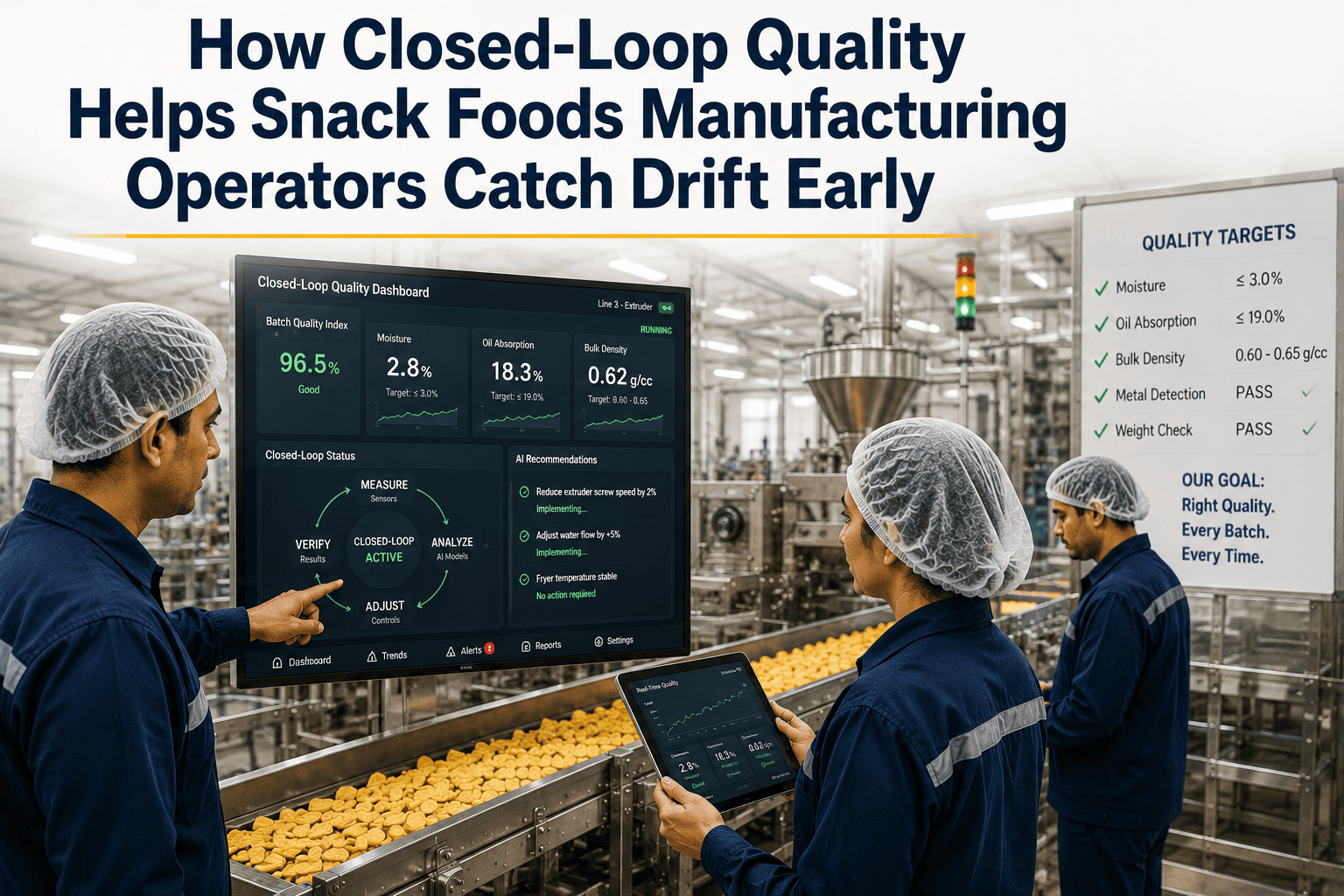
Quality engineers in snack foods manufacturing make a choice every day: hold tight statistical control using traditional SPC (control charts, manual Nelson rules interpretation, monthly capability reviews) or deploy AI-native SPC (real-time pattern detection, continuous setpoint tuning, autonomous drift correction). Traditional SPC is battle-tested but fundamentally reactive — you detect a problem after it's produced rejects. AI-native SPC is predictive — you adjust before the problem occurs. For snack foods, this difference matters enormously: seasoning coverage drift costs giveaway. Weigher tolerance drift costs margin. Flavor consistency variation costs customer returns. This guide compares traditional and AI-native SPC head-to-head, shows real snack foods examples where AI-native wins measurably, and outlines a 6-12 week deployment path to AI-powered quality control. Compare AI SPC Platforms — Book Demo with Us.
AI-Native SPC vs Traditional SPC: Where's Your Yield Going?
Traditional SPC catches problems after they happen. AI-native SPC prevents them. Snack foods manufacturers are recovering 2-4% yield through real-time AI-driven setpoint tuning, automated drift detection, and autonomous giveaway elimination.
The Traditional SPC Trap: Reactive Control Costs Yield
Quality engineers using traditional SPC follow a time-honored protocol: collect data, plot on control chart, watch for out-of-control signals, respond when limits are exceeded. This works — it prevents catastrophic drift. But it's fundamentally reactive. A seasoning drum calibration drifts 2% over 4 hours. The drift is silent. No out-of-control signal yet. Data hasn't accumulated to trigger a Nelson rule. Four hours into the shift, 2,000 units have been over-seasoned. The cost: giveaway multiplied across the entire production run. By the time the control chart signals a problem at hour 6, you've accumulated hours of loss. Traditional SPC is a guardrail, not a steering system. It prevents crashes but can't optimize the trajectory.
Traditional: Control charts require data accumulation. A single point outside 3-sigma doesn't trigger action. Nelson rule typically requires 2-4 consecutive points or 8 points on one side of center line. This means 2-4 production runs (often 1-2 hours of production) before the system signals drift.
Cost: Drift accumulates undetected. A weigher drifting 0.5g/unit undetected for 2 hours (1,200 units) = 600g excess giveaway. At $8/kg material cost, that's $4.80 in material loss per drift event. Five drift events per week = $24/week = $1,250/year per line.
Traditional: Quality engineers must visually inspect control charts, remember Nelson rules (8+ consecutive, 2/3 beyond 2-sigma, 4/5 beyond 1-sigma, etc.), and decide when to intervene. Rules are context-insensitive — same rules for all processes, all times, all conditions.
Cost: Late intervention. A pattern emerges that's statistically meaningful (small trend, slight cyclic pattern) but doesn't violate hard rules. Engineers miss it. Production drifts for hours. Also: engineers get fatigued. Rules are complex. Patterns are missed. Intervention decisions are delayed.
Traditional: Engineers set weight targets with safety margin. Target: 500g, spec: 485-515g. But engineers set actual target to 505g to ensure nothing underweights. Seasoning target: 8%, spec: 6-10%. Engineers target 9% to ensure coverage.
Cost: Giveaway by design. 3-5% weight padding × margin per package × annual volume = massive margin loss. Seasoning giveaway: 12-18% above minimum spec = wasted ingredients, wasted margin, higher cogs.
Traditional: SPC is diagnostic (something is wrong) but not prescriptive (here's what to adjust). Engineer sees chart trending up. Knows something must be adjusted. Guesses: temperature? Speed? Equipment age? Manual tuning follows. Trial and error.
Cost: Wrong adjustments create oscillation. Engineer increases target, overshoots. Decreases target, undershoots. Takes hours to stabilize. Rejects spike during tuning. Shift efficiency drops 10-15%.
AI-Native SPC: Predictive Control Protects Yield
AI-native SPC inverts the traditional model. Instead of waiting for data to accumulate and signal problems, AI continuously monitors process behavior, detects micro-drifts before they become visible on traditional control charts, and automatically recommends (or executes) setpoint adjustments that hold the process on target. The difference is not incremental — it's categorical. Traditional SPC is a safety system. AI-native SPC is an optimization system.
AI analyzes every data point in real time (not waiting for control chart accumulation). Detects micro-trends, cyclic patterns, and shift behavior within 5-10 minutes — before yield is affected. Nelson-rule equivalent triggers automatically when pattern emerges, not after data accumulates.
When drift is detected, AI doesn't just alert — it calculates the optimal adjustment. "Seasoning drum calibration drifted +1.2%. Recommend setpoint decrease of 1.3%." Engineer approves or adjusts. System executes. No guessing. No trial-and-error tuning. No oscillation.
With AI confidence that drift will be caught and corrected in real time, engineers can reduce tolerance padding. Target can move from 505g (safety margin) to 501g (statistical margin). Seasoning target from 9% (coverage insurance) to 8.2% (actual coverage). Margin recovered.
AI adapts detection rules to process context. Morning cold start is different from steady-state production. Seasonal equipment aging is different from seasonal humidity. Rules adjust. False positives drop. Alert relevance rises. Engineers trust the system.
Head-to-Head Comparison: Traditional vs AI-Native SPC
| Dimension | Traditional SPC | AI-Native SPC | Winner for Snack Foods |
|---|---|---|---|
| Drift Detection Time | 2-3 hours (data accumulation for Nelson rules) | 5-10 minutes (pattern emerges) | AI: 12-18x faster |
| False Alarm Rate | Low (rules are conservative) | Very low (contextual, adaptive rules) | AI: Fewer false alerts, higher trust |
| Intervention Recommendation | "Something is out of control" (diagnosis only) | "Seasoning -1.3%, approve?" (diagnosis + prescription) | AI: Engineers know exactly what to adjust |
| Manual Intervention Rate | 8-12 per shift (manual tuning cycles) | 1-2 per shift (only unusual events) | AI: 80% reduction in manual work |
| Giveaway Margin | 3-5% weight, 12-18% seasoning (safety padding) | 1-2% weight, 6-8% seasoning (statistical margin only) | AI: 2-3% yield recovery |
| Capability Analysis Frequency | Monthly (manual analysis, 4-8 hours) | Real-time dashboard (Cpk updates every hour) | AI: Continuous visibility, no manual analysis |
| Seasonal/Environmental Adaptation | Static rules year-round (manual seasonal adjustments) | Automatic adaptation (humidity, temp, seasonal learned) | AI: No manual seasonal recalibration |
| Equipment Age/Drift Compensation | Manual (engineer estimates calibration frequency) | Automatic (AI detects and accounts for sensor drift) | AI: Prevents hidden sensor error drift |
| Root Cause Analysis | Manual investigation (pattern matching against memory) | Automatic analysis (correlates drift with equipment, environment, time patterns) | AI: Root cause identified within minutes |
| Integration with Equipment Control | Chart exists separately from control (no feedback loop) | Closed-loop (AI can recommend or execute adjustments to PLC) | AI: Real-time closed-loop control possible |
Three Snack Foods Examples: AI-Native SPC in Action
Example 1: Seasoning Giveaway Elimination
A cracker line with automated seasoning drum
Quality engineer monitors seasoning level on chart. Target set to 9% (spec: 6-10%) to ensure coverage. Takes 2 hours to detect a 1.5% drift. By detection time, 1,600 units over-seasoned at average +1.2%. Total giveaway per event: 1.2% × 1,600 = 19.2 kg seasoning (cost: $154). Five drift events per week = $770/week = $40K/year lost margin.
AI detects 0.8% drift within 8 minutes (only 106 units affected before alert). Recommends setpoint adjustment -0.9%. Engineer approves. Adjustment made. Next batch on-target. Because AI catches micro-drifts continuously, engineer reduces target from 9% to 8.1% (spec midpoint with 1.9% margin). Line-wide seasoning reduction: (9% - 8.1%) × annual seasoning volume = $187K recovered margin per year.
Example 2: Weight Target Optimization
A snack chip line with 14-head weigher
Target: 507g (spec: 485-515g, 30g window). Padding of 7g built in (9% over minimum to prevent underweight risk). Traditional SPC detects when 2 heads drift out-of-control (usually occurs after 100+ units already drifted). Manual head recalibration follows. Downtime: 30-45 min. By then, rejects accumulate. Giveaway: 7g/unit × 120,000 units/month = 840 kg excess = $6,720/month margin loss.
AI monitors all 14 heads individually in real time. Detects when a single head drifts +0.3g (micro-drift). Within 10 minutes, alerts engineer: "Head 7 drifting +0.3g. Recommend adjustment -0.4g?" Engineer approves. Adjustment made. No downtime. No rejects. Because micro-drifts are caught continuously, target can drop from 507g to 502g (only 2g padding, statistical risk controlled). Giveaway reduction: 5g/unit × 120,000 units/month = 600 kg saved = $4,800/month = $57,600/year margin recovery.
Example 3: Fryer Moisture Drift Prevention
A cheese cracker line with fryer and moisture analyzer
Moisture spec: 1.5-2.5%. Traditional SPC target: 2.1% (50% above minimum, safety margin against brittle product). Monthly capability analysis shows average 2.15%, good Cpk. But undetected: 3-4 micro-drifts per week cause temporary moisture creep to 2.3-2.4% (soggy, reduced shelf life). Rejects: 200-300 units per month to scrapping. Loss: 250 units × $12/kg × 0.5kg = $1,500/month from brittleness/quality rejects.
AI detects moisture trending upward (0.1% per 30 min). Before it reaches 2.2%, recommends fryer temperature decrease -2°F (prevents moisture creep). Engineer approves. Adjustment made within 5 minutes. Moisture stays 1.95-2.05% consistently. Because drift is prevented continuously, target can drop from 2.1% to 1.95% (closer to spec minimum). Margin recovered: (2.1% - 1.95%) × volume × margin per unit = improved shelf life (less soggy product = higher margin, less markdown). Estimated: $200/month reduced quality rejects + $500/month reduced markdown = $700/month = $8,400/year.
Deployment Framework: 6-12 Week AI-Native SPC Implementation
Review current SPC setup, PLC/SCADA connectivity, data availability (quality measurements, equipment parameters, environmental data). Identify key drift sources and giveaway areas. Integrate data feeds to AI server. Test data quality and latency.
Feed historical production data (3-6 months) to AI engine. Model learns process behavior, seasonal patterns, equipment signatures, drift indicators. Engineers validate model outputs against known events. Refine rules and detection thresholds.
Deploy AI in "advisory" mode (alerts only, no automatic adjustments). Engineers receive daily alerts. Validate that alerts are timely and actionable. Tune detection rules based on engineer feedback. Build trust in system.
Enable automatic adjustment recommendations. AI recommends setpoint changes. Engineer approves via dashboard or ignores. System learns from engineer feedback. Monitor for 1-2 weeks. Then reduce tolerance padding (implement margin recovery). Full production control live.
Frequently Asked Questions
Stop Leaving Yield on the Table: Compare AI-Native SPC Platforms
Traditional SPC catches problems. AI-native SPC prevents them. Real-time drift detection, autonomous tuning, margin recovery, and engineer confidence — deployed in 6-12 weeks. See how much yield your line can recover.