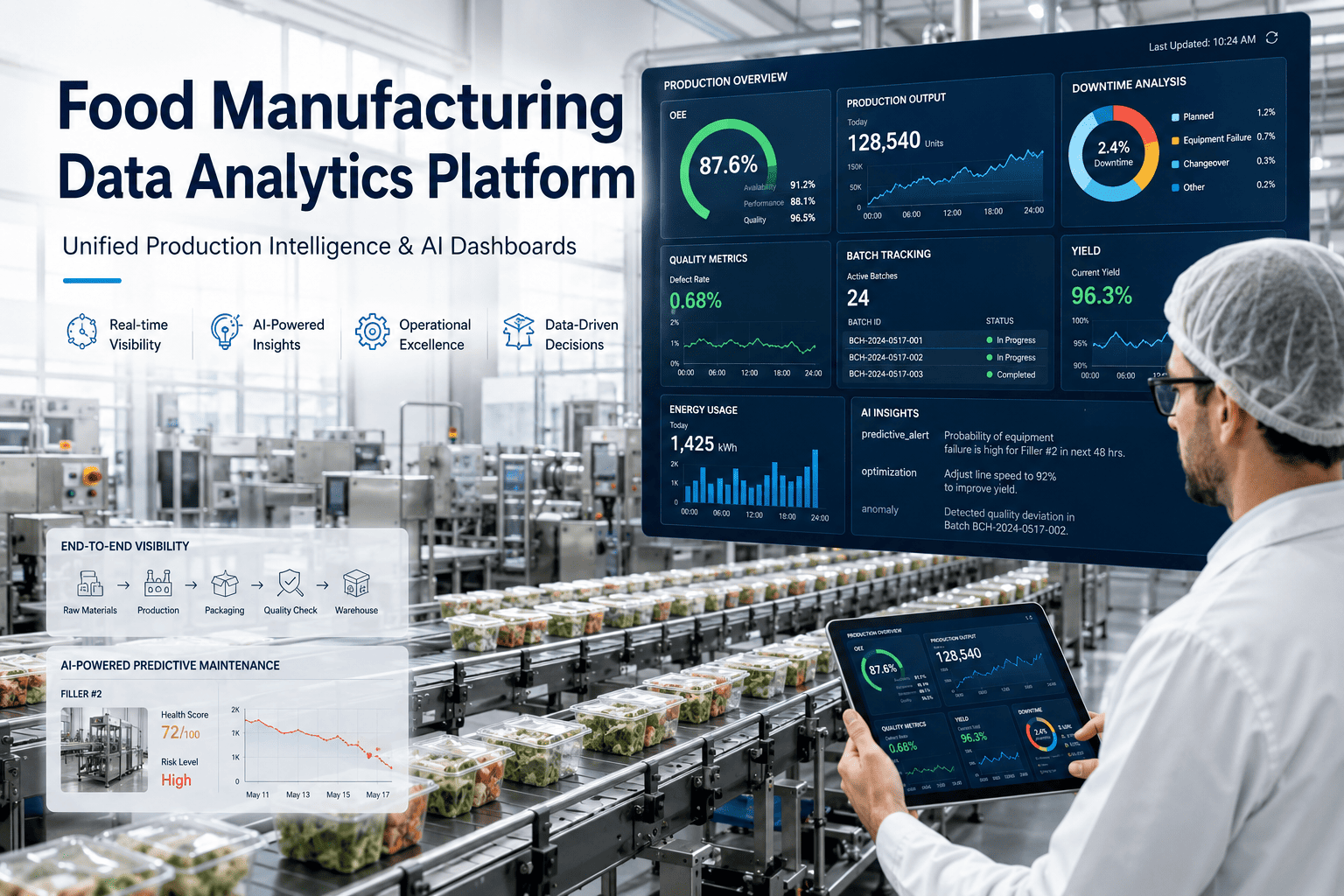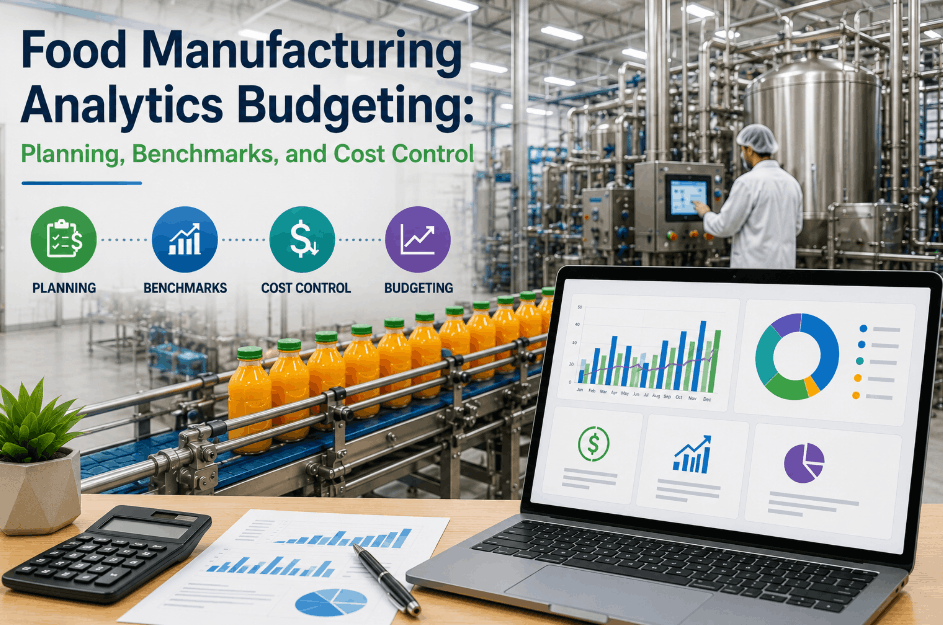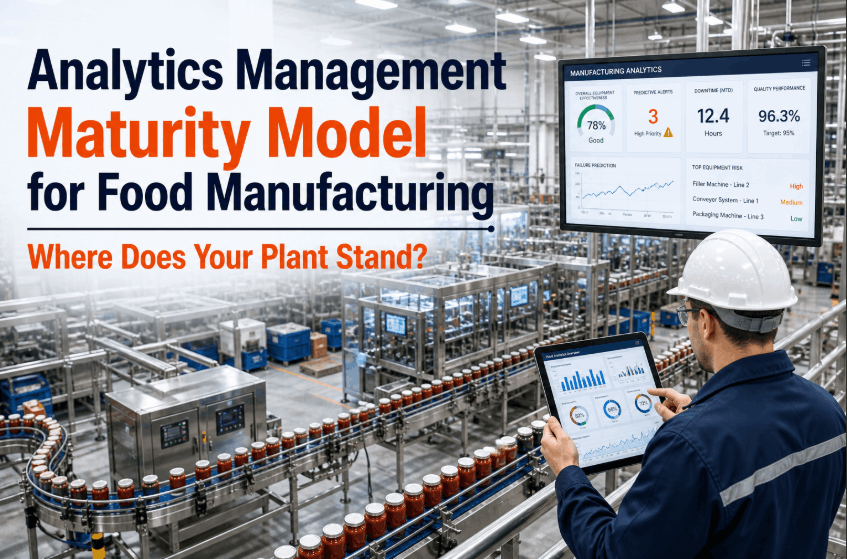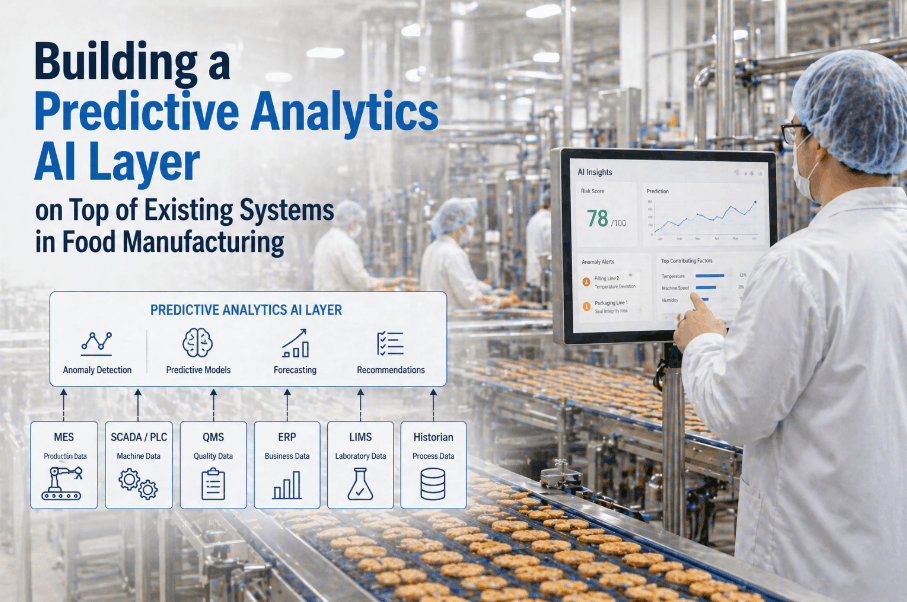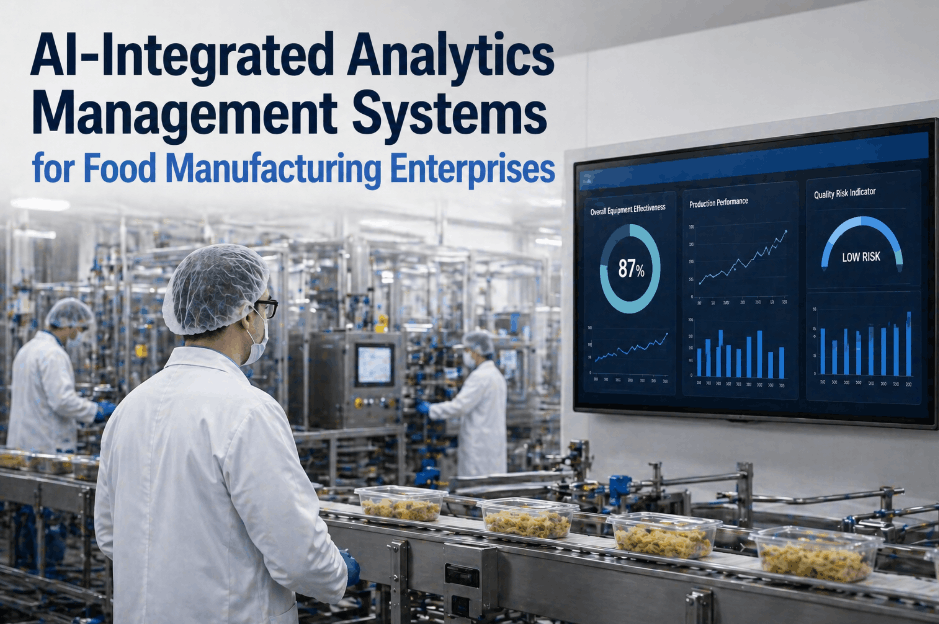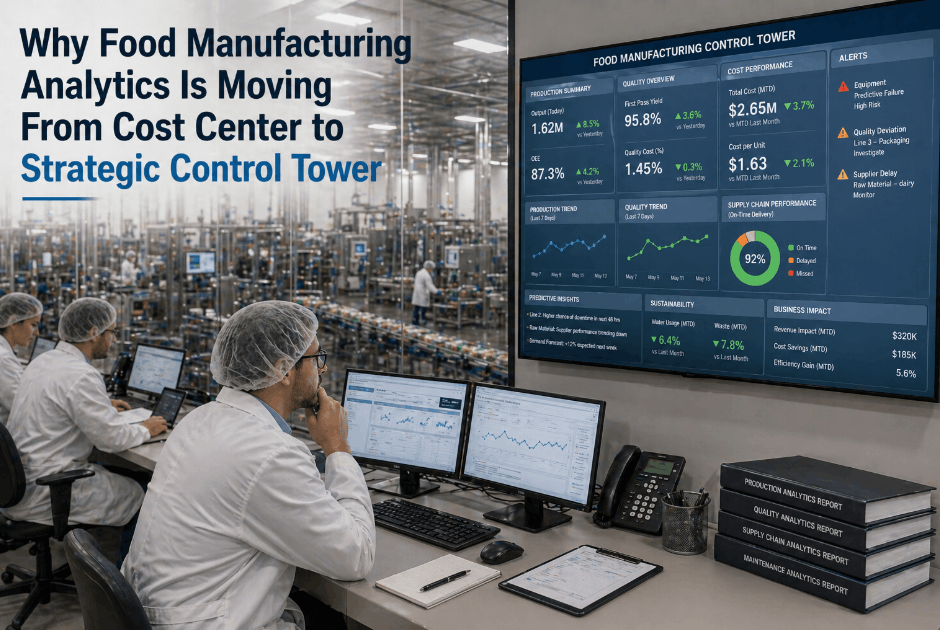
Food manufacturing analytics has undergone a fundamental transformation. What was once treated as a back-office reporting function — isolated dashboards and periodic Excel exports reviewed days after production runs — is now redefining how enterprise food manufacturers manage throughput, compliance, and capital investment in real time. In 2026, leading processors are no longer asking whether to invest in an operational intelligence platform; they are asking how quickly they can consolidate fragmented data streams into a unified control tower that drives strategic decisions across every facility in their network. If your analytics infrastructure still lives in departmental silos, Book a Demo to see how iFactory's manufacturing intelligence software converts raw operational data into enterprise-grade decision support.
Turn Your Analytics Into a Strategic Control Tower
iFactory's industrial analytics platform unifies production data, asset health, compliance records, and financial performance into a single operational intelligence layer — purpose-built for food manufacturing enterprises.
Why Food Manufacturing Analytics Has Outgrown the Cost Center Model
For most of the last two decades, analytics in food manufacturing was defined by what it could not do. Disconnected plant historians, ERP modules that lagged production reality by 24 hours, and quality systems that generated compliance records without surfacing operational intelligence — these were the building blocks of the cost center model. Analytics existed to satisfy auditors and produce post-mortem reports, not to influence decisions in the moment they could be acted upon.
That model is being replaced at pace. The catalysts are structural: labor cost inflation has eliminated the buffer of manual oversight that compensated for slow data; input volatility has compressed the margin for inefficiency to near zero; and regulatory scrutiny under FSMA and global food safety frameworks has made reactive compliance economically untenable. The food manufacturers absorbing these pressures while growing profitably share a single structural advantage — their industrial analytics platform has been repositioned from a reporting tool to a strategic control tower that connects operational visibility to executive decision-making in real time.
What a Strategic Control Tower Actually Means for Food Manufacturing Operations
The control tower concept, imported from supply chain management, describes a centralized intelligence layer that provides real-time visibility, predictive alerting, and decision support across the full operational network. For a multi-site food manufacturer, a true control tower software architecture means that equipment health in a Toledo facility, yield performance in a Fresno plant, and cold chain compliance status in a Dallas distribution center are all visible — simultaneously, in context, with anomalies flagged before they escalate — to both plant managers and the executive team making capital allocation decisions.
This is categorically different from business intelligence dashboards that aggregate historical data. A manufacturing intelligence software control tower is live, predictive, and action-linked. When a compressor in facility four shows an early thermal signature consistent with a bearing failure, the system does not just log the event — it generates a work order, checks parts inventory, flags the HACCP implications of a potential cold chain interruption, and updates the asset health score that feeds the CFO's quarterly capital planning model. To see how this architecture operates across a real multi-site food manufacturing network, Book a Demo and walk through a live control tower deployment.
The Five Pillars of a Food Manufacturing Analytics Control Tower
Building a strategic analytics control tower in food manufacturing requires architectural decisions that go beyond software selection. The platforms generating measurable enterprise value share five foundational capabilities that distinguish them from conventional manufacturing execution system deployments and standalone reporting tools.
Unified Data Infrastructure Across All Production Sites
A control tower requires a single data layer that ingests from PLCs, sensors, ERP systems, quality platforms, and environmental monitors simultaneously — normalizing disparate data formats into a unified operational model that makes cross-site comparison and enterprise benchmarking structurally possible rather than manually assembled.
Real-Time Asset Performance Management
Enterprise asset management in a control tower context means continuous equipment health scoring across every monitored asset — not periodic inspection reports. Asset performance management algorithms evaluate vibration, thermal, electrical, and process signatures in real time, converting equipment telemetry into maintenance timing recommendations and capital replacement projections.
Predictive Maintenance Software Integration
Predictive maintenance software transforms the control tower from a visibility platform into an intervention platform. Machine learning models trained on food manufacturing-specific failure signatures identify developing faults days to weeks in advance — shifting maintenance from calendar-based to condition-based and converting the largest source of unplanned downtime into scheduled production events.
Compliance Intelligence and Automated Documentation
In food manufacturing, regulatory compliance is not a separate workflow from operational performance — it is an output of operational performance. A control tower integrates FSMA documentation, HACCP verification records, SSOP compliance logs, and equipment maintenance records into an automated compliance intelligence layer that converts audit preparation from a periodic event into a continuous state.
Enterprise Decision Support for Executive Visibility
Enterprise decision support software elevates the control tower from an operations tool to a strategic asset. When the CFO and VP of Operations share the same real-time view of production yield, asset health trends, and compliance status across every facility, capital allocation decisions are informed by operational intelligence rather than lagged financial reports — compressing the cycle from insight to action.
From Operational Analytics Software to Strategic Decisions: The Data Flow That Changes Everything
The most significant shift in food manufacturing analytics is not technological — it is structural. The control tower model changes who owns analytics output and how quickly it reaches decision-makers. In the cost center model, operational analytics software produced reports consumed by plant managers and maintenance supervisors, rarely reaching executive stakeholders in a form that drove strategic decisions. The data existed; the decision pathway did not.
In the control tower model, the same operational data flows simultaneously to three decision layers: plant operations teams who need real-time intervention guidance; site leadership who need daily performance benchmarks and resource allocation visibility; and enterprise executives who need portfolio-level asset health, compliance exposure, and yield performance trends to make capital investment and operational strategy decisions. The data does not change — the architecture of who sees it, in what form, and how quickly, changes everything. Manufacturers exploring how to redesign this data flow for their enterprise should Book a Demo to see iFactory's three-layer visibility architecture in a live production environment.
Production Performance Analytics: Where the Control Tower Generates Immediate ROI
Production performance analytics is the highest-frequency output of a food manufacturing control tower — the continuous stream of yield, throughput, waste, and efficiency data that determines whether a shift is profitable before the shift ends. In facilities still operating on end-of-day or end-of-week performance reporting, the financial cost of delayed visibility compounds invisibly: yield losses that could have been corrected at hour two of a shift run for eight hours; equipment degradation that shows up in product quality before it shows up in maintenance records; changeover inefficiencies that are visible in production data but invisible to supervisors managing by observation.
Real-Time Yield Loss Attribution and Recovery
Control tower analytics correlate yield deviations with specific equipment states, raw material lots, operator shifts, and environmental conditions — enabling root cause identification and corrective action within the same production window where the loss is occurring, rather than in a post-mortem review the following week.
Overall Equipment Effectiveness Across the Enterprise Fleet
Enterprise-wide OEE monitoring through a smart factory analytics platform reveals performance gaps between sites operating comparable equipment under comparable conditions — identifying the management practices, maintenance disciplines, and operator behaviors that produce top-quartile OEE performance and making them transferable across the facility network.
Energy Consumption Linked to Equipment Health and Production Rate
Control tower energy analytics identify the correlation between equipment degradation and excess power consumption — detecting cases where a bearing fault or grinder wear is inflating energy cost by measurable percentages weeks before it produces a production stoppage. Energy waste becomes an early warning indicator, not just a utility cost line.
SKU Changeover Time Optimization at Scale
For food manufacturers managing complex SKU portfolios, changeover time variability is a major source of hidden throughput loss. Control tower analytics capture changeover duration with machine-level precision, identify the specific process steps where time is lost, and enable structured improvement cycles that compound across hundreds of changeovers annually.
Digital Transformation in Manufacturing: Why Analytics Is the Enabling Layer
Digital transformation manufacturing initiatives fail at a high rate — not because the technology does not work, but because they begin with technology deployment rather than data architecture. Robotics, automation, and advanced processing equipment generate value proportional to the quality of the analytics infrastructure interpreting their outputs. A high-speed packaging line that produces 400 units per minute without real-time seal integrity monitoring and equipment health scoring is faster than its predecessor but not fundamentally more manageable. The transformation becomes strategic only when the data generated by advanced equipment flows into a control tower that converts it into operational intelligence.
Reliability engineering software integrated into the control tower closes this gap by creating a continuous feedback loop between equipment performance data and engineering decisions. When a packaging line's seal integrity data correlates with specific temperature cycling patterns across multiple facilities, reliability engineers can redesign the thermal profile before it produces food safety exposure. That is digital transformation delivering strategic value — not faster equipment operating with slower intelligence. Food manufacturing executives driving digital transformation programs should Book a Demo to review iFactory's digital transformation analytics framework.
AI-Driven Visibility vs. Traditional Business Intelligence: A Direct Comparison
The distinction between an AI-powered control tower software and a traditional business intelligence platform is not a matter of degree — it is a matter of operating model. The table below captures the dimensions that determine strategic value in food manufacturing analytics deployments.
| Capability Dimension | Traditional BI / Reporting | AI Control Tower Platform | Strategic Impact |
|---|---|---|---|
| Data Latency | Hours to days post-event | Real-time continuous streaming | Interventions happen within the production window |
| Failure Prediction | No predictive capability | Days to weeks advance warning | Unplanned downtime converted to planned maintenance |
| Compliance Documentation | Manual record-keeping, audit-period assembly | Automated continuous documentation | Audit readiness is a permanent operational state |
| Cross-Site Benchmarking | Manual report consolidation | Automated enterprise performance ranking | Best practices identified and transferred systematically |
| Executive Visibility | Weekly/monthly financial summaries | Real-time operational dashboards | Capital decisions informed by live asset data |
| Maintenance Workflow | Reactive or calendar-based | Condition-triggered with work order integration | Maintenance cost reduced while reliability improves |
| Yield Analytics | End-of-shift or end-of-day reporting | Real-time yield attribution and alerting | Losses corrected within the shift they occur |
Building the Business Case: What Food Manufacturing Analytics Control Towers Deliver Financially
The financial case for repositioning analytics as a strategic control tower is grounded in four value categories that compound over the deployment lifecycle. Each represents a measurable return that most food manufacturing finance teams can model against existing cost structures using data they already collect.
Unplanned downtime elimination is the most immediate and largest single return category. At an average cost of $180,000 to $240,000 per hour of unplanned line stoppage in food manufacturing, preventing two to three events per quarter in a large-scale facility typically covers the annual platform investment in the first quarter of deployment. Emergency maintenance cost reduction delivers a secondary return that accelerates as the predictive maintenance model accumulates equipment history and extends its alert lead times. Yield loss recovery, enabled by real-time production performance analytics, compounds quarterly as root cause identification becomes more precise. Manufacturers ready to build a formal business case for control tower investment can Book a Demo and access iFactory's ROI modeling framework calibrated to their specific facility profile and equipment portfolio.
The Competitive Divide Is Opening: Analytics as Structural Advantage in Food Manufacturing
Food manufacturing is entering a period of structural performance divergence. The companies investing now in manufacturing intelligence software and control tower analytics architecture are building operational capabilities that take 18 to 36 months to compound to full strategic value — capabilities that competitors operating on reactive maintenance and lagged reporting cannot replicate quickly even if they start the journey simultaneously.
The gap is not just operational. It is financial, regulatory, and strategic. Manufacturers with unified operational analytics software make faster capital deployment decisions because they have real-time asset health data. They negotiate better insurance terms because they have documented predictive maintenance histories. They respond to FSMA inquiries faster and with greater precision because their compliance documentation is automated and continuous. The competitive divide between analytics leaders and laggards in food manufacturing is not closing — it is accelerating.
Ready to Close the Competitive Gap with Real-Time Analytics?
See how iFactory's control tower platform gives food manufacturers the production performance, asset health, and compliance intelligence to operate faster and smarter than the competition.
Frequently Asked Questions: Food Manufacturing Analytics and Control Tower Strategy
What is a food manufacturing analytics control tower and how does it differ from standard BI tools?
A food manufacturing analytics control tower is a unified operational intelligence platform that delivers real-time visibility, predictive alerts, and decision support across every production site simultaneously. Unlike standard BI tools that produce historical reports, a control tower operates continuously — linking equipment health, compliance records, and financial outcomes into a single decision-making architecture for both plant operators and executive leadership.
How does an industrial analytics platform integrate with existing manufacturing execution systems?
Modern industrial analytics platforms integrate with existing MES, ERP, and plant historian infrastructure through API-based data ingestion that normalizes inputs from disparate systems. This layered approach adds control tower intelligence on top of current technology without requiring costly platform replacement or production downtime during deployment.
What types of food manufacturing equipment can be monitored through an industrial IoT platform?
Industrial IoT platforms can monitor any asset with measurable operating signatures — refrigeration compressors, grinders, conveyors, packaging equipment, mixing systems, ovens, and hydraulic press systems. Non-invasive sensor architectures designed for high-sanitation food processing zones make deployment practical across all critical asset categories without disrupting active production.
How long does it take to deploy a manufacturing intelligence software control tower across multiple facilities?
Priority facility deployments covering refrigeration, primary processing, and packaging lines typically go live within four to six weeks using sensor installation during scheduled sanitation downtime. Enterprise-wide control tower coverage across a multi-site network is typically achieved within six to twelve months, with each facility generating measurable ROI before the next phase begins.
How does predictive maintenance software reduce FSMA compliance risk in food manufacturing?
Predictive maintenance software reduces FSMA compliance risk by preventing the equipment failures that trigger compliance obligations — cold chain excursions, metal contamination from worn components, and grinder plate degradation that elevates microbial risk. Automated maintenance documentation simultaneously creates the continuous compliance records that FSMA verification and FSIS inspection requirements demand.
Build the Analytics Control Tower Your Enterprise Strategy Requires
iFactory's industrial analytics platform transforms production data, asset health, and compliance intelligence into a unified strategic control tower — giving food manufacturing executives the real-time visibility and predictive intelligence to lead operations with precision rather than react to them with urgency.