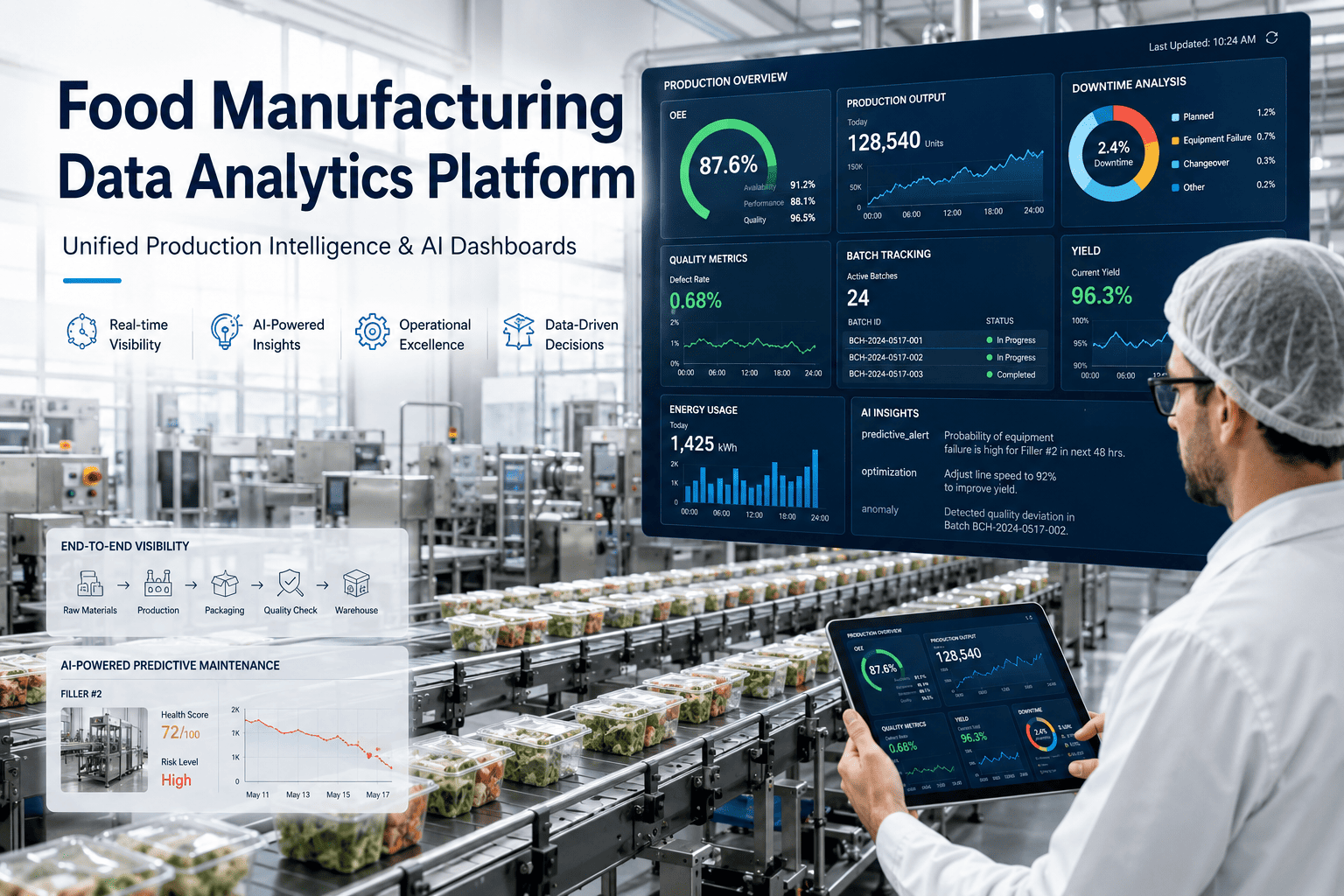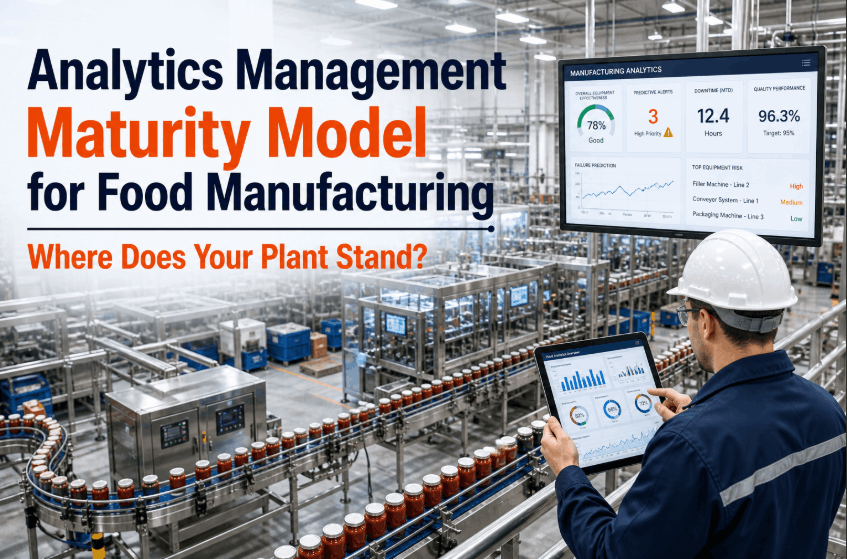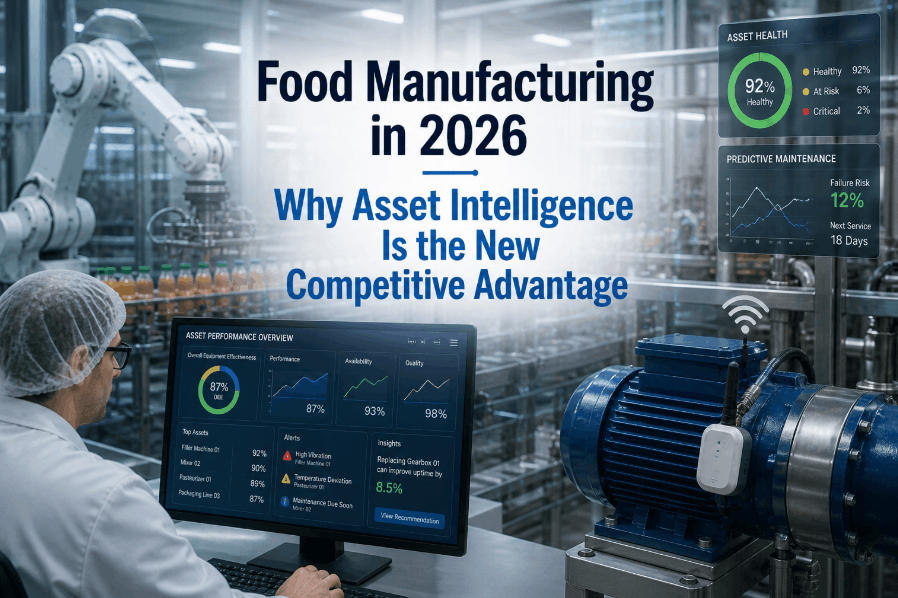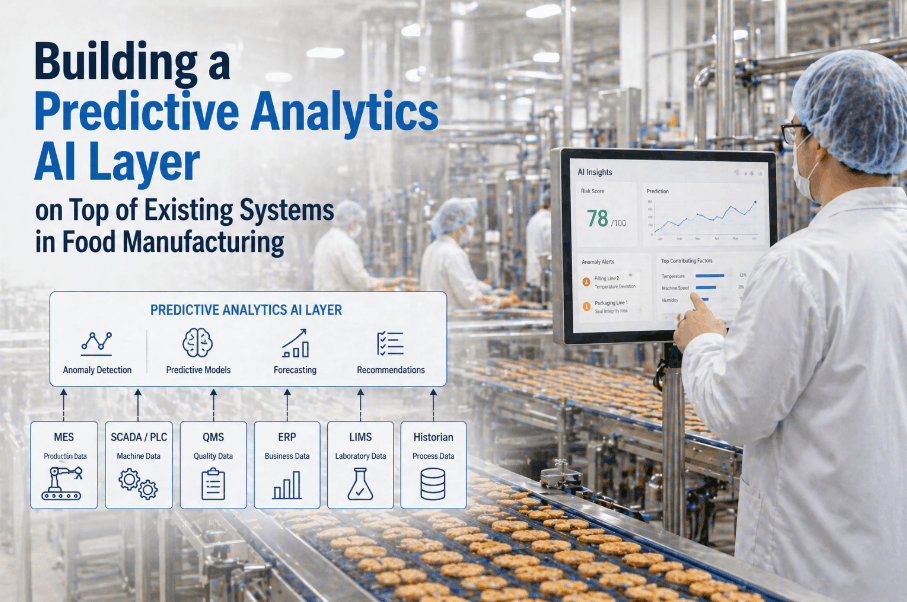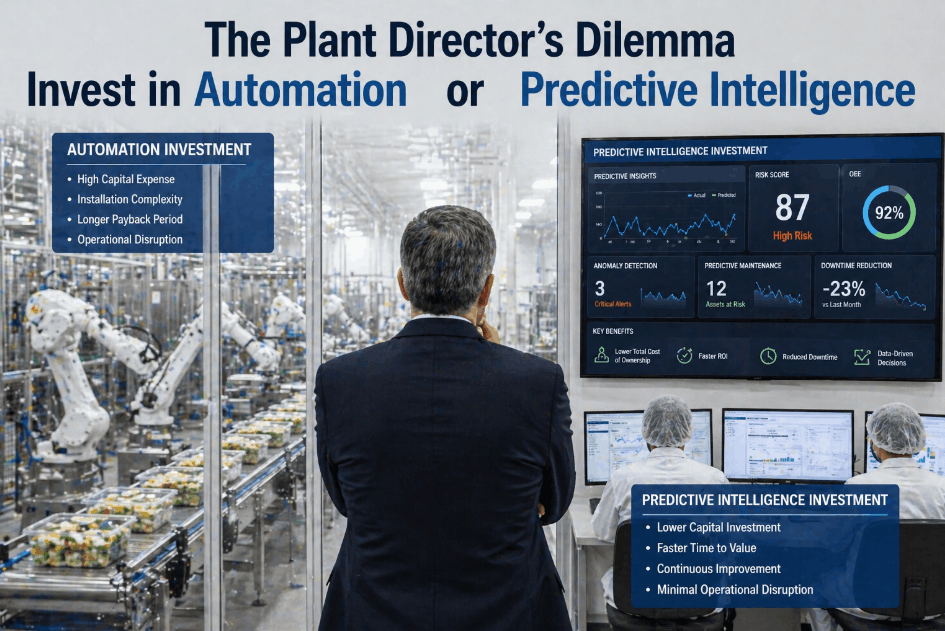
Plant directors in food manufacturing face a structural capital allocation conflict: do you invest in the physical automation of production lines or the digital intelligence that monitors them? While the promise of high-speed robotics and automated packaging systems is undeniable, the hidden ROI often resides in predictive intelligence—the ability to extract actionable reliability data from existing assets. This decision framework analyzes the trade-offs between hardware-heavy automation and AI-driven predictive analytics, providing a roadmap for facilities navigating the transition from reactive throughput to intelligent operational resilience. If you are currently evaluating your next Capex cycle, Book a Demo to receive a digital-first ROI projection for your specific facility environment. This analysis examines the precise technical gaps undermining facility modernization today—and the integrated infrastructure required to close them permanently.
The Automation Paradox: Why New Hardware Often Fails to Resolve Systemic Downtime
The standard response to production inefficiency in food manufacturing is physical automation—replacing manual labor or legacy equipment with faster, more autonomous hardware. However, plant directors often find that new automation layers simply shift the failure modes rather than eliminating them. A high-speed palletizer that shuts down due to an unpredicted sensor failure or a misaligned gearbox creates the same operational deficit as the manual line it replaced, but with significantly higher repair complexity. The paradox is that automation increases throughput potential while simultaneously increasing the financial cost and operational impact of unplanned downtime.
Predictive intelligence addresses the root cause of this paradox by focusing on asset reliability rather than just mechanical speed. By integrating high-resolution vibration sensors, thermal imaging, and PLC data streams into a unified AI engine, food manufacturers can identify the early warning signs of component fatigue weeks before a catastrophic failure occurs. For many facilities, the "automation dilemma" is resolved not by buying more machines, but by making existing machines more visible to the reliability engineers who manage them. When regulatory inspectors or customer auditors examine facility performance, they are looking for this level of continuous, data-driven validation of asset health.
The Capex Trap
Investing in expensive automation hardware without an underlying data layer creates "black box" assets that provide high throughput but offer zero visibility into their own deteriorating health, leading to high-impact surprise failures that disrupt multi-facility supply chains.
Risk: Capital inefficiencyMaintenance Blind Spots
Automation increases the technical burden on maintenance teams. Without predictive intelligence, these teams remain trapped in a reactive "break-fix" cycle, regardless of how modern the production line hardware is, resulting in excessive overtime and emergency spend.
Risk: Increased Opex burdenQuality Variability
Physical automation excels at repetition but fails at adaptation. Predictive intelligence monitors the environmental and mechanical variables that drive quality drift, preventing batch-level failures and finished product disposition decisions that automation alone misses.
Risk: Product waste accumulationScalability Barriers
Hardware-only modernization is linear, capital-intensive, and slow. Predictive intelligence is exponential; once the digital infrastructure is in place, it can be scaled across the entire facility portfolio at a fraction of the cost of physical upgrades.
Risk: Slow modernization paceVisualizing the Impact: Predictive Intelligence vs. Traditional Maintenance Models
To understand the structural advantage of predictive intelligence, we must compare it against the traditional reactive and preventive models that still dominate the food industry. The chart below illustrates the relative impact of these strategies on the three most critical plant metrics: Unplanned Downtime, Total Maintenance Cost, and Asset Lifecycle Longevity. Most facilities find that the transition to a predictive model generates enough free cash flow within 12 months to fund their next major automation project.
Unplanned Downtime Frequency
Maintenance Cost Efficiency
Automation vs. Predictive Intelligence: A Comparative Investment Analysis
Deciding where to allocate capital requires a multi-dimensional view of return that goes beyond simple payback periods. Automation delivers high "point value" by solving specific labor or throughput bottlenecks on a single line, but it often carries multi-year lead times and high implementation risks. Predictive intelligence, conversely, acts as a "force multiplier" across all existing assets—providing a significantly faster time-to-value by reducing the friction of unplanned events and optimizing the performance of both legacy and modern equipment simultaneously.
Evaluating the Financial and Operational Impact of Each Investment Path
The comparison table below outlines the critical differences between hardware-heavy automation projects and digital-first predictive intelligence deployments. For most plant directors, the optimal strategy is not binary; it involves using predictive intelligence to stabilize existing production environments first, thereby generating the predictable throughput and free cash flow required to fund targeted automation projects later in the modernization cycle.
| Metric | Physical Automation (Hardware) | Predictive Intelligence (Digital) | Risk Differential |
|---|---|---|---|
| Initial Capital Outlay | High ($500k - $2.5M+ per line) | Low to Moderate ($50k - $200k per plant) | Intelligence: 10x lower entry cost |
| Time-to-Value | 9–18 months (Order, Delivery, Install) | 4–8 weeks (Integration, Training, Insights) | Intelligence: 5x faster ROI realization |
| Operational OEE Impact | Increases theoretical line capacity | Reduces actual unplanned gap frequency | Hybrid: Stability + Speed |
| Workforce Transition | Reduces headcount; requires specialized skills | Empowers existing teams with real-time data | Intelligence: Lower labor adoption friction |
| Asset Flexiblity | Rigid (Locked to a specific process) | Universal (Applies to all mechanical assets) | Intelligence: Infinite scalability |
| Maintenance Cycle | Periodic/Planned (Regardless of need) | Predictive/Dynamic (Condition-driven) | Intelligence: 30% reduction in spare parts |
Building the "Smart Factory" Data Layer: Connectivity Without Complexity
The primary technical barrier to intelligence is not the machine; it is the data silo. Most food plants operate with a mix of modern PLCs and legacy manual equipment that cannot "speak" to one another. iFactory's architecture bypasses this integration burden by using an edge-to-cloud bridge that consumes data from any source—wireless sensors, SCADA systems, or manual inputs—and converts it into a unified asset health score. This allows plant directors to monitor the reliability of an entire facility from a single dashboard, identifying emerging risks before they reach the production schedule.
Universal Sensor Integration
Wireless vibration, temperature, and current sensors that install in minutes on any asset—from high-speed centrifuges to simple conveyor motors—transmitting sub-millisecond data to the AI engine.
AI Failure Modeling
Proprietary failure models trained on millions of food manufacturing data points to distinguish between normal process variations and emerging mechanical anomalies with 98% accuracy.
Predictive Workflow Alerts
Automated work order triggers that push diagnostic data and "time-to-failure" estimates directly to maintenance teams via mobile or CMMS integration, ensuring zero-latency response.
Unlocking the "Hidden Factory": Using Data to Reclaim Lost Capacity
Every food plant has a "hidden factory"—the latent capacity lost to minor stoppages, slow-running equipment, and extended changeovers. Automation often masks these inefficiencies by simply running faster during uptime, but it doesn't solve the underlying mechanical or process variability. Predictive intelligence uses high-resolution data to surface these micro-inefficiencies, allowing plant directors to reclaim up to 15-20% of lost capacity without purchasing a single new machine. This "digital capacity" is the most cost-effective way to meet growing customer demand without the capital burden of physical expansion. To explore how vibration and thermal analytics can unlock your hidden factory, Book a Demo today.
Vibration Analytics: The Non-Intrusive Early Warning System for Critical Assets
Vibration monitoring is the cornerstone of predictive intelligence for rotating equipment—motors, pumps, gearboxes, and centrifuges. By tracking the specific frequency signatures of bearing wear, misalignment, and imbalance, AI models can predict a failure with extreme precision. This transition from "preventive" (calendar-based) maintenance to "predictive" (condition-based) maintenance eliminates the waste of over-servicing healthy machines while preventing the catastrophic failure of deteriorating ones. This digital layer is the most cost-effective way to extend the lifecycle of aging assets in a capital-constrained environment.
Average reduction in unplanned downtime achieved through the deployment of predictive intelligence across high-speed packaging and processing lines.
Sustained increase in Overall Equipment Effectiveness by identifying and resolving chronic micro-stoppages identified by AI anomaly detection.
Reduction in total maintenance spending by eliminating emergency freight costs, overtime, and unnecessary preventive component replacements.
Average extension of critical asset life through early detection of mechanical stressors that would otherwise lead to terminal component failure.
The Three Pillars of an Intelligent Food Manufacturing Infrastructure
Modernization is not a single procurement event; it is an architectural evolution. Plant directors who succeed do not just buy "Industry 4.0" tools; they build an integrated intelligence layer that connects their physical assets to their strategic financial goals. This infrastructure allows for a "self-funding" modernization cycle where the savings from reduced downtime and optimized maintenance pay for the next phase of physical automation. For a facility-specific roadmap assessment, Book a Demo and speak with our reliability engineers today about your multi-year strategy.
Universal Data Connectivity
Establishing a unified IoT bridge that consumes data from legacy PLCs, wireless vibration sensors, and energy meters—creating a single source of truth for every asset in the facility, regardless of age, manufacturer, or communication protocol.
Connectivity · Foundation · 2–4 weeksPredictive Health Modeling
Deploying AI models trained specifically on food manufacturing failure modes to identify emerging mechanical and process anomalies—triggering proactive work orders before failures disrupt production schedules or impact product quality.
Analytics · Intelligence · 4–8 weeksPrescriptive Optimization
Integrating reliability data with production planning to automatically adjust line speeds, maintenance windows, and energy usage based on real-time asset health and enterprise-level demand forecasts for maximum throughput.
Optimization · Maturity · OngoingBuilding Consensus: How Predictive Intelligence Serves Every Level of the Plant
The primary barrier to modernization is often not technology, but stakeholder alignment. Financial teams want ROI, maintenance teams want a lower work burden, and plant directors want zero-surprises production. Predictive intelligence is the only modernization tool that satisfies these competing demands simultaneously. By providing a transparent, data-driven view of asset performance, it converts technical maintenance discussions into business-level reliability strategies that the entire leadership team can support. Facilities ready to align their teams around data can Book a Demo today.
Strategic Capex Allocation
Use real-time asset health data to prioritize infrastructure spending on the assets with the highest failure risk, ensuring every dollar of capital is deployed where it will have the maximum impact on total facility OEE and multi-plant throughput.
Tool: Executive ROI DashboardCondition-Based Workflow
Transition from reactive firefighting to a controlled, predictive maintenance schedule. Automate work order generation based on vibration thresholds, reducing emergency calls, technician burnout, and spare parts inventory waste.
Tool: Predictive Health AlertsTotal Cost of Ownership (TCO)
Analyze the true operating cost of legacy assets vs. new automation. Quantify the savings from reduced energy waste, spare parts inventory optimization, and avoided production disruptions that impact the corporate bottom line.
Tool: TCO Analytics EngineQuantifying the Opportunity: The Multi-Layered ROI of Predictive Intelligence
The financial justification for predictive intelligence is built on three compounding layers of value that directly impact the facility's profit and loss statement. Unlike physical automation, which provides a static return relative to labor costs, a digital intelligence layer becomes more valuable over time as it accumulates data and refines its predictive models, creating a virtuous cycle of efficiency and cost avoidance that scales with your growth.
Immediate: Downtime Avoidance
Preventing a single catastrophic failure on a primary production line—encompassing lost product, emergency repair costs, and missed shipping deadlines—frequently pays for the entire predictive platform implementation in one event. For high-volume food manufacturers, this "single-event ROI" is the most compelling entry point for digital modernization.
Short-term value driverIntermediate: OEE Optimization
Sustained OEE improvements of 15-20% allow facilities to meet increasing demand without adding shifts or purchasing additional lines. By maximizing the throughput of existing assets, predictive intelligence converts hidden capacity into pure margin—directly impacting the plant's profitability every production cycle.
Medium-term growth driverLong-term: Capex Rationalization
With precise data on asset health and lifecycle trends, plant directors can defer expensive automation upgrades by 3–5 years while maintaining extreme reliability. This ability to extend the life of existing capital while precisely timing future investments creates a structural financial advantage that competitors cannot match.
Long-term capital efficiencyPlant Modernization & Intelligence — Frequently Asked Questions
Can predictive intelligence work with 20-year-old legacy equipment?
Yes. In fact, legacy assets often provide the highest ROI for predictive intelligence. By adding non-intrusive wireless vibration and temperature sensors, we can bring modern visibility to any machine, regardless of its age or the presence of an existing PLC, ensuring reliability across the entire line.
How does predictive intelligence integrate with our current ERP or CMMS?
iFactory is designed for deep integration. Our platform can automatically push predictive health alerts and diagnostic data directly into your CMMS (like SAP, Maximo, or UpKeep), ensuring that predictive insights result in immediate, actionable work orders for your maintenance team without manual entry.
What is the typical time-to-value for a digital-first modernization project?
Most facilities begin seeing actionable data within the first 48 hours of sensor deployment. Full ROI—measured by avoided downtime and OEE improvement—typically compounds within the first 3 to 6 months as the AI models baseline your specific equipment failure modes and operational variables.
Does predictive intelligence replace the need for physical automation?
No, they are complementary. Predictive intelligence stabilizes your environment and provides the data needed to make smarter, risk-adjusted automation decisions. It ensures that when you do invest in expensive hardware, it is integrated into a reliability framework that protects that investment from day one.
What level of internal IT support is required for implementation?
Very little. iFactory typically uses an "edge-to-cloud" architecture that operates independently of your local IT network if needed (via cellular gateway), minimizing the burden on your IT resources while ensuring enterprise-grade data security and continuous uptime.
How does predictive intelligence impact the insurance and liability profile of a food plant?
High-fidelity asset health records provide documented proof of due diligence, which can be used to negotiate lower insurance premiums and reduce liability exposure during regulatory or legal inquiries by demonstrating proactive risk management.
Is there a minimum asset count or facility size required for a positive ROI?
While larger facilities see higher absolute returns, the platform is modular. Facilities with as few as 5 critical assets (e.g., primary processing line) typically achieve a full ROI within the first year by avoiding a single major failure that would have halted production.