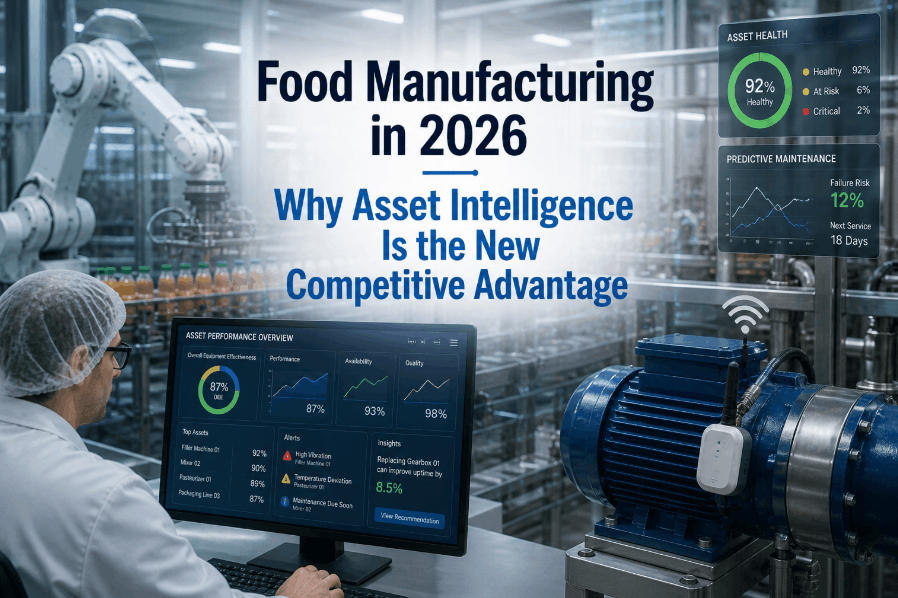
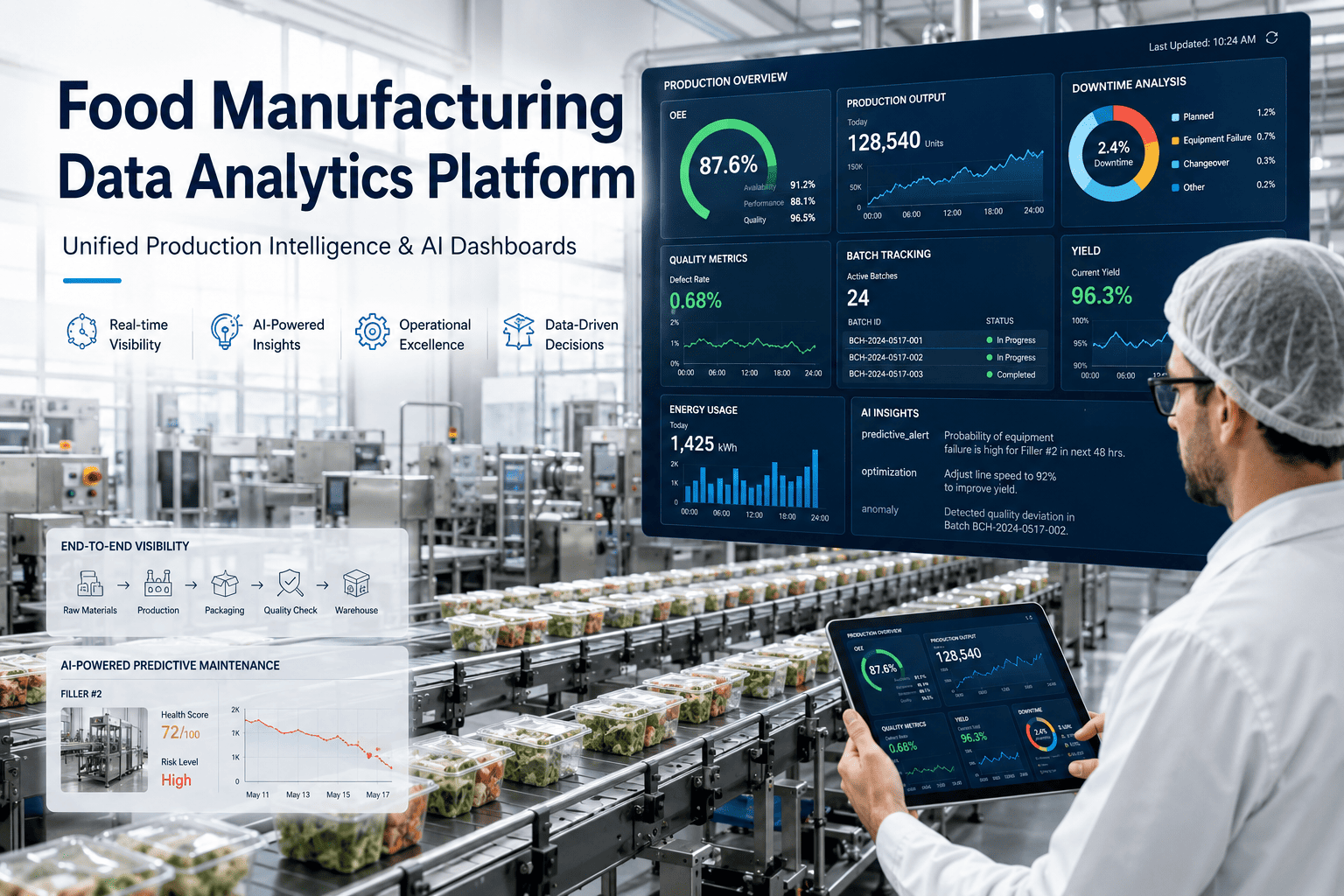
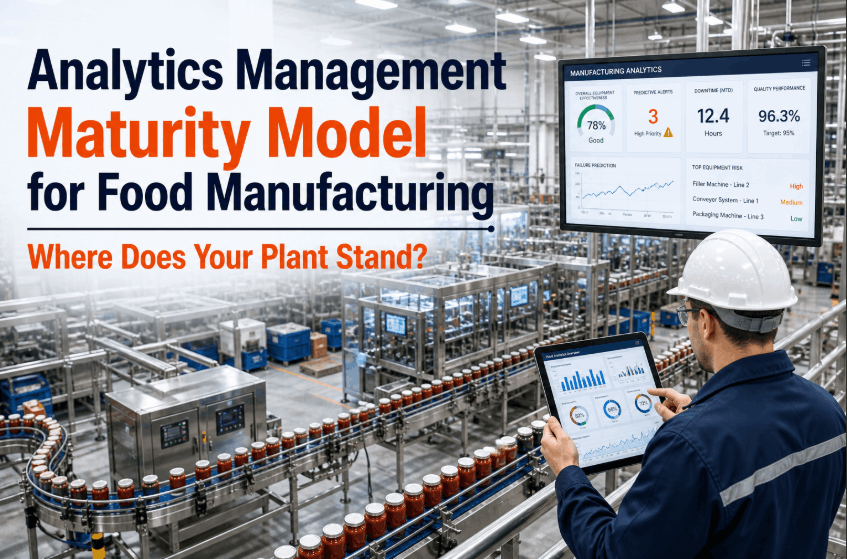
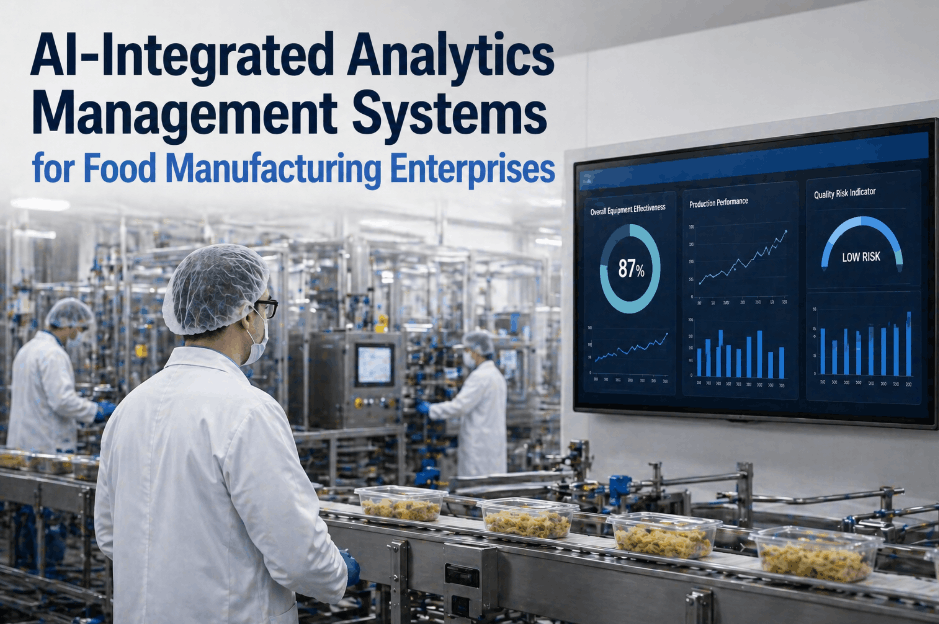
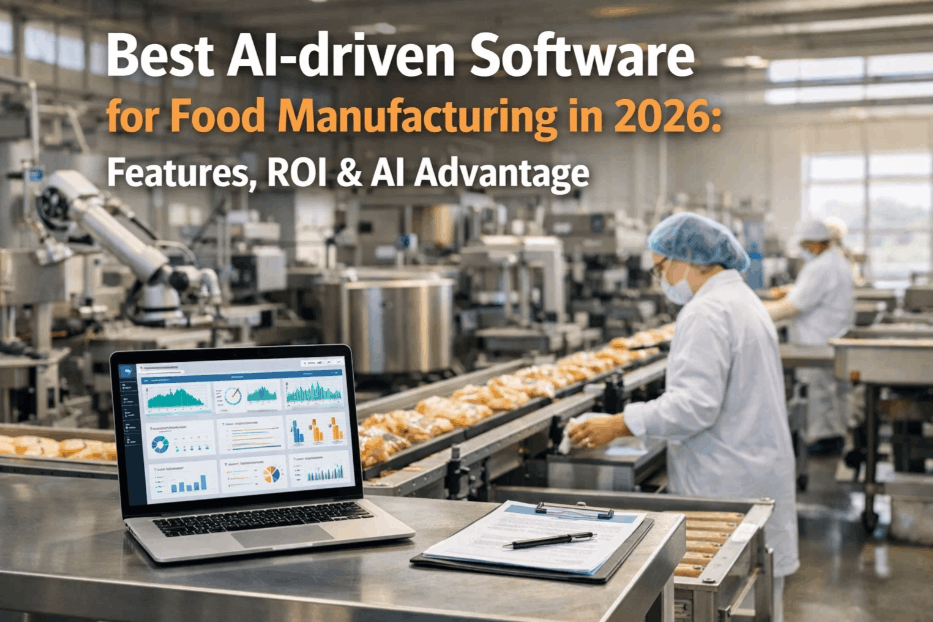
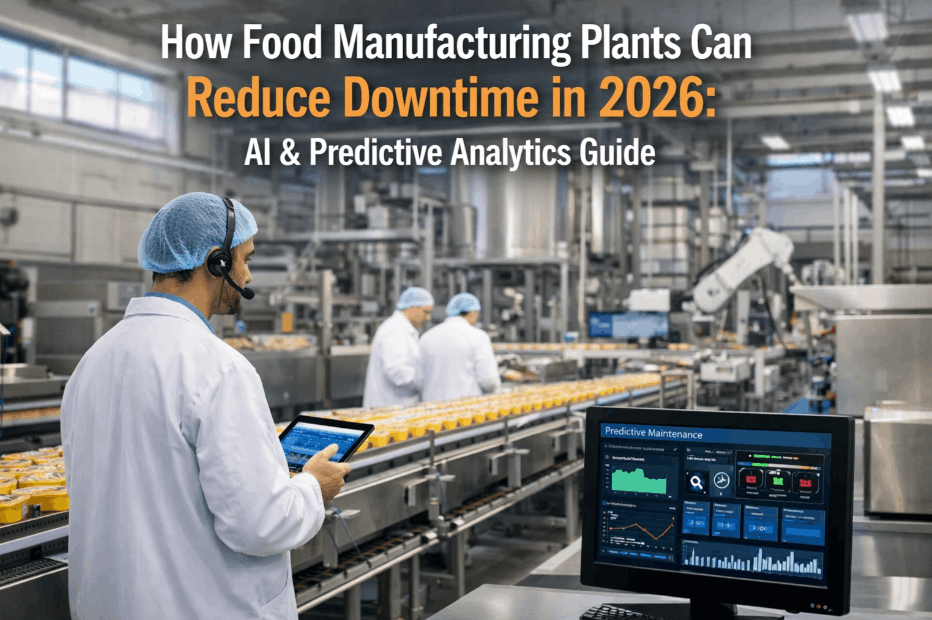
Food manufacturing in 2026 is no longer won on the production floor alone — it is won in the data layer that sits above it. As global supply chain volatility, tightening food safety regulations, and escalating labor costs converge simultaneously, manufacturers that have invested in asset intelligence platforms are outperforming peers by margins that are impossible to close through traditional operational improvement alone. Asset intelligence — the real-time synthesis of equipment sensor data, maintenance history, production throughput, and AI-driven failure prediction — has moved from a forward-looking capital investment to the defining competitive differentiator in food manufacturing today. Manufacturers still relying on reactive maintenance cycles, manual KPI reporting, and disconnected plant-level systems are not competing on a level playing field. They are competing at a structural disadvantage that compounds with every production quarter.
ASSET INTELLIGENCE · FOOD MANUFACTURING · 2026
See How Asset Intelligence Transforms Food Manufacturing Operations
iFactory's asset intelligence platform delivers predictive maintenance, real-time OEE visibility, and enterprise-wide analytics built specifically for food manufacturers — from single-site operations to 20-plant global networks.
What Is Asset Intelligence — And Why Food Manufacturers Can No Longer Ignore It
Asset intelligence is the operational capability that emerges when an organization connects equipment sensor data, maintenance work order history, production output metrics, and AI-powered predictive models into a single, continuously updated intelligence layer. Unlike traditional enterprise asset management software that records what has already happened, an asset intelligence platform actively interprets what is about to happen — surfacing failure risk, maintenance optimization opportunities, and production constraints before they become downtime events or quality failures.
For food manufacturers, the stakes of this distinction are uniquely high. A packaging line failure during peak seasonal production does not simply create a maintenance cost — it creates a cascading event that affects customer fill rates, retailer relationships, regulatory recordkeeping obligations, and food safety traceability chains simultaneously. Asset performance management built on true intelligence — not reactive logging — is what separates manufacturers that absorb these disruptions from those that prevent them entirely.
The shift underway in 2026 is structural. According to industry benchmarks, food manufacturers that have fully deployed predictive maintenance software across their critical equipment lines report 31–42% reductions in unplanned downtime compared to facilities operating reactive-first maintenance programs. The ROI is not incremental — it is transformational. And the manufacturers who recognized this three years ago are now operating at efficiency levels their competitors cannot replicate without making the same infrastructure investments.
42%
Average reduction in unplanned downtime with full predictive maintenance deployment
29%
OEE improvement reported by food manufacturers using asset intelligence platforms
3.8x
Higher AI prediction accuracy from network-trained models vs. single-plant data
8–14 mo
Typical full ROI timeline for asset intelligence deployment in food manufacturing
Competitive Landscape
The Competitive Gap Is Widening — Why 2026 Is the Inflection Point
The food manufacturing sector entered 2026 at a competitive inflection point that has been building since 2021. Post-pandemic supply chain reconstruction, accelerating FSMA 204 traceability mandates, and the explosion of industrial IoT sensor costs falling below deployment thresholds have combined to create the precise conditions under which manufacturing intelligence software delivers outsized returns. The gap between manufacturers who have acted and those who have not is now measurable in quarterly earnings — and it is accelerating, not stabilizing.
Three structural forces are driving this divergence in 2026. First, industrial IoT monitoring infrastructure has become significantly cheaper to deploy — the cost per connected asset endpoint has dropped by over 60% since 2021, removing the capital barrier that previously limited deployment to only the largest food enterprises. Second, AI model accuracy has improved dramatically as training datasets have grown — manufacturers that deployed early now hold a compounding data advantage that late entrants cannot close quickly. Third, regulatory pressure from FSMA 204 electronic recordkeeping requirements is accelerating forced digital transformation across the sector, and manufacturers who deployed asset intelligence infrastructure proactively are satisfying compliance requirements as a byproduct of operational improvements rather than as a separate compliance burden. You can book a demo to see how leading food manufacturers are navigating all three forces simultaneously with a single platform.
IoT Infrastructure Cost Reduction
Per-asset sensor and connectivity costs have declined sharply, making comprehensive industrial IoT monitoring economically viable for mid-market food manufacturers that previously could not justify the capital investment. Full production line coverage is now achievable within a single budget cycle.
AI Model Maturity and Training Data Advantage
Early adopters of predictive maintenance software have accumulated 3–5 years of labeled failure event data — a compounding advantage that produces significantly more accurate predictive models than late-deploying competitors can achieve in their first 12–18 months of operation.
Regulatory Compliance as Operational Driver
FSMA 204 traceability requirements and expanding GFSI scheme documentation mandates are forcing digital infrastructure investments across the sector. Manufacturers with asset intelligence platforms in place satisfy these requirements automatically — those without face duplicative compliance investments.
Labor Market Pressure on Maintenance Operations
Skilled maintenance technician shortages are reaching critical levels in food manufacturing. Reliability engineering software that optimizes maintenance scheduling, reduces emergency callout frequency, and prioritizes interventions by risk is becoming essential infrastructure for workforce retention and operational continuity.
Platform Capabilities
The Five Core Capabilities of a Modern Asset Intelligence Platform for Food Manufacturing
Not all enterprise asset management software delivers genuine asset intelligence. The distinction between a sophisticated maintenance logging system and a true asset intelligence platform lies in five capability dimensions that determine whether a platform can actually predict, prevent, and optimize — or simply record. Food manufacturers evaluating operational analytics software should assess every candidate platform against these dimensions before committing to a deployment. If you want to understand how iFactory performs across each dimension in a food manufacturing context, book a demo with our engineering team.
01
Real-Time Equipment Performance Monitoring with Anomaly Detection
A genuine asset intelligence platform ingests sensor data continuously and applies anomaly detection models that distinguish meaningful deviation patterns from normal operational variance in real time. Equipment performance monitoring at this level — not daily or shift-end batch reporting — is what enables pre-failure intervention windows measured in hours rather than days. For food manufacturers operating continuous processing lines, this is the difference between a planned 45-minute intervention and a 6-hour unplanned shutdown that triggers a recall investigation.
02
Predictive Failure Modeling Trained on Industry-Specific Failure Patterns
AI models in predictive maintenance software built for food manufacturing must account for failure patterns that do not appear in general industrial datasets — the impact of washdown frequency on bearing life, temperature cycling effects in cold storage processing environments, and the accelerated wear profiles of high-speed packaging equipment handling variable product formats. Generic industrial AI models applied to food manufacturing contexts consistently underperform purpose-built models trained on food-specific failure event libraries. The model's training data source is the most important single factor in prediction accuracy — not the algorithm architecture.
03
Asset Performance Management with Cross-Facility Benchmarking
True asset performance management does not evaluate equipment in isolation — it benchmarks asset health scores, maintenance cost per unit output, and lifecycle position against identical or comparable assets across the network. A filler line operating at 73% OEE is a very different operational challenge depending on whether peer lines average 68% or 88%. Network-wide benchmarking, powered by standardized data models across facilities, is what converts individual asset data into enterprise-level improvement intelligence.
04
Integrated Food Safety and Traceability Intelligence
Asset intelligence in food manufacturing cannot exist in a silo disconnected from food safety systems. CCP monitoring data, environmental monitoring trends, supplier verification status, and lot traceability records must integrate with maintenance and equipment performance data to provide a complete operational intelligence picture.
Smart factory analytics that unify these data streams give quality assurance teams predictive insight into food safety risk — not just retrospective documentation of what went wrong. If you want to see how integrated food safety intelligence works in practice,
book a demo and we will walk through a live demonstration with food safety data included.
05
Production Optimization Intelligence That Connects Maintenance to Throughput
Production optimization software that operates independently from asset health data produces recommendations that are chronically disconnected from operational reality. Scheduling a major production run on a line flagged by the maintenance system as high-risk is a common and preventable failure mode in food manufacturing. The asset intelligence platforms delivering genuine competitive advantage in 2026 are those that model maintenance scheduling, production allocation, and capacity planning from a single unified data layer — ensuring that operational decisions account for asset risk in real time.
2026 Benchmark Data
Asset Intelligence vs. Traditional Maintenance Management — 2026 Performance Benchmark
The following benchmark comparison reflects performance data from food manufacturing operations measured across reactive, preventive, and AI-driven asset intelligence maintenance programs in 2026. The performance gap between traditional maintenance management software and full asset intelligence platform deployment has widened significantly compared to 2022 benchmarks — reflecting both the maturation of AI prediction models and the compounding advantage of multi-year training datasets held by early adopters.
Food Manufacturing Asset Intelligence Performance Benchmark — 2026
Digital Transformation
Digital Transformation in Food Manufacturing — The Asset Intelligence Maturity Model
Digital transformation in food manufacturing does not happen in a single deployment event. It follows a maturity progression that most food manufacturers are currently navigating at different stages — and the stage at which an organization currently operates determines both the magnitude of the improvement opportunity available and the speed at which competitive disadvantage is accumulating. Understanding where your operation sits on the asset intelligence maturity model is the essential first step toward a credible improvement roadmap. For a tailored maturity assessment relevant to your specific facilities and asset base, book a demo and our team will conduct a structured evaluation.
Stage 1
Reactive Operations
Maintenance is triggered by failure events. KPIs are manually assembled from disconnected systems. Equipment data exists in isolated logs with no synthesis or pattern detection. Compliance documentation is assembled manually for each audit cycle. This describes the majority of food manufacturing facilities globally as of 2023 — and approximately 38% of facilities as of 2026.
Stage 2
Preventive Systems
Scheduled preventive maintenance programs are in place. Basic maintenance management software tracks work orders and PM compliance. KPI dashboards exist at the plant level but require manual data entry and reconciliation. Downtime is reduced compared to reactive operations but remains unpredictable because maintenance intervals are time-based rather than condition-based.
Stage 3
Connected Monitoring
IoT sensors are deployed on critical assets and feeding data to equipment performance monitoring dashboards in real time. Condition-based maintenance is active for high-criticality equipment. OEE is calculated automatically from sensor data rather than manually. Cross-facility data visibility is emerging but not yet standardized or fully benchmarked at the enterprise level.
Stage 4
Predictive Intelligence
AI-driven predictive maintenance software is generating failure predictions with 7–14 day advance warning on critical assets. Maintenance scheduling is driven by predicted need rather than elapsed time. Production planning accounts for asset health risk in real time. Reliability engineering software is optimizing spare parts inventory based on predicted demand rather than historical consumption patterns.
Stage 5
Full Asset Intelligence
Enterprise-wide asset intelligence platform unifies all facilities into a single intelligence layer. AI models trained on network-wide failure data deliver prediction accuracy that single-facility models cannot approach. Production optimization software dynamically allocates capacity and maintenance windows across the network. Compliance documentation is generated automatically. Best practices propagate from top-performing facilities to underperforming peers through structured benchmarking programs.
Implementation Intelligence
How to Build an Asset Intelligence Capability in Food Manufacturing — A Strategic Roadmap
Deploying a genuine asset intelligence platform in a food manufacturing environment requires a sequenced capability-building approach that delivers measurable ROI at each phase rather than deferring value until a theoretically complete deployment is reached. Food enterprises that attempt to boil the ocean — deploying every capability simultaneously across every facility — consistently underperform the phased approach in both speed to value and organizational adoption quality. The following roadmap reflects deployment patterns validated across food manufacturing operations ranging from single-site processors to twenty-four facility global networks.
Phase 1
Asset Criticality Assessment and Data Infrastructure Foundation (Weeks 1–6)
Classify every asset by criticality tier — production-critical, quality-critical, and support — and map the current state of sensor coverage, CMMS integration, and data quality at each facility. Identify the 20% of assets that drive 80% of downtime cost. Define the enterprise data model and KPI governance framework that will make cross-facility analytics comparable from day one. Select two to three pilot facilities that represent the performance range of the broader network.
Outcome: Criticality map, data model, KPI governance framework, pilot facility selection
Phase 2
Sensor Deployment and Real-Time Monitoring Activation (Weeks 7–16)
Deploy IoT sensors on all Tier 1 critical assets at pilot facilities and establish real-time data feeds to the industrial analytics platform. Integrate existing CMMS, ERP, and SCADA data streams to eliminate manual data entry. Activate condition-based maintenance programs for critical assets and establish the performance baselines that will quantify improvement ROI in subsequent phases. The goal is live equipment performance monitoring dashboards populated with validated, automatically collected data — not manual-entry approximations.
Outcome: Live monitoring dashboard, automated data collection, condition-based maintenance active
Phase 3
AI Predictive Model Training and Deployment (Weeks 17–28)
With 10–12 weeks of high-quality sensor data collected, AI failure prediction models can be trained and validated against historical failure events in CMMS records. Deploy predictive models on critical assets and begin generating advance warning alerts for the maintenance team. Measure prediction accuracy, false positive rate, and intervention success rate systematically — this data improves model accuracy and builds organizational trust in AI-generated recommendations. Extend deployment to remaining facilities using the validated pilot playbook.
Outcome: Predictive maintenance active on critical assets, validated model accuracy, network rollout initiated
Phase 4
Enterprise Optimization and Continuous Intelligence Activation (Week 29+)
With all facilities connected and AI models trained on network-wide failure data, activate enterprise-level production optimization — dynamically scheduling maintenance windows to minimize supply chain impact, allocating production capacity based on real-time asset health, and identifying best-practice facilities whose operational approaches should propagate across the network. Establish structured monthly benchmarking reviews and measure ROI against the baselines established in Phase 2. The competitive advantage now compounds continuously as models improve, benchmarking intelligence accumulates, and operational efficiency software optimizes decisions that previously required manual analysis.
Outcome: Full enterprise asset intelligence, compounding AI accuracy, quantified ROI documentation
Industry Outlook
The Future of Asset Intelligence in Food Manufacturing — What 2026 Signals for 2028 and Beyond
The asset intelligence trajectory in food manufacturing points toward three developments that will further widen the competitive gap between early adopters and lagging organizations by 2028. Understanding these vectors is essential for food manufacturers making capital allocation decisions in 2026 — the investments made in the next 18 months will determine competitive positioning for the remainder of the decade.
First, AI model accuracy will continue to improve as training datasets grow — manufacturers operating smart factory analytics platforms today are accumulating the labeled failure event data that will make their 2028 predictive models significantly more accurate than anything a competitor starting deployment in 2027 can build in their first two years of operation. The data advantage compounds in a way that capital investment alone cannot close on an accelerated timeline. Food manufacturers that recognize this compounding dynamic are treating asset intelligence deployment as an urgent strategic priority rather than a planned future initiative. You can book a demo today to understand your current competitive position and the cost of delayed deployment in quantified terms.
Second, the integration between asset performance management and enterprise sustainability reporting will become a regulatory requirement rather than a voluntary capability. Scope 1 and Scope 2 emissions reporting requirements are tightening across jurisdictions, and the energy consumption data generated by a fully deployed asset intelligence infrastructure is precisely the data required to satisfy these requirements accurately. Manufacturers without integrated industrial IoT monitoring will face duplicative investment to satisfy both operational intelligence and sustainability reporting requirements from separate systems.
Third, customer-driven supply chain intelligence requirements will escalate. Major retail customers are increasingly requiring food manufacturers to demonstrate digital supply chain capabilities — not simply claim them — as a condition of preferred supplier status. The manufacturers who can share real-time production confidence data, lot traceability assurance, and quality system performance documentation through integrated digital channels will command commercial premiums and supply chain priority that competitors operating paper-based or semi-digital systems cannot access.
Compounding AI Data Advantage
Every week of operation adds labeled failure event data that improves model accuracy. Early deployers of predictive maintenance software are building a structural data moat that late entrants cannot close through capital investment alone — the data advantage requires time to accumulate, not just money to acquire.
Sustainability Reporting Integration
Asset intelligence infrastructure generates the granular energy consumption and emissions data that Scope 1/2 regulatory reporting will require. Manufacturers with operational analytics software already deployed will satisfy sustainability mandates as a byproduct of their existing operations — without additional investment in parallel reporting systems.
Customer-Driven Digital Capability Requirements
Retail customers are beginning to mandate demonstrated digital supply chain capabilities as a condition of preferred supplier status. Manufacturers with enterprise asset management software generating real-time production intelligence and traceability data will command commercial advantages that legacy operators cannot match.
Frequently Asked Questions
Asset Intelligence in Food Manufacturing — Frequently Asked Questions
What is asset intelligence and how is it different from traditional maintenance management?
Traditional maintenance management software records failures after they occur. Asset intelligence synthesizes real-time sensor data and AI models to predict failures before they happen — closing the gap between 12–18% unplanned downtime and just 2–4%.
How accurate are predictive maintenance models for food manufacturing equipment?
Purpose-built predictive maintenance software trained on food-specific failure data achieves 87–94% precision at a 7–14 day prediction horizon. Generic industrial models consistently underperform by 15–25 percentage points when applied to food equipment failure patterns.
What ROI can food manufacturers expect from an asset intelligence platform deployment?
Food manufacturers with 3–8 production lines typically achieve full ROI within 8–14 months via downtime reduction (31–42%), OEE improvement (18–29%), and maintenance cost savings (22–34%). Annual value for a 5-line operation commonly reaches $3.2–6.8M.
How does asset intelligence support FSMA 204 traceability compliance?
An integrated asset intelligence platform generates CTE documentation automatically as production events occur. Lot traceability records that require 4–24 hours of manual assembly today can be produced in under 8 minutes — satisfying FSMA 204 as a byproduct of normal operations.
Can asset intelligence platforms integrate with existing food manufacturing technology stacks?
Yes. Purpose-built industrial analytics platforms include pre-built connectors for SAP, Oracle, IBM Maximo, Rockwell, Siemens, and Wonderware. Existing plant systems keep running — the asset intelligence layer sits above them, normalizing data without rip-and-replace disruption.
How long does it take to deploy an asset intelligence platform across a multi-plant food operation?
Most food manufacturers achieve live equipment performance monitoring at pilot facilities within 6–10 weeks. Full AI predictive model deployment completes within 20–28 weeks, with enterprise-wide network rollout finishing within 16–24 weeks for 4–12 facility operations.
ASSET INTELLIGENCE · PREDICTIVE MAINTENANCE · FOOD MANUFACTURING 2026
Deploy Asset Intelligence Across Your Food Manufacturing Operation in 2026
iFactory's purpose-built asset intelligence platform delivers real-time equipment monitoring, AI-driven predictive maintenance, enterprise OEE benchmarking, and automated FSMA 204 compliance documentation — built specifically for food manufacturers ready to make asset intelligence their competitive advantage.