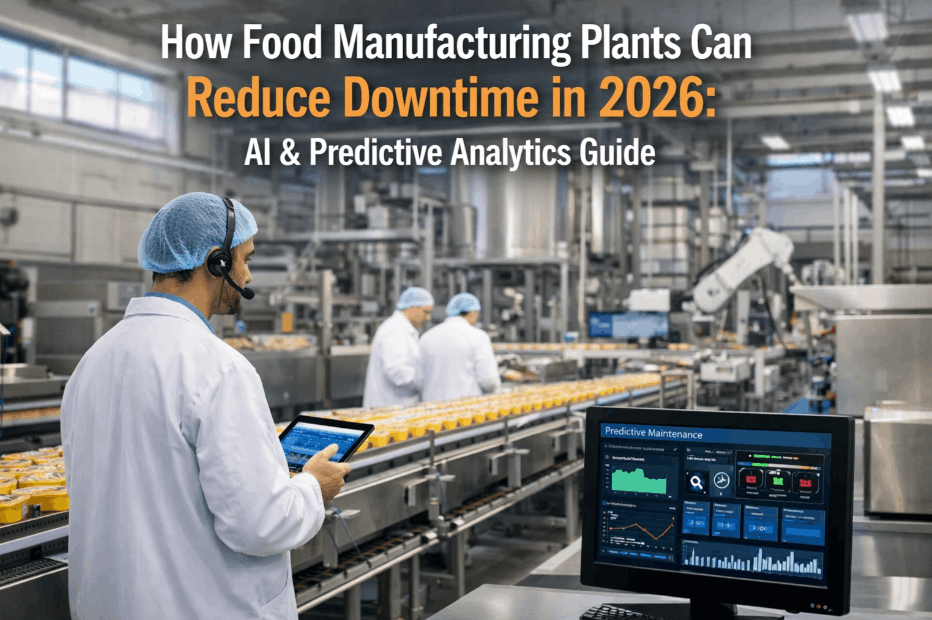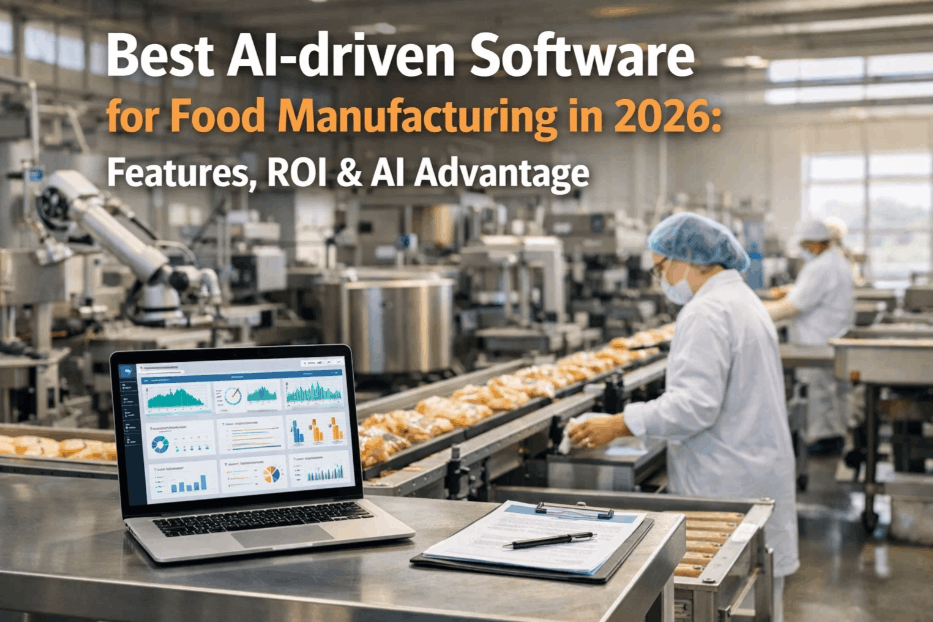
The food manufacturing industry is undergoing a seismic shift in 2026. As plant managers grapple with aging equipment, shrinking workforces, and tightening compliance mandates, the demand for AI-driven software for food manufacturing has never been more urgent. The best platforms no longer just track work orders — they predict failures, guide technicians in real time, and generate audit-ready reports automatically. This guide breaks down the top AI-powered analytics solutions available today, comparing features, ROI timelines, and the true AI advantage each delivers to modern food processing plants. If your facility is still running on paper-based maintenance logs or legacy CMMS systems, you are already behind. Book a demo to see what a fully AI-augmented plant operation looks like in practice.
Why Food Manufacturers Are Switching to AI-Driven Analytics Software in 2026
The global food processing industry is facing a compounding set of operational pressures: record equipment downtime costs, FSMA and HACCP compliance complexity, and a technical labor shortage that has left plants running at 60–70% of their optimal staffing levels. Traditional analytics software — built around calendar-based PM schedules and spreadsheet reporting — simply cannot handle the demand. The best AI-driven food processing analytics software platforms of 2026 address all three pressure points simultaneously by turning raw machine data into actionable, prioritized work orders before a failure ever occurs.
According to industry data, food manufacturers using predictive analytics platforms report a 25–40% reduction in unplanned downtime within the first year of deployment. These platforms integrate directly with PLCs, SCADA systems, and IoT sensors to monitor asset health in real time — making them far more effective than any fixed-interval inspection routine. The ROI case for AI-powered maintenance software in the food industry is now well-established, and early adopters are widening their competitive gap every quarter.
Key Features to Look for in the Best AI-Driven Food Manufacturing Software
Not all analytics platforms are created equal. When evaluating food factory asset management systems and digital analytics software for food plants, procurement teams should prioritize the following feature categories. A platform that excels across all five areas delivers the highest total ROI in a food manufacturing environment.
A true AI engine analyzes historical failure patterns, sensor readings, and production load to forecast asset failures days or weeks in advance — enabling scheduled repairs instead of emergency responses. Look for platforms with machine-learning models trained on food processing equipment specifically, as generic industrial models underperform in F&B environments.
The best AI-driven platforms with HACCP compliance features automatically generate timestamped digital records, pre-populate audit packages, and flag compliance deviations in real time. Manual compliance logging is a significant source of error and labor waste — automation eliminates both risks simultaneously.
When a fault is detected, the system should automatically generate a work order complete with AI-recommended troubleshooting steps, required parts, safety protocols, and asset history. This "digital mentor" capability is what separates leading smart analytics software for food plants from basic CMMS tools.
Floor-level adoption is the single biggest failure point for analytics software rollouts. The best platforms feature large-format mobile interfaces, voice-to-text input, and swipe-to-complete task flows designed for gloved hands in high-noise environments — not for office desks.
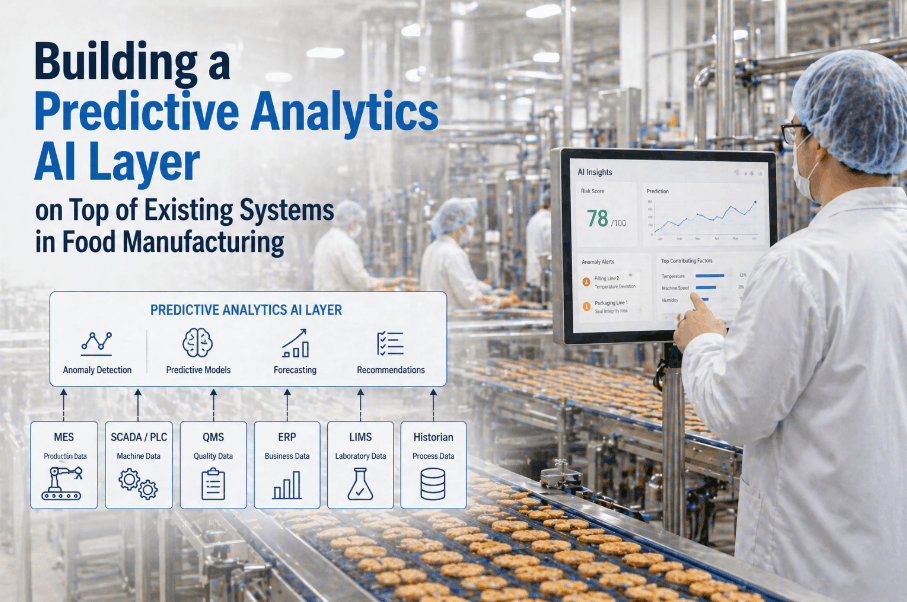
Standalone analytics software that doesn't communicate with your ERP, production scheduling system, or sensor network creates data silos. Top-tier industrial analytics SaaS platforms for food manufacturing offer pre-built connectors for SAP, Oracle, Aveva, and major PLC manufacturers, enabling a unified operational picture.
Plant leaders need live visibility into MTTR, OEE, PM compliance rates, and labor utilization — not weekly PDF reports. AI-driven dashboards that surface anomalies proactively (rather than reactively) allow management to intervene before small deviations become costly production losses.
AI-Driven Software Comparison: Manual vs. AI-Augmented Food Plant Operations
The operational delta between a traditionally managed food plant and an AI-augmented facility is most visible in the metrics that directly drive profitability. The following comparison illustrates how leading AI-powered analytics platforms for food processing transform each core maintenance function — and the measurable impact on plant-wide efficiency. Plants exploring this upgrade can book a demo to see exact benchmarks for their segment.
| Plant Function | Legacy / Manual Approach | AI-Driven Platform Capability | Measurable Improvement | Business Impact |
|---|---|---|---|---|
| Equipment Monitoring | Fixed-interval walk-arounds by technicians | Continuous IoT-based condition monitoring | 10–15 labor hours saved per week | Fewer techs cover more assets |
| Fault Detection | Operator reports symptom after failure | AI detects anomaly 3–14 days before failure | 60–80% reduction in surprise failures | Eliminates unplanned downtime events |
| Work Order Creation | Manual supervisor review and data entry | Auto-generated on fault signature trigger | 5+ hours per lead per week recovered | Removes administrative bottleneck |
| Repair Troubleshooting | Manual binder lookup and experience recall | AI generates step-by-step diagnosis guide | 35% reduction in Mean Time to Repair | Junior techs perform at senior levels |
| Compliance Logging | Paper-based records filed manually | Automatic timestamped digital audit trail | 20+ hours per week across team | Zero technician admin time for logs |
| Audit Preparation | Days of searching archives and binders | One-click exportable compliance packages | 80–100 hours saved per audit cycle | Dramatically reduces audit stress |
| New Hire Onboarding | Weeks of shadow training with senior staff | AI-guided work orders with embedded training | 50% faster time-to-competency | Scales new frontline hires rapidly |
The ROI Case for AI-Driven Analytics Software in Food Processing Plants
For plant engineers and operations directors evaluating AI-driven software ROI in food manufacturing, the financial justification is straightforward. The three primary cost levers — unplanned downtime, overtime labor, and third-party contractor spend — are all directly reduced by a well-implemented predictive analytics platform. Most food manufacturers report full ROI within 6–9 months of go-live, driven by measurable improvements in each category. Understanding how predictive analytics eliminates emergency repair costs is the starting point for building the internal business case.
Segment-Specific AI Analytics Capabilities: Which Platform Features Matter Most for Your Operation
Food manufacturing is not a monolithic industry. The right AI-driven analytics software for food processing must address the specific equipment complexity, turnover rates, and compliance burden of each segment. A dairy plant's CIP automation challenges are fundamentally different from a snack manufacturer's changeover complexity. The most effective plant engineering AI software platforms offer segment-specific configuration that accounts for these differences. Leading manufacturers across all segments are inviting their engineering teams to book a demo to see segment-specific workflows in action.
High turnover rates and demanding sanitation schedules require rapid onboarding tools and voice-controlled mobile interfaces. AI-driven platforms in this segment prioritize HACCP-linked digital checklists and automated sanitation logging to keep compliance intact despite rotating crews.
Complex CIP systems and aseptic line management demand advanced diagnostic AI. Fewer specialized technicians can manage intricate flow, temperature, and pressure balance requirements when supported by AI-guided troubleshooting tied directly to sensor telemetry from pasteurizers and fillers.
Continuous throughput lines and dusty environments make bearing and motor wear a persistent challenge. Vibration and thermal monitoring integrated into AI analytics platforms allows early-stage wear detection — replacing costly emergency repair shifts with scheduled daytime interventions.
Millisecond-accuracy filling and labeling lines generate enormous amounts of reject and jam data. AI analysis of rejection patterns allows technicians to proactively tune filler performance — avoiding the massive product scrap events that follow undetected mechanical drift in high-volume operations.
Deep-freeze environments create severe physical inspection challenges. Remote AI monitoring of refrigeration compressors, condensers, and evaporators replaces much of the manual inspection burden — protecting cold chain integrity while reducing technician exposure to extreme temperature environments.
Allergen changeover procedures are among the most labor-intensive and compliance-critical processes in food manufacturing. AI-optimized changeover checklists and automated sanitation scheduling consistently reduce changeover downtime by 30–40% while ensuring zero documentation gaps for allergen control records.
Implementation Roadmap: How to Deploy AI-Driven Analytics Software in a Food Plant
Successful AI analytics software deployment in food manufacturing follows a structured, phased approach that minimizes operational disruption while maximizing adoption speed. Plants that attempt a single-phase "big bang" rollout consistently underperform compared to those that build competency progressively. The following roadmap reflects best practices across dozens of F&B plant implementations. Facilities ready to begin this journey can schedule a labor optimization assessment as the first step.
Workflow Audit & Asset Hierarchy Mapping
Identify where technician hours are being lost to paperwork, travel, and unplanned response. Map your complete asset hierarchy — from critical production lines to supporting utilities — into the AI platform's digital twin. This foundational phase creates the data architecture that all subsequent AI models will rely on for accurate predictions.
Digital Work Order Deployment & Team Adoption
Replace paper PMs with mobile-first digital work orders and activate AI-guided troubleshooting. This phase typically delivers a 15–20% productivity boost through better task organization alone — and builds the technician habit of digital documentation that all future AI features depend on for data quality.
IoT Sensor Integration & Predictive Alert Go-Live
Connect critical machinery to the AI platform via IoT sensors and shift from calendar-based PMs to condition-based maintenance triggers. This is the phase where the platform begins actively predicting failures and generates its most dramatic ROI — typically a 40–60% reduction in unplanned downtime events within the first 90 days.
AI Capacity Planning & Labor Optimization
With a full dataset of equipment health trends, the AI begins projecting future labor demand weeks in advance. Shift schedules and technician assignments are optimized around predicted maintenance windows — eliminating the labor crunch that occurs when multiple unplanned failures coincide during peak production periods.
Full ERP Integration & Continuous Workforce Development
Integrate labor analytics with ERP and HR systems to create a unified operational intelligence layer. Continuous skills gap analysis and automated in-work-order training modules ensure your workforce improves in capability every single shift — turning AI-driven analytics software into a permanent competitive advantage for your facility.
Frequently Asked Questions: AI-Driven Software for Food Manufacturing
A traditional CMMS records maintenance history and manages work orders reactively. An AI-driven analytics platform goes further by analyzing equipment sensor data in real time, predicting failures before they occur, and automatically generating prioritized work orders with AI-recommended repair instructions. In a food manufacturing environment, this distinction is critical — CMMS systems reduce administrative effort, while AI analytics platforms directly reduce downtime and labor costs.
Leading AI-driven platforms automatically generate timestamped digital records for every maintenance task completed, every inspection performed, and every corrective action taken. These records are structured to align with FSMA and HACCP documentation requirements, allowing one-click audit package export that eliminates the days of manual archive searching that traditional compliance preparation requires.
Most food manufacturing facilities report measurable ROI within 6–9 months of full deployment, driven primarily by reductions in unplanned downtime events, overtime elimination, and contractor spend reduction. Plants with high baseline emergency repair frequency tend to see ROI even faster — sometimes within the first 60–90 days of predictive alerting going live.
The best platforms are designed for the production floor, not the IT department. Features like large-format mobile layouts, voice-to-text input, photo capture within work orders, and swipe-to-complete task flows ensure that technicians of all technical backgrounds can adopt the system quickly — typically reaching full proficiency within one to two weeks of onboarding.
Yes. While newer machinery with built-in sensor outputs integrates most seamlessly, leading platforms support retrofitted IoT sensors on older equipment, allowing plants to extend predictive monitoring to legacy assets without replacing them. Vibration sensors, thermal imaging attachments, and current monitoring clamps can be added to virtually any production line equipment manufactured in the past two decades.