Food manufacturing plants lose an average of $50,000 per hour of unplanned production downtime — and in 2026, that number is climbing faster than ever. As consumer demand intensifies and supply chains tighten, a single unexpected machine breakdown on a high-speed packaging or processing line can trigger cascading delays, missed delivery windows, and devastating compliance gaps. The good news: AI-powered predictive analytics and smart asset monitoring systems are now transforming how food factories prevent, detect, and eliminate production line downtime before it ever occurs. Book a Demo to see how iFactory's AI analytics platform cuts downtime by up to 47% across food processing lines.
AI-Driven Predictive Analytics for Food Factories
See how food manufacturers are achieving near-zero unplanned downtime with AI-driven analytics — purpose-built for food processing environments.
Why Food Manufacturing Downtime Is a $260 Billion Problem in 2026
The global food processing industry is staring down a compounding crisis. According to industry analysts, unplanned equipment failures account for nearly 23% of total production capacity loss in food manufacturing plants worldwide. What makes food factories uniquely vulnerable is the intersection of perishable raw materials, strict hygiene regulations, and continuous high-speed operations. Traditional preventive maintenance schedules are rapidly becoming obsolete, costing the average mid-sized food manufacturer between $1.2M and $3.8M annually. The shift to AI-driven predictive analytics for food processing is no longer an innovation story — it is a competitive survival requirement. Plants that deploy smart asset monitoring and machine learning-based failure prediction are achieving equipment availability rates above 97%, while their reactive-maintenance counterparts struggle to exceed 82%.
The Top 5 Root Causes of Production Line Downtime in Food Factories
Before deploying any food production line analytics software, plant managers need to understand exactly where their downtime originates. Industry data consistently points to five primary failure categories that together account for over 80% of all unplanned stops in food manufacturing environments.
Mechanical Wear on High-Speed Packaging Equipment
Fillers, sealers, and labelers operating at 400–600 units per minute experience accelerated bearing wear, belt degradation, and misalignment. Without real-time vibration and temperature monitoring, these failures announce themselves only after a catastrophic stop — not before.
Sanitation-Cycle Damage and Moisture Intrusion
Daily CIP (Clean-In-Place) and wet washdown cycles are legally mandatory in food production — but they are also the leading cause of electrical and sensor failures. High-pressure water intrusion into motor housings, control panels, and conveyor drives goes undetected until the next shift discovers a dead machine.
Unmonitored HVAC and Cold Chain Equipment Failure
In poultry, dairy, and frozen food processing, ambient temperature maintenance is both a product quality and food safety requirement. Compressor failures or refrigerant leaks in cold-room environments can result in entire batch losses worth hundreds of thousands of dollars — losses that proper equipment reliability monitoring can prevent entirely.
Manual Work Order Backlogs and Delayed Maintenance Response
In plants still operating on paper-based or spreadsheet work orders, the lag between fault detection and technician dispatch averages 4.2 hours. During this window, secondary damage compounds the original failure, turning a 45-minute repair into a 6-hour production halt. Book a Demo to see how digital work order automation cuts response time to under 12 minutes.
Spare Parts Stockouts and Unplanned Procurement Delays
When critical components fail unexpectedly, the repair timeline is often determined not by technician skill but by parts availability. Plants without predictive spare parts inventory management routinely face 24–72 hour procurement delays for motors, bearings, and seals — every hour of which translates directly to lost production output.
How AI Predictive Analytics Software Works in Food Manufacturing
Modern AI analytics software for food factories operates on a fundamentally different principle than traditional time-based maintenance. Instead of asking "when was this machine last serviced?", it asks "what does this machine's current sensor signature tell us about its failure probability in the next 4 hours?" The technical architecture of an industrial analytics automation platform for food manufacturing typically integrates four data streams simultaneously: vibration signatures, thermal imaging, electrical consumption anomaly detection, and production throughput deviation tracking. When these streams are analyzed together by a machine learning model, the system can predict with 89–94% accuracy whether a specific asset will fail within the next maintenance window. Book a Demo to see iFactory's four-stream analytics model applied to your specific line configuration.
Real-Time OEE Monitoring and Digital Twin Integration
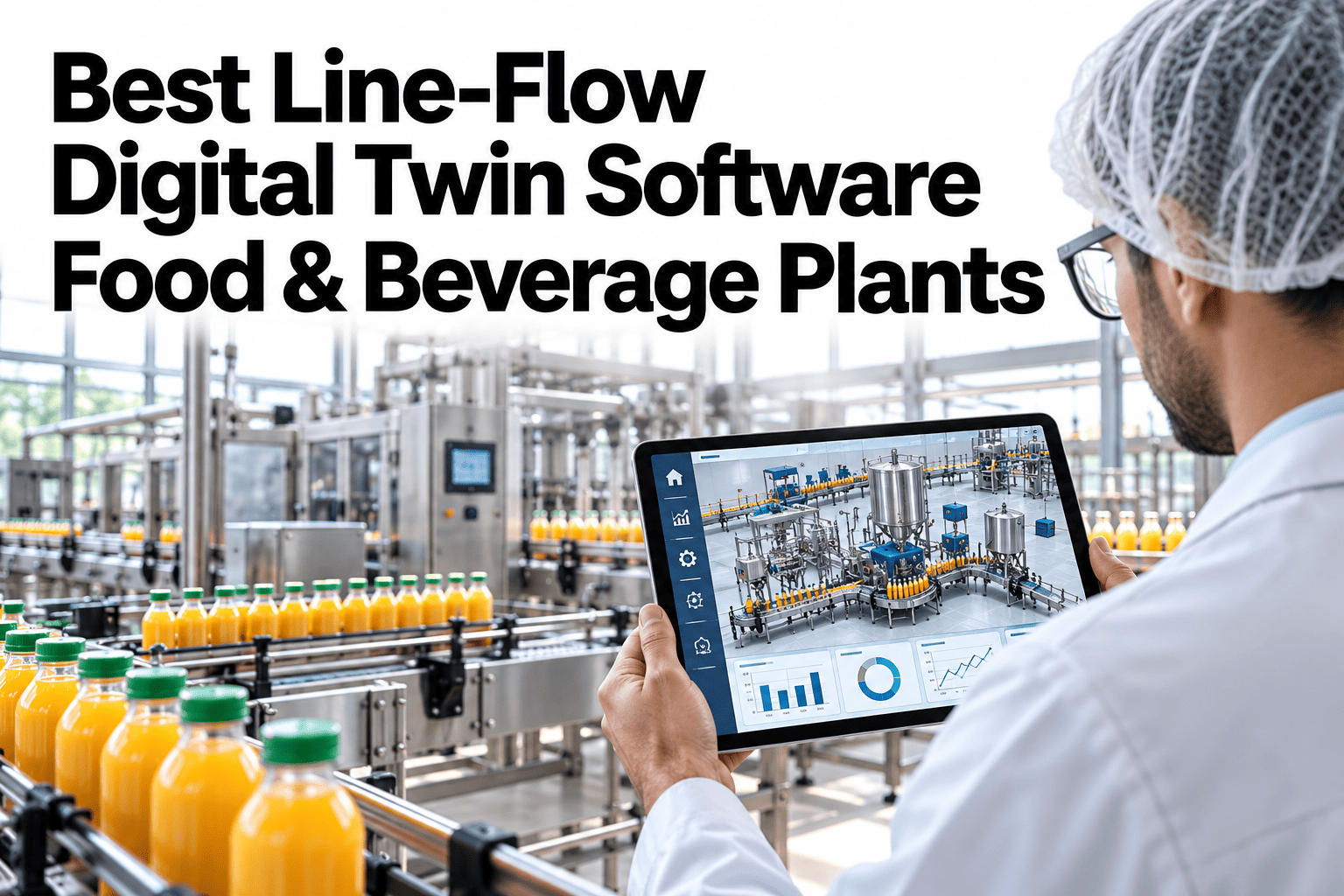
The most advanced smart factory analytics solutions now combine predictive failure analytics with real-time Overall Equipment Effectiveness (OEE) dashboards and digital twin technology. A digital twin creates a live virtual replica of each production asset, updating in milliseconds. When the digital twin detects a divergence between expected and actual performance parameters, it triggers an automated alert hierarchy. For food manufacturers, this capability is particularly powerful during changeovers and after sanitation cycles — the two highest-risk periods for undiscovered equipment damage. The system continuously validates that each asset has returned to baseline performance signature before the line resumes full-speed production.
AI vs. Traditional Maintenance: A Direct Performance Comparison
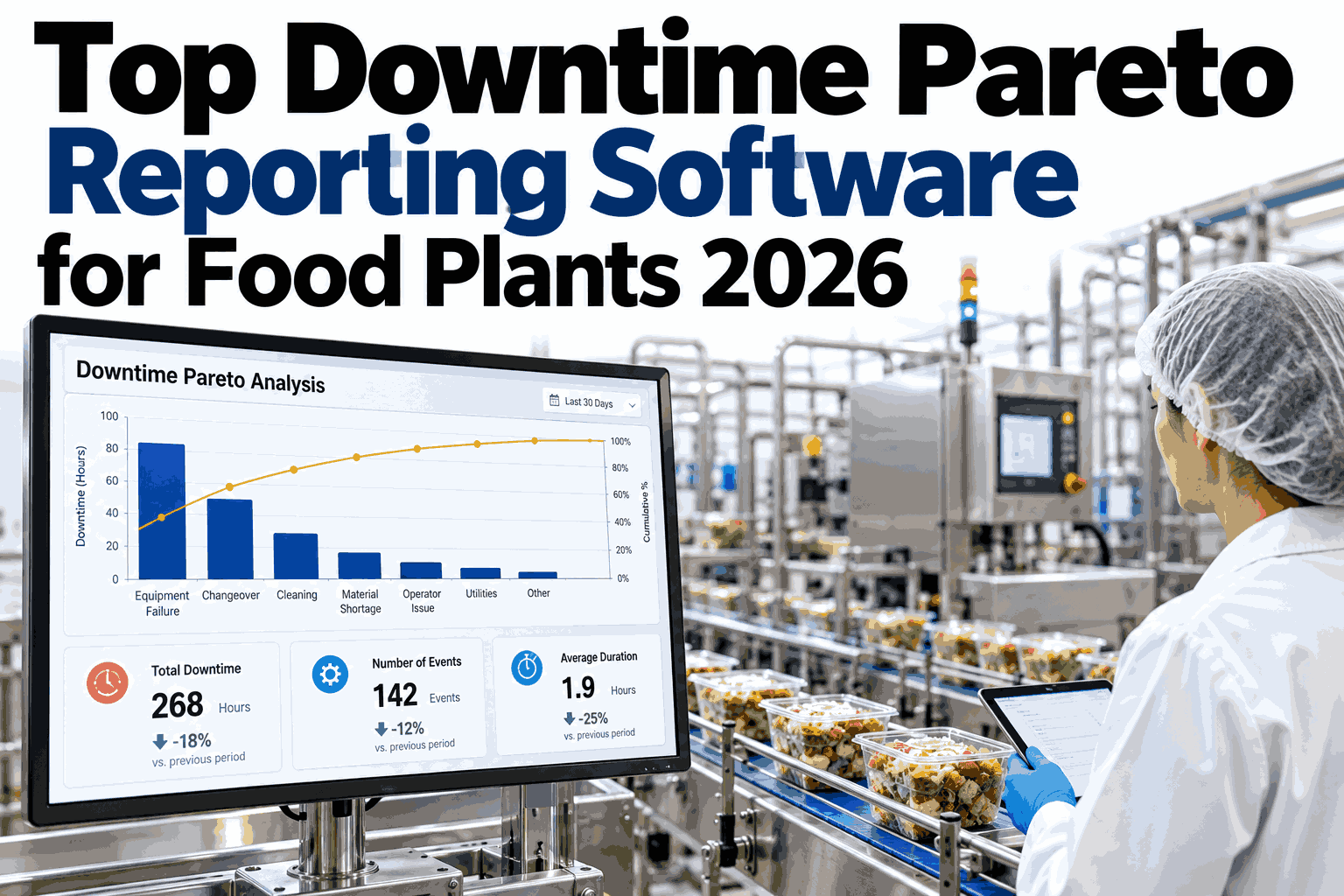
To quantify the value of deploying AI-driven maintenance for food processing plants, the following comparison maps key performance metrics across three maintenance maturity levels commonly found in the food industry today.
| Performance Metric | Reactive Maintenance | Scheduled Preventive | AI Predictive Analytics |
|---|---|---|---|
| Unplanned Downtime / Month | 18–26 hours | 8–14 hours | 1–3 hours |
| Mean Time to Detect Fault | After failure | At next scheduled check | 4–15 minutes |
| Work Order Response Time | 4.2 hours avg | 2.1 hours avg | Under 12 minutes |
| Equipment Availability (OEE) | 74–81% | 83–88% | 94–98% |
| Annual Maintenance Cost / Line | $420K–$680K | $280K–$420K | $140K–$220K |
| Spare Parts Inventory Accuracy | Untracked | Periodic manual count | Real-time, demand-linked |
| Compliance Documentation | Paper binders | Scanned records | Auto-generated, audit-ready |
Key Features of a Food Factory Analytics Intelligence Platform
Not all industrial analytics platforms are built with food manufacturing's unique operational and regulatory requirements in mind. A purpose-built food factory analytics intelligence platform must address food-grade environments, GMP compliance, FSMA traceability requirements, and the unique challenges of wet processing, cold storage, and high-throughput packaging simultaneously. Here are the six capabilities that separate a truly effective system from a generic CMMS solution.
Sanitation-Aware Equipment Monitoring
The system must understand CIP cycles, washdown schedules, and chemical exposure profiles for each asset. Post-sanitation anomaly detection ensures that water-damaged sensors or motors are flagged before the next production run begins — not discovered when the line fails two hours in.
Cold Chain and Ambient Temperature Intelligence
For refrigerated and frozen food processing, compressor health monitoring, refrigerant pressure trending, and ambient temperature deviation alerts are non-negotiable. A 2°C temperature drift in a blast freezer that goes undetected for 90 minutes can render an entire production batch non-compliant under FDA temperature logging requirements.
Digital Work Order Automation with Mobile Dispatch
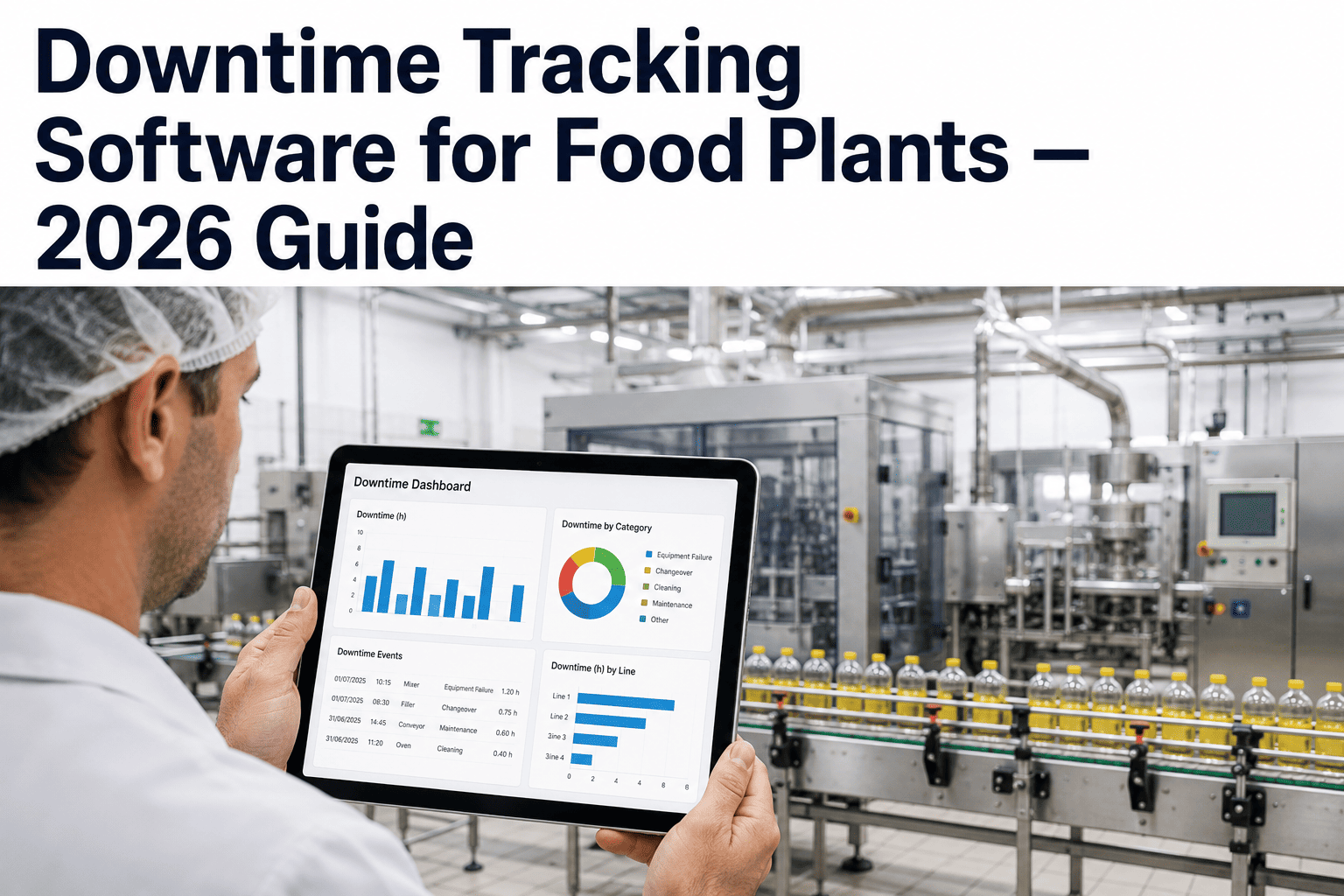
When a predictive alert triggers, the system must automatically generate a structured work order — including the fault description, required parts, relevant SOP documentation, and technician assignment — and deliver it to the maintenance team's mobile device within 60 seconds. This capability alone accounts for a 73% reduction in mean time to repair in early-adopter food plants. Book a Demo to see iFactory's automated dispatch workflow in action.
Predictive Spare Parts Inventory Management
By correlating equipment health scores with historical failure patterns, AI analytics can forecast which components will need replacement 30–60 days in advance — triggering purchase orders before stockouts occur. This eliminates the most common cause of extended downtime in food plants: waiting for parts to arrive.
FSMA and GMP Compliance Audit Trail
Every maintenance event, calibration check, and equipment inspection must be time-stamped, digitally signed, and stored in an immutable audit log that satisfies FDA 21 CFR Part 11 requirements and GFSI audit standards. Manual paper records are inherently non-compliant with modern traceability mandates — and increasingly are flagged during third-party audits.
Multi-Line OEE Benchmarking Dashboard
Plant managers need a unified view of availability, performance, and quality rates across every production line in real time. A benchmarking dashboard that compares current OEE against historical baselines, shift targets, and industry benchmarks gives operations leadership the visibility needed to make data-driven staffing, scheduling, and capital investment decisions.
Implementation Roadmap: From Reactive to Predictive in 6 Months
The most common barrier food manufacturers cite when considering AI analytics software is implementation complexity. The reality is that a structured, phased deployment can achieve measurable downtime reduction results within the first 60 days — well before full platform deployment is complete. Here is the proven 6-month roadmap that leading food plants are following in 2026.
Complete digital inventory of all production assets. Install IoT vibration, temperature, and current sensors on Tier 1 critical equipment. Establish 30-day baseline data collection to calibrate failure prediction models.
Replace paper-based work orders with automated digital dispatch. Connect maintenance team mobile devices. Begin tracking mean time to detect, respond, and repair for all assets.
AI models train on accumulated sensor data and historical failure events. Predictive alerts go live for high-priority assets. First wave of prevented failures validated against previous downtime records.
Expand sensor coverage to all production lines. Activate spare parts forecasting. Generate first quarterly ROI report documenting downtime reduction, rework elimination, and compliance cost savings.
ROI Calculator: What Predictive Analytics Is Worth to Your Plant
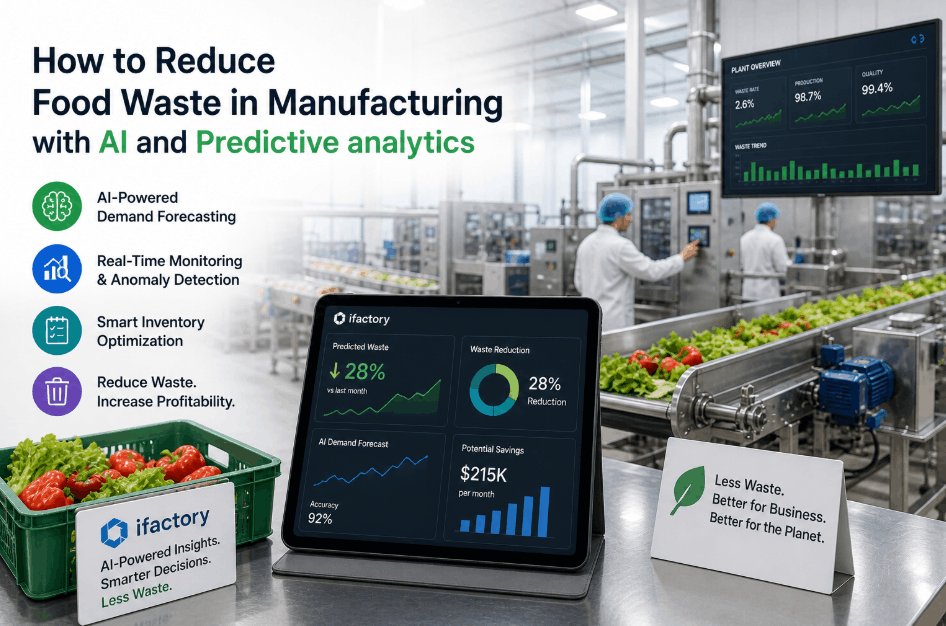
Food manufacturing executives consistently ask one question before approving analytics investments: "What is the measurable financial return?" The answer depends on plant size, product mix, and current downtime baseline — but industry data provides reliable estimates that finance teams can model with confidence. The financial case for AI-powered maintenance for food industry operations is consistently one of the strongest in any capital investment category available to plant leadership in 2026.
Frequently Asked Questions: AI Analytics for Food Manufacturing Downtime
Can AI predictive analytics integrate with our existing SCADA and PLC systems?
Yes. Modern food factory analytics platforms support OPC-UA, Modbus, MQTT, and REST API protocols — enabling direct integration with all major PLC brands including Siemens, Allen-Bradley, Mitsubishi, and Omron. Data flows in real time from existing control systems without requiring line modifications or production interruptions during deployment.
How long does it take to see measurable downtime reduction after deployment?
Most food manufacturing plants report a measurable reduction in unplanned stops within the first 45–60 days of sensor deployment and baseline training. Full predictive model accuracy — where the system reliably predicts failures 4–8 hours in advance — typically reaches optimal performance after 90 days of operational data accumulation on each monitored asset.
Does the platform support multi-site operations across different geographies?
Cloud-native food factory analytics platforms are designed for multi-site deployment from the ground up. Operations directors can monitor OEE, maintenance backlogs, and equipment health scores across facilities in different countries from a single unified dashboard — with drill-down capability to the individual asset or sensor level at any site.
How does AI analytics handle the unique challenges of wet and washdown production environments?
Purpose-built food factory sensors are IP69K rated for high-pressure washdown resistance. The analytics platform maintains separate baseline models for pre-sanitation, during-sanitation, and post-sanitation equipment states — so washdown cycles don't generate false alarms, and genuine post-washdown damage is detected within minutes of line restart. Book a Demo to see how iFactory handles washdown environments across poultry, dairy, and beverage processing lines.
What is the difference between predictive analytics and traditional preventive maintenance software?
Traditional preventive maintenance software schedules service based on calendar intervals or usage hours — regardless of actual equipment condition. Predictive analytics uses real-time sensor data and machine learning to service assets only when condition indicators signal an approaching failure. This eliminates both over-maintenance (servicing healthy equipment unnecessarily) and under-maintenance (missing failures between scheduled checks).
Is the system compliant with FSMA, SQF, and GFSI audit requirements?
Yes. All maintenance events, inspections, and equipment health records are stored with immutable timestamps, digital signatures, and full audit trails that satisfy FSMA Section 204 traceability requirements, SQF Code Edition 9 maintenance program standards, and GFSI-benchmarked scheme documentation requirements. Audit-ready reports can be generated in under 60 seconds for any time period.
See iFactory's AI Predictive Analytics Platform Live — Built for Food Manufacturing
Demo configured around your equipment types, production lines, compliance environment, and downtime baseline.