A CIP (Clean-In-Place) system is the backbone of sanitation compliance in food manufacturing — but without structured preventive analytics, even the most sophisticated CIP circuit becomes a liability. When chemical concentrations drift, temperature contact times fall short, or flow velocities fail to reach turbulent thresholds, the result isn't just a failed audit; it's a potential pathogen harborage that no amount of reactive cleaning can fully remediate. Book a Demo to see how iFactory's AI-driven platform digitizes your CIP preventive analytics and delivers audit-ready compliance from day one.
CIP ANALYTICS PLATFORM
FSSAI & FSMA READY
REAL-TIME MONITORING
Automate Your CIP Sanitation Compliance Across Every Processing Line
Centralize CIP cycle logs, validate chemical dosing, track temperature contact time, and generate immutable audit trails — all from one AI-driven food safety management platform.
Why a CIP Preventive Analytics Checklist Is Non-Negotiable in Food Manufacturing
Modern food processing facilities run dozens of CIP cycles daily across tanks, pipelines, heat exchangers, and filling equipment. Without a structured CIP system preventive analytics checklist, maintenance teams have no reliable way to detect cycle drift, chemical concentration depletion, or pump degradation before these failures result in a regulatory non-conformance or, worse, a contaminated product batch. Preventive analytics transforms your CIP program from a paper-based, shift-dependent process into a digitally governed, continuously improving compliance machine. Book a Demo and discover how leading food manufacturers have reduced sanitation non-conformances by over 40% in the first six months of implementation.
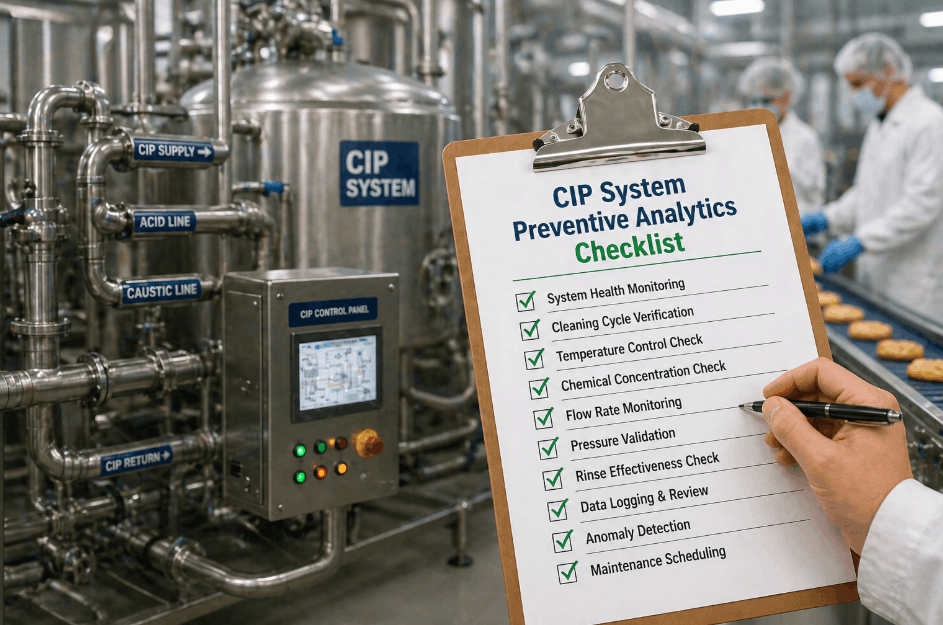
The following checklist is structured across six critical domains of CIP system oversight: circuit integrity, chemical analytics, thermal compliance, microbiological validation, sensor calibration, and digital documentation. Each domain represents a distinct failure mode that, when left unmonitored, escalates into an audit finding or a product safety incident. Work through each section systematically before your next scheduled sanitation cycle or FSMA inspection window.
1. CIP Circuit Integrity & Flow Path Verification
Confirm that every inch of your CIP loop is mechanically sound and hydraulically validated. Dead legs, bypassed valves, and corroded fittings are the most common source of recurring sanitation failures in food plants. Book a Demo to map your CIP circuits digitally.
2. Chemical Concentration & Dosing Analytics
Validate that every CIP chemical phase delivers the correct concentration at the point of contact. Under-concentration fails to remove biofilm; over-concentration damages equipment and creates compliance liabilities. Book a Demo to automate your chemical dosing logs.
3. Temperature & Contact Time Compliance Monitoring
Heat is a non-negotiable CIP parameter — insufficient temperature collapses cleaning efficacy regardless of chemical concentration. This section ensures your thermal profile is validated against the Arrhenius relationship that governs chemical reaction kinetics in sanitation chemistry.
4. Microbiological Validation & ATP Swab Analytics
Chemical and thermal compliance data tells you the process ran correctly — ATP and environmental monitoring data tells you whether it worked. Integrate your microbiological verification data into the same digital platform as your CIP cycle logs to enable true root-cause trending.
5. Sensor Calibration & Instrumentation Integrity
Your CIP analytics are only as accurate as the instruments generating the data. Drifted sensors produce false compliance records — the most dangerous type of documentation failure because it creates the illusion of control where none exists.
6. Digital Documentation, Audit Trail & Compliance Reporting
A perfectly executed CIP cycle has zero regulatory value if the documentation is incomplete, inaccurate, or tamper-susceptible. This final section ensures your digital records are as robust as your physical sanitation program. Book a Demo to see iFactory's immutable audit log in action.
TRANSFORM COMPLIANCE
ZERO AUDIT DEFICIENCY
Digitize Your CIP Preventive Analytics Program Today
Join leading food manufacturers automating CIP cycle validation, chemical dosing analytics, microbiological trending, and real-time audit-trail generation — all in one AI-driven food safety platform.
Frequently Asked Questions — CIP System Preventive Analytics
1. What is the difference between CIP validation and CIP verification in food manufacturing?
CIP validation is a scientific study that proves a specific protocol achieves the required log-reduction of target organisms on the equipment being cleaned. CIP verification is the day-to-day monitoring of cycle parameters to confirm that validated process is being executed consistently. Both are required by FSMA, SQF, and BRC standards.
2. How often should CIP sensors be calibrated in a food processing facility?
Temperature sensors should be calibrated every six months, conductivity probes every three months, and pH electrodes monthly due to their inherent drift characteristics. Intervals should be shorter when the parameter being measured is a Critical Control Point in your HACCP plan. All calibration records must remain traceable to a NIST-recognized standard.
3. What ATP result threshold indicates a failed CIP cycle on food-contact surfaces?
Aligned with 3-A Sanitary Standards, a passing result is ≤10 RLU on direct food-contact surfaces; results of 11–50 RLU trigger a re-clean and re-test protocol. Any result above 50 RLU constitutes a failed CIP event and must initiate a full deviation investigation before the line is released for production.
4. Can a single CIP program be used for all equipment in a food plant?
No — each CIP circuit requires a validated program that reflects the unique geometry, soil load, and hydraulic characteristics of that specific loop. Using a single generic program across all equipment is a common regulatory finding and a root cause of persistent microbiological failures. Each loop must be validated independently before routine use.
5. How does predictive analytics improve CIP efficiency without compromising food safety?
Predictive analytics identifies patterns in chemical consumption, temperature recovery, and ATP pass rates that precede cycle failures, allowing teams to intervene before a sanitation breakdown occurs. This proactive approach eliminates unplanned repeat cycles, reducing both chemical and water consumption while maintaining full compliance. The result is measurable cost reduction alongside stronger food safety performance.
6. What regulatory standards govern CIP documentation requirements in food manufacturing?
FDA's FSMA Preventive Controls rule (21 CFR Part 117), SQF Edition 9, BRC Global Standard Issue 9, and FSSAI Schedule 4 all mandate documented CIP procedures with frequency, concentration, temperature, and contact time records. Non-compliance with documentation requirements is consistently among the top five audit findings across all major food safety certification bodies.
7. What is the typical ROI timeline for implementing a digital CIP analytics platform in food manufacturing?
Most facilities recover their investment within 6–9 months through reduced chemical waste, elimination of repeat cleaning cycles, and avoidance of audit non-conformance costs. The prevention of even a single product recall — which averages $10 million in direct costs for food manufacturers — represents the highest-value outcome of a fully digitized CIP compliance program.
8. How do I know if my current CIP system is underperforming before a regulatory audit?
Key early indicators include rising ATP failure rates despite consistent chemical usage, increasing frequency of repeat clean cycles, and unexplained product quality deviations tied to specific processing lines. If your team is relying on paper logs without trend analysis, you are operating blind — by the time an auditor identifies the gap, the root cause has typically been active for months.
AUDIT-READY FROM DAY ONE
REAL-TIME CIP INSIGHTS
Ready to Eliminate CIP Compliance Gaps Across Your Facility?
See how iFactory's AI-driven platform gives your food safety team complete visibility into every CIP cycle — from chemical dosing and thermal compliance to ATP trending and instant audit-export.


-system-analytics-best-practices-for-food-and-beverage.png)
-system-validation-and-analytics-checklist.png)