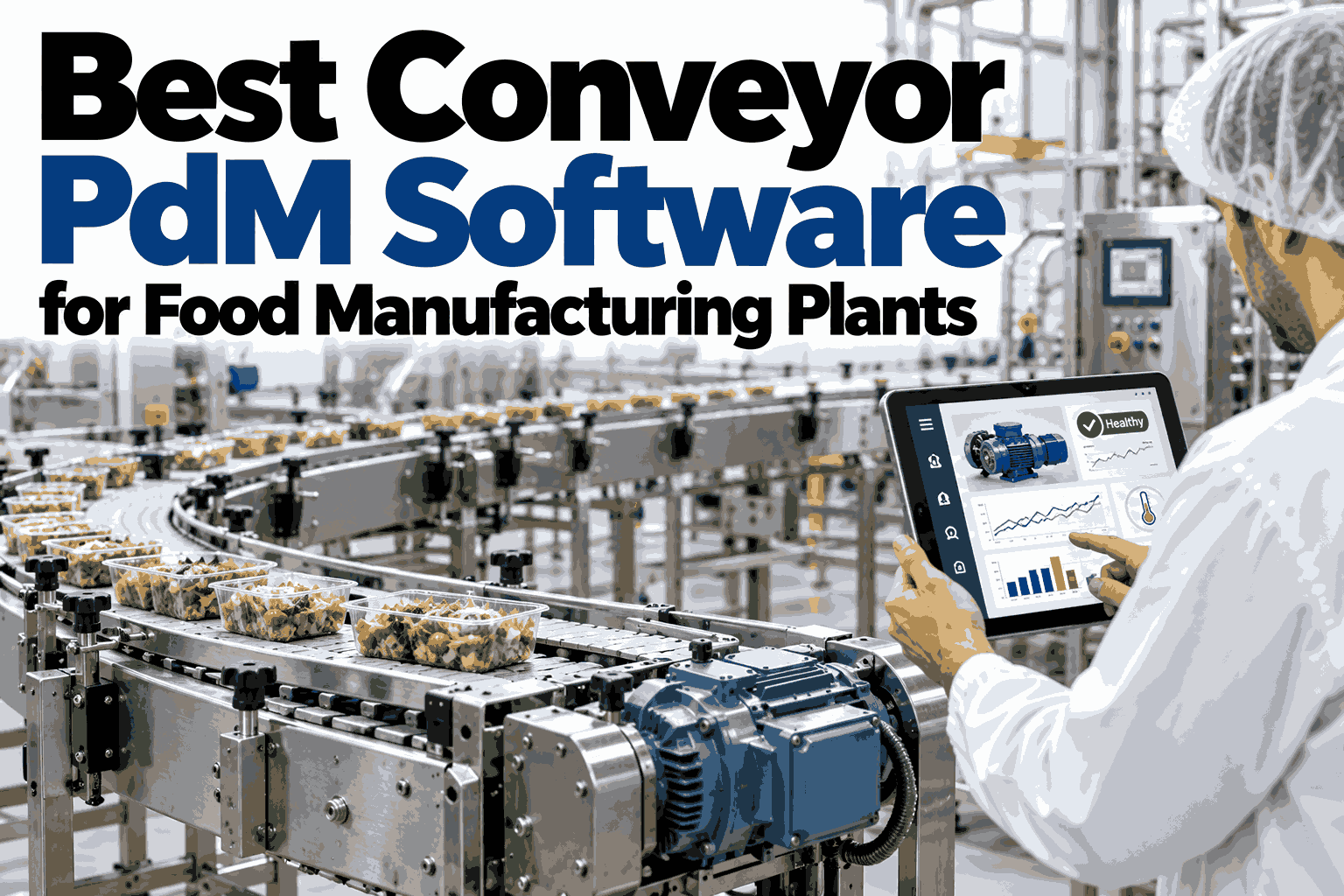
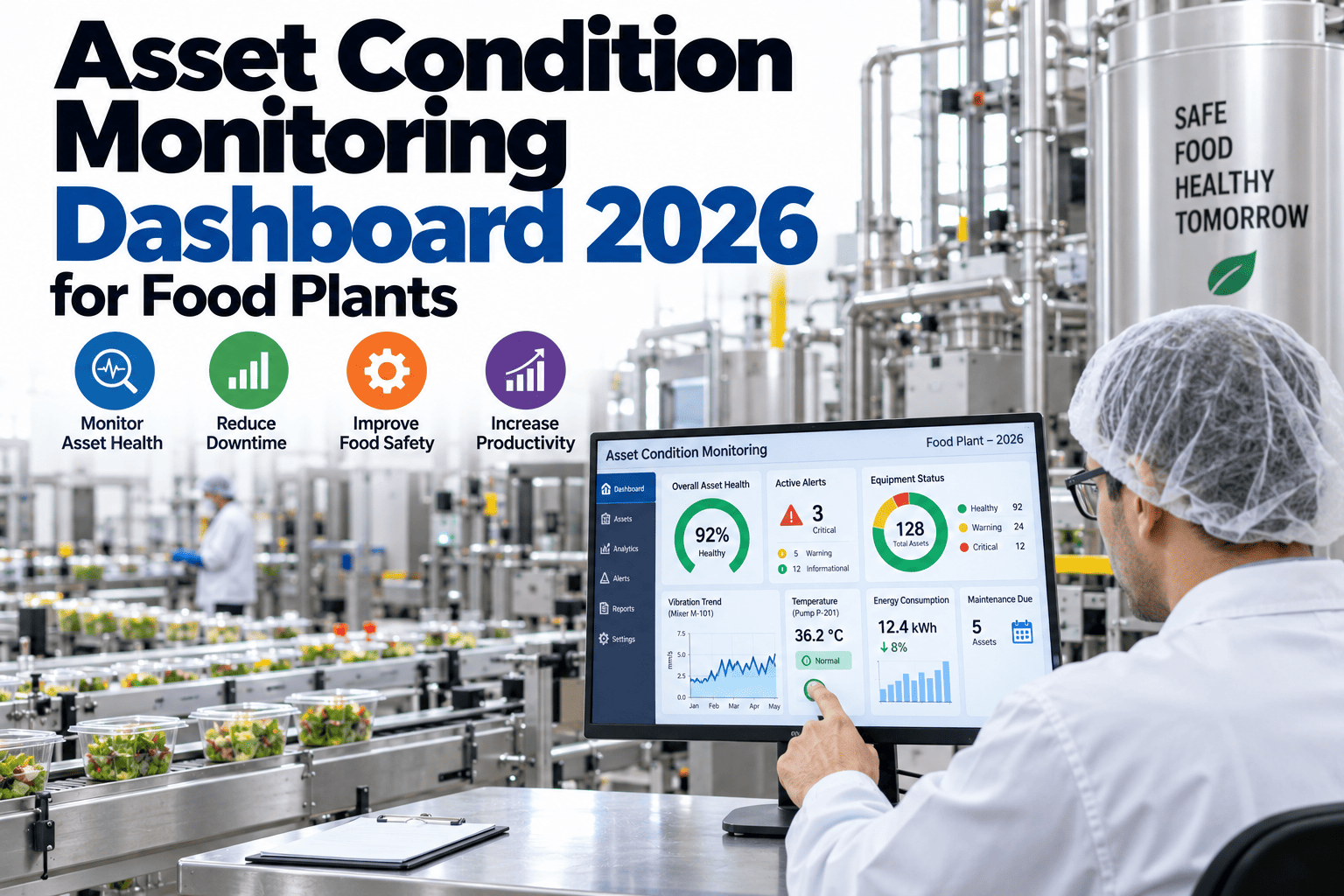
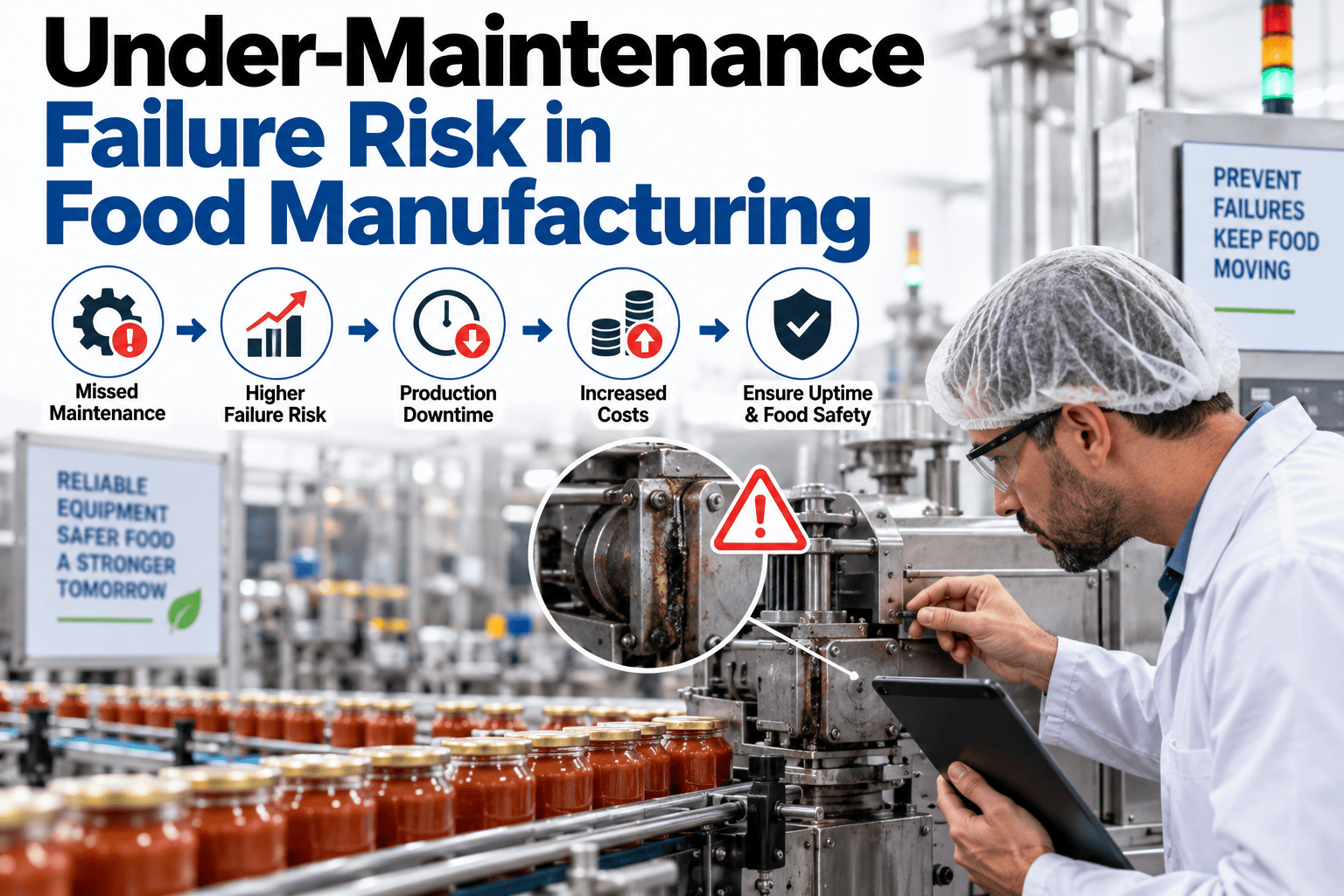
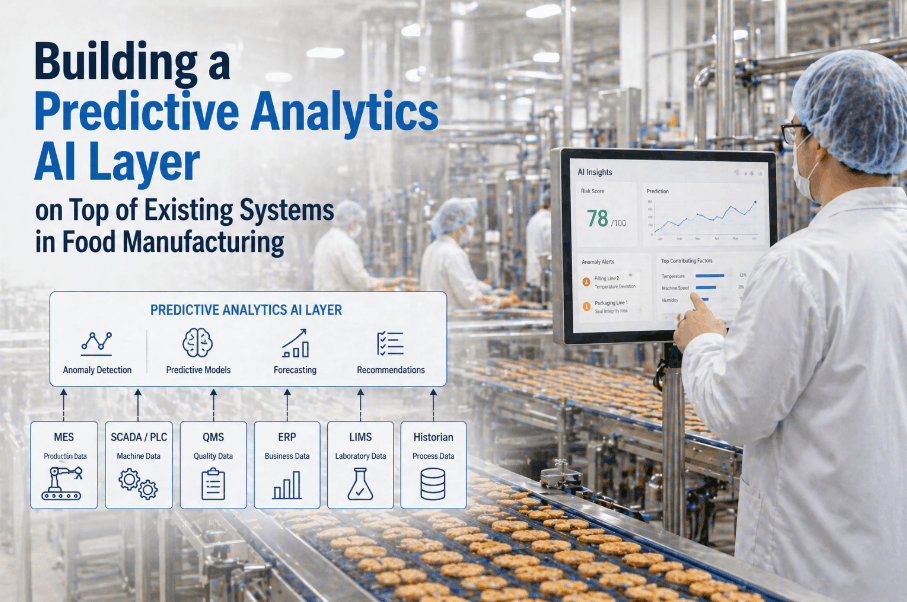
AI-powered downtime probability modeling is fundamentally reshaping how food manufacturing plants anticipate, quantify, and prevent equipment failures before they disrupt production continuity. Unlike reactive break-fix cycles or fixed-interval scheduled maintenance, predictive maintenance software driven by machine learning generates real-time failure probability scores for every critical asset on the line — from high-speed fillers and pasteurizers to conveyor drives and CIP pump sets. The result is a mathematically defensible, continuously updated shutdown prevention engine that transforms raw sensor telemetry into operational decision intelligence. If your plant is still scheduling maintenance based on calendar intervals rather than actual machine condition, Book a Demo to see how AI downtime prediction changes the operational calculus entirely.
AI RELIABILITY · DOWNTIME PREDICTION · FOOD MANUFACTURING
Predict Equipment Failures Before They Happen
Deploy AI downtime probability models across your food plant's critical asset base and shift from reactive maintenance to precision reliability engineering.
Why Downtime Probability Modeling Matters for Food Plant Operations
Food and beverage manufacturing plants operate under unique pressures that make unplanned downtime disproportionately costly. Production lines run 24/7 with minimal changeover buffer, compliance windows for temperature-sensitive products are narrow, and a single line stoppage can cascade into batch spoilage, missed shipments, and FDA or FSMA audit scrutiny. Traditional condition monitoring flags anomalies only after thresholds are breached — by then, the degradation curve has passed the point of low-cost intervention. Book a Demo to see how AI probability scoring shifts this equation entirely.
Core Inputs Powering AI Failure Prediction in Food Plants
The accuracy of any equipment failure prediction system is directly proportional to the diversity and quality of its input data streams. In food manufacturing environments, the highest-signal data sources combine mechanical condition indicators with process performance telemetry and contextual operational variables.
How the AI Probability Model Generates Risk Scores
iFactory's downtime prediction engine uses an ensemble of gradient boosting classifiers, RNN temporal sequence models, and physics-informed degradation curves calibrated per equipment family. Each asset receives a continuous Downtime Probability Index (DPI) — a 0-to-1 score representing failure likelihood within a configurable forecast horizon. A DPI above 0.75 auto-generates a high-priority work order; scores between 0.45 and 0.74 populate a watch list; below 0.45 requires no immediate action. Book a Demo to walk through a live DPI dashboard during an active production scenario.
AI Downtime Prediction Across Key Food Manufacturing Asset Classes
Different equipment families in a food processing facility exhibit distinct failure mode profiles and degradation timescales. iFactory's asset performance management platform maintains separate model configurations optimized for each major equipment class, ensuring that the probability scoring logic reflects the physics of failure unique to that machine type rather than applying a generic industrial template.
| Asset Class |
Primary Failure Mode |
Leading Indicator Signals |
Avg. Detection Lead Time |
Failure Cost Without AI |
| High-Speed Rotary Fillers |
Cam follower wear, seal degradation |
Vibration envelope, fill weight CV |
3–5 weeks |
$85,000–$220,000 per event |
| Pasteurizer / HTST Units |
Heat exchanger fouling, pump seal failure |
Differential pressure, thermal gradient |
2–4 weeks |
$60,000–$180,000 per event |
| CIP Pump Sets |
Impeller erosion, mechanical seal wear |
Current signature, flow deviation |
4–6 weeks |
$25,000–$90,000 per event |
| Conveyor Drive Systems |
Gearbox bearing spalling, chain elongation |
Vibration spectral harmonics, motor amps |
5–8 weeks |
$40,000–$130,000 per event |
| Mixing and Emulsification Units |
Agitator bearing failure, shaft seal leak |
Vibration RMS, motor current THD |
3–6 weeks |
$50,000–$160,000 per event |
| Packaging Line Servo Drives |
Encoder degradation, motor winding fault |
Velocity jitter, thermal trending |
2–3 weeks |
$30,000–$75,000 per event |
Integrating Predictive Risk Modeling with CMMS and ERP Workflows
AI prediction only delivers full value when outputs connect directly to the maintenance execution systems your teams already use. iFactory integrates with SAP PM, Oracle EAM, IBM Maximo, and independent CMMS platforms via REST API. When an asset crosses a DPI threshold, the system auto-generates a structured work order — asset ID, ranked fault hypothesis, inspection scope, and a suggested intervention window aligned to the production schedule. Technicians work entirely within their existing CMMS interface; no new platform adoption required. Book a Demo to see iFactory's bidirectional CMMS integration live.
Financial ROI of AI Downtime Probability Modeling: A Plant-Level Analysis
Executive stakeholders evaluating investments in operational risk management and predictive maintenance software consistently apply two financial lenses: the cost of a prevented failure event and the portfolio-level impact on OEE across the facility's asset base. Both lenses generate compelling ROI narratives when the underlying model performs with high precision and low false-positive rates.
68%
Reduction in unplanned downtime events in Year 1 post-deployment across food plant pilots
6–9 mo
Typical full ROI payback period for mid-size food manufacturing facilities (50–200 assets)
22%
Average reduction in total maintenance spend driven by elimination of emergency parts procurement premiums
4.1x
Average ROI multiple measured across food and beverage manufacturers in the first 24 months of AI reliability deployment
Deployment Architecture: From Sensor Data to Actionable Probability Scores
Deploying a production-grade AI downtime probability modeling system in a food manufacturing plant follows a structured architecture pathway that ensures data quality, model accuracy, and integration stability from day one. The deployment sequence below reflects iFactory's validated implementation methodology refined across multiple food and beverage facility roll-outs.
Asset Criticality Mapping and Sensor Gap Analysis
A structured asset register review identifies which equipment classes carry the highest unplanned failure cost. Sensor coverage gaps are flagged and addressed before model training begins, ensuring the AI has consistent, high-quality time-series data for every priority asset in the fleet.
Baseline Data Collection and Feature Engineering
A minimum of 8 to 12 weeks of multi-channel sensor data is collected under representative operating conditions. Feature engineering extracts fault-relevant signal characteristics — RMS vibration, spectral band energy, crest factor, current THD — that become the model's predictive input variables.
Model Training, Validation, and Precision Tuning
Historical failure records from the CMMS are used to label training data. Model precision and recall are optimized through cross-validation to minimize false positives — which erode technician trust — while maintaining high sensitivity to genuine early-stage degradation events.
Live Deployment and CMMS Integration Activation
The validated model is deployed to the iFactory edge-cloud hybrid infrastructure. Automated work order triggers are activated in the connected CMMS platform, and the maintenance team is onboarded to interpret DPI dashboards within the context of their operational planning cadence.
Continuous Model Retraining and Performance Monitoring
Feedback loops capture technician findings from completed work orders — confirmed faults, near-misses, and no-fault-found outcomes — to continuously retrain the model and improve its precision over time. Model performance metrics are surfaced in a dedicated reliability intelligence dashboard for engineering leadership review.
Common Failure Patterns AI Catches Early in Food Processing Lines
One of the most valuable capabilities of AI-powered predictive maintenance software is its ability to recognize complex, multi-variable failure signatures that no human analyst or single-threshold alarm could reliably detect. In food manufacturing environments, the following failure patterns represent the highest-frequency, highest-cost unplanned downtime scenarios — and the ones where early AI detection generates the clearest, most measurable financial return. Book a Demo to see live pattern detection examples from an active food plant deployment.
Pattern 01
Bearing Race Fatigue — High-Speed Fillers
Signal: Vibration FFT (BPFO/BPFI)Lead Time: 5–7 weeks
Sub-harmonic energy rises at bearing defect frequencies well before any audible noise or performance drop. AI raises the DPI score incrementally, giving a clear 30-day window for planned replacement.
Pattern 02
Mechanical Seal Wear — CIP Pump Sets
Signal: Pressure + Current DrawLead Time: 3–5 weeks
Micro-drops in discharge pressure combined with rising current baseline — neither triggers a traditional alarm alone, but AI correlates both and flags a 70%+ failure probability.
Pattern 03
Gear Mesh Irregularity — Conveyor Drives
Signal: Gear Mesh HarmonicsLead Time: 5–8 weeks
The AI tracks the rate of change in gear mesh frequency energy — not just magnitude — predicting the inflection point where tooth wear accelerates before threshold alarms can fire.
Pattern 04
Heat Exchanger Fouling — Pasteurizers
Signal: Differential Pressure + ThermalLead Time: 2–4 weeks
Rising differential pressure and declining thermal efficiency are cross-correlated against time since last CIP cycle to build a product-specific fouling probability score.
Pattern 05
Encoder Degradation — Packaging Servo Drives
Signal: Velocity Jitter + Position ErrorLead Time: 2–3 weeks
Microsecond-level velocity deviations invisible to operators are flagged by AI as precursors to fill-weight drift and packaging registration failures before any line stop occurs.
Pattern 06
Winding Insulation Breakdown — Drive Motors
Signal: Cumulative Thermal ExposureLead Time: 6–10 weeks
AI tracks thermal aging against manufacturer derating curves, predicting insulation failure months ahead of any measurable current imbalance or resistance test deviation.
Reliability Benchmarks: Food Plants With vs. Without AI Downtime Prediction
Cross-industry reliability data consistently demonstrates a structural performance gap between food manufacturing facilities operating AI-driven downtime prediction software and those relying on traditional planned maintenance or reactive repair models. The comparison below reflects aggregated benchmark data from mid-size food and beverage plants in the 100 to 500 employee range across processing, bottling, and dry-goods packaging sectors.
Unplanned Downtime Events / Year (per line)
18–32 events
5–9 events
Average MTTR (Mean Time to Repair)
6.4 hours
2.1 hours
Maintenance Cost as % of Asset Replacement Value
4.2% – 5.8%
1.9% – 2.6%
Emergency Parts Procurement Incidents / Year
24–40 incidents
4–8 incidents
Overall Equipment Effectiveness (OEE)
68% – 74%
83% – 91%
Failure Detection Lead Time
0 – 2 days (post-threshold)
3 – 8 weeks (pre-failure)
Annual Maintenance Budget Overrun Rate
34% of facilities exceed budget
7% of facilities exceed budget
Frequently Asked Questions: AI Downtime Prediction in Food Manufacturing
How accurate are AI downtime probability models for food plant equipment?
iFactory's ensemble models achieve precision rates above 87% with false positive rates below 8% after 12 months of labeled data. Maintenance teams receive actionable alerts — not noise — meaning every flag corresponds to a genuine, verifiable degradation event.
Can the system handle the diverse asset mix found in a multi-line food plant?
Yes. iFactory maintains separate model configurations for over 40 food and beverage equipment classes — fillers, pasteurizers, CIP systems, conveyors, and packaging lines. Each is tuned to the specific failure physics of that asset family.
What happens when a new asset is added that the model has not seen before?
New assets enter a supervised baselining period before predictive scoring activates. Transfer learning from similar asset classes in the fleet accelerates time-to-useful-prediction even with limited new-asset history.
Does the AI model account for product changeovers and seasonal operational shifts?
Yes. Product SKU, cleaning cycle intensity, ambient temperature, and run-rate are encoded as contextual features. Probability scores stay calibrated accurately through seasonal peaks, changeovers, and scheduled shutdown windows.
Is the system compliant with FSMA and FDA food safety documentation requirements?
iFactory generates immutable audit-trail logs for every anomaly event, work order trigger, and maintenance outcome. These records directly support FSMA preventive control documentation and FDA food safety audit evidence requirements.
How long does the initial deployment take before the system generates live predictions?
Facilities with existing sensor infrastructure go live in 6 to 10 weeks. Greenfield deployments take 14 to 18 weeks including hardware installation, data collection, and model training.
Does AI downtime prediction work for facilities with older legacy equipment that lacks built-in sensor connectivity?
Yes. Retrofit wireless sensors — magnetic-mount vibration nodes, clamp-on current loggers, and non-contact thermal sensors — instrument legacy assets with no machine modification. iFactory's hardware-agnostic ingestion layer normalizes signals from both legacy retrofits and modern connected assets in a single platform.
How does the system prioritize which assets to monitor when the facility has hundreds of machines?
iFactory's onboarding scores each asset across failure consequence severity, production line dependency, and historical failure frequency. Highest-scoring assets receive full sensor coverage and AI modeling on day one; lower-criticality assets follow in later phases.
Stop Reacting. Start Predicting.
Deploy AI downtime probability modeling across your food manufacturing plant and eliminate unplanned equipment failures with precision reliability intelligence from iFactory.