SAP xMII 15.5 reaches end of support in 2027—and there is no version 15.6. The J2EE architecture that powers your OEE dashboards, shop-floor integration, and quality reports was built for early-2000s data volumes. It cannot handle real-time sensor density, predictive analytics, or the adaptive SPC that modern food manufacturing demands. With migration timelines running 12–36 months, the planning window is already closing. Book a demo to see how food manufacturers are replacing xMII with predictive OEE that delivers 12–22% throughput gains within 12 months.
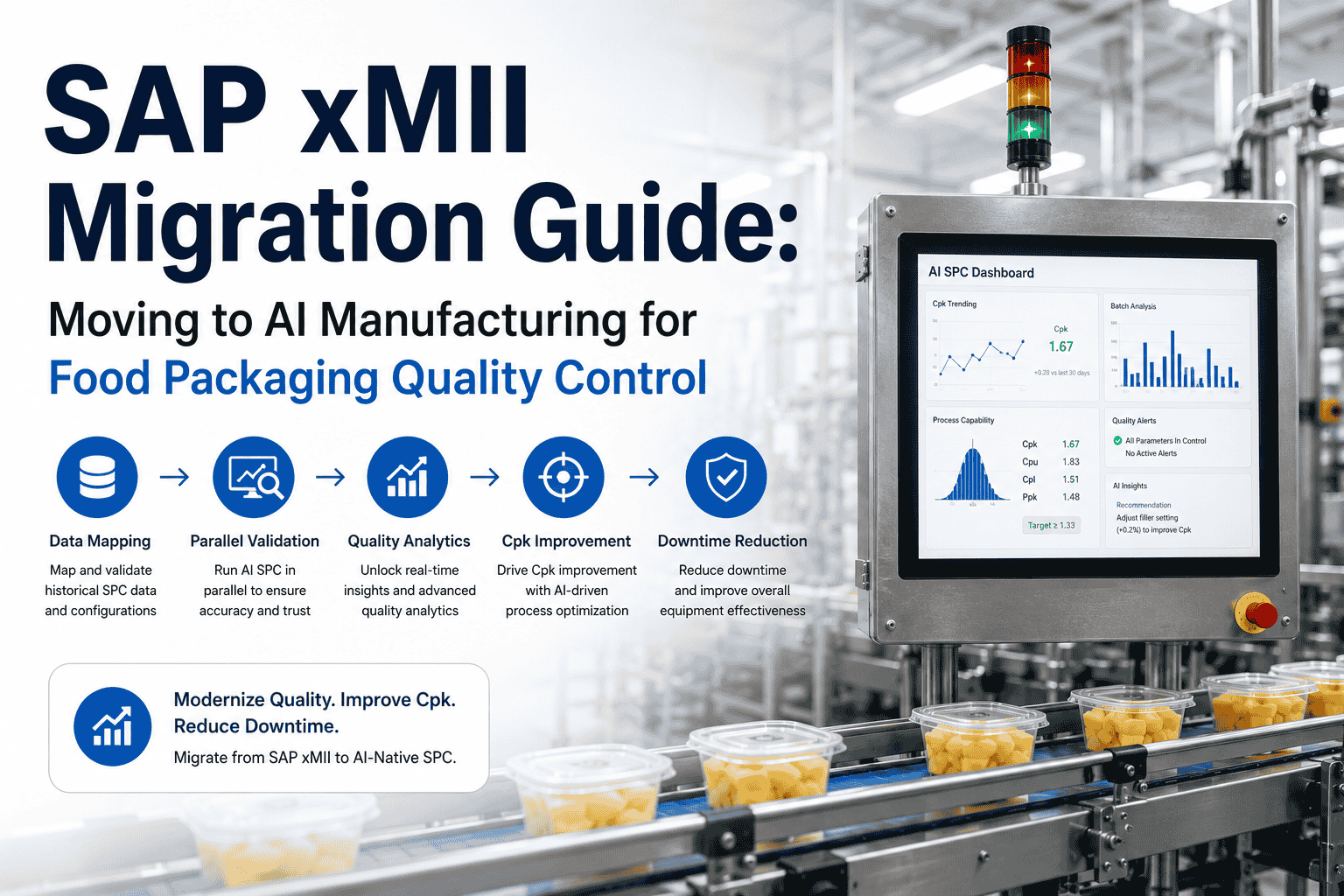
SAP xMII End-of-Life Migration
Migrate xMII to Predictive OEE
The 2027 deadline is real. Here's the migration path food manufacturers are choosing.
2027
SAP xMII support ends
12–36 mo
typical migration timeline
No 15.6
no upgrade path exists
+12–22%
OEE gain with AI migration
The xMII End-of-Life Reality: What Breaks and When
SAP xMII 15.5 runs on NetWeaver AS Java 7.5—architecture from the early 2000s. SAP has confirmed no successor version is planned. Here's the concrete timeline food manufacturers are facing, and why waiting until 2027 to act means arriving at the deadline mid-migration.
Now
Planning Window Open
Audit xMII custom logic (BLS transactions, queries, integration points). This inventory determines whether your migration is 12 months or 36. Start the assessment now—every month of delay compresses the execution window.
2026
Migration Execution
Connect new platform to existing data sources, train predictive models, run parallel operation. This phase requires 8–16 weeks of active implementation with production validation before cutover.
2027
Support Ends
No security patches, no bug fixes, no SAP support tickets. Any xMII failure after this date is your team's problem alone. Plants still running xMII face unpatched vulnerabilities and zero vendor support.
Don't know how complex your xMII migration will be? Book a migration assessment — we'll audit your BLS transactions and integration points in 30 minutes.
Migration Options Compared: Where Should You Go?
Food manufacturers leaving xMII face three migration paths. Each has different cost profiles, capability ceilings, and implementation timelines. The right choice depends on whether you want to replicate what you had, or leapfrog to what you need.
SAP Digital Manufacturing (DMC)
SAP's official successor. Cloud-based MES with ERP integration. Maintains SAP ecosystem continuity but moves OEE and quality to SAP's cloud infrastructure.
Strengths
Deepest SAP ERP integration, familiar interface for SAP teams, supported migration tooling from SAP
Limitations
Cloud-dependent (data sovereignty concerns for F&B), limited predictive analytics, no adaptive SPC, 12–18 month implementation
Third-Party MES (Plex, AVEVA, Proficy)
Replace xMII with a category MES platform. Good production execution but typically requires separate analytics and quality layers.
Strengths
Industry-specific features, strong production execution, established F&B deployments
Limitations
SAP integration requires middleware, no native predictive OEE, separate SPC tools needed, 12–24 month implementation
AI-Native Platform + MES (Predictive OEE)
Layer AI-native predictive OEE alongside your MES choice (including SAP DMC). The AI layer handles what no MES can: predictive performance, adaptive SPC, and automated root-cause intelligence.
Strengths
Predictive OEE (4–24 hr forecasting), adaptive SPC, automated root-cause, on-prem data sovereignty, 12-week implementation, works with any MES
Considerations
Requires MES for production execution (can pair with SAP DMC or any MES), AI model training period of 2–4 weeks
See Predictive OEE on Your Production Data
In a 30-minute workshop, we'll assess your xMII environment, compare migration options for your specific situation, and show predictive OEE running on your line configurations.
The OEE Gains: What Food Manufacturers Actually Recover
The xMII migration isn't just a platform swap—it's an opportunity to leapfrog from historical reporting to predictive intelligence. Here's what food manufacturers are recovering across the three OEE factors when they migrate to AI-native predictive OEE.
Predictive Downtime Prevention
AI learns equipment failure signatures and alerts operators 30–60 minutes before unplanned stops. Changeover optimization reduces planned downtime by recommending sequence adjustments based on historical performance data.
Real-Time Speed Loss Detection
Micro-stops and speed losses invisible in batch-level reports become visible in streaming data. AI identifies specific conditions triggering speed reductions—material lots, ambient temperature, operator technique—and recommends corrections.
Adaptive Quality Prediction
Predictive SPC with adaptive control limits monitors every parameter in real time. When drift trends toward exceedance, the system alerts and recommends corrections before scrap is produced—eliminating the batch-inspection lag entirely.
Combined Impact for Mid-Size F&B Plants
+12–22%
OEE gain within 12 months
1,800–3,200
production hours recovered annually
$4M–$9M
throughput recovery per year
Want a sized OEE-gain projection for your specific plant? Schedule a predictive OEE demo and get a throughput recovery estimate in 30 minutes.
Expert Perspective
"The F&B manufacturers handling the SAP MII transition best in 2026 recognize that the replacement question has two answers: what platform handles production execution and ERP integration, and what platform handles adaptive SPC, predictive recommendations, and shop-floor AI intelligence. Treating these as one decision forces compromise. Treating them as two decisions optimizes each."
— F&B Manufacturing Architecture Best Practice
30–40%
less time operators spend on quality investigation post-migration
80%
faster implementation vs. traditional MES migration timelines
12 wk
first line live with predictive OEE and adaptive SPC
Still running xMII with the 2027 clock ticking? Request a demo and see predictive OEE on your actual production data.
Conclusion: Migrate to Predictive, Not Just Modern
The worst xMII migration outcome is replacing a legacy platform with another system that only tells you what happened yesterday. The best outcome is leapfrogging to a platform that predicts the next shift's performance, detects losses before they compound, guides operators with specific actions, and learns from every run. With support ending in 2027 and migration timelines running 12–36 months, food manufacturers who start now arrive at the deadline with predictive OEE running, operators trained, and throughput gains already compounding. Those who wait arrive mid-migration with no safety net.
Start Your xMII Migration With Predictive OEE
In a 30-minute workshop, we'll assess your xMII environment, map the migration path, and show you predictive OEE on your specific lines. No disruption to current operations.
Frequently Asked Questions
When does SAP xMII reach end of life and what happens after?
SAP xMII 15.5 support ends in 2027 with no successor version planned. After that date, there will be no security patches, no bug fixes, and no SAP support tickets for xMII issues. The underlying NetWeaver AS Java 7.5 platform will also lose support. Plants still running xMII after 2027 face unpatched security vulnerabilities and zero vendor support for any system failure. Migration timelines run 12–36 months depending on custom logic complexity, which is why planning should start immediately.
Book a demo to see the migration path for your xMII setup.
What is the difference between historical OEE and predictive OEE?
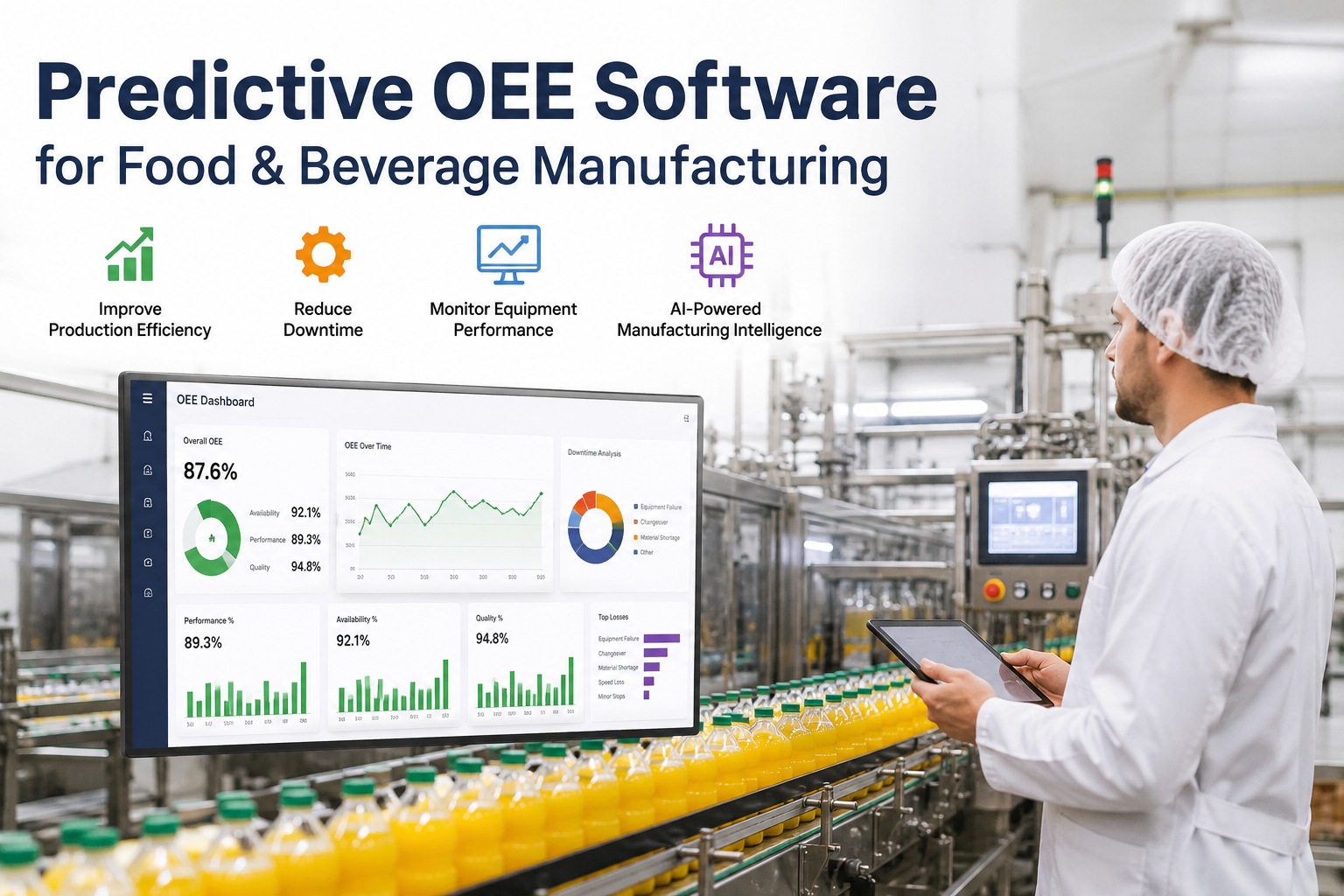
Historical OEE (what xMII provides) calculates Availability × Performance × Quality after a shift or batch completes—telling you what happened yesterday. Predictive OEE uses AI models trained on your equipment, products, and process data to forecast the next 4–24 hours of performance across all three factors. It identifies which specific variables will drive predicted drops and recommends corrective actions before losses occur. The shift from historical to predictive typically delivers 12–22% OEE improvement within 12 months for F&B operations.
Should I migrate to SAP DMC or an AI-native platform?
The best-practice answer is both—they solve different problems. SAP DMC handles production execution and ERP integration (the MES question). An AI-native platform handles predictive OEE, adaptive SPC, and automated root-cause intelligence (the AI question). The AI layer works alongside any MES, including SAP DMC. For F&B specifically, on-premise data sovereignty for food safety records, allergen tracking, and recipe IP is a strong argument for the AI layer being a separate plant-resident system.
How much OEE improvement can food manufacturers expect?
F&B operations migrating from xMII to AI-native predictive OEE typically see +12–22% combined OEE gain within 12 months: +4–8% Availability from prevented downtime and optimized changeovers, +3–6% Performance from eliminated micro-stops and speed optimization, and +2–5% Quality from prevented scrap and reduced false rejects. For a mid-size plant with 70% baseline OEE running 4–8 lines, that translates to 1,800–3,200 recovered production hours and $4M–$9M in annual throughput recovery.
How does predictive OEE improve operator productivity specifically?
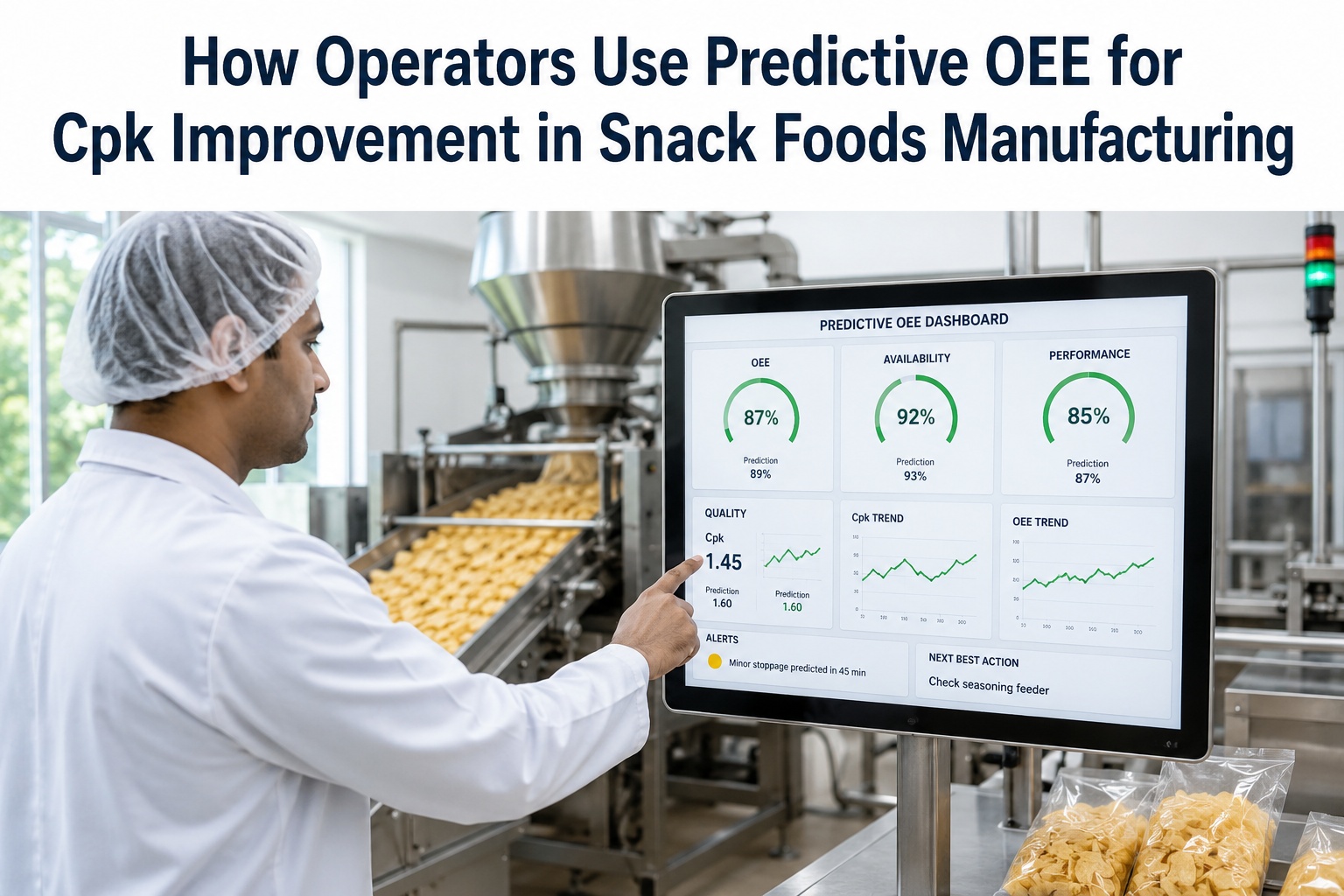
Legacy xMII requires operators to review batch-level reports, manually investigate loss events, and hypothesize root causes—consuming hours of productive time. Predictive OEE delivers real-time actionable alerts directly to operator interfaces: what's about to go wrong, why, and what to do about it. This eliminates investigation time, reduces reaction lag from hours to minutes, and shifts operator effort from firefighting to prevention. Food manufacturers report 30–40% less time spent on quality investigation post-migration.