Frozen food processing equipment analytics is rapidly transforming how plant engineers manage IQF tunnels, spiral freezers, blast freezers, and cold storage systems. As global demand for frozen food accelerates, the gap between reactive maintenance and predictive, AI-driven process control has never been more costly to ignore. Equipment failures, unplanned defrost cycles, and refrigerant inefficiencies silently erode throughput and product quality — often going undetected until an entire batch is compromised. Modern frozen food plants that book a demo with iFactory are discovering that continuous equipment analytics can cut energy costs by up to 15%, extend freezer asset life, and maintain cold chain integrity across every production shift.
From Reactive Downtime to Predictive Cold Chain Control
iFactory's Mobile AI App delivers real-time analytics for IQF freezers, spiral freezers, blast freezers, and cold storage — purpose-built for frozen food plant engineers focused on yield, compliance, and energy efficiency.
Why Frozen Food Processing Equipment Analytics Is a Business-Critical Priority
The frozen food industry operates on razor-thin margins where a single unplanned freezer failure can write off tens of thousands of dollars in product. Traditional preventive maintenance schedules — based on fixed calendar intervals — fail to account for the real-world variability of production load, ambient temperature swings, and the cumulative wear of refrigeration compressors and evaporator coils. IQF freezer analytics, spiral freezer analytics, and cold storage food monitoring represent the next generation of plant management: continuous, sensor-driven, and predictive — because unlike discrete manufacturing, frozen food processing is thermally continuous, and a missed defrost trigger or refrigerant leak doesn't just slow production, it compromises food safety and HACCP traceability. Plant engineers who schedule a strategy session with iFactory consistently identify hidden losses in energy, throughput, and compliance that were entirely invisible in their legacy SCADA dashboards.
The Anatomy of a Frozen Food Processing Line — and Where Analytics Matters Most
A modern integrated frozen food processing line consists of several thermally and mechanically interdependent zones. Understanding where process entropy originates is the first step toward effective equipment analytics deployment.
Incoming Product
Raw product enters at ambient or chilled temperature. Variations in moisture content and density directly affect freezer load and belt speed requirements.
IQF / Spiral Freezer
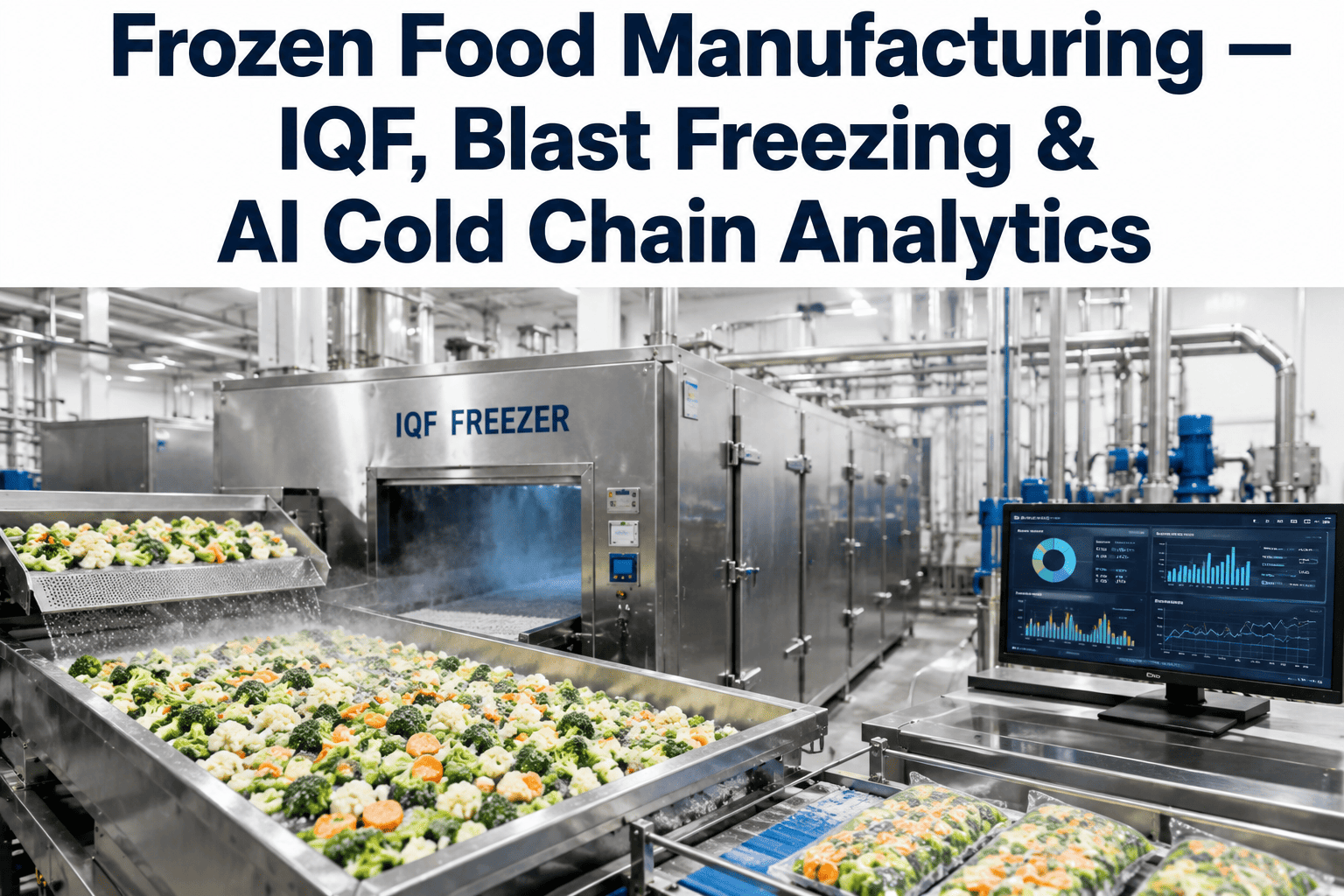
The thermal core of the line. Belt speed, airflow velocity, evaporator temperature, and defrost timing must be dynamically balanced against product load.
Blast Freezer / Plate Freezer
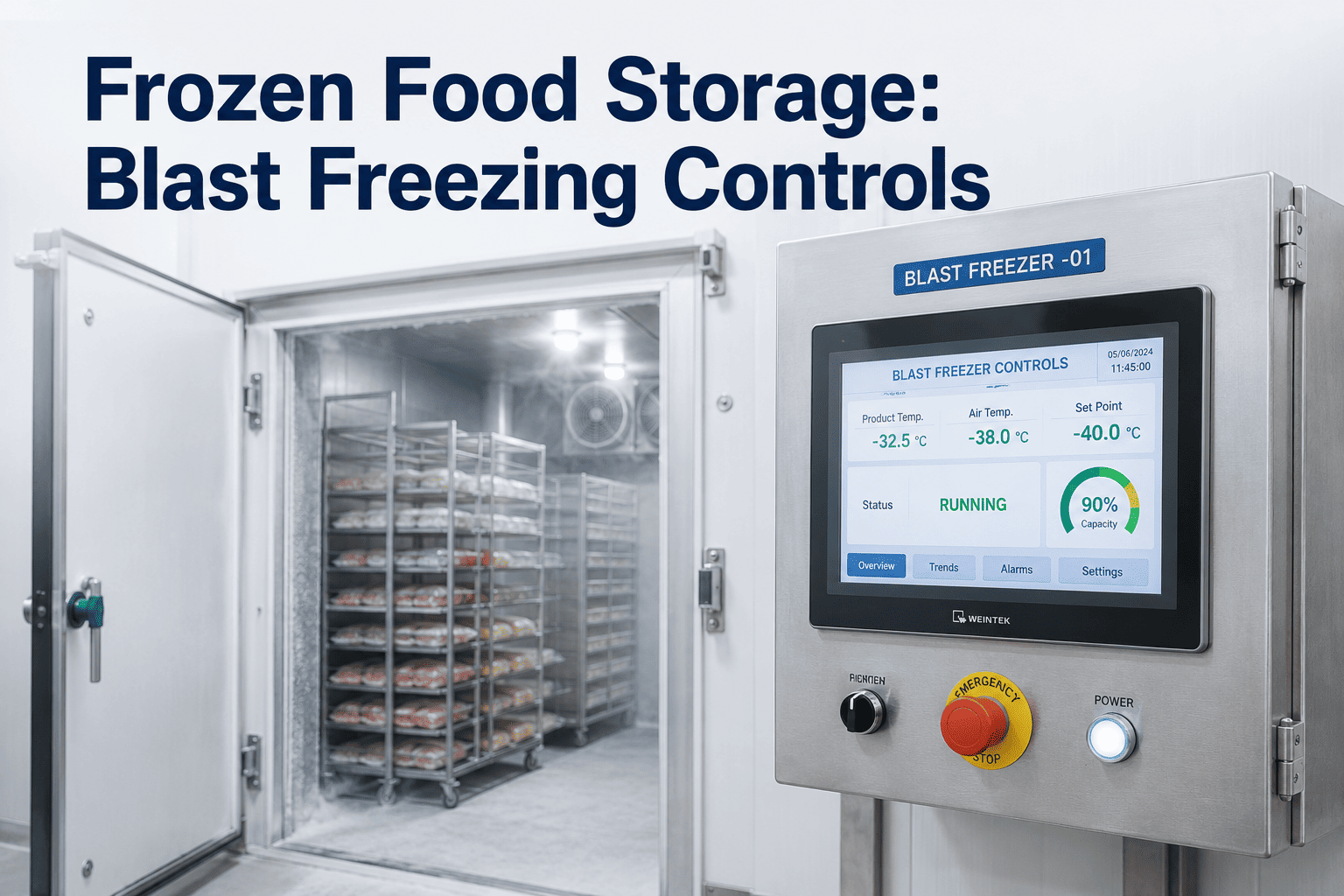
High-velocity secondary freezing for portion-controlled or bulk products. Compressor efficiency and refrigerant charge directly determine pull-down speed.
Cold Storage
Long-term holding at −18°C to −25°C. Door seal integrity, evaporator frost accumulation, and compressor cycling are primary energy waste vectors.
IQF Freezer Analytics: Detecting Drift Before Product Quality Suffers
Individual Quick Freezing (IQF) tunnels are among the highest-value assets on any frozen food processing line — and among the most analytically complex. Belt speed, air velocity, evaporator coil temperature, and defrost cycle timing interact in ways that standard threshold alarms simply cannot capture. IQF freezer analytics platforms ingest these variables at millisecond resolution to detect "inter-parameter drift" — the subtle compound deviations that precede product quality failures.
Evaporator Coil Ice Buildup Detection
As ice accumulates on evaporator coils between scheduled defrosts, airflow resistance increases and freezing efficiency drops. AI models correlate fan motor current draw with supply/return air differential temperature to predict ice buildup 2–4 hours before it causes a detectable process deviation — enabling demand-triggered defrost instead of fixed-time defrost cycles.
Belt Speed vs. Product Load Correlation
Inconsistent product infeed rates create uneven thermal loads across the IQF belt. Without real-time analytics, operators run conservative (slow) belt speeds to ensure full freeze — sacrificing throughput. AI-driven belt speed optimization dynamically adjusts dwell time based on live product load sensing, recovering 5–12% throughput capacity without compromising core temperature targets.
Refrigerant Charge Anomaly Detection
Slow refrigerant leaks in IQF systems are notoriously difficult to detect until suction pressure drops below alarm thresholds. Continuous analytics track the relationship between compressor suction superheat, condensing pressure, and evaporating temperature to flag charge drift weeks before a hard alarm — protecting both the refrigeration system and food safety compliance.
Spiral Freezer Analytics: Maximizing Uptime on Your Highest-Throughput Asset
Spiral freezers represent a significant capital investment and are typically the throughput bottleneck of the entire processing line. Unplanned downtime on a spiral freezer — whether from belt misalignment, evaporator flooding, or drive motor failure — can idle an entire production shift. Comprehensive spiral freezer analytics address the four primary failure vectors that account for over 70% of unplanned stoppages.
Belt Tracking & Tension Monitoring
Real-Time AlignmentBelt misalignment in spiral freezers begins with micro-deviations in lateral tracking that develop over hours or days. AI models correlate drive motor torque signatures with tension load cell readings across multiple belt tiers, providing early warning of tracking drift before it causes mechanical damage or product spillage that contaminates the freezer interior.
Airflow Distribution Analysis
±0.3°C UniformityUneven airflow distribution across spiral freezer tiers is a leading cause of inconsistent product core temperatures. iFactory's thermal mapping analytics identify "warm spots" caused by damaged air baffles, fan blade degradation, or product stacking anomalies — ensuring every tier of the spiral delivers consistent freeze performance and reducing the risk of partially-frozen product reaching the packaging line.
Defrost Cycle Management
Demand-Based TriggersFixed-time defrost schedules waste energy and interrupt production unnecessarily. AI-driven defrost cycle management calculates the optimal defrost trigger point based on real-time frost accumulation modeling — using airflow resistance, coil differential temperature, and historical defrost duration data. This reduces average defrost frequency by 20–35% while ensuring complete melt completion before the next production run.
Blast Freezer & Plate Freezer PM: Preventing the $50,000 Compressor Failure
Blast freezers and plate freezers operate under extreme thermal stress — rapid pull-down cycles, heavy compressor loading, and frequent door openings create a harsh environment for refrigeration components. Blast freezer PM programs enhanced by real-time analytics shift maintenance from calendar-based to condition-based, focusing engineer attention on assets that actually need intervention; the most catastrophic failure mode is compressor failure caused by liquid slugging or oil migration, and AI-driven monitoring correlates suction superheat, oil pressure differential, and compressor discharge temperature to identify early signatures of liquid carryover weeks before a scheduled maintenance visit would catch them. Plant engineers who book a demo with iFactory routinely report identifying compressor health deviations 3–6 weeks before a scheduled maintenance visit would have caught them.
Cold Storage Food Monitoring: Protecting Inventory Value 24/7
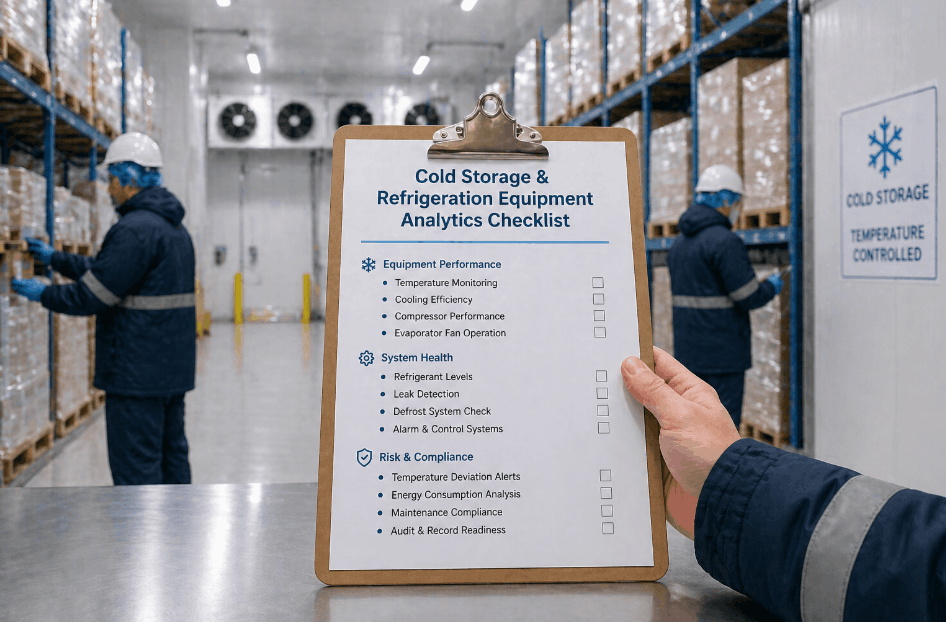
Cold storage facilities represent both a critical food safety control point and a major energy cost center. A typical −20°C cold store running 24/7 consumes 250–400 kWh per day per cell — and up to 40% of that energy can be wasted through door seal degradation, evaporator frost buildup, and inefficient compressor cycling. Cold storage food monitoring with AI analytics addresses these waste vectors systematically and continuously.
Door Seal & Infiltration Loss Detection
Air infiltration through degraded door seals is the single largest source of refrigeration load in cold storage operations. AI analytics correlate door open event duration, ambient dew point, and room temperature recovery time to quantify infiltration losses in real time — alerting maintenance teams to specific door positions with abnormal thermal recovery curves before energy waste compounds into a food safety deviation.
Compressor Cycling Optimization
Short-cycling compressors — where units start and stop too frequently due to oversized capacity or control setpoint oscillation — dramatically increases motor wear and electrical demand charges. AI-driven setpoint optimization smooths compressor cycling, reducing start frequency by 30–50% while maintaining tighter temperature bands. For facilities paying demand-based electricity tariffs, this alone delivers measurable monthly savings.
HACCP Temperature Deviation Alerting
Regulatory compliance in cold storage requires continuous temperature monitoring with documented evidence of controlled conditions. AI-enhanced HACCP monitoring goes beyond simple high-temperature alarms — it tracks thermal trend rates and provides predictive deviation alerts when temperature is trending toward a critical limit, giving operators 15–45 minutes of intervention time rather than a reactive alarm after the limit has already been breached.
Frozen Food Energy Efficiency: The Financial Case for AI-Driven Optimization
Refrigeration energy accounts for 60–75% of total electricity consumption in a frozen food processing facility. As energy prices remain volatile and carbon reporting requirements tighten, frozen food energy efficiency has become a boardroom-level priority — not just an engineering concern — and the economic argument for AI analytics is grounded in "marginal efficiency recovery": the cumulative gains from hundreds of small, continuous optimizations that no human operator or fixed control loop can sustain. iFactory's platform provides a unified energy dashboard that correlates refrigeration system performance with production throughput, giving plant engineers the ability to calculate true energy cost per kilogram of frozen product, and reliability managers looking to build a data-driven energy reduction roadmap regularly choose to schedule a session to see how cross-system energy analytics are structured for frozen food environments.
Achieved through demand-based defrost, compressor cycling optimization, and evaporator performance monitoring.
AI detects freezer anomalies up to 30 minutes before traditional threshold alarms would trigger a response.
Automated HACCP temperature records and digital maintenance logs eliminate manual compliance documentation gaps.
Typical payback period for integrated AI analytics across IQF, spiral, blast freezer, and cold storage assets.
Refrigerant Handling in Food Processing: Analytics for Compliance and Leak Prevention
Refrigerant management in food processing facilities sits at the intersection of operational efficiency, environmental compliance, and food safety — with the F-Gas Regulation in Europe and EPA Section 608 requirements in North America imposing strict leak detection, record-keeping, and servicing obligations on large-charge refrigeration systems. AI-driven refrigerant analytics continuously monitor the thermodynamic signature of the refrigeration cycle, tracking subcooling, superheat, pressure ratios, and compressor efficiency indices to detect charge anomalies weeks before they become reportable leak events, and teams responsible for refrigerant handling food compliance who book a demo with iFactory can see how automated refrigerant charge trending integrates directly with their regulatory reporting workflows.
Frozen Food Processing Equipment Analytics — Frequently Asked Questions
Does AI-driven analytics work with our existing freezer SCADA and BMS systems?
Yes. iFactory's platform is designed as an intelligent overlay above existing Level 2 SCADA, Building Management Systems (BMS), and legacy PLCs. It ingests data from your current sensor network via standard industrial protocols (Modbus, Profibus, OPC-UA) without requiring replacement of existing automation infrastructure.
How does defrost cycle management AI improve on our existing timed defrost schedule?
Fixed-time defrost schedules are set conservatively to prevent ice buildup under worst-case conditions — meaning most defrost cycles occur when they aren't needed. AI-driven defrost triggers based on real-time frost accumulation modeling reduce unnecessary defrosts by 20–35%, saving energy and reducing production interruptions without compromising freezer performance.
Can the platform generate HACCP-compliant temperature records automatically?
Yes. iFactory creates an immutable digital temperature log for every production period and cold storage holding zone, automatically formatted for HACCP audit readiness. Records include AI-verified temperature ranges, deviation events, and corrective action timestamps — eliminating manual log sheet gaps that frequently cause audit findings.
What sensors are needed for IQF freezer analytics implementation?
Many existing IQF tunnels have sufficient sensor infrastructure (evaporator temperature probes, fan motor current sensors, belt speed encoders) for analytics deployment. Where gaps exist, iFactory recommends targeted additions — typically wireless temperature nodes and differential pressure sensors — that integrate with ruggedized IoT gateways suitable for cold, wet food processing environments.
How long does an ROI baseline assessment take for a frozen food plant?
iFactory performs a data-driven ROI baseline analysis in 2–4 weeks using your historical process and energy data. This provides a clear financial roadmap showing exactly where yield improvements, energy savings, and maintenance cost reductions will be realized — before any capital commitment to full platform deployment.
Can plate freezer analytics detect glycol circuit fouling before it affects freeze time?
Yes. Plate freezer analytics monitor glycol supply and return temperature differential alongside compressor performance metrics to detect heat transfer degradation caused by fouling, scale, or glycol concentration drift. Early detection allows for scheduled chemical cleaning during planned downtime, preventing the gradual freeze time elongation that erodes throughput over months of operation.
Ready to Build a Smarter Frozen Food Processing Plant?
iFactory's AI-driven analytics platform delivers real-time equipment intelligence across your entire cold chain — from IQF tunnel to cold storage. Built for frozen food plant engineers who demand measurable ROI and audit-ready compliance.