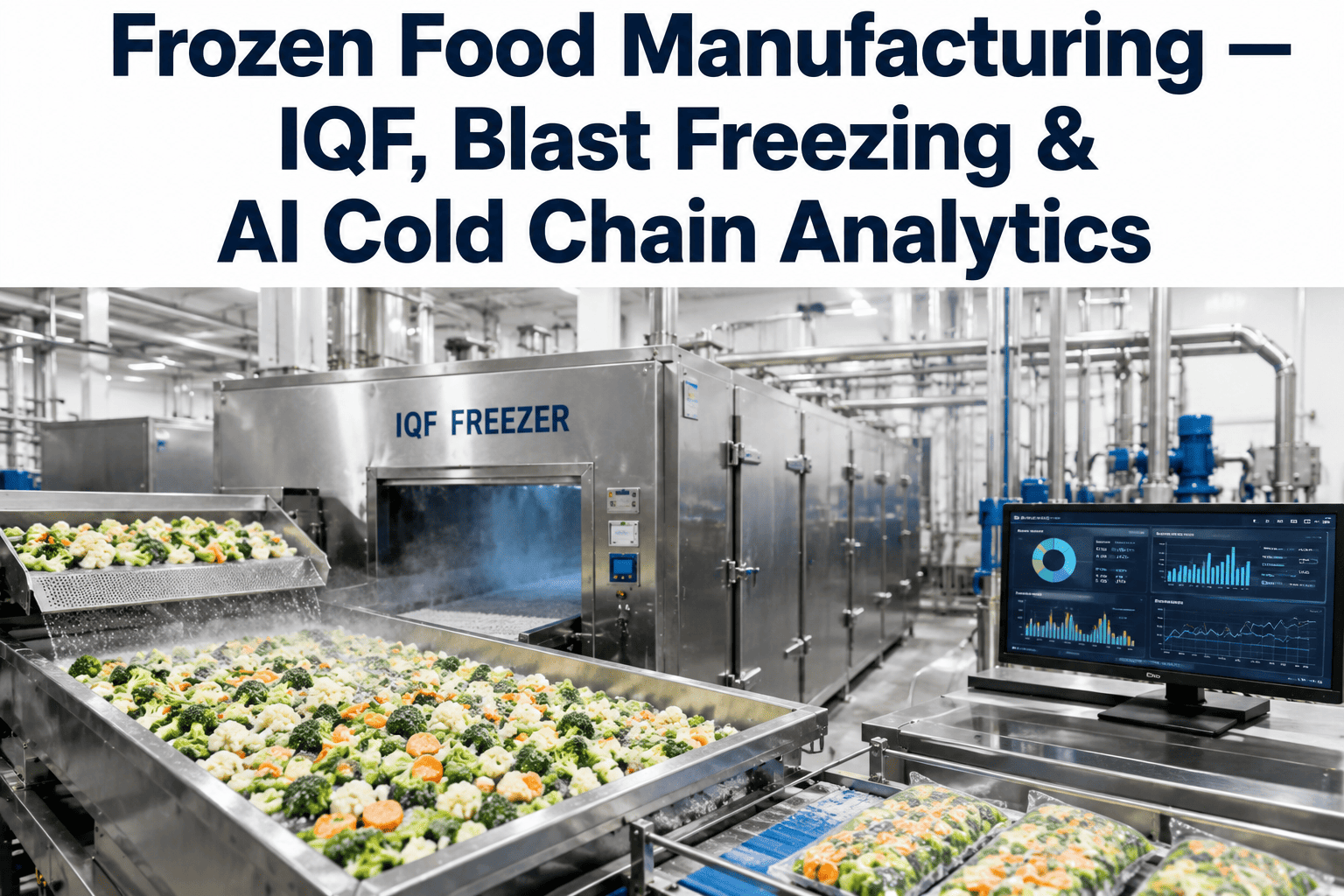
Frozen food manufacturing stands at a critical inflection point where operational precision directly determines product quality, energy expenditure, and market competitiveness. The journey from raw ingredient to individually quick-frozen (IQF) or blast-frozen product involves intricate thermal dynamics, stringent temperature control, and relentless monitoring across the entire cold chain. For plant managers and maintenance directors, the challenge is not merely achieving target temperatures but doing so with minimal energy waste, consistent throughput, and uncompromised food safety. Advanced AI-driven analytics now offer unprecedented visibility into freezing processes, enabling real-time optimization of IQF tunnel performance, blast freezer efficiency, and cold chain temperature logging. By leveraging predictive models for freezing time and energy consumption, enterprises can reduce operational costs by up to 18% while enhancing product texture and shelf life. This comprehensive guide delves into the technical nuances of frozen food production, from equipment selection to AI integration, providing actionable insights for industry leaders. Book a Demo to see how iFactory transforms your freezing operations.
Transform Your Freezing Line
Achieve consistent quality and energy savings with AI-driven optimization. Schedule a personalized demo today.
IQF Tunnel Dynamics
IQF tunnels rely on high-velocity cold air to freeze individual pieces rapidly, preserving cellular structure and preventing clumping. Key parameters include air temperature, velocity, belt loading, and dwell time. AI models analyze real-time sensor data to adjust fan speeds and refrigerant flow, maintaining optimal heat transfer coefficients. This prevents surface freezing defects and ensures uniform core temperature reduction.
Blast Freezer Efficiency
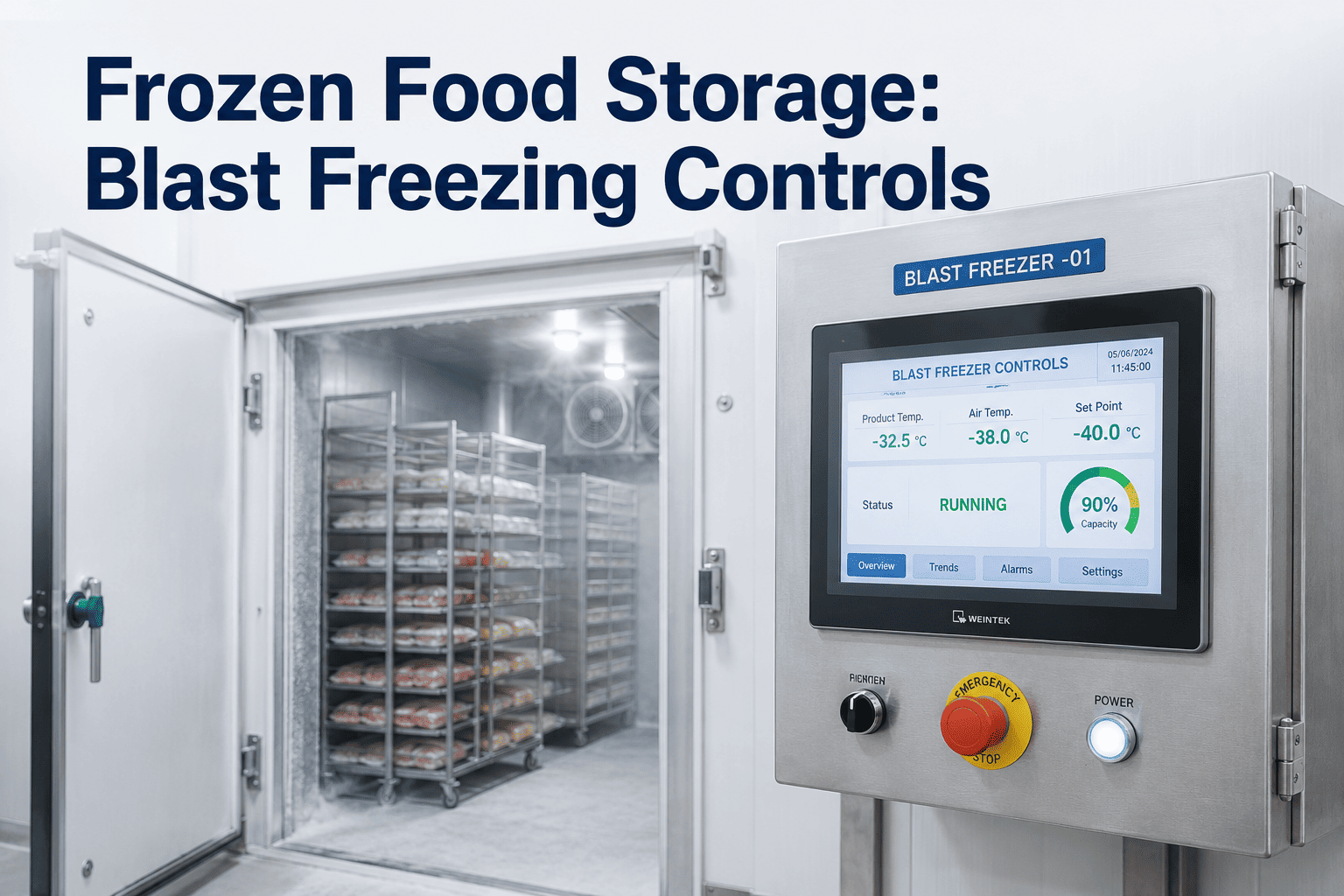
Blast freezers handle bulk products or packaged items, requiring careful management of airflow distribution and defrost cycles. Predictive algorithms forecast frost buildup and initiate defrost only when necessary, reducing energy spikes. Thermal imaging and vibration analysis on evaporator fans detect early bearing wear, preventing unplanned downtime. This approach extends equipment life and maintains consistent freezing rates.
Cold Chain Integrity
From production to distribution, temperature excursions degrade product quality. IoT-enabled loggers transmit data to a central AI platform that correlates temperature history with quality metrics like drip loss and texture. Anomaly detection triggers alerts for corrective actions, while predictive models estimate remaining shelf life. This ensures compliance with HACCP and FSMA regulations while reducing waste.
AI-Driven Freezing Time Prediction
Data Acquisition
High-frequency sensors capture product temperature, air velocity, humidity, and belt speed at multiple points within the freezer. Historical quality data from lab tests is integrated to label training datasets.
Model Training
Machine learning models, including gradient boosting and neural networks, learn the complex relationships between process parameters and freezing time. Feature engineering incorporates product geometry, initial temperature, and thermal properties.
Real-Time Inference
Deployed models predict the remaining freezing time for each batch, enabling dynamic adjustments to belt speed or airflow. Operators receive alerts when predicted time deviates from targets, allowing proactive intervention.
Continuous Improvement
Prediction accuracy improves over time as the model ingests new data. A/B testing compares AI-optimized settings against standard recipes, quantifying gains in throughput and energy consumption.
Key Performance Indicators
| Parameter | Traditional Approach | AI-Optimized Approach | Improvement |
|---|---|---|---|
| Freezing Time Variance | ±15% | ±3% | 80% reduction |
| Energy per kg | 0.45 kWh | 0.37 kWh | 18% savings |
| Defrost Frequency | Every 8 hours | Every 14 hours | 43% reduction |
| Product Temperature Uniformity | ±2.5°C | ±0.8°C | 68% improvement |
| Unplanned Downtime | 12 hours/month | 4 hours/month | 67% reduction |
Thermal Dynamics of IQF Tunnels
The heat transfer mechanism in IQF tunnels is dominated by forced convection, where the air velocity and temperature gradient drive the freezing rate. The product's surface area-to-volume ratio, initial moisture content, and ice crystal formation kinetics all influence the process. Computational fluid dynamics (CFD) simulations have traditionally been used to design tunnels, but they lack real-time adaptability. AI models trained on sensor data can predict local heat transfer coefficients and adjust fan speeds to maintain a uniform freezing front. This prevents the formation of large ice crystals that damage cell walls, resulting in better texture after thawing. Additionally, predictive maintenance on fans and compressors ensures consistent airflow, reducing the risk of hot spots.
Blast Freezer Defrost Optimization
Frost accumulation on evaporator coils reduces heat transfer efficiency and increases energy consumption. Traditional defrost cycles are time-based, often running when unnecessary or insufficient. AI models analyze coil temperature, air humidity, and runtime data to predict frost thickness. Defrost is triggered only when efficiency drops below a threshold, typically saving 15-20% of defrost-related energy. Furthermore, the model can schedule defrost during low-demand periods, smoothing energy load. Vibration sensors on fan bearings detect early signs of imbalance, enabling condition-based maintenance that prevents catastrophic failures. This integrated approach extends equipment lifespan and maintains stable freezing performance.
Cold Chain Temperature Logging and Compliance
Maintaining the cold chain from production to retail is a regulatory requirement and a quality imperative. IoT temperature loggers placed at critical points transmit data to a cloud-based AI platform that analyzes trends and detects anomalies. The system correlates temperature history with product quality attributes measured in lab tests, building a predictive model for shelf life. When a deviation is detected, such as a rise above -18°C for more than 30 minutes, the system automatically alerts quality assurance teams and recommends corrective actions like accelerating product shipment or re-inspection. This reduces waste and ensures compliance with FSMA and HACCP standards. The platform also generates audit-ready reports, simplifying regulatory submissions.
Energy Management in Freezing Operations
Freezing is the most energy-intensive step in frozen food production, often accounting for 30-40% of total plant energy consumption. AI-driven optimization reduces this load by dynamically adjusting compressor setpoints, fan speeds, and defrost schedules based on real-time demand. For example, during periods of low throughput, the system can reduce fan speed without compromising product quality, saving up to 12% energy. Predictive models also forecast energy consumption based on production schedules, enabling plants to participate in demand response programs and reduce peak demand charges. Combined with condition-based maintenance, these strategies lower overall operational costs while maintaining high product quality.
Predictive Maintenance for Freezer Assets
Unplanned freezer downtime can result in significant product loss and production delays. AI-powered predictive maintenance analyzes vibration, temperature, and current data from compressors, fans, and conveyors to detect early signs of wear. For example, an increase in vibration amplitude on a fan bearing may indicate impending failure, allowing maintenance to be scheduled during planned downtime. Similarly, compressor discharge temperature trends can predict valve leakage or refrigerant loss. This approach reduces unplanned downtime by up to 67% and extends equipment life by ensuring timely interventions. The system also provides a digital twin of the freezer, enabling simulation of maintenance scenarios and optimization of spare parts inventory.
Product Quality and Texture Preservation
The freezing rate directly affects ice crystal size and distribution within the product. Rapid freezing (IQF) produces small, uniform crystals that minimize cellular damage, preserving texture and moisture. AI models optimize freezing parameters to achieve the fastest possible freezing rate without causing surface cracking or freezer burn. By analyzing product temperature profiles and quality feedback, the system continuously refines setpoints. For products like berries, shrimp, or diced vegetables, this results in superior appearance and mouthfeel after thawing. For blast-frozen items like pizzas or entrees, consistent freezing ensures even cooking and extended shelf life. The economic impact is significant: reduced rework, fewer customer complaints, and premium pricing opportunities.
Integration with MES and ERP Systems
Seamless data flow between AI optimization systems and existing manufacturing execution systems (MES) or enterprise resource planning (ERP) platforms is critical for operational efficiency. The AI platform provides real-time dashboards showing freezing performance, energy consumption, and quality metrics. It also sends predictive maintenance alerts and optimization recommendations directly to the MES. Integration with ERP enables automatic adjustment of production schedules based on predicted freezing times and energy availability. This holistic approach eliminates data silos and empowers decision-makers with actionable insights. Standard interfaces like OPC UA and REST APIs ensure compatibility with legacy systems, minimizing implementation friction.
Regulatory Compliance and Audit Readiness
Frozen food manufacturers must comply with stringent regulations from agencies like the FDA, USDA, and EU food safety authorities. The AI platform automatically logs all critical control points (CCPs) including freezer temperatures, defrost cycles, and product temperatures. It generates audit-ready reports with traceability from raw material to finished product. Anomaly detection and predictive analytics help prevent deviations before they occur, reducing the risk of non-compliance. The system also supports electronic recordkeeping required by 21 CFR Part 11, ensuring data integrity and security. This not only simplifies audits but also builds trust with retailers and consumers.
Scalability and Multi-Site Deployment
For large enterprises operating multiple freezing lines across different facilities, the AI platform offers centralized monitoring and management. Each line's data is aggregated in a unified dashboard, allowing comparison of performance and best practice sharing. The system can automatically adjust optimization models based on local conditions such as ambient temperature, product mix, and equipment age. This scalability ensures consistent quality and efficiency across the entire production network. New lines can be onboarded quickly with minimal configuration, leveraging pre-trained models and transfer learning. The platform also supports role-based access, enabling plant managers, maintenance directors, and corporate executives to view relevant KPIs.
Cost-Benefit Analysis of AI Implementation
Investing in AI-driven freezing optimization yields a compelling return on investment. Typical benefits include 18% energy savings, 67% reduction in unplanned downtime, and 80% reduction in freezing time variance. For a medium-sized plant with annual energy costs of $500,000, this translates to $90,000 in direct energy savings. Reduced downtime saves an additional $120,000 per year in lost production and product waste. Improved quality reduces rework costs by $40,000 annually. The total annual benefit of $250,000 easily justifies the initial investment in sensors, software, and integration, with payback periods typically under 12 months. Additionally, the platform enables premium pricing for higher-quality products, further enhancing profitability.
Future Trends in Frozen Food Manufacturing
The next frontier in frozen food production involves fully autonomous freezing lines where AI not only optimizes but also executes control actions without human intervention. Advances in edge computing will enable real-time inference directly on freezer controllers, reducing latency. Digital twins of entire freezing lines will allow operators to simulate changes and predict outcomes before implementation. Integration with supply chain systems will enable dynamic scheduling based on real-time energy prices and demand forecasts. Sustainability goals will drive further energy and refrigerant optimization, with AI helping to select low-global-warming-potential refrigerants and minimize leakage. iFactory is at the forefront of these innovations, continuously evolving its platform to meet the needs of Industry 4.0.
Ready to Optimize Your Freezing Operations?
Leverage AI to reduce energy, improve quality, and eliminate downtime. Book a demo to see the impact.
Frequently Asked Questions
How does AI improve IQF tunnel performance compared to traditional PID controllers?
Traditional PID controllers maintain setpoints based on fixed parameters, but they cannot adapt to changing product loads, ambient conditions, or equipment degradation. AI models analyze historical and real-time data to predict optimal fan speeds, refrigerant flow, and belt speed. This dynamic adjustment reduces freezing time variance by 80% and prevents quality issues like surface cracking or clumping. The AI system also learns from past batches, continuously improving its predictions. For a deeper dive, contact our support team for technical white papers.
What sensors are required for implementing AI-driven cold chain monitoring?
A typical implementation includes temperature and humidity sensors at multiple points in freezers, cold storage, and transport vehicles. Air velocity sensors in IQF tunnels and vibration sensors on fans and compressors are also recommended. These sensors connect to an IoT gateway that transmits data to the cloud or edge server. The AI platform then processes this data to detect anomalies, predict freezing times, and optimize settings. For a detailed sensor list and integration guide, visit our support page.
Can AI models predict freezing time for new products without historical data?
Yes, through transfer learning and physics-informed neural networks. The model is pre-trained on a wide range of food products and thermal properties. When a new product is introduced, the system uses its physical characteristics (size, moisture content, initial temperature) to generate initial predictions. As production data accumulates, the model fine-tunes itself to the specific product. This approach reduces the need for extensive historical data and accelerates deployment. For more information, book a demo to see how we handle new product introductions.
How does the system ensure data security and compliance with food safety regulations?
The platform uses end-to-end encryption for data transmission and storage, with role-based access controls to ensure only authorized personnel can view or modify settings. It complies with 21 CFR Part 11 for electronic records and signatures, providing audit trails and data integrity checks. All temperature logs and quality data are automatically timestamped and stored in an immutable format. The system also generates reports tailored to HACCP and FSMA requirements. For compliance documentation, contact our support team.
What is the typical ROI timeline for implementing AI in freezing operations?
Most plants achieve payback within 12 to 18 months. Energy savings alone can cover the initial investment in sensors and software within 10 months. Reduced downtime and improved quality further accelerate ROI. For a medium-sized plant, total annual benefits often exceed $250,000. The exact timeline depends on current efficiency levels, equipment age, and product mix. To get a personalized ROI estimate, book a demo with our team.
Take Control of Your Freezing Process
Join industry leaders who have reduced energy costs and improved quality with iFactory. Schedule your demo now.