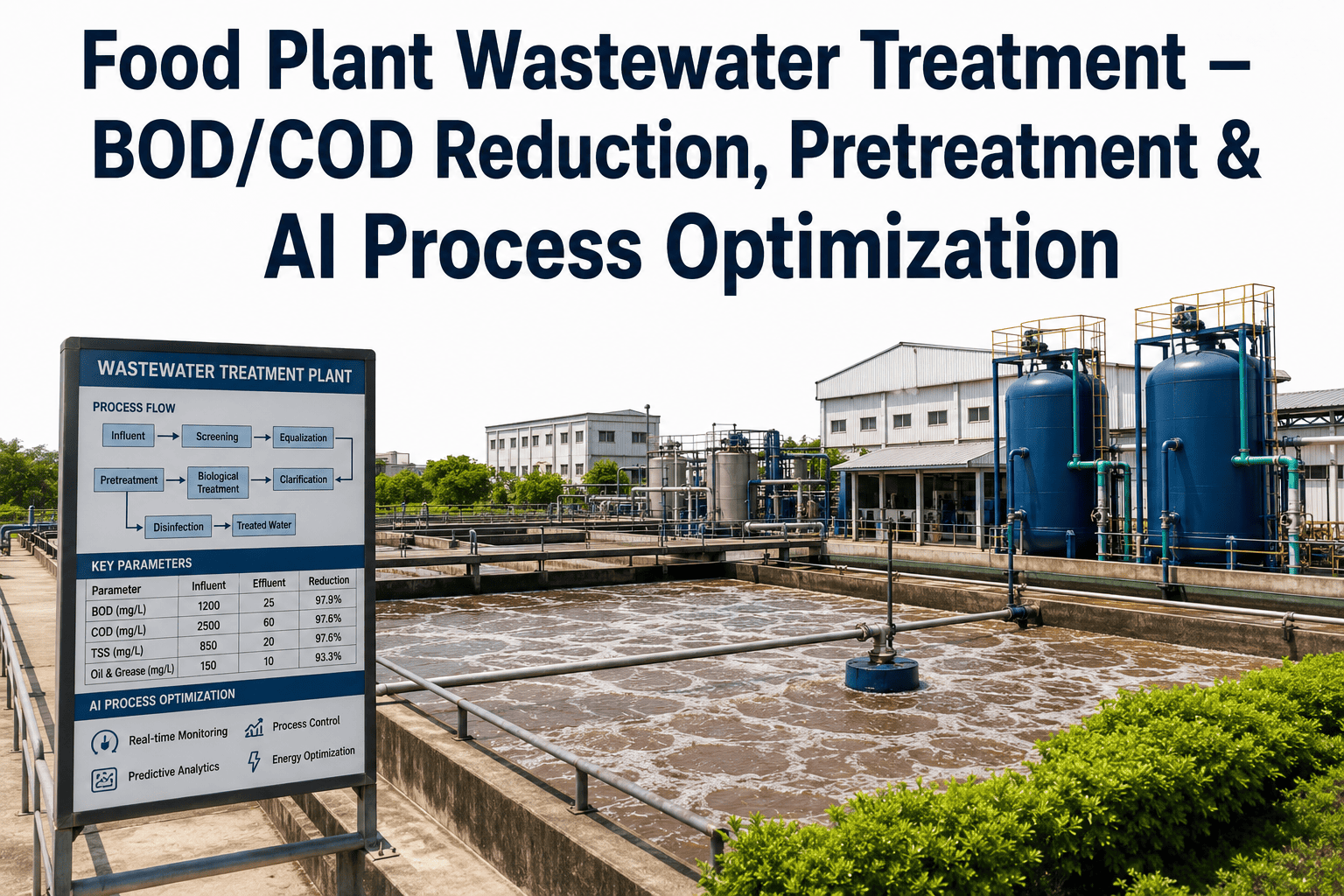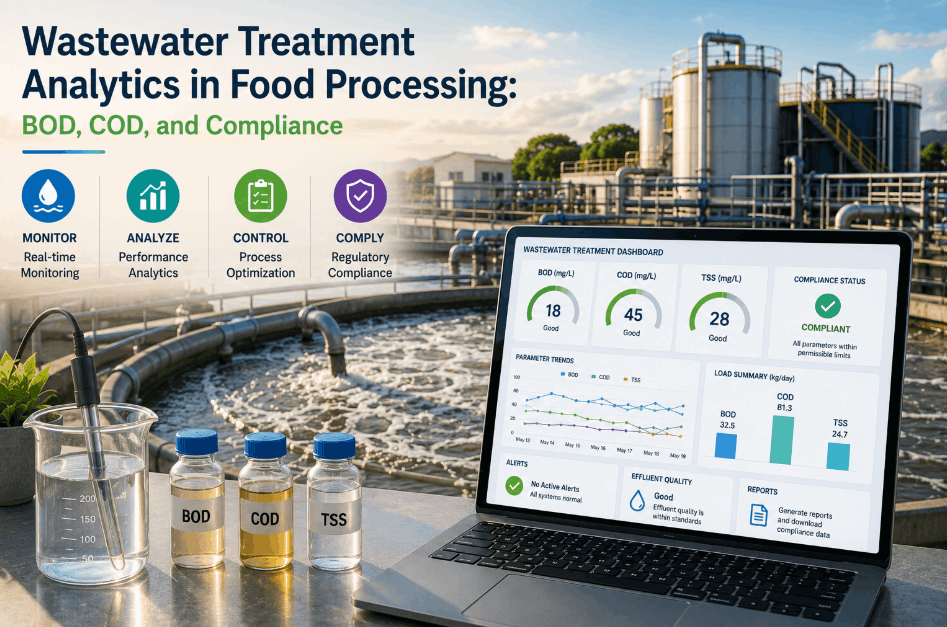
Wastewater treatment analytics in food processing is rapidly evolving from a compliance checkbox into a core operational discipline. Food and beverage manufacturing facilities generate some of the highest-strength effluent in the industrial sector—loaded with fats, oils, grease, suspended solids, and organic compounds that drive BOD and COD values far above municipal discharge limits. For environmental and utilities engineers responsible for effluent treatment systems, the gap between reactive compliance and proactive analytics-driven management determines whether your facility operates under a valid discharge permit or faces enforcement action. If your plant is managing wastewater monitoring manually or relying on lagging laboratory data to make treatment decisions, Book a Demo to see how AI-driven wastewater analytics can transform compliance performance across your entire effluent treatment train.
Why Food Processing Wastewater Is the Most Analytically Demanding Effluent Stream in Industry
Food processing plants generate effluent with extreme BOD, COD, TSS, and pH variability that shifts dramatically across production runs—from dairy wash water to beverage rinse streams to meat processing discharge. Unlike municipal or light industrial wastewater, these streams require real-time treatment adjustment rather than static dosing protocols. Without continuous analytics, engineers make decisions on data that is hours old while the actual load has already moved through the system. The regulatory consequences of permit exceedance—surcharge billing, consent orders, and production restrictions—make reactive monitoring a costly risk. Facilities ready to close this gap can Book a Demo to benchmark their monitoring infrastructure against best-practice standards.
High Organic Load Variability
Food plant effluent BOD values can range from 500 mg/L during light cleaning cycles to over 10,000 mg/L during product changeover or CIP discharge events—variability that overwhelms fixed-rate biological treatment systems not calibrated by real-time load monitoring.
Impact: Biological system shock · Permit exceedanceFOG Loading on DAF Systems
Fats, oils, and grease (FOG) from meat processing, dairy operations, and frying lines demand dissolved air flotation (DAF) systems operating at precise polymer dosing rates and air-to-solids ratios. Without continuous turbidity and TSS feedback, DAF units under-perform and pass FOG load to downstream biological stages.
Impact: DAF failure · Secondary treatment overloadpH Swings and Nutrient Imbalance
Acidic CIP rinses, alkaline caustic wash discharges, and fermentation byproducts create rapid pH swings in equalization basins that destabilize biological treatment microbial communities. Nutrient deficiencies—particularly nitrogen and phosphorus—further suppress aerobic and anaerobic treatment performance when not analytically managed.
Impact: Biological treatment failure · COD exceedanceDischarge Permit Compliance Complexity
Food processing discharge permits typically include BOD, COD, TSS, pH, temperature, FOG, ammonia, and flow volume limits—each with daily maximum and monthly average thresholds that require independent monitoring, documentation, and regulatory reporting on different submission schedules.
Impact: Multi-parameter permit risk · Regulatory reporting burdenFood Plant Wastewater Treatment Train: From Screening to Discharge Compliance
A complete food processing wastewater treatment system operates as a staged treatment train, with each unit process performing a specific removal function and generating performance data that should feed into a centralized analytics platform. Understanding where monitoring gaps exist at each treatment stage is the foundation of any effective wastewater compliance program. Engineers who want to map their current analytics coverage against treatment train best practices can Book a Demo for a site-specific gap assessment.
Screening and Grit Removal
Bar screens, rotary drum screens, and grit chambers remove large solids—food particles, packaging fragments, and grit—before they reach downstream equipment. Screen differential pressure and screenings volume analytics predict blinding events and allow preventive cleaning before solids bypass into the equalization basin.
Key metrics: Screen ΔP · Screenings mass · Bypass eventsEqualization and Flow Balancing
Equalization basins absorb the peak flow and load variability inherent in food plant production schedules—preventing hydraulic and organic shock to downstream biological systems. Real-time BOD, COD, pH, and flow rate monitoring in the equalization basin is the primary control point for treatment chemical dosing and biological system protection.
Key metrics: BOD load · Flow rate · pH · HRTDAF Unit Performance and FOG Removal
Dissolved air flotation systems are the primary FOG and TSS removal mechanism in food processing wastewater treatment. DAF analytics must track influent and effluent TSS, turbidity, polymer dosing rate, air-to-solids ratio, float blanket depth, and recycle flow rate to maintain removal efficiency above 85–95% consistently across variable loading conditions.
Key metrics: TSS removal · Polymer dosage · Float depthBiological Treatment — Aerobic and Anaerobic
Activated sludge systems, moving bed biofilm reactors (MBBR), and anaerobic digesters reduce soluble BOD and COD through biological oxidation and fermentation. Biological system analytics—DO, MLSS, SVI, F/M ratio, biogas production rate—are the leading indicators of treatment performance that predict effluent quality days before discharge sampling confirms a problem.
Key metrics: DO · MLSS · F/M ratio · Biogas yieldBOD and COD Compliance in Food Processing: Monitoring Strategies That Prevent Permit Exceedances
BOD and COD compliance in food processing wastewater is fundamentally a data latency problem. Traditional five-day BOD testing provides critical regulatory data, but a five-day result cannot prevent a permit exceedance that occurred four days ago. AI-driven wastewater analytics platforms address this latency gap by building surrogate parameter models—using real-time COD proxy sensors, UV-Vis spectrophotometers, and dissolved oxygen consumption rates to estimate BOD load continuously, enabling treatment adjustments that prevent exceedances rather than document them after the fact. Environmental engineers who need to close the BOD monitoring latency gap in their facilities should Book a Demo to see how surrogate BOD monitoring integrates with existing laboratory programs.
Real-Time COD Proxy Monitoring
UV-Vis spectrometer probes installed in equalization basins and DAF effluent streams provide continuous COD and TSS estimates at sub-minute resolution—enabling biological treatment operators to adjust dissolved oxygen setpoints, return activated sludge rates, and supplemental nutrient dosing before organic loads overwhelm treatment capacity.
Predictive BOD Load Modeling
AI-driven load forecasting models correlate production schedules, CIP cycle timing, and historical effluent characterization data to predict BOD load peaks hours in advance—giving treatment operators the lead time needed to pre-condition biological systems, pre-dilute high-strength streams, and stage equalization discharge rates to protect downstream treatment capacity.
Automated Permit Limit Alerting
Compliance tracking systems configured with facility-specific discharge permit thresholds generate automated alerts when real-time surrogate data indicates trajectory toward daily maximum or monthly average permit limit exceedances—enabling corrective action before the sampling period closes and regulatory reporting obligations are triggered.
Laboratory Data Integration and Correlation
Five-day BOD and composite COD sample results feed back into AI analytics models as calibration data points—continuously improving the accuracy of real-time surrogate estimates and maintaining the regulatory chain of custody documentation that supports NPDES Discharge Monitoring Report submission.
DAF Unit Performance Analytics: Preventing FOG Breakthrough and Optimizing Polymer Dosing
Dissolved air flotation unit performance is the single most operationally variable factor in food processing wastewater treatment—and the one most directly responsible for biological treatment upsets when it underperforms. FOG breakthrough from a poorly performing DAF unit coats biofilm media, suppresses activated sludge activity, and can collapse an aerobic biological system within 24 to 48 hours. Food plants that have experienced repeated biological treatment upsets should Book a Demo to evaluate how DAF performance analytics can prevent the upstream failures that drive downstream treatment collapse.
AI-Driven Polymer Dosing Control
Real-time influent TSS and turbidity monitoring combined with DAF effluent quality feedback enables adaptive polymer dosing algorithms that maintain optimal coagulation and flocculation performance across variable FOG loading—eliminating the over-dosing waste and under-dosing breakthrough that characterize manual operator-controlled systems.
KPI: Polymer cost per kg TSS removedDissolved Air System Analytics and Fault Detection
DAF recycle pump performance, saturator pressure, recycle flow ratio, and release valve operation generate continuous diagnostic data that identifies air system faults—nozzle fouling, saturator waterlogging, pump cavitation—before they reduce bubble formation efficiency and allow FOG solids to pass through the flotation zone.
KPI: Air-to-solids ratio · Bubble size distributionFloat Blanket Depth Control and Sludge Withdrawal Timing
Ultrasonic float blanket level sensors and automated skimmer timing algorithms maintain optimal float depth without manual operator monitoring—preventing float carryover into the effluent stream during high-loading events and ensuring consistent sludge withdrawal rates that support downstream sludge thickening and dewatering operations.
KPI: Float blanket depth · Skimmer cycle efficiencyAerobic and Anaerobic Biological Treatment Optimization in Food Wastewater Systems
Biological treatment is the heart of any food processing wastewater treatment system—and the component most sensitive to the upstream variability that characterizes food plant effluent. Whether operating activated sludge, MBBR, sequencing batch reactor (SBR), or anaerobic digestion systems, the biological community performance is governed by a set of measurable parameters that, when monitored continuously and managed analytically, maintain consistent BOD and COD removal efficiency across all production conditions.
| Biological System Parameter | Monitoring Method | Target Range (Aerobic) | Deviation Indicator | Corrective Action Trigger |
|---|---|---|---|---|
| Dissolved Oxygen (DO) | In-line DO probe — continuous | 1.5 – 3.0 mg/L | <1.0 mg/L or >4.0 mg/L | Blower speed adjustment / load reduction |
| Mixed Liquor Suspended Solids (MLSS) | Turbidity sensor or daily grab sample | 2,500 – 4,000 mg/L | <2,000 or >5,000 mg/L | WAS rate adjustment / RAS optimization |
| Sludge Volume Index (SVI) | 30-min settling test — lab | 80 – 150 mL/g | >200 mL/g (bulking) | Selector zone optimization / polymer addition |
| Food-to-Microorganism Ratio (F/M) | Calculated from BOD load and MLVSS | 0.05 – 0.20 kg BOD/kg MLVSS/day | >0.35 (overloaded) | Equalization discharge rate reduction |
| pH (Biological Zone) | In-line pH probe — continuous | 6.5 – 8.0 | <6.0 or >8.5 | Caustic or acid dosing / influent isolation |
| Biogas Production Rate (Anaerobic) | In-line gas flow meter | Facility-specific baseline | >15% deviation from baseline | Organic loading rate review / temperature check |
| Effluent Ammonia-N | Ion-selective electrode or colorimetric | <5 mg/L (permit-dependent) | Rising trend >3 mg/L | Nitrification assessment / SRT adjustment |
Sludge Handling and Dewatering Analytics for Food Processing Wastewater Systems
Sludge handling is the most operationally intensive and disposal-cost-sensitive component of food processing wastewater treatment. Food plant biological sludge is high in volatile solids, difficult to dewater without polymer conditioning, and subject to land application and landfill disposal regulations that require accurate dry-solids mass tracking. AI-driven sludge analytics platforms monitor thickener underflow concentration, belt press or centrifuge cake solids content, polymer dosing efficiency, and sludge production rates to minimize disposal volume, optimize dewatering chemical costs, and maintain the regulatory waste characterization records that disposal permits require.
Gravity and Dissolved Air Flotation Thickener Analytics
Gravity thickener underflow solids concentration monitoring and DAF thickener float solids tracking enable continuous polymer dosing optimization—maintaining target thickened sludge concentration for dewatering feed without operator grab-sampling-dependent manual adjustments that lag actual solids variability by hours.
Belt Press and Centrifuge Performance Monitoring
Dewatering equipment analytics track cake solids percentage, polymer dosing rate per tonne of dry solids, filtrate turbidity, and throughput rate—enabling cost-per-tonne disposed optimization and predictive maintenance scheduling based on belt tension, roller bearing temperature, and differential pressure trends.
Sludge Production Tracking and Regulatory Documentation
Automated sludge mass balance calculations—reconciling biological system WAS rates, thickener performance, and dewatering output—generate the disposal quantity records required for land application permits, municipal receiving station agreements, and landfill manifests, eliminating manual mass balance worksheet reconstruction at month-end reporting.
AI-Driven Wastewater Analytics: From Reactive Compliance to Predictive Environmental Performance
The transition from reactive wastewater compliance management to predictive environmental performance is driven by the integration of continuous sensor data, production scheduling information, and historical treatment performance records into a unified AI analytics platform. By correlating upstream production events—product changeovers, CIP cycles, high-yield production runs—with downstream effluent quality outcomes, AI-driven systems identify the causal patterns that precede permit exceedances and enable treatment interventions before regulatory thresholds are breached. Environmental engineers who want to see predictive wastewater analytics applied to their facility's specific treatment train can Book a Demo for a live platform walkthrough.
Reduction in annual permit exceedance events when AI-driven BOD/COD surrogate monitoring and predictive load alerts replace reactive laboratory-only compliance monitoring.
Reduction in annual DAF and dewatering polymer consumption through adaptive dosing algorithms that eliminate the over-dosing buffer maintained under manual operator control.
Reduction in activated sludge and biofilm system upset events when F/M ratio, DO, and FOG loading alerts enable proactive load management rather than post-upset recovery.
Improvement in regulatory reporting preparation time when NPDES DMR data, laboratory results, and sludge disposal records are centralized in a single compliance documentation platform.
Discharge Permit Compliance Management: NPDES Reporting, Monitoring Schedules, and Regulatory Documentation
Maintaining NPDES or local discharge permit compliance in a food processing facility requires managing multiple overlapping monitoring obligations—daily flow measurements, weekly composite BOD and TSS samples, monthly pH and temperature records, quarterly FOG and ammonia analyses—each on independent schedules with separate laboratory hold times, chain of custody requirements, and reporting submission deadlines. Manual compliance calendar management creates gaps that regulators identify during inspections and that result in notice of violation even when effluent quality meets all permit limits. Structured compliance tracking platforms automate monitoring schedule management, sample collection reminders, laboratory submission tracking, and Discharge Monitoring Report preparation—ensuring the administrative compliance infrastructure matches the analytical compliance performance your treatment system delivers.
What BOD and COD limits apply to food processing wastewater discharge permits?
Food plant BOD limits typically range from 30 mg/L for surface water discharge to 250–500 mg/L under municipal pretreatment permits. COD limits are generally set at 2 to 2.5 times the BOD value. Always review your facility-specific permit for exact parameters and averaging periods.
How does AI-driven analytics reduce biological treatment upsets in food processing wastewater systems?
AI platforms correlate upstream load indicators—equalization COD, DAF effluent TSS, CIP discharge timing—with biological system stress signals to generate predictive alerts before F/M ratio or pH deviation impacts treatment performance. Operators receive actionable warnings hours before a biological upset would occur under manual monitoring alone.
What monitoring frequency is required for food processing wastewater compliance?
Most NPDES permits require continuous flow monitoring, daily pH and temperature checks, weekly composite BOD and TSS sampling, and monthly FOG and ammonia analysis. Compliance platforms automate schedule management and generate collection reminders tied to permit-specific sampling windows and lab hold times.
How is DAF unit performance measured and benchmarked in food plant wastewater treatment?
Primary DAF benchmarks include TSS removal efficiency, FOG removal percentage, and polymer dosing rate per kg of dry solids removed. Best-performing food plant DAF systems achieve 90–97% TSS removal consistently. Continuous turbidity and TSS monitoring enables real-time performance tracking against these targets.
Can a single AI platform manage wastewater compliance documentation across multiple food manufacturing sites?
Yes. Multi-site AI compliance platforms support site-specific permit configurations within a unified corporate dashboard, allowing environmental teams to monitor real-time treatment performance and exceedance risk across all facilities simultaneously without separate system instances or manual report consolidation.
What sludge disposal documentation is required for food processing wastewater biosolids?
Land application under 40 CFR Part 503 requires pathogen reduction certification, metals analysis, and agronomic rate calculations. Landfill disposal requires waste characterization and manifested weight records. AI-driven platforms automate sludge mass balance tracking and maintain all disposal documentation in audit-ready format.