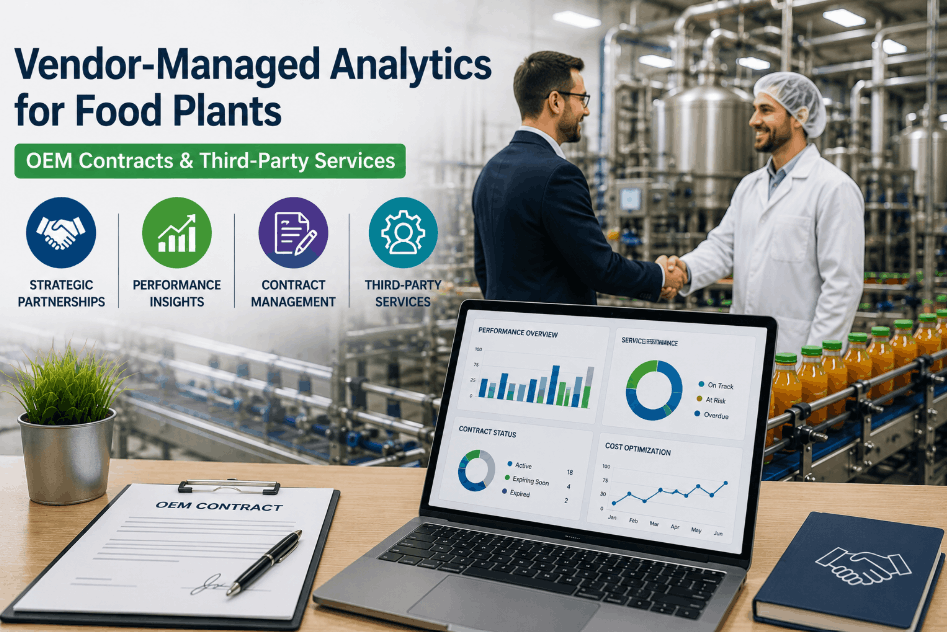
Vendor-managed analytics has emerged as a critical frontier for food manufacturing efficiency, yet it remains one of the most complex domains for Procurement and Plant Directors to master. In an era where a single production line might involve assets from five different Original Equipment Manufacturers (OEMs) and three third-party service providers, the challenge is no longer just capturing data—it is governing the vendors who provide it. Fragmented OEM portals, incompatible data standards, and opaque service-level agreements (SLAs) often lead to "analytics silos" that hide the true cost of equipment ownership. This guide explores how to structure your vendor analytics ecosystem, comparing the strengths of OEM-specific monitoring against unified third-party platforms, and providing a framework for driving vendor accountability through AI-driven performance tracking. To see how a unified platform can centralize your multi-vendor intelligence, book a demo with iFactory today.
Master Your Multi-Vendor Analytics Ecosystem
iFactory gives food plant directors a unified command center to track OEM performance, verify SLA compliance, and eliminate redundant analytics spend across your entire vendor landscape.
The Strategic Shift: From Fragmented Vendor Logs to Unified Performance Intelligence
For decades, food plants have relied on OEMs to provide the "black box" analytics for their specific machines. While proprietary OEM monitoring offers deep technical insight into individual assets, it creates a massive visibility gap for the plant as a whole. When your filler, labeler, and palletizer all run on different analytics platforms, your team spends more time reconciling reports than optimizing production. The shift toward vendor-managed analytics is about breaking these silos and demanding that vendors plug into a unified plant architecture.
Strategic vendor management now requires a shift from trust-based relationships to data-driven accountability. Procurement teams are increasingly including "Data Sovereignty" clauses in OEM contracts, ensuring that the plant—not the vendor—owns the granular performance data. To understand how to embed these analytics requirements into your next service agreement, book a demo and walk through our vendor governance framework.
OEM Contracts vs. Independent Service Providers: A Benchmarking Model
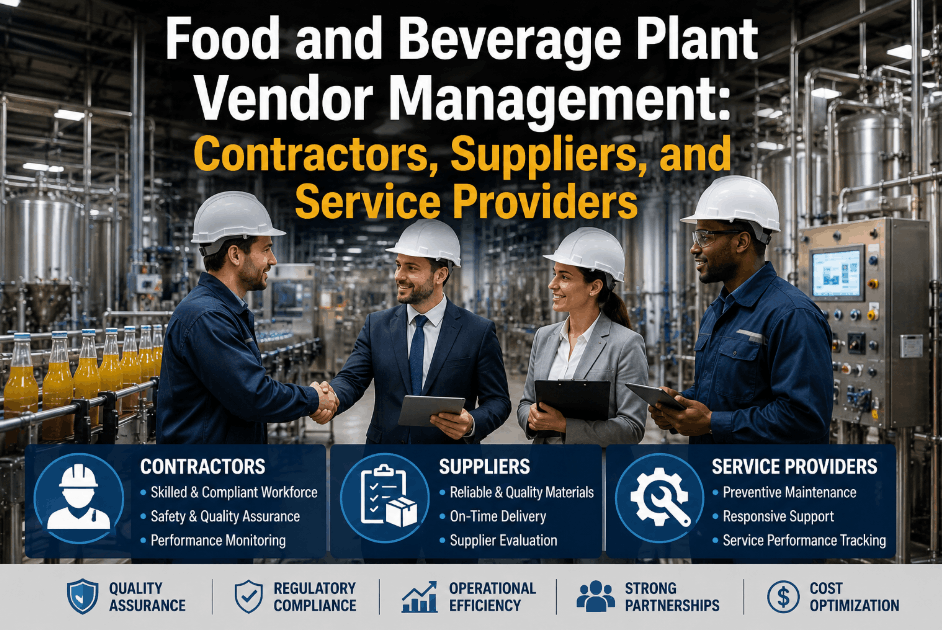
Choosing between OEM-managed analytics and third-party independent service providers (ISPs) involves balancing technical depth against operational flexibility. OEMs offer unparalleled expertise but often at a premium price and with restrictive data access. Third-party providers offer broader cross-platform integration and lower costs but may lack the deep proprietary knowledge required for highly specialized processing equipment.
Deep technical monitoring for specific assets. High subscription costs. Data lock-in makes multi-vendor optimization nearly impossible.
OEMs provide the sensors, but data is piped into a third-party platform for unified OEE and vendor performance tracking across the plant.
Independent sensors and platforms. Lowest cost and maximum flexibility. Ideal for older facilities or mixed-vendor packaging lines.
Industry data suggests that food plants utilizing a hybrid model—where they maintain OEM relationships for maintenance but centralize analytics—experience a 15-18% higher return on their digital investment compared to those relying solely on proprietary OEM portals.
A Four-Tier Framework for Vendor Analytics Governance
Effective vendor management requires a structured approach to how analytics are delivered and consumed. Without a tiered governance framework, plants often find themselves paying for advanced AI capabilities from vendors while their teams still struggle to get basic uptime data from the same machines.
Data Access & API Connectivity
Ensuring all OEM equipment has open APIs or MQTT support. Goal: Eliminate manual data exports from vendor portals.
Normalized Multi-Vendor KPIs
Standardizing MTBF and MTTR definitions across all service providers. Goal: Apples-to-apples vendor performance comparison.
Automated SLA Verification
Using real-time sensor data to trigger service credits when vendors miss uptime targets. Goal: 100% contract compliance.
Predictive Service Orchestration
AI-driven scheduling that coordinates multiple vendors to minimize total downtime. Goal: Zero-waste service cycles.
Key Drivers for Vendor Analytics in Food Manufacturing
Food plants have unique vendor constraints—specifically around hygiene, food safety compliance, and highly seasonal production cycles—that dictate how analytics contracts should be structured.
Warranty & Compliance Analytics
Automated tracking of operational parameters ensures that warranty claims are never denied due to "improper use" disputes. Analytics provide the objective truth during vendor negotiations.
Remote OEM Diagnostics Efficiency
Giving OEMs secure, real-time access to machine analytics reduces on-site service hours by 30-40%. Remote troubleshooting becomes the default, saving thousands in travel and hourly fees.
Third-Party Hygiene & Safety Tracking
Monitoring service provider activity levels ensures that external technicians adhere to sanitation protocols. Digital logs replace manual sign-ins for FSMA audit readiness.
Multi-Vendor Interoperability
Analytics that bridge the gap between a German filler and an Italian labeler prevent "finger-pointing" when a line fails. The data identifies the root cause vendor instantly.
AI-Driven Vendor Scorecards: Moving Beyond Subjective Reviews
Traditional vendor management relies on quarterly meetings and subjective feedback from maintenance managers. AI-driven vendor scorecards replace this with real-time performance data, calculating a "Quality of Service" (QoS) score for every OEM and contractor based on actual machine response and repair effectiveness.
When a third-party service provider claims 99% uptime but the AI layer shows 15 minor stoppages that were never reported, the plant has the leverage to renegotiate contract terms. Leading procurement teams book a demo to automate these scorecards and eliminate manual vendor auditing.
| Vendor Management Metric | Traditional Manual Review | AI-Driven Real-Time Scorecard | Business Impact |
|---|---|---|---|
| SLA Uptime Verification | Vendor-provided monthly reports | Direct sensor-to-contract validation | Eliminate 100% of "over-reporting" |
| Repair Effectiveness (MTB-F) | Anecdotal "how is it running?" | Post-repair Mean Time Between Failure | Reduce repeat failures by 25% |
| Parts Usage Optimization | Trust-based ordering | Analytics-verified wear pattern analysis | 12–15% reduction in spare parts spend |
| Lead Time Accuracy | Estimated dates in ERP | Historical vendor performance tracking | Improve production scheduling by 18% |
| Contract Renewal Leverage | Relationship-based renewal | Performance-based ROI calculation | Secure 8–10% better renewal terms |
Calculating the ROI of Analytics-Driven Vendor Management
Justifying the investment in a vendor analytics platform requires a clear understanding of the "hidden costs" of poor vendor management. By quantifying these leaks, Plant Directors can build a bulletproof business case for a unified intelligence layer.
Consolidated License Savings
Replacing five separate OEM monitoring subscriptions with one unified plant platform typically recovers $15K to $40K per facility in annual software licensing fees. This "software consolidation" often pays for the platform in year one.
Service Hour Optimization
AI-driven remote diagnostics reduce on-site vendor visits by an average of 22%. For a plant spending $200K on annual service hours, this translates to $44K in direct labor savings and significantly lower travel surcharges.
Warranty Recovery Value
Documenting precise operating conditions ensures that vendors cannot evade warranty obligations. High-volume food plants report recovering $30K to $80K annually in parts and labor that would have otherwise been paid out-of-pocket.
Downtime Penalty Reclamation
Enforcing downtime penalties in SLAs using objective sensor data acts as a powerful incentive for vendors to improve response times. This results in an average 12% improvement in vendor-related machine availability.
Vendor Accountability: The Quarterly Performance Review Cadence
Analytics are only effective if they lead to action. Establishing a rigorous cadence for vendor reviews, backed by unified data, is the final step in moving from a vendor-dependent plant to a vendor-optimized operation.
Monthly Data Sanity Checks
Review the data bridge between OEM machines and your central platform. Ensure all APIs are healthy and data latency is below 5 seconds. This foundation ensures that when you meet with the vendor, the data is indisputable.
The Data-Driven QBR
Replace the "lunch meeting" with a data-driven Quarterly Business Review. Present the vendor with their OEE impact, repair effectiveness, and SLA compliance. Use these metrics to set "Performance Improvement Plans" for the next quarter.
Total Cost of Ownership (TCO) Audit
Once a year, use the accumulated analytics to calculate the TCO for each OEM's equipment. Compare initial purchase price against ongoing service and analytics costs. Use this to inform your next capital equipment procurement cycle.
Vendor Analytics Implementation: A 12-Month Roadmap
For food plants transitioning from a vendor-locked state to a unified analytics model, this roadmap provides the sequence of events needed to reclaim control of your production data.
Contractual Data Audit
Review all active OEM and service contracts for data access rights. Identify "dark assets" where vendors are blocking data flow. Map current analytics spend across all vendors.
Unified API Integration
Select a central analytics platform. Establish API connections with key OEMs. Install edge gateways for older equipment that lacks native connectivity. Normalize data tags.
SLA Baselining
Monitor actual vendor performance against contract terms for 90 days. Build the first set of automated vendor scorecards. Identify the bottom 20% of underperforming vendors.
SLA Renegotiation & Enforcement
Use the 90-day baseline to renegotiate underperforming contracts. Implement service credit triggers in new agreements. Train procurement teams on analytics-driven negotiation.
Continuous Optimization
Roll out predictive service orchestration. Link vendor performance data to your capital equipment planning process. Achieve a fully transparent, data-driven vendor ecosystem.
"We were essentially flying blind when it came to our OEM service costs. We knew we were paying a lot, but we couldn't prove where the value was. iFactory allowed us to consolidate our analytics and hold our vendors to the same standard as our own internal teams. Within six months, we identified two vendors who were consistently missing SLAs, and the data-backed renegotiation saved us $140K in the first year alone. The transparency changed everything."
Frequently Asked Questions: Vendor-Managed Food Plant Analytics
What is the biggest risk of relying solely on OEM-managed analytics?
Data lock-in. When a vendor controls the data, they control the narrative. You cannot easily compare machine performance across different lines, and you are often forced into proprietary service contracts that may not be the most cost-effective for the plant.
How do we ensure vendors share their data with our central platform?
This must be addressed at the contract level. Modern "Smart Procurement" clauses should specify that the vendor must provide an open API, MQTT, or OPC-UA feed of specific data points as a condition of the equipment purchase or service agreement.
Can we use third-party analytics for equipment that is still under OEM warranty?
Yes. In fact, third-party analytics can protect your warranty by proving that you operated the equipment within specified parameters. The key is to ensure your monitoring is non-intrusive (e.g., using edge gateways or existing PLC data ports).
What metrics are most important for a vendor scorecard in a food plant?
The "Big Three" are: MTBF (Mean Time Between Failure) to judge repair quality, MTTR (Mean Time to Repair) to judge service speed, and Cost-per-Repair-Hour to judge overall value. For food plants, "Audit Readiness of Service Logs" is also a critical metric.
Is it better to have many small vendors or fewer large OEMs managing analytics?
While consolidating to a few large OEMs simplifies administration, it increases the risk of proprietary lock-in. The optimal approach is a "Best-of-Breed" equipment strategy supported by a unified, third-party analytics platform that integrates them all.
Ready to Reclaim Control of Your Vendor Performance Data?
iFactory's unified industrial analytics platform gives food plant Procurement and Operations leaders a single source of truth to manage OEM contracts, track service performance, and drive down total cost of ownership.