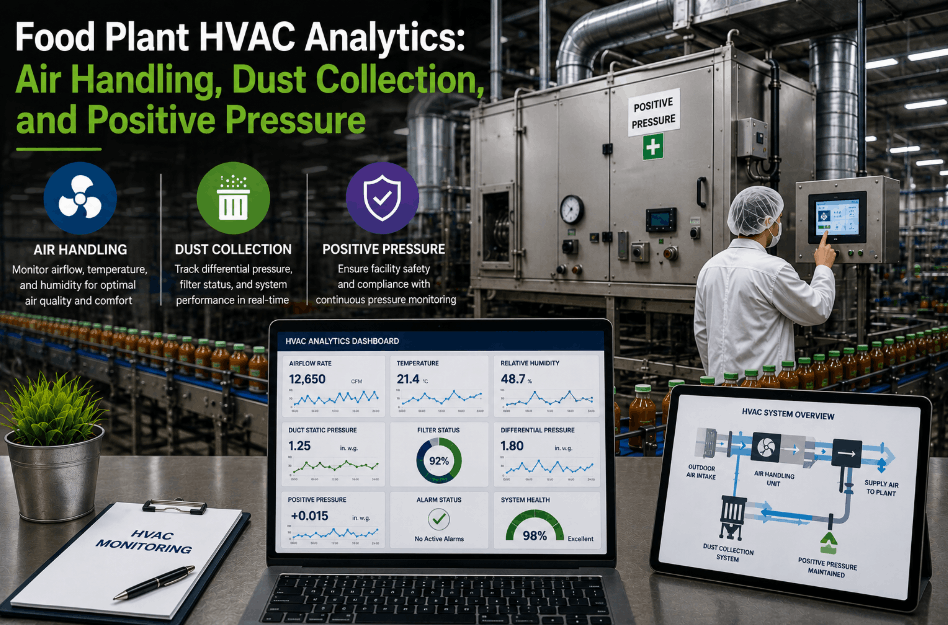
Food plant HVAC analytics is no longer a back-of-house afterthought. For facilities engineers managing air handling in food manufacturing, the condition of your air handling units, dust collection systems, and positive pressure zones is a direct determinant of product safety, regulatory compliance, and operational cost. Most food processing facilities still manage HVAC performance through reactive maintenance cycles and manual inspection rounds that leave critical air quality data invisible until a problem surfaces. Book a demo to see how AI-driven HVAC analytics gives facilities engineers real-time visibility into every air handling control point across your plant.
The Hidden Risk in Food Plant Air Handling Systems
In food manufacturing environments, air is an active vector for cross-contamination, allergen migration, microbial loading, and particulate infiltration. When any HVAC system drifts — a filter loading past threshold, a fan belt degrading, a damper actuator losing calibration — the resulting deviation can compromise a high-care zone or trigger an allergen control failure. Conventional HVAC monitoring captures point-in-time data without the contextual analysis needed to identify degrading performance before it reaches a critical threshold. That is the gap food plant HVAC analytics platforms are built to close.
Air Handling Unit Analytics: Monitoring AHU Performance in Food Manufacturing
Air handling units are the primary control mechanism for temperature, humidity, and air quality in food processing facilities. AHU performance degradation — from filter fouling, coil fouling, fan bearing wear, or damper calibration drift — directly impacts the controlled environment conditions that food safety programs depend on. Analytics platforms monitor interrelated parameters in real time, identifying degradation signatures that no individual sensor would flag independently. Book a demo to see how AHU analytics integrates with your existing building management system.
Dust Collection Analytics for Food Processing: Preventing Particulate and Allergen Migration
Dust collection in food manufacturing removes airborne particulates generated during processing and prevents the migration of allergen-bearing dust into controlled or allergen-free areas. Dust collectors operating below designed efficiency create conditions for particulate accumulation in ductwork, elevated airborne allergen concentrations, and contamination of adjacent product zones. Book a demo to see how dust collection performance data integrates with allergen control documentation in a unified food plant compliance platform.
Bag filter differential pressure trending is the primary indicator of dust collector filter condition. AI analytics track pressure trends over time — detecting abnormal loading rates and flagging incomplete pulse cleaning cycles that indicate pulse valve failures or compressed air supply issues.
Hopper level monitoring and bridging detection prevents dust accumulation in collector hoppers that reduces effective filter area and creates re-entrainment risk. Real-time analytics with AI-driven bridging alerts notify maintenance teams before hopper conditions impact collector performance.
Ductwork negative pressure validation confirms that the dust collection system maintains adequate capture velocity at each collection hood. Insufficient capture velocity — from ductwork leakage, hood blockage, or fan degradation — is a primary mechanism for allergen migration in food plant production spaces.
Positive Pressure Monitoring in Food Plants: Protecting High-Care and Allergen-Free Zones
Positive pressure differentials between food processing zones are the primary engineered barrier against contaminant ingress. Maintaining specified pressure relationships is a regulatory requirement under FSMA, a core HACCP control, and an allergen management audit checkpoint. Positive pressure analytics provide continuous monitoring across every zone boundary — not periodic spot-checks from a gauge during manual rounds. Book a demo to see how continuous positive pressure analytics is implemented across multi-zone food manufacturing facilities.
| Monitoring Parameter | Manual Inspection Approach | AI-Driven Analytics Approach | Compliance Impact |
|---|---|---|---|
| Zone differential pressure | Periodic gauge readings, 1–3x daily | Continuous real-time monitoring, 1-second intervals | Detects sub-threshold deviations before breach |
| Pressure loss event duration | Unknown — gaps between rounds | Logged automatically with timestamp and duration | Audit-ready event record for every deviation |
| Root cause identification | Manual investigation post-event | AI correlation with door, AHU, and airlock data | Targeted corrective action, not symptom management |
| Allergen zone validation | Shift-start and post-changeover checks | Continuous zone integrity confirmation | Real-time allergen control documentation |
| AHU contribution to pressure loss | Not correlated in real time | AHU performance linked to pressure differential trends | Predictive pressure maintenance vs reactive response |
| Regulatory documentation | Manual log reconstruction | Automated compliance record generation | Audit-ready positive pressure records on demand |
Temperature and Humidity Analytics for Food Processing Environments
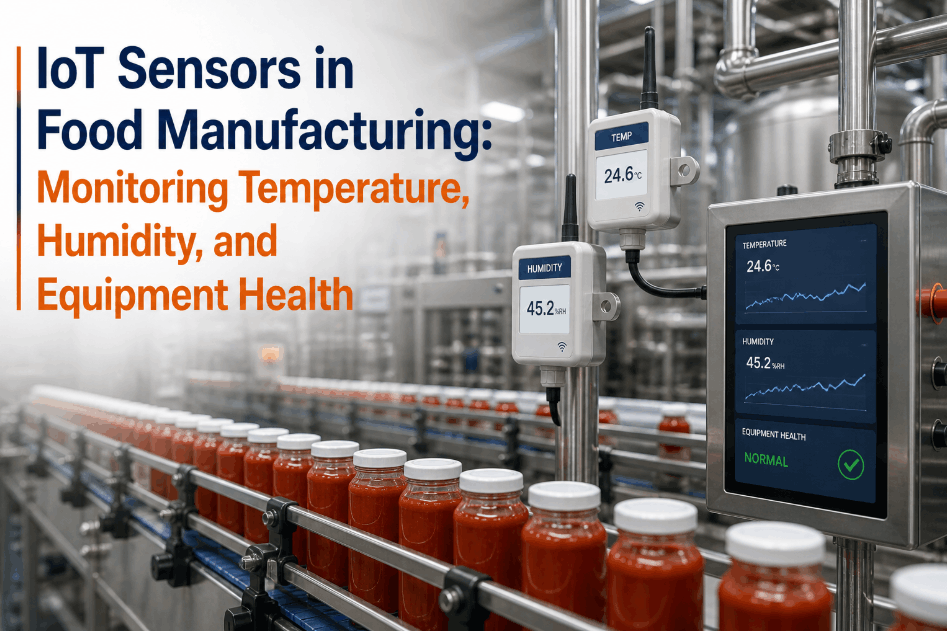
Temperature and humidity control in food manufacturing maintains process conditions required for product quality, controls microbial growth in production and storage areas, and meets regulatory requirements for temperature-controlled operations. HVAC systems that fail to maintain specified setpoints — due to AHU capacity degradation, sensor calibration drift, or control loop instability — create conditions that compromise product quality and trigger regulatory findings. Analytics platforms provide zone-level performance data with AI anomaly detection that identifies setpoint deviation trends before they reach action thresholds.
Allergen Control HVAC Analytics: Using Air Management as a Primary Allergen Barrier
Allergen management programs in food manufacturing traditionally focus on cleaning verification and ingredient segregation — treating HVAC as a supporting system rather than a primary allergen control. Yet airborne allergen migration through inadequate zone pressure differentials, insufficient dust collection efficiency, and suboptimal filter performance is a documented cross-contact mechanism that cleaning protocols alone cannot address. Allergen control HVAC analytics elevates air management into a documented food safety control point — with continuous performance data reviewable by certifying bodies and retail auditors alongside allergen cleaning records. For a live walkthrough, book a demo with ifactory's food compliance engineering team.
Deploying Food Plant HVAC Analytics: Implementation Approach and Measurable Outcomes
The most effective food plant HVAC analytics deployments cover all four subsystems simultaneously — air handling, dust collection, positive pressure, and temperature/humidity — creating a unified performance view that reveals system interactions point-system monitoring cannot capture. Facilities engineers should assess BMS integration requirements and the specific compliance parameters the platform monitors against food manufacturing regulatory needs.
All existing HVAC sensors, BMS data points, and monitoring equipment integrated into the analytics platform. Coverage gaps addressed with additional monitoring points. AI baseline establishment begins immediately — requiring 14–21 days of operational data to establish facility-specific anomaly detection thresholds.
Allergen zone pressure specs, temperature and humidity setpoints, filter change intervals, and dust collection thresholds configured as compliance control points. Alert thresholds calibrated to trigger before regulatory or food safety action limits are reached — giving engineering teams meaningful intervention lead time.
Facility-level and zone-level HVAC performance dashboards deployed to engineering, quality, and operations teams. Automated documentation generation configured to produce audit-ready records — pressure differential logs, temperature excursion records, and filter change documentation — formatted to certifying body and regulatory requirements.
Food Plant HVAC Analytics: Converting Air Management from a Maintenance Cost Into a Compliance Asset
Food plant HVAC analytics transforms air management into a documented, auditable food safety control system. By providing real-time visibility into AHU performance, dust collection efficiency, positive pressure zone integrity, and temperature and humidity control — and integrating that data into compliance documentation — analytics platforms give facilities engineers the tools to prevent failures that create regulatory exposure, allergen risk, and unplanned production interruption. HVAC failures detected days before they cause production impact cost a fraction of the emergency response and corrective action costs associated with failures detected after the fact.