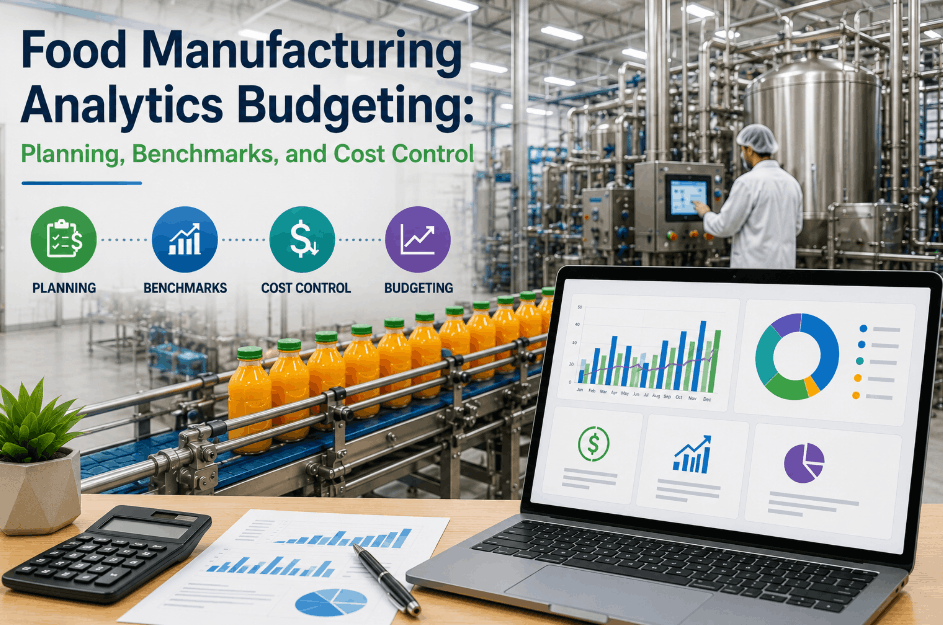
Food manufacturing analytics budgeting is one of the most underestimated financial disciplines in plant operations. For Finance Directors and Plant Managers navigating volatile ingredient costs, regulatory compliance, and competitive margin pressure, a structured analytics budget is no longer optional — it is the foundation of operational intelligence. Yet most food plants still allocate analytics spend reactively, without benchmarks, without ROI frameworks, and without a clear strategy for aligning data infrastructure to production goals. This guide breaks down how to plan your food plant analytics budget with precision, using industry-standard RAV percentages, cost allocation models, and AI-driven financial reporting tools that turn raw data into measurable cost control. If you want to see how a unified platform can anchor your analytics investment, book a demo with iFactory today.
Build a Smarter Food Plant Analytics Budget
iFactory's AI-driven analytics platform gives Food Finance Directors and Plant Managers real-time cost visibility, production KPIs, and vendor performance data — purpose-built for food manufacturing environments.
Why Food Manufacturing Analytics Budgeting Demands a Strategic Framework
Most food manufacturing facilities treat analytics as a cost center rather than a value driver. The result is fragmented spending — a dashboard tool here, a spreadsheet-based quality log there — with no coherent architecture and no way to measure whether the investment is producing a return. A strategic analytics budget for a food plant must answer three questions: What data do we need? What infrastructure do we need to capture it? And what is the measurable financial outcome we are targeting?
The budgeting framework — anchored in RAV (Replacement Asset Value) percentages, labor cost ratios, and clearly defined capability tiers — applies universally across the food and beverage manufacturing sector. Finance Directors who treat analytics budgeting as a one-time CapEx line item consistently underinvest in data quality and integration work. To see how leading food plants structure this, book a demo with iFactory and walk through a real ROI model.
Food Plant Analytics Budget Benchmarks: The RAV Percentage Model
The most widely accepted benchmarking method for analytics spend in food manufacturing is the RAV percentage model. High-performing food plants allocate between 1% and 3% of their total Replacement Asset Value annually to analytics, monitoring, and performance intelligence systems. Plants spending below 0.8% of RAV typically operate in a reactive mode — responding to quality failures rather than predicting and preventing them.
Reactive operations. Manual data collection. Limited traceability. High cost of quality failures and compliance gaps.
Automated OEE tracking. Digital quality logs. Basic predictive maintenance. Measurable reduction in unplanned downtime.
AI-driven financial reporting. Real-time S-curve production tracking. Integrated vendor scorecards. Full audit traceability.
Best-in-class food plants typically spend between 18% and 25% of their combined maintenance and quality labor budget on analytics systems. A plant spending $2M per year on maintenance engineers should be investing $360K to $500K in the digital tools that amplify their output.
Cost Allocation for Food Manufacturing Analytics: A Four-Tier Budget Architecture
Effective analytics budget planning requires allocating spend across four distinct functional tiers. Underfunding any single tier creates a bottleneck that limits the value of investment in the others. The most common mistake is over-allocating to Tier 1 (hardware) while severely underfunding Tier 3 (integration) — precisely where most analytics implementations fail.
Data Collection Infrastructure
Sensors, PLCs, SCADA upgrades, and IoT edge devices. Allocation: 25–30% of total analytics budget.
Analytics Platform & Licensing
MES, ERP analytics modules, and dedicated food manufacturing analytics platforms. Allocation: 30–35% of total analytics budget.
Integration & Data Quality
API integrations between ERP, MES, and quality systems. Allocation: 20–25%. Responsible for 60% of analytics failures when underfunded.
Training & Continuous Improvement
User adoption, analytics literacy training, and continuous model recalibration. Allocation: 15–20%. Determines full ROI extraction from Tiers 1–3.
Key Analytics Cost Drivers Specific to Food Manufacturing
Food and beverage manufacturing creates several analytics cost drivers that differ significantly from other industrial sectors. Understanding these drivers allows Finance Directors to build more accurate budget models and avoid costly mid-year overruns.
Regulatory Traceability & Compliance
FDA FSMA, GFSI audits, and retailer traceability standards create a mandatory analytics baseline. These non-discretionary costs consume 20–30% of a food plant's total analytics budget before any performance tools are added.
OEE & Yield Analytics
OEE tracking is the single highest-ROI analytics investment. A 1% OEE improvement on a $50M line recovers $500K in production capacity. Infrastructure cost ranges from $80K–$250K per facility.
Cold Chain & Environmental Monitoring
Undetected temperature excursions can cause product losses exceeding $500K per incident. Continuous monitoring platforms add $30K–$80K annually and pay for themselves after the first prevented loss event.
Supplier & Raw Material Cost Analytics
Real-time analytics on raw material cost per unit enables Finance Directors to model the true cost impact of ingredient substitutions and supplier changes. Typical annual spend: $40K–$120K.
AI-Driven Financial Reporting for Food Plants: Moving Beyond Static Dashboards
The shift from static monthly reporting to AI-driven financial reporting is the most transformative capability available to food manufacturing Finance Directors today. Traditional financial reporting operates on a lag — production data is manually reconciled into ERP, cost variances are identified weeks after they occur, and by the time corrective action is taken, the margin damage is already done.
When a filling line experiences a 12% yield loss, the AI layer immediately calculates the cost per unit impact, flags the variance against budget, and routes an alert before the shift ends — not at month close. Food manufacturers exploring this shift consistently begin by choosing to book a demo to quantify the lag reduction opportunity in their own operations.
| Financial Reporting Capability | Traditional Monthly Reporting | AI-Driven Real-Time Reporting | Business Impact |
|---|---|---|---|
| Cost Variance Detection | Identified at month close, 3–4 weeks lag | Detected within the shift it occurs | Prevent 70–80% of variance accumulation |
| OEE-to-Financial Link | Manual reconciliation in spreadsheets | Automated unit cost calculation per line | Eliminate 40+ hours/month of analyst time |
| Waste & Yield Tracking | End-of-week supervisor estimate | Continuous real-time yield monitoring | $120K–$250K annual waste reduction |
| Supplier Cost Analytics | Quarterly procurement review | Per-batch raw material cost tracking | 8–12% improvement in ingredient cost efficiency |
| Audit & Compliance Reporting | Manual document compilation, days of effort | One-click digital audit export | 100% FSMA and GFSI audit readiness |
Building the Business Case: Calculating Analytics ROI for Food Manufacturing
Every analytics budget proposal must be supported by a quantified ROI model. Finance Directors need a structured methodology for converting analytics investment into hard-dollar returns. The following framework covers the four primary ROI levers available in food manufacturing analytics investments.
Downtime Reduction Value
Apply the industry-average 30–35% downtime reduction from predictive analytics to your facility's hourly production value. This lever typically generates $150K to $500K in annual recovered production value — the most powerful first-year ROI driver in any food plant analytics budget.
Waste and Yield Improvement Savings
Real-time OEE and yield analytics consistently deliver a 1.5–3% improvement in overall yield. For a plant processing $30M in raw material annually, a 2% yield improvement represents $600K in recovered ingredient value — especially impactful for high-value protein and dairy processing.
Quality and Recall Risk Reduction
The average cost of a food recall in North America exceeds $10M. Analytics investments in automated SPC monitoring, real-time CCP tracking, and digital traceability reduce recall probability. Even a modest risk reduction delivers ROI that dwarfs the analytics budget required to achieve it.
Labor Productivity Amplification
Digital work orders and real-time dashboards increase productive time per shift by 12–18%. For 50 skilled technicians at $75K fully-loaded cost, a 15% productivity gain equals $562K in annual labor efficiency — without a single headcount reduction.
Analytics Cost Tracking: Ensuring Budget Discipline Through the Year
Approving an analytics budget is only the beginning. Maintaining discipline through the fiscal year requires structured review cadences, accurate cost classification, and objective vendor accountability — three disciplines that most food plants underinvest in relative to the technology itself.
Monthly Analytics Value Review
Hold a focused 60-minute monthly review between Finance and Operations leadership. Track actual downtime reduction, yield improvement, and compliance automation savings against original budget projections. Plants running this cadence report 25–40% better budget adherence on multi-year analytics programs.
Separate CapEx and OpEx with Precision
SaaS-based analytics platform subscriptions are OpEx under GAAP and IFRS. Hardware sensors and integration development qualify as CapEx. Maintaining clean separation is essential for accurate financial reporting and tax efficiency. Finance Directors should book a demo to understand how iFactory's commercial structure optimizes both CapEx and OpEx treatment.
Vendor Scorecards for Analytics Suppliers
Food plants typically engage three to seven analytics technology vendors. Quarterly vendor scorecards — scoring uptime, response time, feature delivery, and measured ROI contribution — give procurement teams objective data for renegotiating contracts and eliminating underperforming tools that consume budget without delivering results.
Food Manufacturing Analytics Budget Planning: A 12-Month Roadmap
For Plant Managers and Finance Directors preparing their first structured analytics budget or rebuilding an underperforming program, the following 12-month roadmap provides a sequential framework that minimizes risk and maximizes early ROI realization.
Analytics Maturity Assessment
Audit current data collection capabilities, identify critical visibility gaps, and benchmark current analytics spend against RAV percentage targets. Establish baseline KPIs for downtime, yield, and quality cost.
Platform Selection & Budget Finalization
Issue RFPs, evaluate vendors against a structured capability matrix, and finalize the four-tier budget allocation. Secure executive approval with a 3-year ROI model projecting returns across the four primary value levers.
Tier 1 & 2 Deployment
Deploy data collection infrastructure on highest-priority production lines. Activate analytics platform for OEE monitoring, quality tracking, and basic financial reporting. Target first line fully live within 90 days of contract signature.
Integration & AI Reporting Activation
Complete ERP and MES integration. Activate AI-driven financial reporting modules. Launch Tier 4 training for plant supervisors and maintenance teams. Begin monthly analytics value reviews with Finance and Operations leadership.
ROI Validation & Year-2 Planning
Conduct formal ROI validation comparing actual downtime reduction, yield improvement, and productivity gains against original projections. Use validated results to build the Year-2 analytics budget with expanded scope.
"We went into our analytics budgeting process with no benchmarks and no framework — just a vague sense that we needed better data. iFactory gave us a structured ROI model that let us justify a $400K analytics investment to our CFO with confidence. Twelve months later, we had recovered $620K in production value from downtime reduction alone and our quality audit preparation time dropped by 70%. The budget practically justified itself."
Frequently Asked Questions: Food Manufacturing Analytics Budgeting
What percentage of revenue should a food plant budget for analytics?
Industry benchmarks suggest 0.3–0.8% of annual revenue, but the RAV percentage model (1–3% of Replacement Asset Value) provides a more precise and operationally grounded target. Plants with higher automation maturity typically sit toward the higher end of this range.
How do we justify analytics CapEx investment to a CFO focused on short-term cost control?
Focus on three quantified risks analytics investment directly mitigates: one unplanned production stoppage, one quality recall, and annual manual reporting labor eliminated. In most food manufacturing contexts, a single prevented event exceeds the entire annual analytics budget.
Should food plant analytics costs be treated as CapEx or OpEx?
Hardware sensors and on-premise software installations qualify as CapEx. SaaS-based analytics platform subscriptions are OpEx, expensed in the period incurred. Many food manufacturers intentionally maximize OpEx flexibility in early years while preserving CapEx for core processing equipment.
How long does it typically take to see ROI from a food manufacturing analytics investment?
Most food plants see measurable returns within 6–9 months of full deployment. Downtime reduction on high-volume lines delivers the fastest ROI, while compliance and audit automation value is realized immediately upon the first external audit following deployment.
What is the biggest mistake food plants make when budgeting for analytics?
Over-investing in data collection hardware while severely underfunding integration and data quality work. A plant with $500K in sensors flowing into a disconnected system gets zero analytical value. The second most common error is budgeting for technology only with no allocation for training and change management.
Ready to Build a Results-Driven Food Manufacturing Analytics Budget?
iFactory's industrial analytics platform gives food plant Finance Directors and Operations leaders a unified command center for cost control, production performance, and compliance traceability — with a structured ROI model to anchor every budget conversation.