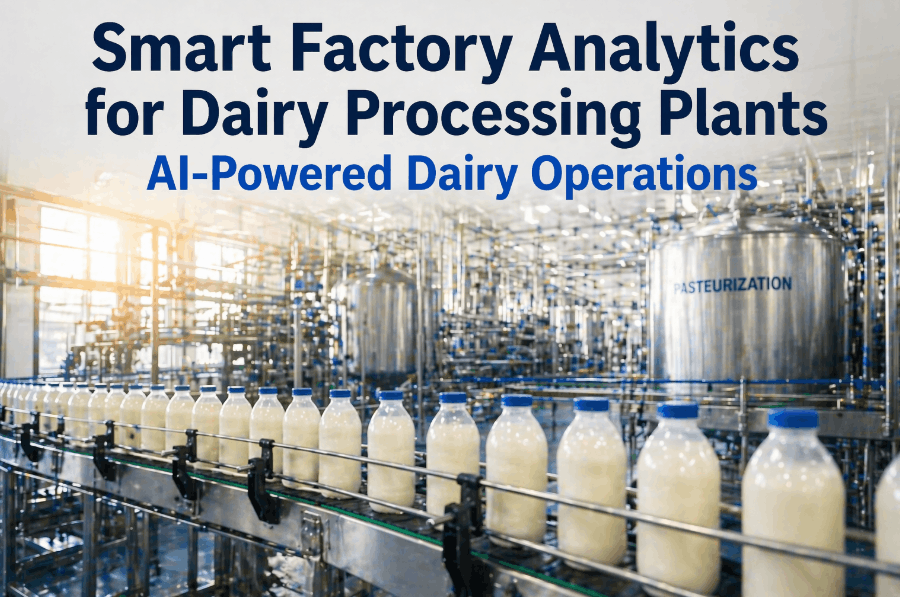
In 2026, dairy processing plants face mounting pressure to deliver consistent product quality, minimize waste, and stay ahead of regulatory demands — all while managing aging equipment and razor-thin margins. Smart factory analytics for dairy processing plants is no longer a future-state investment; it is the operational foundation that separates high-performing dairy manufacturers from facilities perpetually managing reactive crises. AI-powered monitoring platforms now give dairy plant managers real-time visibility into pasteurizer performance, separator efficiency, CIP cycle validation, and cold storage integrity — transforming raw operational data into actionable intelligence that protects both product quality and profitability. To see how AI-driven dairy operations work in practice, book a demo and explore what real-time factory analytics can deliver for your facility.
Transform Your Dairy Plant with AI-Powered Smart Factory Analytics
iFactory's manufacturing intelligence platform delivers real-time equipment health scoring, predictive maintenance alerts, and automated compliance documentation — purpose-built for the demands of dairy processing operations.
Why Smart Factory Analytics Are Critical for Dairy Processing in 2026
Dairy processing environments impose unique mechanical and microbial challenges that no other food manufacturing sector fully replicates — pasteurizers, homogenizers, cream separators, and evaporation systems operate under continuous thermal cycling, aggressive CIP chemical exposure, and strict temperature control requirements all simultaneously. Traditional scheduled maintenance cycles cannot match the precision that modern dairy operations require, and a pasteurizer gasket that begins to fail between inspection intervals does not wait for the next scheduled service window. Industrial IoT for dairy plants addresses this gap by monitoring equipment health continuously, detecting developing faults from vibration signatures, thermal drift, and process flow deviations days or weeks before they escalate into production-stopping failures — and dairy plant managers exploring condition-based monitoring can book a demo to understand how AI monitoring integrates with existing processing infrastructure without disrupting ongoing production.
How AI-Powered Dairy Processing Analytics Work
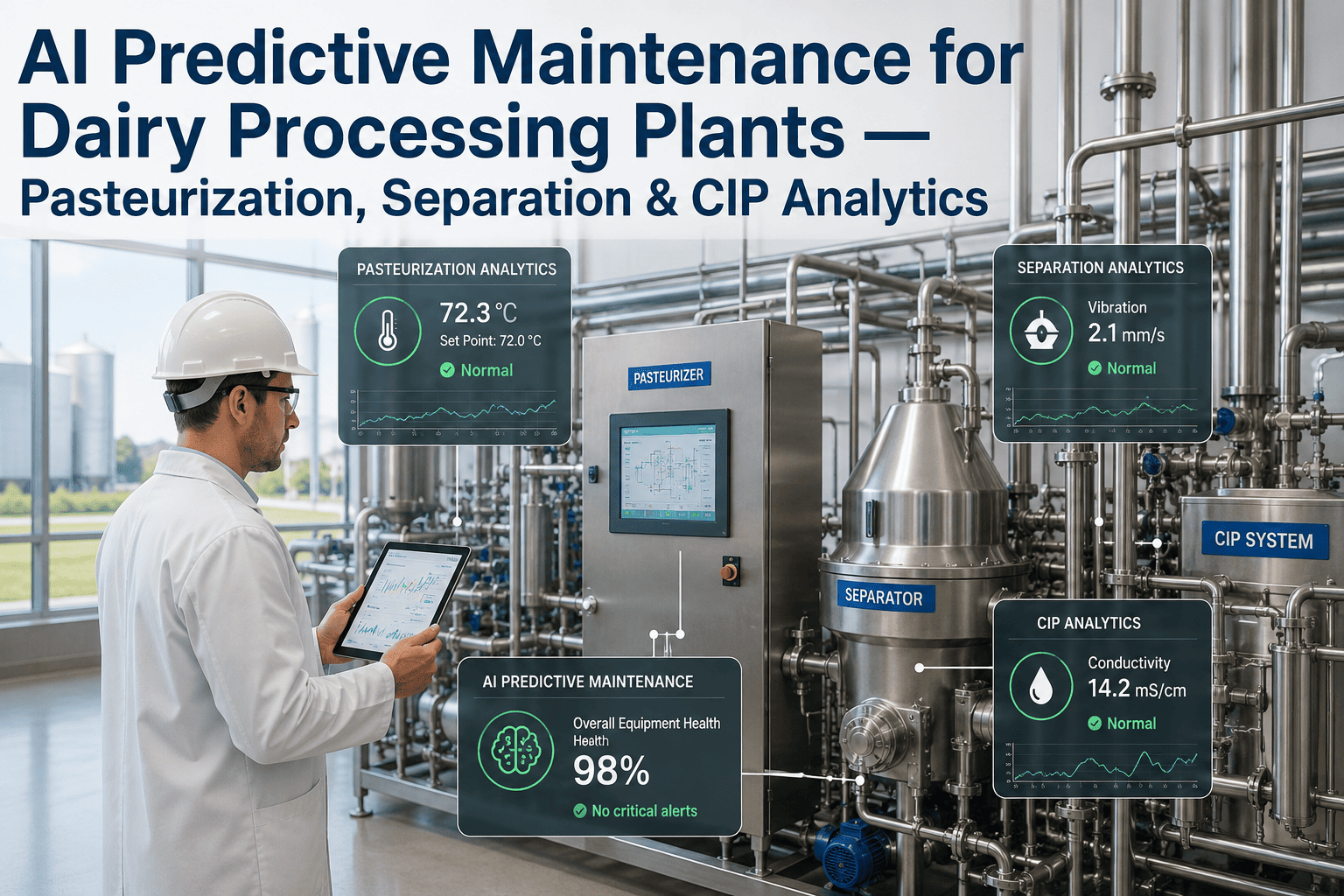
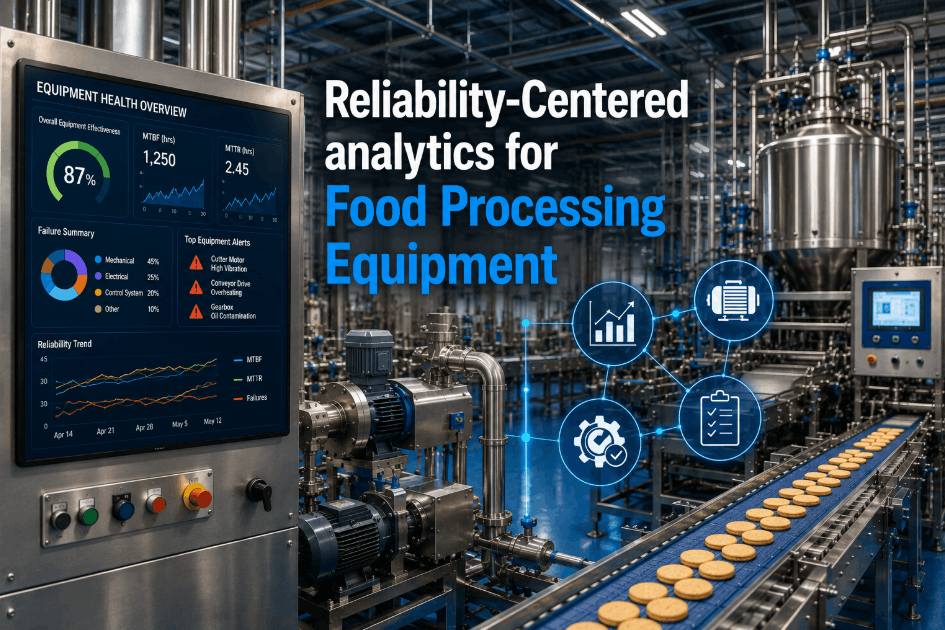
Smart factory analytics platforms for dairy manufacturing are built on machine learning models trained on equipment-specific operational signatures — the thermal, mechanical, electrical, and process patterns that characterize both healthy operation and the early stages of failure. Rather than triggering alarms only at failure thresholds, these systems score asset health continuously, tracking the direction and velocity of performance change and flagging deviations that indicate developing faults with enough lead time for planned intervention — shifting facilities from calendar-driven component replacement to condition-based dairy plant predictive maintenance that intervenes precisely when equipment health data indicates the need, simultaneously reducing both premature replacement costs and catastrophic failure risk. Dairy operations teams wanting to see how this translates in a live production environment can book a demo to walk through a real-time asset health scoring demonstration.
Bearing and Pump Fault Detection Weeks in Advance
AI models trained on vibration frequency spectra identify bearing race defects, pump cavitation signatures, and shaft imbalance patterns that precede catastrophic failure — giving dairy plant maintenance teams precise intervention windows rather than surprise shutdowns during peak processing shifts.
Pasteurizer and Heat Exchanger Performance Trending
Temperature profile algorithms continuously validate pasteurizer hold tube performance and detect fouling progression in plate heat exchangers — identifying thermal efficiency loss before it reaches the point of process deviation or HTST regulatory non-compliance.
Separator and Homogenizer Efficiency Monitoring
Real-time flow rate and pressure differential analytics detect separator bowl wear, homogenizer valve degradation, and pump efficiency decline — correlating process performance data with equipment health scoring to identify root causes before production quality is affected.
Clean-in-Place Cycle Effectiveness Analytics
AI systems monitor CIP cycle temperature profiles, chemical concentration curves, and flow velocity patterns to validate sanitation effectiveness in real time — automatically flagging cycles that deviate from validated parameters and generating corrective action documentation for regulatory records.
Key Equipment Categories in Dairy Plants That Demand Continuous AI Monitoring
Effective dairy operations optimization through smart analytics starts with asset criticality mapping — identifying the equipment categories where failure consequences are highest in terms of food safety exposure, production downtime, and regulatory risk. Not every asset in a dairy facility carries equal consequence, but the categories below represent the core monitoring priorities for any AI deployment program, and facilities building their first predictive analytics program can book a demo to walk through an asset criticality assessment tailored to their specific processing lines.
Hold Tube Validation and Flow Diversion Valve Monitoring
Pasteurizer failures create immediate FDA and state dairy regulatory non-compliance events — temperature violations that require product condemnation, regulatory notification, and documented corrective actions. AI monitoring of hold tube temperature profiles, flow diversion valve response times, and regeneration section thermal efficiency detects developing faults before critical control point violations occur.
Cold Storage and Chiller Compressor Health Analytics
Refrigeration failures in dairy processing create cascading cold chain violations — temperature excursions that trigger product hold protocols, shelf-life recalculation obligations, and potential disposal of high-value finished goods inventory. Predictive compressor monitoring detects refrigerant system degradation and condenser efficiency decline weeks before thermal threshold alarms activate.
Centrifugal Separator Bowl and Drive Train Monitoring
Separator bowl imbalance and bearing degradation in high-speed centrifugal separators create both catastrophic mechanical failure risk and product quality exposure through inconsistent fat content standardization. Vibration-based AI monitoring of separator bowl dynamics identifies wear progression and imbalance development with enough lead time for scheduled maintenance window intervention.
Evaporator Fouling Detection and Spray Dryer Analytics
Evaporator fouling and spray dryer nozzle degradation reduce energy efficiency, affect product moisture content consistency, and accelerate downstream equipment stress. AI process analytics track heat transfer coefficients, pressure differential trends, and outlet temperature consistency to detect fouling progression and atomization efficiency decline before product specification deviations occur.
Real-Time Operational Analytics: From Data to Dairy Plant Decision-Making
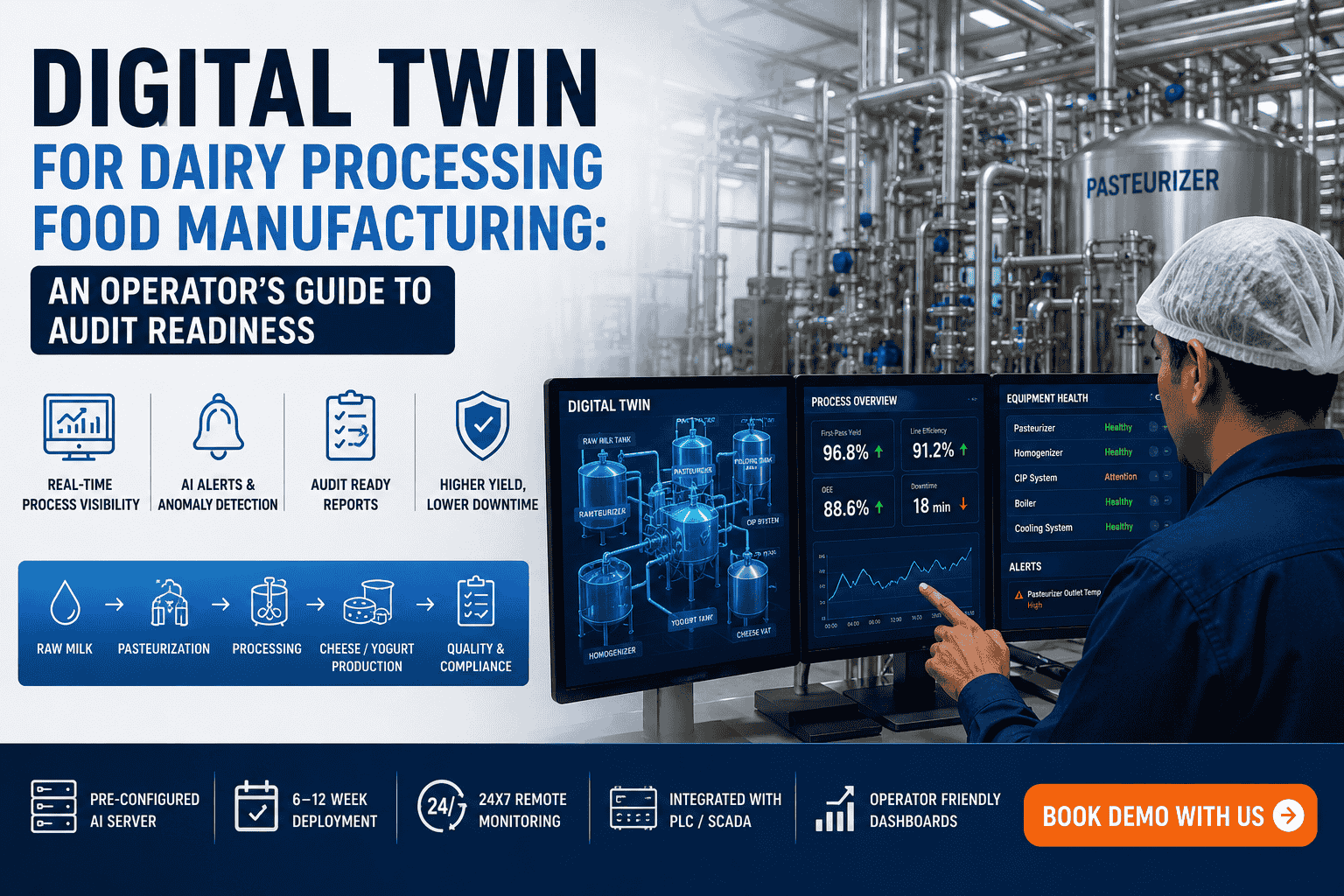
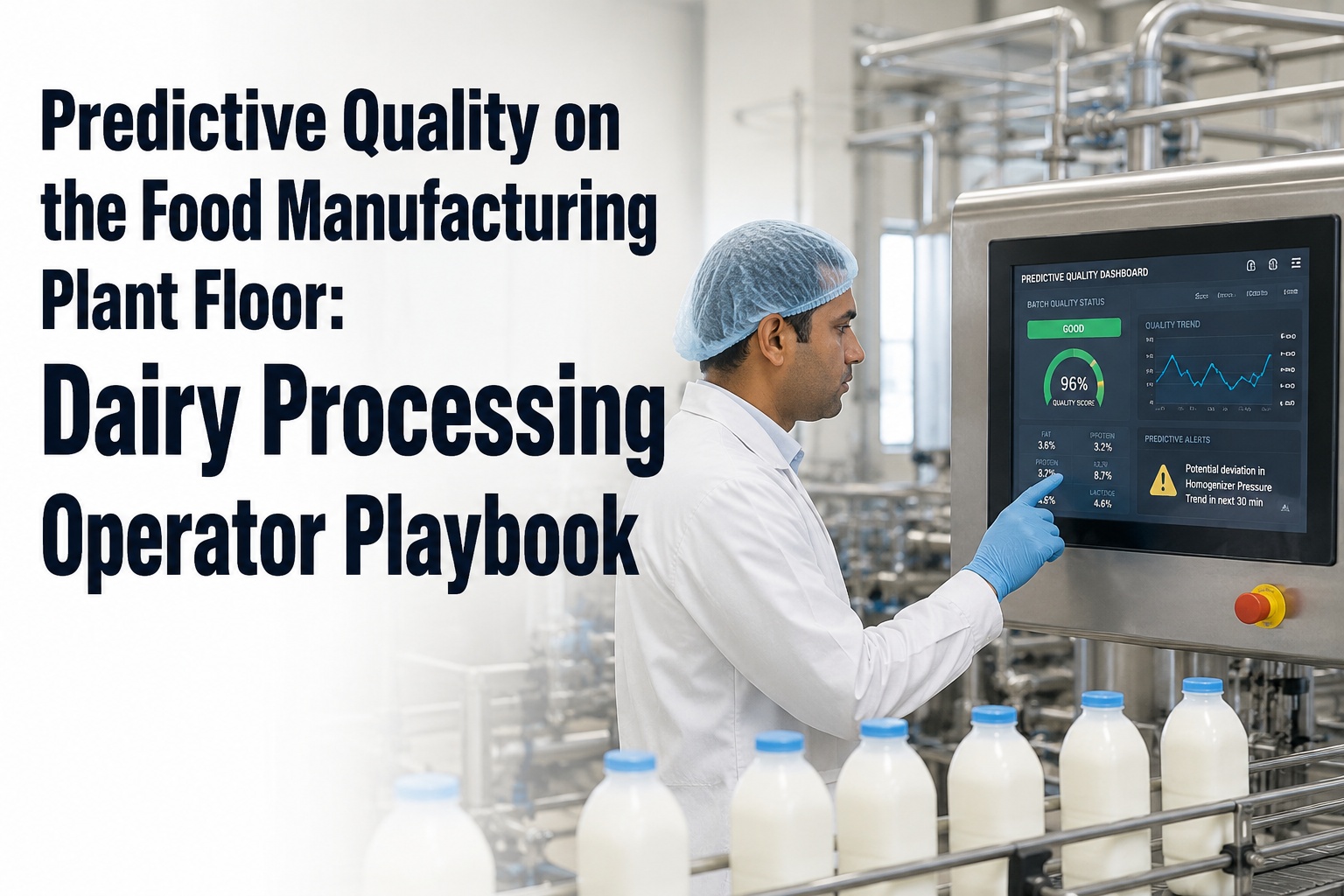
Real-time factory analytics for dairy operations deliver value only when they translate sensor data into decisions that maintenance, production, and quality teams can act on immediately — platforms that surface raw data without structured alert workflows, severity scoring, and maintenance integration create dashboard overload where teams spend time interpreting data rather than responding to it. Effective manufacturing intelligence software for dairy plants connects equipment health events to predefined response workflows and work order generation, and the most advanced deployments go further by correlating equipment health data with product quality metrics to transform operational analytics into a dairy production monitoring platform that optimizes product quality and equipment reliability simultaneously. Facilities ready to see this level of integration in action can book a demo to review live dashboard architectures built for dairy processing environments.
AI Monitoring vs. Traditional Maintenance: Dairy Plant Performance Comparison
The operational case for AI in dairy manufacturing is most clearly demonstrated through direct comparison with conventional maintenance approaches — the table below outlines performance differences across the dimensions that matter most for dairy plant efficiency, food safety compliance, and maintenance cost management, showing precisely where condition-based monitoring outperforms reactive and calendar-based programs across every critical operational metric.
| Dimension | Reactive / Scheduled Maintenance | AI Smart Factory Analytics | Operational Impact |
|---|---|---|---|
| Failure Detection | After breakdown or at fixed intervals | Days to weeks before failure event | Eliminates unplanned production stoppages |
| Pasteurizer Compliance | Manual log review after the fact | Real-time CCP deviation alerting | Regulatory violations prevented proactively |
| CIP Validation | Operator observation, paper records | Automated cycle effectiveness scoring | Continuous sanitation assurance and documentation |
| Cold Chain Integrity | Temperature alarm at excursion event | Compressor degradation flagged weeks prior | Product loss and hold protocols prevented |
| Maintenance Documentation | Manual work orders, paper logs | Automated digital maintenance records | FDA and state dairy audit readiness continuous |
| Parts Procurement | Emergency sourcing at premium cost | Planned procurement with full lead time | Eliminates emergency parts premium and delays |
| Multi-Line Visibility | Line-by-line manual reporting | Unified plant-wide health dashboard | Enterprise asset performance management |
Digital Transformation in the Dairy Industry: Compliance and Documentation Benefits
Dairy processing plants operate within one of the most documentation-intensive regulatory environments in food manufacturing — FDA PMO compliance, state dairy regulatory programs, FSMA Preventive Controls, and HACCP plan verification all generate ongoing record-keeping obligations that intersect directly with equipment maintenance and process monitoring. Smart analytics systems that integrate with existing compliance documentation frameworks automatically generate equipment maintenance records, CIP validation logs, and process deviation reports — creating the continuous audit trail that regulatory inspectors and third-party auditors require without relying on manual record entry that introduces human error and documentation gaps. For facilities managing FDA warning letter history or preparing for third-party SQF or BRC certification audits, book a demo to review how iFactory's automated records architecture maps to their specific regulatory requirements.
Implementing Smart Factory Analytics in a Dairy Processing Plant: Deployment Roadmap
The practical barrier to industrial IoT in dairy plants has historically been perceived integration complexity and disruption risk during deployment, but modern dairy analytics platforms have substantially reduced both barriers through non-invasive sensor architectures that install during scheduled CIP and maintenance windows and phased deployment models that generate measurable ROI from priority asset monitoring before requiring facility-wide implementation commitment.
Critical Asset Sensor Installation
Non-invasive vibration, temperature, and flow sensors are installed on highest-consequence assets — HTST pasteurizers, refrigeration compressors, and primary separators — during scheduled CIP or sanitation downtime windows. No production interruption, no PLC integration required at this stage.
Baseline Modeling and Alert Calibration
AI models establish equipment-specific performance baselines across full production cycles, including product changeovers, seasonal raw milk variation, and CIP cycle transitions. Alert thresholds are calibrated to each asset's actual operating profile — eliminating false positives that erode technician confidence in the monitoring system.
Continuous Learning and Coverage Expansion
AI models continuously refine failure prediction accuracy as equipment history accumulates across production seasons. Monitoring coverage expands to secondary asset categories — homogenizers, evaporators, filling lines — as initial ROI is validated, building toward full-facility coverage within 6–12 months of initial deployment.
Building a Predictive Maintenance Culture in Dairy Manufacturing Operations
Technology deployment is the starting point, not the end state — the compounding ROI of smart factory analytics for dairy processing plants comes from the cultural shift that follows successful platform adoption, when maintenance teams begin using equipment health dashboards proactively rather than waiting for alerts to arrive. Dairy processing facilities that invest in AI-powered dairy processing analytics now are building the operational foundation that drives compounding efficiency gains over time, with year one delivering immediate downtime reduction and compliance documentation improvement, and years two and three surfacing the equipment performance patterns that enable systemic throughput improvements and food safety risk reduction that scheduled maintenance programs can never achieve. The dairy facilities winning in 2026 are the ones where the next equipment failure is already a maintenance event on the calendar — and operations teams looking to start that journey today can book a demo to see the full platform in action.
Ready to Optimize Your Dairy Plant with Smart Factory Analytics?
iFactory's AI monitoring platform gives dairy processing plants real-time equipment health scoring, predictive failure alerts, CIP validation analytics, and automated compliance documentation — so your next equipment failure becomes a planned maintenance event, not a production emergency.
Frequently Asked Questions: Smart Factory Analytics for Dairy Processing Plants
What equipment in a dairy plant can AI monitoring systems track?
AI monitoring platforms can track any dairy processing asset with measurable operating signatures — HTST pasteurizers, plate heat exchangers, centrifugal separators, homogenizers, refrigeration compressors, CIP systems, evaporators, spray dryers, and filling lines. Non-invasive sensor architectures make deployment practical even in high-sanitation dairy processing zones.
How does smart factory analytics improve food safety in dairy processing?
Predictive analytics prevent food safety exposure by detecting pasteurizer performance drift, refrigeration system degradation, and CIP cycle effectiveness decline before they reach the point of regulatory non-compliance or product quality impact. Real-time CCP monitoring ensures critical control points are validated continuously, not just at inspection intervals.
Can dairy plant analytics platforms integrate with FDA and state dairy compliance documentation?
Yes. Platforms like iFactory automatically generate equipment maintenance records, CIP validation logs, and process deviation documentation that integrate with HACCP verification systems and support FDA PMO compliance, FSMA Preventive Controls documentation, and third-party audit readiness requirements.
How long does deployment take for AI monitoring in a dairy processing facility?
Priority asset monitoring — pasteurizers, refrigeration, and separators — typically goes live within 4–6 weeks using non-invasive sensor installation during scheduled CIP or maintenance downtime. No production interruption is required, and predictive alerts begin generating following initial baseline calibration completion.
What ROI can dairy plants expect from smart factory analytics investment?
ROI comes from unplanned downtime elimination, emergency maintenance cost reduction, extended equipment service life, energy efficiency improvements, and avoided food safety events. For high-throughput dairy facilities, preventing a single unplanned line stoppage per month typically covers platform costs within the first year of deployment.