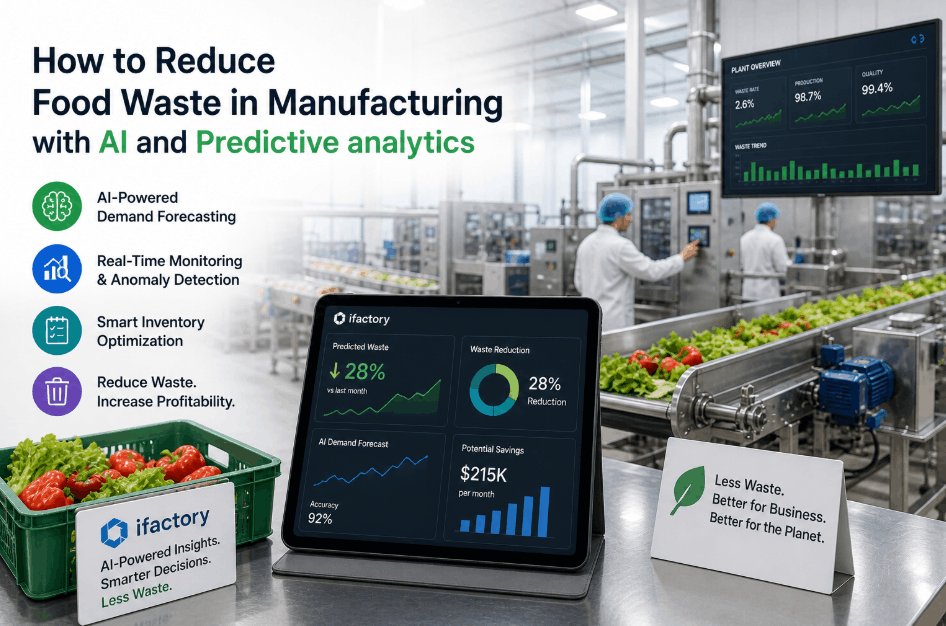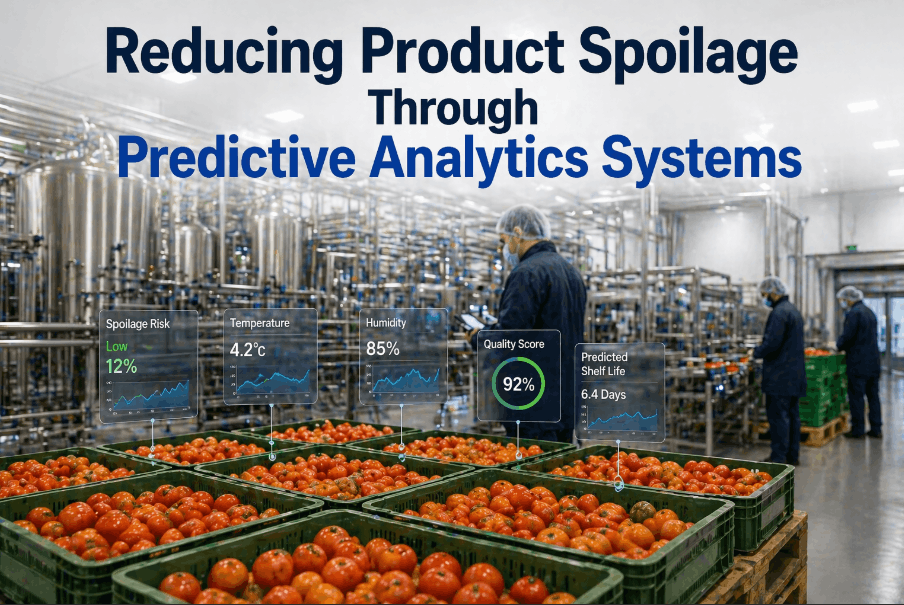
Product spoilage in food manufacturing is not an unavoidable cost of doing business — it is a measurable operational failure with a quantifiable cause. Predictive analytics systems for food spoilage reduction transform how plants monitor temperature variance, equipment degradation, and process deviation by replacing reactive discovery with proactive intelligence. When your predictive analytics platform detects a cooling unit trending toward failure four hours before breakdown, it doesn't just prevent one batch loss — it eliminates the cascading quality, compliance, and customer impact that follow every undetected spoilage event. For food and beverage manufacturers managing tight margins and complex cold-chain requirements, deploying AI-powered food safety analytics is the single highest-leverage operational investment available today.
Stop Spoilage Before It Starts
iFactory's predictive analytics platform delivers real-time spoilage prevention, equipment health tracking, and AI-driven process optimization — purpose-built for food and beverage plants.
Why Traditional Monitoring Fails to Prevent Food Product Spoilage
Conventional temperature monitoring systems and scheduled inspection routines share a fundamental architectural flaw: they detect spoilage conditions after deviation has already occurred. By the time an alert fires in a legacy SCADA system or a quality technician logs an out-of-spec refrigeration reading, the damage window has been open for minutes or hours. In cold-chain food manufacturing — dairy, protein, fresh produce, and ready-to-eat categories — even a 90-minute undetected temperature excursion can compromise an entire production batch, trigger a regulatory hold, and expose the plant to recall risk. Predictive analytics food spoilage prevention systems close this gap by analyzing equipment behavior patterns, ambient conditions, and process variables continuously — surfacing deterioration signals before any threshold is breached.
The scale of avoidable loss is significant. Industry data consistently shows that 30–40% of food spoilage events in manufacturing environments are preceded by detectable equipment health anomalies — compressor efficiency drops, seal wear signatures, airflow restriction patterns — that traditional monitoring architectures simply are not designed to capture. Plants that have booked a demo with iFactory's platform regularly discover that their existing sensor infrastructure was already generating these precursor signals — they simply lacked the analytics layer to act on them.
How Predictive Analytics Systems Detect and Prevent Food Spoilage in Real Time
Modern spoilage prevention analytics platforms operate across three simultaneous intelligence layers: equipment health tracking, environmental condition modeling, and process deviation forecasting. Each layer feeds a central AI inference engine that correlates signals across all three dimensions — because spoilage risk is rarely caused by a single variable. A compressor cycling 7% more frequently than its baseline, combined with a 0.4°C ambient temperature rise in a storage zone and a slight increase in door-open frequency, constitutes a compound risk signal that no individual threshold alarm would surface. Predictive analytics food manufacturing platforms are engineered specifically to detect these multi-variable compound patterns.
Equipment Health Tracking
Continuous monitoring of refrigeration compressors, conveyor motors, CIP systems, and thermal processing units at the component level. Vibration signatures, power draw patterns, and thermal gradients are compared against degradation curves derived from thousands of historical failure events. When a pattern matches a precursor signature, a maintenance work order is triggered before any product is at risk.
Real-Time Temperature Monitoring
Multi-zone temperature monitoring systems with sub-minute data resolution across cold storage, blast freezing, pasteurization, and ambient holding areas. Physics-informed models predict how current thermal conditions will evolve over the next 2–48 hours — enabling corrective action before any product zone enters a spoilage-risk temperature band.
Process Deviation Forecasting
AI-driven analysis of upstream process variables — fill weights, pH readings, water activity levels, packaging seal integrity — identifies quality deviations trending toward spoilage risk before they breach specification limits. Closed-loop integration with process controls enables autonomous correction within operator-defined safety boundaries.
Supply Chain Condition Intelligence
Inbound raw material condition tracking correlates supplier delivery temperature logs, transit duration variance, and incoming quality inspection data against spoilage probability models — enabling receiving teams to make real-time hold or release decisions backed by predictive risk scores rather than pass/fail threshold checks.
Equipment Health Tracking and Asset Performance Monitoring in Food Plants
The relationship between equipment health and product spoilage risk is direct and financially significant. A blast chiller running at 94% of its rated cooling capacity — a degradation level invisible to periodic inspection but detectable through continuous power-draw analysis — extends product core temperature pull-down time by 12–18 minutes per cycle. Over a 16-hour production day, that margin erosion creates a compounding spoilage risk exposure that predictive maintenance food plant analytics can eliminate entirely by scheduling a servicing intervention during the next planned changeover window.
Asset performance monitoring extends this principle across every piece of equipment with a thermal, mechanical, or fluid-handling role in product quality. Plants that have deployed iFactory's equipment health tracking module report that requesting a demo session consistently revealed 3–7 pieces of equipment in active degradation states that correlated directly with their highest-frequency spoilage zones. Connecting those dots — from equipment health to spoilage geography — is the foundational insight that converts maintenance from a cost center into a spoilage prevention function.
| Equipment Type | Traditional Monitoring | Predictive Analytics Approach | Spoilage Risk Reduction |
|---|---|---|---|
| Refrigeration Compressors | Monthly refrigerant checks | Continuous power draw & thermal tracking | Up to 68% fewer cold-chain failures |
| Pasteurization Systems | Shift-start calibration logs | Per-cycle temperature profile analysis | 91% reduction in under-process events |
| CIP Systems | Fixed schedule sanitization | Biofilm risk-score-triggered cleaning | 44% reduction in microbial deviations |
| Packaging Seal Units | Visual end-of-line inspection | Per-seal pressure & temperature analytics | 79% reduction in seal-related returns |
| Cold Storage Doors | Manual open/close logs | Door cycle frequency & thermal impact modeling | Avg. 2.1°C zone temperature improvement |
Real-Time Production Monitoring: The Intelligence Architecture Behind Spoilage Prevention
Real-time production monitoring for food manufacturing differs fundamentally from conventional SCADA dashboards in one critical dimension: causality. A SCADA system tells you that Zone 4 cold storage is at 3.8°C. A real-time operational analytics platform built for spoilage prevention tells you that Zone 4 is trending toward 4.6°C within the next 90 minutes based on current compressor degradation patterns, door-open frequency, and ambient loading dock temperature — and it tells you this before the zone breaches specification. That predictive posture is the entire value proposition of industrial IoT food plant analytics applied to spoilage prevention.
Layered Alerting Architecture for Graduated Spoilage Risk Response
Effective spoilage prevention analytics don't generate uniform alerts — they generate graduated risk intelligence calibrated to decision hierarchy. Line operators receive real-time corrective action recommendations. Shift supervisors receive trend summaries with predicted outcome scenarios. Plant managers receive daily spoilage risk exposure reports with financial quantification. Quality directors receive compliance-ready deviation logs. This layered alerting architecture ensures that every stakeholder is acting on the same underlying data set — processed through the lens most relevant to their decision horizon. Food manufacturers who explore a live demo of iFactory's platform consistently describe this multi-stakeholder intelligence layer as the feature that most directly accelerates organizational adoption.
Process Optimization Analytics: Closing the Spoilage Loop Autonomously
The highest maturity deployment of process optimization analytics in food manufacturing is closed-loop spoilage prevention: the platform detects a deviation trending toward spoilage risk, simulates its causal chain, determines the optimal corrective parameter adjustment, and — on lines with control system integration — executes that adjustment autonomously within predefined safety limits. This autonomous correction capability reduces the human reaction time dependency that accounts for 40–60% of spoilage event severity in manually monitored environments. When a chiller set-point deviation at 2:40 AM is corrected by the analytics platform at 2:41 AM without requiring an operator wake call, the product, the shift cost, and the compliance record all benefit simultaneously.
Predictive Analytics Impact Across Key Food Manufacturing KPIs
The performance gains from deploying a predictive analytics platform span every operational dimension — from spoilage reduction and equipment uptime to energy efficiency and compliance readiness. The chart below benchmarks the average improvement food plants achieve across critical KPIs within 12 months of full deployment, based on iFactory customer data across beverage, dairy, protein, and packaged goods production environments.
AI Food Safety Analytics: How Machine Learning Builds Spoilage Intelligence Over Time
The competitive advantage of AI-driven food safety analytics compounds with operational time. Unlike fixed-threshold monitoring systems that perform identically on day one and day five hundred, machine learning models embedded in predictive analytics platforms become more accurate as they accumulate plant-specific failure history, seasonal pattern data, and product-line behavioral baselines. A predictive analytics system that correctly flags 82% of spoilage precursor events in its first quarter of deployment typically achieves 91–94% accuracy by month twelve — because every confirmed event, whether intercepted or missed, refines the model's understanding of your specific plant's spoilage signature landscape.
This learning curve has a direct financial implication: the ROI of predictive analytics for food spoilage prevention is not static — it improves continuously. Plants that commit to full platform integration rather than partial pilot deployments capture this compounding accuracy benefit across all product lines simultaneously. Operations teams exploring this trajectory for their own manufacturing environments find that a demo conversation with iFactory's engineers provides a plant-specific accuracy projection model rather than generic industry estimates.
Digital Transformation in Food Safety: Building the Data Infrastructure for Sustainable Spoilage Control
Sustained reduction in food product spoilage requires more than isolated analytics deployments — it demands a manufacturing intelligence platform that contextualizes operational signals against product-specific spoilage risk profiles, regulatory temperature requirements, and shelf-life modeling simultaneously. This is the data infrastructure imperative of digital transformation in food manufacturing: not sensors alone, not dashboards alone, but an integrated operational intelligence layer that converts raw IoT streams into actionable spoilage prevention decisions across every production zone, every shift, every product SKU.
Food manufacturers who have built this infrastructure with iFactory's manufacturing intelligence platform report that the most transformative operational shift is not the volume of alerts generated — it is the elimination of the investigative work that previously followed every spoilage event. When root-cause analysis that consumed 6–12 hours of quality team time is completed automatically by the analytics platform within minutes of event detection, the capacity freed for proactive process improvement is substantial. That capacity reallocation — from reactive investigation to proactive prevention — is the organizational lever that converts predictive analytics from a cost-saving tool into a competitive manufacturing capability.
Deploying Predictive Analytics for Spoilage Prevention: A Practical Implementation Roadmap
Implementing a predictive analytics system for food spoilage prevention follows a structured three-phase architecture that prioritizes data quality, model accuracy, and operational adoption in that sequence. Compressing this sequence to accelerate ROI consistently produces lower-accuracy models that erode operator trust — the most damaging outcome in a system where human acceptance of automated alerts is the critical adoption variable.
Sensor Audit, Gap Analysis, and IoT Infrastructure Deployment
Map existing instrumentation against spoilage risk zones, identify monitoring gaps, and deploy IoT edge devices and data historians at critical control points. Pre-deployment sensor audits that connect measurement requirements to specific product spoilage risk profiles prevent costly gap remediation in later phases. Timeline: 6–12 weeks. CapEx: $45k–$160k depending on line count and existing instrumentation density.
AI Model Calibration and Predictive Alert Activation
Commission product-specific spoilage risk models using historical process data, calibrate predictive failure signatures against confirmed spoilage event records, and activate real-time alerting with graduated risk classification. This is the phase where the platform transitions from data collection to actionable spoilage prevention intelligence. Timeline: 5–9 weeks. Platform cost: $35k–$80k/year.
Closed-Loop Control Integration and Continuous Model Improvement
Integrate predictive analytics outputs with process control systems, MES batch records, and ERP quality modules to enable autonomous corrective actions and automated compliance documentation. Ongoing model retraining against new operational data continuously improves spoilage prediction accuracy. Timeline: Ongoing. Incremental OpEx: $15k–$38k/year.
Quantifying the ROI of Predictive Analytics for Food Spoilage Reduction
Direct Spoilage Loss Recovery
The most immediately quantifiable ROI dimension is the direct recovery of product that would otherwise be lost to spoilage. A mid-size dairy plant processing 8 million liters annually with a 1.8% spoilage rate at average product value carries $1.4M in annual avoidable loss. Predictive analytics food spoilage systems consistently eliminate 50–70% of this exposure within the first operating year — delivering full platform payback in under 9 months for high-volume refrigerated production environments. The financial case becomes even stronger when distribution and recall risk exposure is included in the calculation.
Compliance and Recall Risk Reduction
Every food plant carries a calculable annualized recall risk exposure based on historical deviation frequency, product volume, and distribution reach. A predictive analytics platform that compresses spoilage-risk detection from hours to minutes does not eliminate this exposure — but it measurably reduces expected event severity and the probability that a containable deviation escalates to a full product recall. The continuous digital compliance log generated automatically by iFactory's platform eliminates $18k–$45k in annual labor currently consumed by manual FDA and GFSI documentation preparation at most mid-size food plants. For operations teams still managing compliance documentation manually, a demo session is the fastest path to quantifying that cost gap precisely.
Energy and Maintenance Cost Optimization
The third ROI dimension — frequently underweighted in initial business cases — is the compound savings from optimized refrigeration energy consumption and condition-based maintenance scheduling. Digital twin-driven energy analytics on refrigeration systems identify compressor inefficiencies, defrost cycle over-runs, and thermal loading patterns that collectively represent 14–20% of avoidable energy spend in cold-chain food manufacturing environments. When combined with the CapEx deferral from condition-based equipment management — extending asset service life 22–34% beyond OEM calendar schedules — this dimension alone often justifies the platform investment independently of any spoilage loss benefit.
Predictive Analytics for Food Spoilage — Frequently Asked Questions
How does predictive analytics differ from standard temperature monitoring systems?
Standard temperature monitoring systems alert when a threshold is breached — after a spoilage-risk condition already exists. Predictive analytics platforms analyze trends, equipment health patterns, and process variable interactions to forecast when a spoilage-risk condition will develop — giving operations teams 2–8 hours of advance warning rather than a reactive alarm after the fact. The distinction is prevention versus detection.
What data sources does a food spoilage predictive analytics system require?
Core data sources include IoT temperature and humidity sensors, refrigeration equipment power draw and cycle data, PLC and SCADA signals, MES batch records, inbound material condition logs, and quality inspection records. Most deployments achieve meaningful spoilage prediction accuracy with 60–75% of available data sources connected at initial launch, with model accuracy improving as additional sources are integrated over time.
How long does it take to see measurable spoilage reduction after deployment?
Plants with existing IoT infrastructure and historian systems typically begin capturing measurable spoilage reduction within 8–12 weeks of platform activation as AI models calibrate against their specific operational patterns. Full model maturity — where prediction accuracy exceeds 90% — is typically achieved within 6–9 months of continuous operation. The ROI curve accelerates as model accuracy improves over the first operating year.
Can predictive analytics integrate with existing cold chain management and ERP systems?
Yes. Modern predictive analytics platforms provide bidirectional API integration with SAP, Oracle, Microsoft Dynamics, and most major MES and cold chain management vendors. This integration allows spoilage risk predictions and equipment health alerts to feed directly into production scheduling, procurement decisions, and quality management workflows — amplifying the value of existing enterprise systems without replacing them.
What is the typical payback period for predictive analytics investment in food manufacturing?
Most food manufacturers achieve full ROI payback within 8–14 months, depending on baseline spoilage rate, product value, and existing infrastructure. High-value product lines — protein, dairy, fresh prepared — with historically loose process controls and reactive maintenance practices frequently achieve payback under 6 months. Plants with strong existing IoT infrastructure see the fastest deployment timelines and earliest returns.
How does a predictive analytics platform support FDA and FSMA compliance in food plants?
Predictive analytics platforms generate a continuous, auditable record of all temperature conditions, equipment states, quality measurements, corrective actions, and process deviations. This persistent digital compliance log satisfies FSMA preventive controls documentation requirements, eliminates manual record-keeping workflows, and reduces FDA inspection preparation time from 3–5 days to under 4 hours — while providing inspectors with verified, time-stamped evidence of hazard control at every production stage.
Reduce Product Spoilage with Predictive Analytics Built for Food Manufacturing
iFactory's predictive analytics platform delivers real-time spoilage prevention, equipment health tracking, and AI-driven process optimization — purpose-built for food and beverage plants.