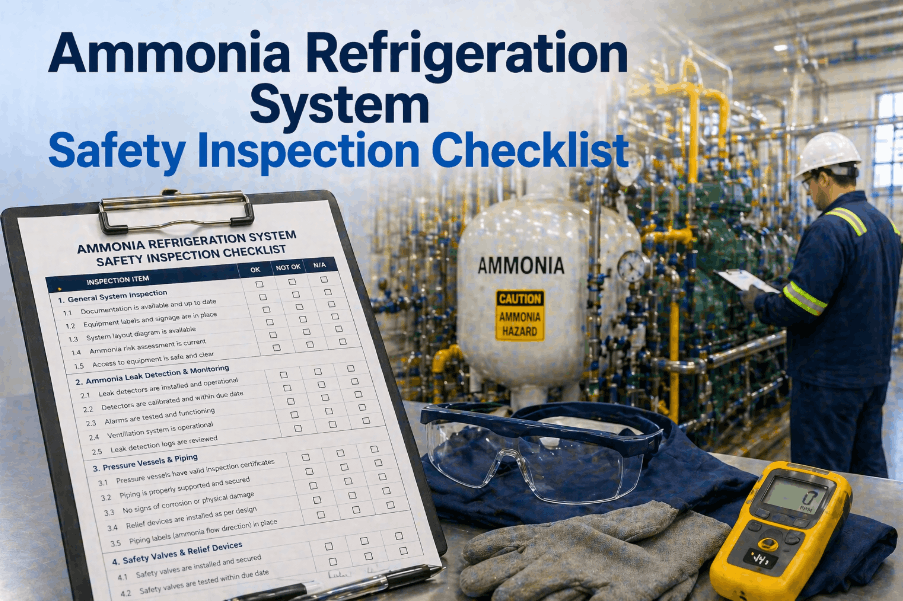
Ammonia Refrigeration System Safety Inspection Checklist

By Josh Turley on April 23, 2026

ammonia-refrigeration-system-safety-inspection-checklist

Ammonia refrigeration systems are among the most energy-efficient cooling solutions in industrial food processing — but they carry significant life-safety and regulatory obligations. A single undetected leak, a failed pressure relief valve, or a missing Emergency Response Plan can expose your facility to OSHA PSM citations, EPA RMP penalties, and catastrophic personnel injury. Implementing a rigorous, documented ammonia refrigeration safety inspection checklist is not optional — it is the operational backbone of every compliant cold-storage and food manufacturing facility. Book a Demo to see how iFactory digitizes your ammonia safety inspection logs and keeps your team audit-ready 365 days a year.

PSM COMPLIANCE AI AMMONIA SAFETY OSHA READY

Achieve Zero-Finding Ammonia Inspections with AI-Driven Compliance Tracking

iFactory monitors every pressure vessel, relief valve, detector calibration, and PPE station across your ammonia refrigeration system — delivering real-time compliance status and audit-ready documentation for your next OSHA PSM or EPA RMP inspection.

Why Ammonia Refrigeration Safety Inspection is Non-Negotiable

OSHA PSM & EPA RMP Compliance Threshold

Facilities storing 10,000 lbs or more of ammonia are subject to OSHA's Process Safety Management standard and EPA's Risk Management Program. Both mandates require documented mechanical integrity inspections, operator training records, and Process Hazard Analysis on a strict schedule. A missed inspection cycle can trigger a Willful citation, carrying penalties exceeding $15,000 per violation per day. Book a Demo to automate your PSM inspection calendar and never miss a compliance deadline.

Acute Toxicity & Rapid Escalation Risk

Ammonia is a toxic, flammable refrigerant that can incapacitate personnel within minutes at concentrations above 300 ppm. Catastrophic releases from failed welds, corroded vessels, or improperly maintained relief valves can force multi-block evacuations and trigger HAZMAT response. Every layer of your inspection program — from detector calibration to emergency shutdown drill records — must be documented, timestamped, and retrievable on demand.

1. Ammonia Leak Detection & Monitoring Systems
2. Pressure Vessel & Piping Mechanical Integrity
3. Safety Relief Valve (SRV) & Pressure Control Testing
4. Compressor & Machinery Room Safeguards
5. Emergency Response Equipment & PPE Readiness
6. Condenser, Evaporator & Heat Exchanger Inspection
7. PSM / RMP Process Safety Documentation
8. Ammonia Inventory, Charging & Oil Management
REAL-TIME DATA COMPLIANCE TRACKING

Ready to Eliminate Ammonia Safety Gaps Across Your Facility?

Standardize your OSHA PSM inspections, track SRV certification dates, and generate predictive maintenance alerts before a refrigeration failure occurs. iFactory keeps your ammonia program audit-ready every single day.

Benefits of Digital Ammonia Safety Management

OSHA NEP Audit Readiness

Timestamped digital inspection logs satisfy OSHA PSM mechanical integrity documentation requirements and dramatically reduce citation risk during National Emphasis Program inspections targeting ammonia refrigeration facilities.

Automated SRV & Calibration Renewals

iFactory automatically tracks SRV re-certification dates, detector calibration windows, and vessel UT inspection intervals — sending escalating alerts to your refrigeration team before any deadline lapses.

Deficiency-to-Work-Order Automation

Failed inspection items immediately generate high-priority maintenance work orders and notify your safety officer — eliminating the paper trail gap that allows critical deficiencies to go unresolved for weeks.

Mobile-First Machinery Room Patrols

Operators log pressure readings, oil levels, and detector status directly from their smartphones at each inspection point — replacing paper patrol logs with GPS-tagged, tamper-proof digital records.

Multi-Site PSM Compliance Dashboard

Monitor ammonia safety compliance scores, open deficiencies, and overdue PHA revalidations across every facility in your cold-storage portfolio from a single centralized command center.

Insurance & EPA RMP Documentation

Immutable, cloud-stored inspection records provide verified proof of diligence for FM Global property audits and EPA RMP compliance certifications, supporting premium reductions and accelerating incident response.
Ammonia Refrigeration Safety FAQs

1. What OSHA standard applies to ammonia refrigeration systems?
Facilities with 10,000 lbs or more of ammonia are regulated under OSHA 29 CFR 1910.119 — the Process Safety Management (PSM) standard. PSM requires documented Process Hazard Analysis, mechanical integrity inspections, operator training records, Management of Change procedures, and an Emergency Response Plan. Non-compliant facilities face Willful OSHA citations exceeding $15,625 per violation per day under the National Emphasis Program targeting refrigerated food facilities. Book a Demo to see how iFactory structures your PSM documentation into a single, audit-ready compliance platform.
2. How often must ammonia safety relief valves be tested?
Per IIAR Bulletin 110 and ASHRAE 15, safety relief valves on ammonia pressure vessels must be replaced or bench-tested and re-certified at intervals not exceeding 5 years. For dual-relief installations, a changeover schedule ensures one valve remains active while the other is serviced. Documentation must include the set pressure, test date, certifying contractor, and vessel identification number for each valve in the system.
3. What ammonia concentration levels require evacuation?
ASHRAE 15 establishes the IDLH (Immediately Dangerous to Life or Health) concentration for ammonia at 300 ppm. Most facility emergency response plans set a precautionary evacuation alarm at 150 ppm and a mandatory full-facility evacuation at 300 ppm. Fixed detector systems must be set to alarm at 25 ppm (low-level personnel warning) to provide adequate response time before concentrations become life-threatening in the machinery room.
4. How frequently must ammonia gas detectors be calibrated?
Industry best practice and most Authority Having Jurisdiction (AHJ) requirements mandate that fixed ammonia gas detectors be calibrated at least annually using NIST-traceable span gas. High-humidity food processing environments may require semi-annual calibration due to sensor fouling from cleaning chemicals. Calibration records must capture the pre-calibration reading, post-calibration reading, span gas concentration used, technician name, and date of service for each sensor location.
5. What is required in an ammonia emergency response plan?
An OSHA PSM-compliant Emergency Response Plan for ammonia refrigeration must include: evacuation routes and assembly points, roles and responsibilities for emergency response team members, communication protocols with local emergency services (LEPC), procedures for emergency shutdown of the refrigeration system, and documentation of annual drills with after-action review records. The plan must be reviewed and updated whenever a significant change to the system or facility layout occurs under the Management of Change procedure.
6. Can digital inspection records satisfy OSHA PSM documentation requirements?
Yes. OSHA PSM documentation requirements specify that records must be accurate, complete, and accessible — they do not mandate paper format. Digital records with tamper-evident timestamps, electronic operator sign-off, and cloud backup are increasingly preferred by OSHA compliance officers and insurance auditors because they eliminate pencil-whipping, provide searchable corrective action histories, and remain accessible even if the physical facility is compromised during an emergency release event.
GET STARTED TRANSFORM NOW

Digitize Your Ammonia Safety Program Today

Join leading food manufacturers and cold-storage operators automating PSM compliance, tracking SRV certifications in real-time, and passing OSHA inspections with zero findings using iFactory.


Share This Story, Choose Your Platform!