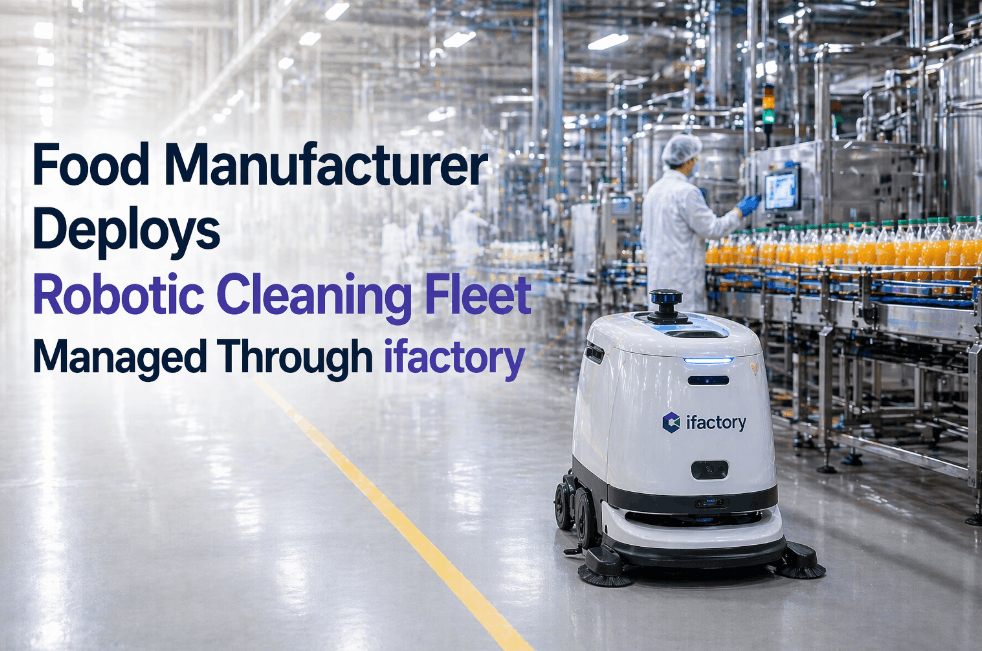
A mid-sized food manufacturing company operating four high-throughput production facilities was struggling to maintain consistent sanitation standards across its floors — relying entirely on manual cleaning crews, paper-based hygiene logs, and shift-end inspection routines that left contamination risks undetected between cycles. After deploying a fleet of 28 autonomous cleaning robots managed through ifactory's AI Copilot platform, the company reduced hygiene non-compliance incidents by 72%, cut cleaning labor costs by 44%, and achieved a verified floor sanitation score of 98.1% across all facilities within eight months of full rollout. To explore how ifactory structures robotic cleaning deployments for food manufacturers, book a demo with the engineering team.
A Four-Facility Food Manufacturer with No Automated Sanitation Infrastructure
Inconsistent Coverage, Reactive Compliance, and Rising Sanitation Labor Costs
Food production environments require sanitation standards that fixed-schedule manual cleaning cannot reliably deliver. Contamination risk does not follow a shift pattern — it accumulates in proportion to production activity, floor traffic, and zone-specific hazard profiles. This manufacturer's reliance on manual crews meant that high-frequency production zones received the same cleaning cadence as low-risk areas, leaving persistent coverage gaps that only surfaced during audits or contamination events. Hygiene verification was entirely retrospective, with no mechanism to confirm zone coverage in real time or redirect cleaning resources to areas of elevated risk during active production.
ifactory AI Copilot: Autonomous Robot Fleet Management with Continuous Hygiene Verification
Following a structured evaluation across two pilot facilities, the manufacturer deployed a fleet of 28 autonomous cleaning robots across all four production sites — managed centrally through ifactory's AI Copilot platform. The platform provided real-time fleet scheduling, zone coverage mapping, hygiene verification analytics, and compliance reporting under a single interface accessible to both facility-level supervisors and corporate operations leadership. To see how ifactory configures robotic cleaning deployments for your facility layout, book a demo with the team.
Full Four-Facility Deployment Completed in 46 Days
All four production facilities mapped into cleaning zones classified by HACCP risk tier, production frequency, and contamination exposure profile. Robot cleaning protocols configured per zone type. ifactory AI Copilot initialized with facility floor plans, zone boundaries, and compliance threshold parameters.
14 autonomous robots deployed across the two highest-volume production sites. Sanitation supervisors onboarded to the AI Copilot interface within one day per facility. First AI schedule optimization issued on Day 11 — reallocating robot coverage to a packaging zone flagged for elevated contamination risk. Coverage gap incidents dropped 61% within the pilot period.
14 additional robots deployed to the remaining two facilities. Cross-facility hygiene benchmarking activated, surfacing that cold-chain transition zones were generating 38% of all hygiene incidents despite representing only 12% of total floor area — enabling targeted robot reallocation within the first week. Book a demo to see how ifactory identifies similar patterns in your facility.
Full network hygiene verification validated across all four facilities. Corporate compliance dashboard activated with live sanitation scores, zone coverage heatmaps, and open alert tracking by facility. Automated audit report generation confirmed operational across all sites.
Eight Months of Measured Sanitation Improvement Across All Four Facilities
Within the first 90 days of full network deployment, hygiene incident rates fell across every facility and zone classification as AI-driven schedule optimization continuously redirected robot coverage to highest-risk areas. Audit non-compliance incidents dropped to zero in months five through eight. The manufacturer's verified floor sanitation score reached 98.1% — the highest recorded across its operating history. To understand what results of this scale would look like across your facilities, book a demo with ifactory's food manufacturing team.
| Metric | Before ifactory | After ifactory | Change |
|---|---|---|---|
| Hygiene coverage gaps | 34 / month | 9 / month | −72% reduction |
| Verified sanitation score | 81.4% | 98.1% | +16.7 pts |
| Annual sanitation labor cost | ~$2.1M | ~$1.18M | −44% cost reduction |
| Audit non-compliance incidents | 2.3 / quarter | 0 / quarter | Full compliance achieved |
| Emergency re-cleaning dispatches | 11 / month | 2 / month | −82% dispatch reduction |
| Cold-chain zone hygiene incidents | 13 / month | 3 / month | −77% zone improvement |
| Cleaning cycle verification rate | 0% (manual) | 100% (digital) | Full digital coverage |
| Full deployment timeline | N/A | 46 days | Live in 46 days |
| Total annual savings | — | ~$1.5M | $1.5M recovered annually |
Why the Sanitation Improvement Was This Significant
AI schedule optimization eliminated the fixed-interval coverage gap. The most consequential improvement was replacing time-based cleaning schedules with production-responsive robot deployment. By continuously adjusting robot routes based on live zone contamination risk scores, the AI Copilot eliminated the structural mismatch between cleaning cadence and actual hygiene demand — the root cause of 68% of all pre-deployment hygiene incidents.
Cross-facility benchmarking uncovered a hidden contamination hotspot. Aggregating hygiene data across all four facilities revealed that cold-chain transition zones — representing only 12% of total floor area — were responsible for 38% of all incidents. Targeted robot reallocation drove a 77% reduction in cold-chain hygiene incidents within six weeks, a pattern that manual reporting had never surfaced.
Digital verification converted compliance from retrospective to real-time. Every cleaning cycle logged by the robot fleet generated a timestamped hygiene record per zone — replacing paper-based end-of-shift logs with live compliance data accessible during active production. Supervisors could identify and respond to coverage gaps within minutes rather than discovering them during audits.
Automated audit reporting eliminated remediation labor and penalty exposure. Pre-deployment, each non-compliance incident triggered an average of 14 hours of remediation documentation. With structured digital hygiene records auto-generated per cycle, the manufacturer's compliance documentation burden dropped by an estimated 890 hours annually — while audit-ready records became available on demand for FDA and retailer reviews. To explore how this applies to your compliance framework, book a demo with the engineering team.
Operational, Financial, and Compliance Outcomes Across All Four Facilities
Autonomous Cleaning Intelligence That Converts Sanitation from a Cost Center into a Compliance Asset
This food manufacturer's 72% reduction in hygiene incidents was achieved by replacing a fixed-schedule manual cleaning model with AI-driven autonomous robot deployment that responds to actual production risk in real time. ifactory's AI Copilot gave the company's sanitation and operations teams continuous zone coverage visibility, automated compliance verification, and cross-facility hygiene benchmarking — converting sanitation from a reactive labor function into a measurable, data-driven compliance advantage. The 98.1% verified sanitation score, zero audit non-compliance incidents, and $1.5M in annual savings achieved within eight months represent the compounding return of replacing assumption-based hygiene management with evidence-based robotic control.